Sep 17, 2018 | News
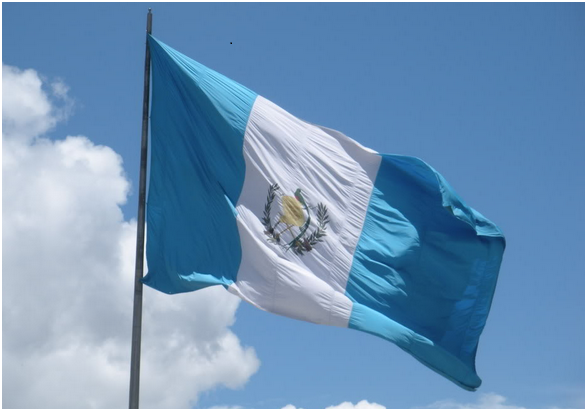
On 16 September, the Constitutional Court made public its decision to order that the Commissioner of the International Commission against Impunity (CICIG) Iván Velásquez be permitted to re-enter the country.
For more than a decade, the UN-backed CICIG has helped investigate high-profile officials for corruption.
Under the tenure of head commissioner Ivan Velasquez, the CICIG has helped Guatemalan prosecutors investigate and prosecute many high-level politicians, judges and government officials, including former president Otto Perez Molina and members of his cabinet.
Elected in 2015, current President Jimmy Morales initially supported the CICIG but he himself and other family members have become subjects of investigations into illegal campaign financing. They deny all charges.
President Morales declared on 31 August that he would not renew the mandate of the CICIG which is due to expire in September 2019 and then proceeded to ban Commissioner Velasquez from re-entering the country.
This decision sparked a number of protests including legal challenges in the Constitutional Court.
“The decision by the Constitutional Court should permit the CICIG to continue its work. It removes one of the greatest obstacles, imposed by order of Guatemalan President Jimmy Morales himself, to the fulfilment of Guatemala’s international obligations, as enshrined in the International Accord on Human Rights which created the Commission,” said Ramon Cadena, ICJ Director for Central America.
With respect to the amparo lawsuits which sought an injunction to reverse the the decision of the President Morales not to renew the mandate of the CICIG, the Constitutional Court declined to order provisional measures and therefore these legal proceedings will continue until they are determined in court.
“The ICJ urges the Constitutional Court to respect the legal time limits and to make a final decision on the lawsuit, in compliance with international human rights law and standards.
If the mandate of the CICIG were not renewed, it would seriously affect access to justice and constitute a major obstacle to the fulfilment of Guatemala’s international obligation to combat impunity,” Ramon Cadena added.
Sep 14, 2018 | News
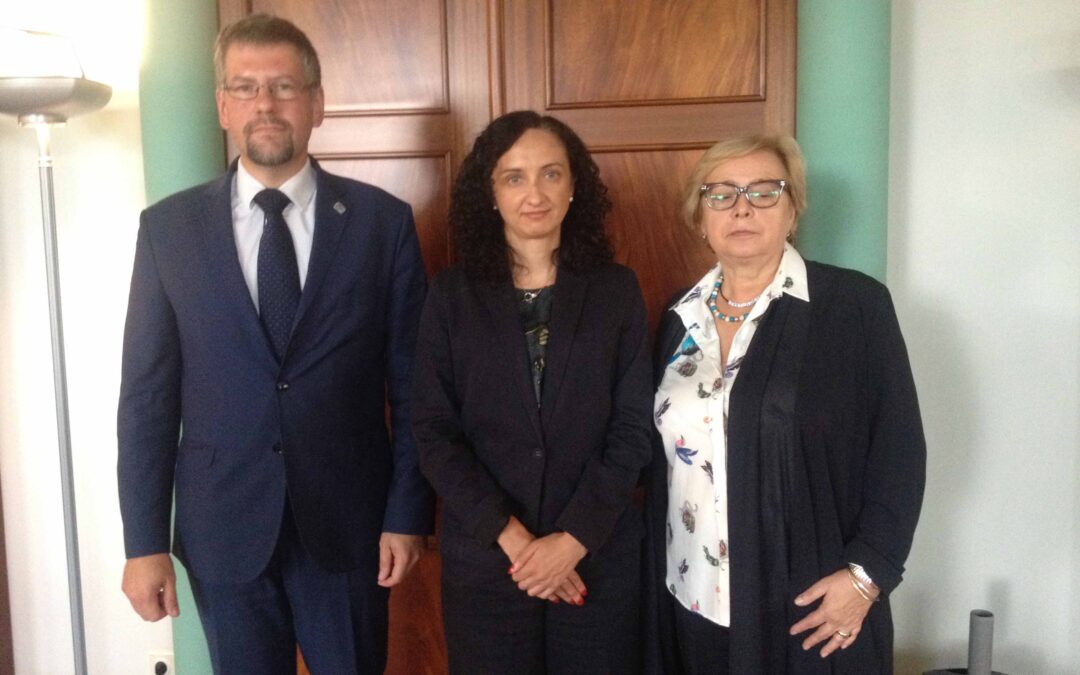
The ICJ met this week in Warsaw with the First President of the Polish Supreme Court, Małgorzata Gersdorf.
Róisín Pillay, Director of the ICJ Europe and Central Asia Programme, met with President Gersdorf to convey the support of the ICJ for the Court’s defence of the rule of law and the independence of the judiciary in Poland, in the face of government attacks.
The ICJ emphasized that a new law on the Supreme Court that attempts to force the “retirement” of 27 of the 72 Supreme Court judges, including the First President, by lowering the mandatory retirement age for its judges from 70 to 65 years, contravenes international human rights law and standards, including the right to a fair hearing.
The measure is contrary to the principle of the security of tenure of judges and therefore to the independence of the judiciary, as expressed in the UN Basic Principles on the Independence of the Judiciary.
In August, the Supreme Court submitted a preliminary ruling request to the Court of Justice of the EU (CJEU) seeking its interpretation on the compliance of the measure with EU law. The Supreme Court has suspended implementation of the law pending the proceedings before the CJEU.
The European Commission has recognized the current situation as undermining “the principle of judicial independence, including the irremovability of judges” and has triggered a procedure under Article 7 of the Treaty of the European Union that could ultimately lead to suspension of Poland’s EU voting rights.
The Commission has also launched infringement proceedings against Poland in respect of the law on the Supreme Court.
An ICJ letter of 11 July 2018, signed by 22 senior judges from all regions of the world, urged the Polish government to act immediately to reinstate the forcibly retired judges in office.
Sep 14, 2018 | Noticias
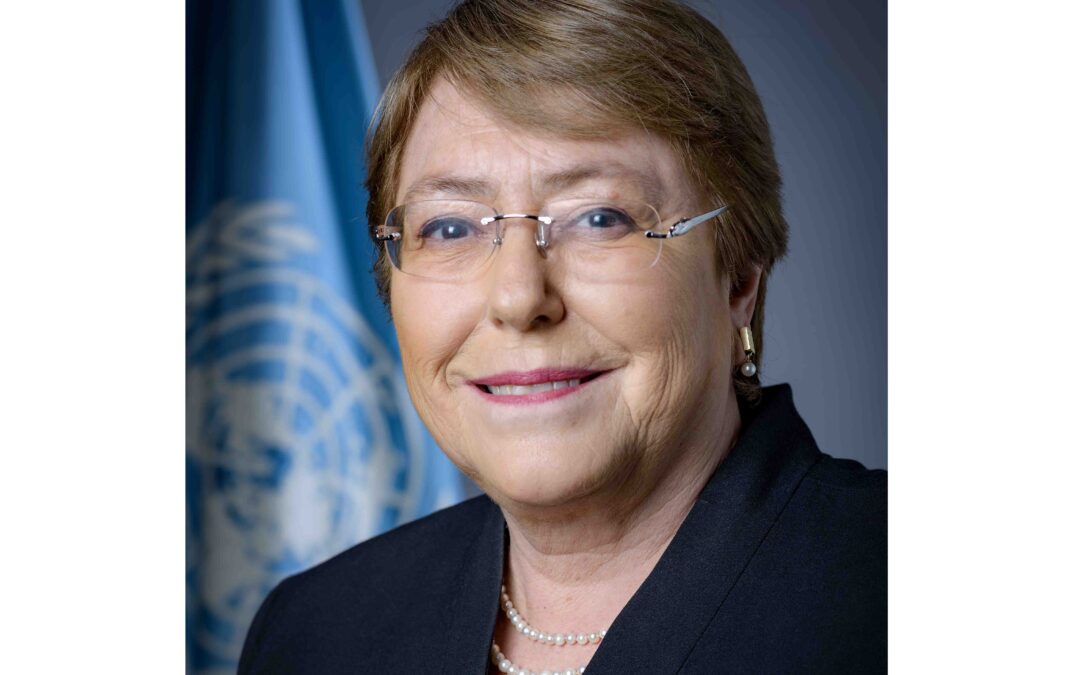
El 14 de septiembre 2018, la CIJ junto a 67 otras organizaciones internacionales y guatemaltecas de la sociedad civil enviaron una carta a la Alta Comisionada de las Naciones Unidas para los Derechos Humanos, Michelle Bachelet, para expresar sus graves preocupaciones en relación a los acontecimientos recientes restringiendo los esfuerzos para combatir la impunidad en el país.
Estos incluyen la decisión del Presidente Jimmy Morales el 31 agosto de 2018 de no renovar el mandato de la Comisión Internacional contra la Impunidad en Guatemala (CICIG); y la decisión subsecuente de parte de las autoridades guatemaltecas el 4 septiembre de 2018 de prohibir el regreso al país del comisionado de la CICIG Iván Velásquez; y las reformas judiciales aprobadas por el Congreso el 6 septiembre de 2018 que amenazan a socavar la independencia judicial y la función de los y las jueces de la Corte de Constitucionalidad y la oficina del Procurador de los Derechos Humanos.
Los signatarios expresaron su beneplácito por la referencia crítica sobre estos acontecimientos de parte de la Alta Comisionada en sus observaciones en la apertura del 39º periodo de sesiones del Consejo de Derechos Humanos.
En su carta, las organizaciones pidieron a la Alta Comisionada de continuar apoyando la luche contra la corrupción y la impunidad en Guatemala y de seguir presionando a las autoridades guatemaltecas para que adopten las medidas necesarias para facilitar el cumplimiento del mandato de la CICIG según los términos del Acuerdo firmado entre Guatemala y las Naciones Unidas.
La carta en español está disponible aquí. Guatemala-Letter to Michelle Bachelet-News-2018-SPA
Sep 14, 2018 | News
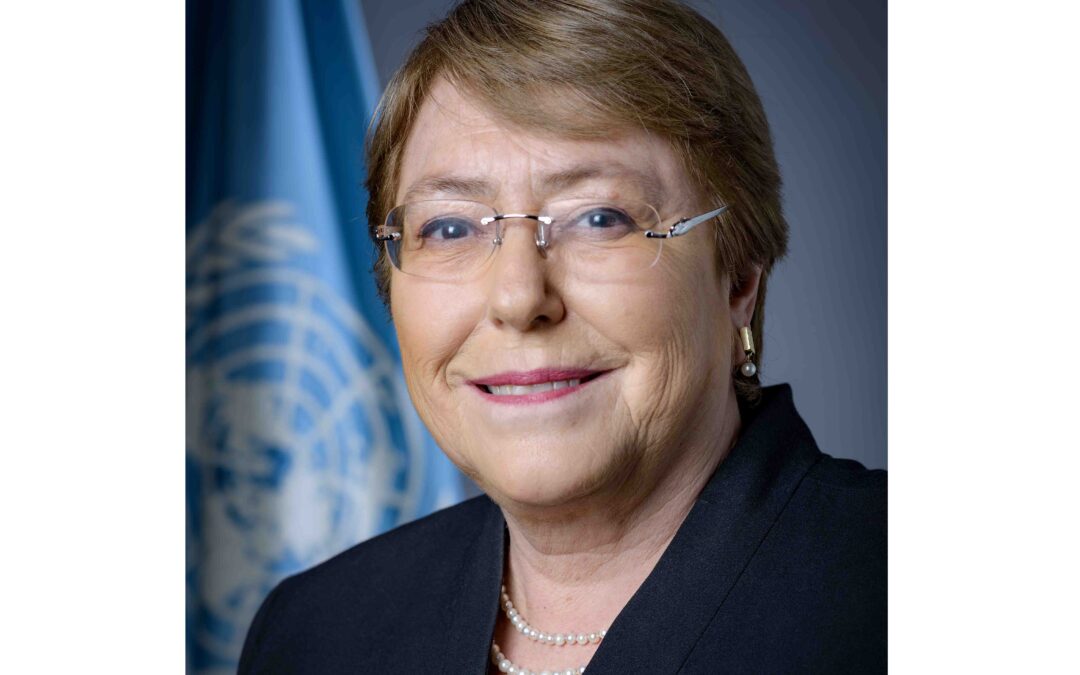
On 14 September 2018, the ICJ joined 67 other international and Guatemalan civil society organizations in a letter to the High Commissioner for Human Rights, Michelle Bachelet, to express grave concern about recent developments to curtail anti-impunity efforts in the country.
These include President Jimmy Morales’ decision on 31 August 2018 not to extend the mandate of the International Commission against Impunity in Guatemala (CICIG); the Guatemalan authorities’ subsequent decision on 4 September 2018 to prohibit the re-entry into the country of the CICIG’s Commissioner Iván Velásquez; and judicial reforms adopted by Congress on 6 September 2018 that threaten to undermine the independence of the judiciary and the function of the Constitutional Court judges and the office of the Human Rights Ombudsman.
The signatories welcomed the High Commissioner’s critical reference of these developments in her opening remarks to the 39th session of the Human Rights Council.
They asked that the High Commissioner give continued support in the fight against corruption and impunity in Guatemala and called on her to press the Guatemalan authorities to adopt necessary measures to facilitate compliance with the mandate of the CICIG under the terms of the Agreement signed between Guatemala and the United Nations.
The letter is available here (in Spanish): Guatemala-Letter to Michelle Bachelet-News-2018-SPA
Sep 11, 2018 | Events, News
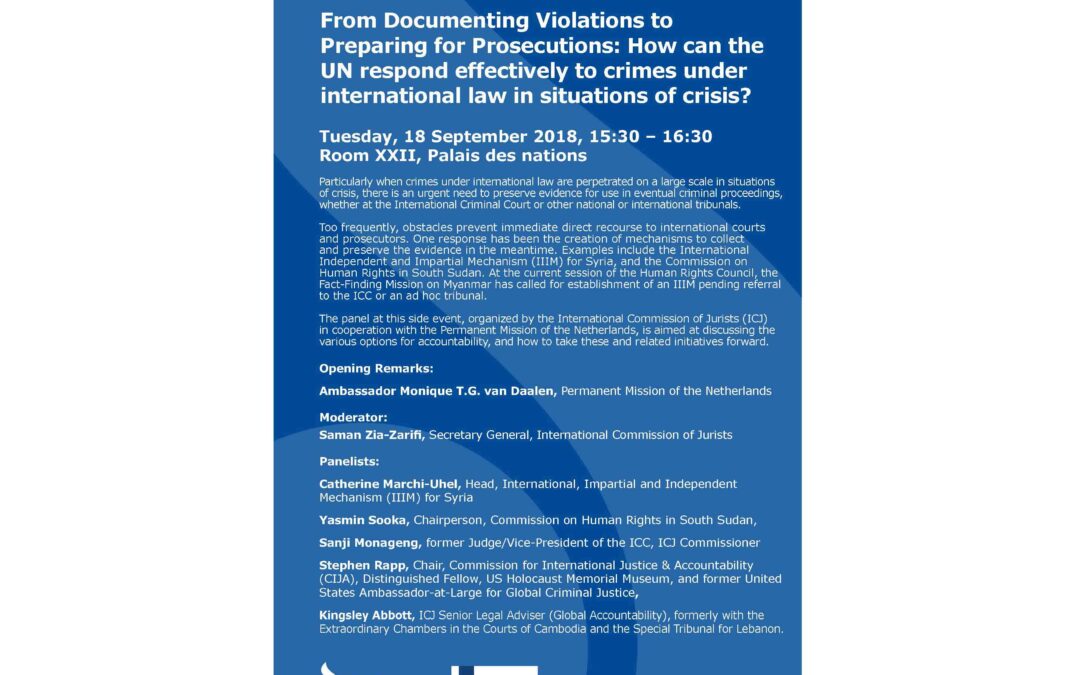
The ICJ will organize this side event, in cooperation with the Permanent Mission of the Netherlands, at the Human Rights Council on Tuesday 18 September 2018 from 15:30 – 16.30 in Room XXII of the Palais des Nations.
Particularly when crimes under international law are perpetrated on a large scale in situations of crisis, there is an urgent need to preserve evidence for use in eventual criminal proceedings, whether at the International Criminal Court or other national or international tribunals
Too frequently, obstacles prevent immediate direct recourse to international courts and prosecutors. One response has been the creation of mechanisms to collect and preserve the evidence in the meantime. Examples include the International Independent and Impartial Mechanism (IIIM) for Syria, and the Commission on Human Rights in South Sudan.
At the current session of the Human Rights Council, the Fact-Finding Mission on Myanmar has called for establishment of an IIIM pending referral to the ICC or an ad hoc tribunal.
The various options for accountability, and how to take these and related initiatives forward will be discussed.
Opening Remarks:
Ambassador Monique T.G. van Daalen, Permanent Mission of the Netherlands
Moderator:
Saman Zia-Zarifi, Secretary General, International Commission of Jurists
Panelists:
- Catherine Marchi-Uhel, Head, International, Impartial and Independent Mechanism (IIIM) for Syria
- Yasmin Sooka, Chairperson, Commission on Human Rights in South Sudan
- Sanji Monageng, former Judge/Vice-President of the ICC, and Commissioner of the ICJ
- Stephen Rapp, Chair, Commission for International Justice & Accountability (CIJA), Distinguished
Fellow, US Holocaust Memorial Museum, and former United States Ambassador-at-Large for Global Criminal Justice
- Kingsley Abbott, ICJ Senior Legal Adviser (Global Accountability), formerly with the Extraordinary Chambers in the Courts of Cambodia and the Special Tribunal for Lebanon
Universal-ICJ-NL-Side event-News-events-2018-ENG (flyer of the event in PDF)