Oct 10, 2017 | Multimedia items, News, Video clips
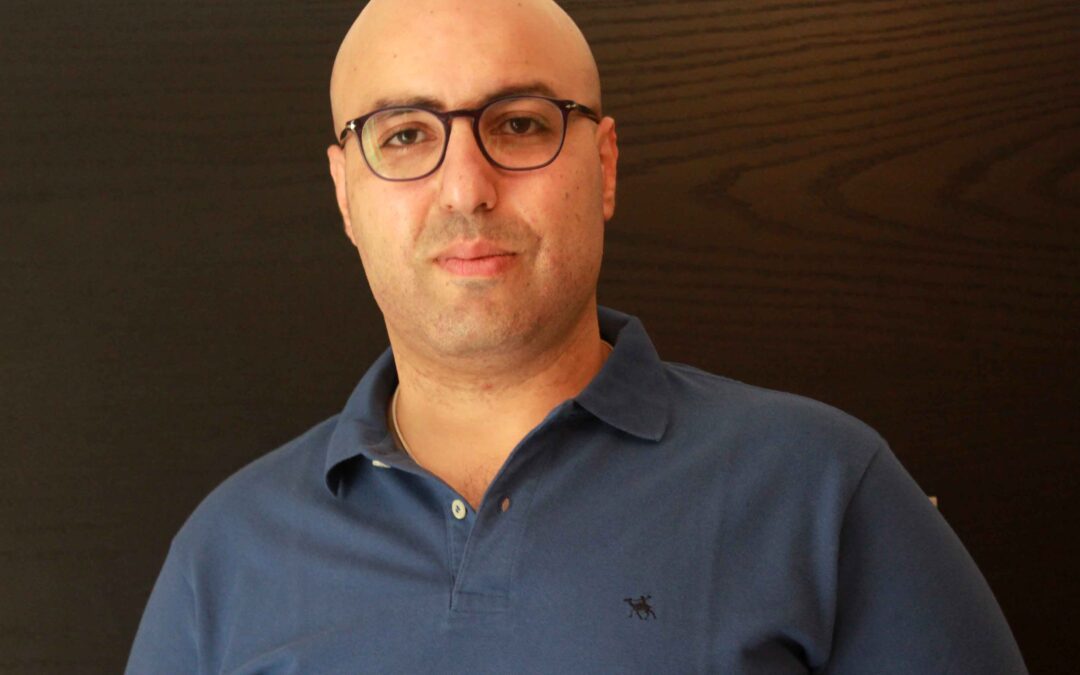
Selected by a jury of 10 global human rights organizations, including the ICJ, Mohamed Zaree is a devoted human rights activist and legal scholar whose work focuses on human rights advocacy around freedom of expression and association.
Mohamed Zaree is also known for his role as the Egypt Country Director of the Cairo Institute for Human Rights Studies (CIHRS), which works throughout the Arabic speaking world.
He assumed this role after government pressure on CIHRS prompted them to relocate their headquarters to Tunis in 2014.
The Egyptian government has been escalating its pressure on the human rights movement.
Human rights NGOs and defenders are confronted with a growing wave of threats, harassment, and intimidation, legal and otherwise.
Despite this, Mohamed Zaree is leading CIHRS’ research, human rights education, and national advocacy initiatives in Egypt and is shaping the media debate on human rights issues.
During this critical period for civil society, he is also leading the Forum of Independent Egyptian Human Rights NGOs, a network aiming to unify human rights groups in advocacy.
Zaree’s initiatives have helped NGOs to develop common approaches to human rights issues in Egypt.
Within the context of the renewed crackdown on Egyptian human rights organizations, he has become a leading figure in Egypt’s human rights movement.
He is currently facing investigation under the “Foreign Funding Case” and is at high risk of prosecution and life imprisonment. The “Foreign Funding Case” highly restricts NGO activities.
Despite this, Mohammed Zaree continues to engage the authorities in dialogue wherever possible, arguing that respect for human rights will increase stability in Egypt.
He has been under a travel ban since May 2016 but remains present and active in Egypt and represents CIHRS inside the country.
“Mohamed Zaree is a leading voice for justice in Egypt. Honoring him with the Martin Ennals Award is a recognition of the courageous and tireless work done by Egyptian human rights defenders, individuals and NGOs, in their fight against all forms of intimidation, harassment and repression waged by the Egyptian military and government against them,” said Said Benarbia, Director of the ICJ Middle East and North Africa Programme.
FreeThe5KH (Cambodia) and Karla Avelar, the two other finalists, received Martin Ennals Prizes.
FreeThe5KH are five Human Rights Defenders who were recently released after 427 days of pre-trial detention.
They are awaiting trial and are banned from travel.
There were widespread international calls for their unconditional release, and a stop to judicial harassment of human rights defenders in Cambodia.
This comes in the context of an increasingly severe crackdown on civil society and the political opposition in Cambodia.
Karla Avelar, a transgender woman in El Salvador, founded the country’s first organization of transgender women – COMCAVIS TRANS.
She grew up on the streets, suffering discrimination, violence, sexual exploitation, rape, and attempted murder.
She works to change national legislation and the authorities’ practices, by publicizing violations suffered by LGBTI people.
Her advocacy helped prompt the authorities to segregate LGBTI prisoners for their own safety, and provide HIV treatment.
Background
The “Nobel Prize of Human Rights”, the Martin Ennals Award for Human Rights Defenders (MEA) is a unique collaboration among ten of the world’s leading human rights organizations to give protection to human rights defenders worldwide.
Strongly supported by the City of Geneva, the award is given to Human Rights Defenders who have shown deep commitment and face great personal risk.
Its aim is to provide protection through international recognition.
The Jury is composed of the following NGOs: ICJ, Amnesty International, Human Rights Watch, Human Rights First, Int’l Federation for Human Rights, World Organisation Against Torture, Front Line Defenders, EWDE Germany, International Service for Human Rights, and HURIDOCS.
Contact:
Michael Khambatta, Director, Martin Ennals Foundation, t: +41 79 474 8208, e: khambatta(a)martinennalsaward.org
Olivier van Bogaert, Director, ICJ Media and Communications, and ICJ Representative on the MEA Jury, t: +41 22 979 38 08, e: olivier.vanbogaert(a)icj.org
The Award will be presented by the United Nations Deputy High Commissioner for Human Rights at 18.15 on 10 October at the University of Geneva. The ceremony can be watched live on Martin Ennals Award Facebook page
Watch the movie on Mohammed Zaree
Oct 10, 2017 | News
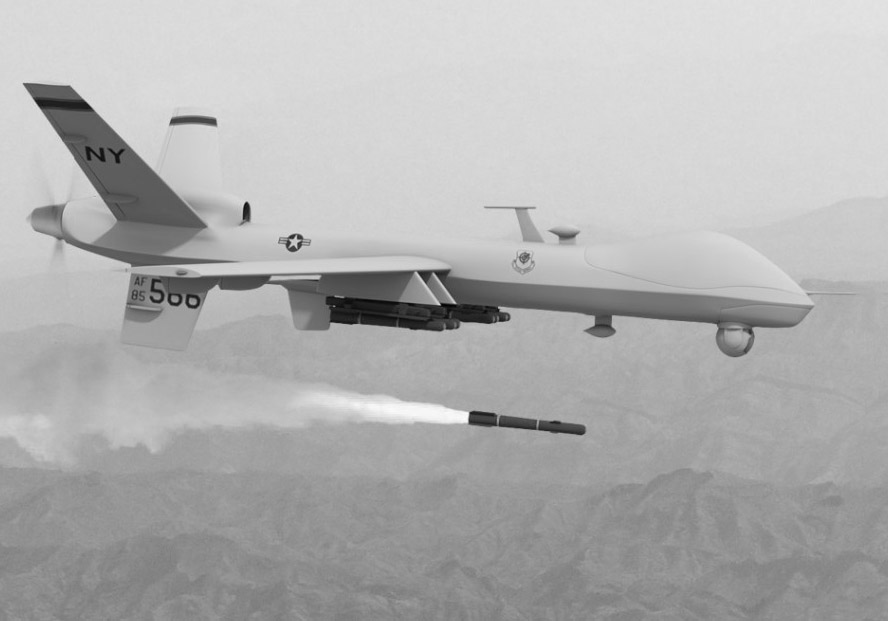
At UN General Assembly First Committee, over 40 organisations from across the world endorsed a statement calling on states to take concerted action to address harm from armed drones and work towards agreement on the limits of the acceptable use of these technologies.
Few states have raised this issue at the First Committee recently, despite the urgent need to address the peace and security implications of armed drones.
Universal-dronesstatement-advocacy-2017-ENG (full pdf)
Oct 9, 2017 | Events, News
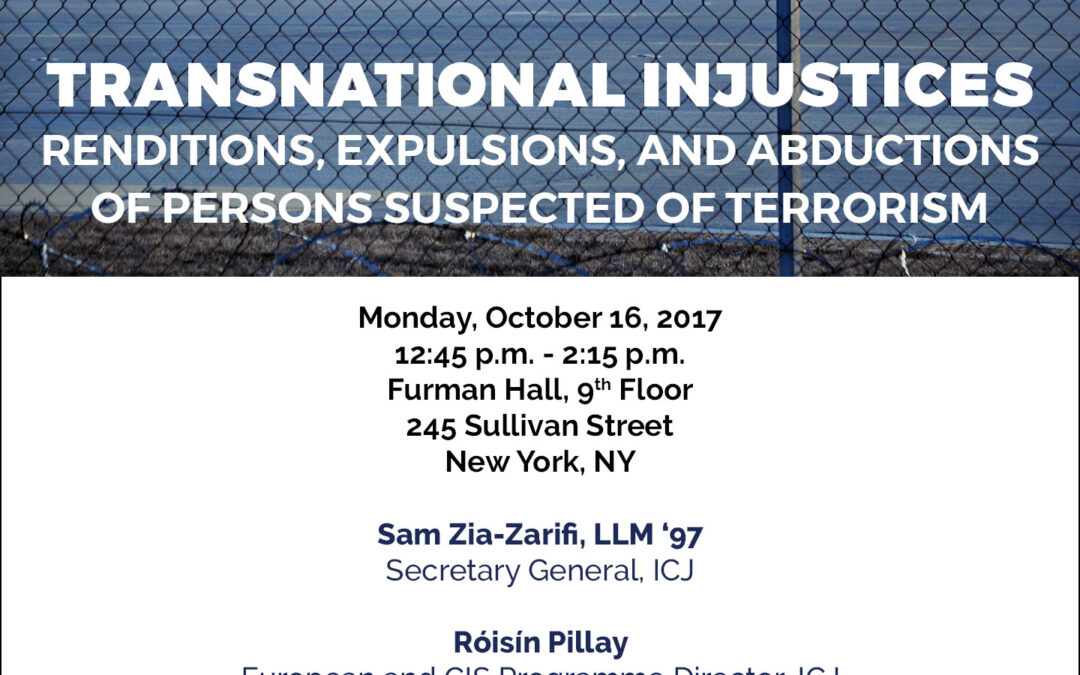
The ICJ, the Center for Human Rights and Global Justice and Amnesty International invite you today to an event to discuss challenges in prevention of, and accountability for, violations of human rights in the US-led rendition system, and in transfers of suspects in the CIS region.
Join us for a moderated discussion marking the U.S. launch of the International Commission of Jurists’ report, Transnational Injustices: National Security Transfers and International Law.
Panelists will discuss the ongoing practice of states unlawfully rendering people accused of terrorism, particularly in Russia and Central Asia, and explore the extent to which the impact of the CIA’s notorious extraordinary renditions can still be felt today.
When: Monday, October 16, 2017 – 12:45 pm to 2:15 pm
Where: Lester Pollack Colloquium Room – Furman Hall, 9th Floor, NYU School of Law – 245 Sullivan Street, New York City
RSVP here
Refreshments will be served
Speakers:
- Sam Zia-Zarifi, Secretary General, ICJ
- Róisín Pillay, European and CIS Programme Director, ICJ
- Margaret Satterthwaite, JD ’99, Professor of Clinical Law, NYU School of Law
Moderated by Julia Hall, Expert on Counter-Terrorism and Human Rights, Amnesty International
A flyer for this event is available in PDF format by clicking here.
Oct 5, 2017 | News
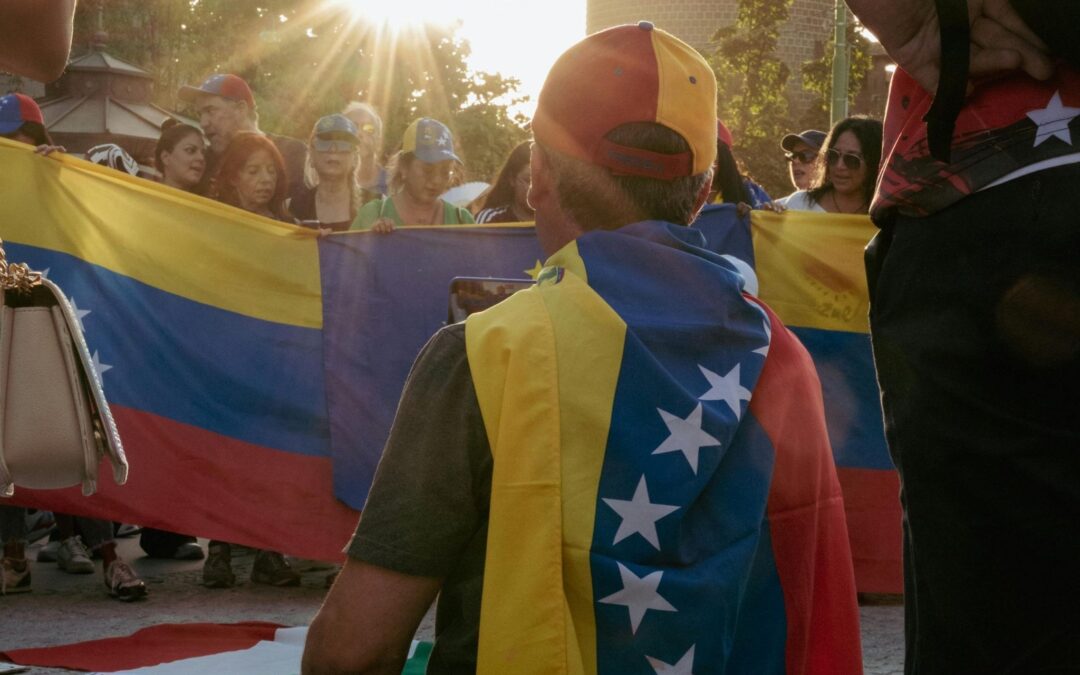
The ICJ calls for Venezuela to accept long-standing requests for country visits by UN Special Procedures whose mandates are most relevant to the rule of law and human rights crisis in the country.
The ICJ takes note of the announcement by the Venezuelan Government that it is inviting the UN Independent Expert on the promotion of a democratic and equitable international order, Mr. Alfred de Zayas, to visit the country.
This announcement, together with a recent invitation to the Special Rapporteur on the right to development is significant. For more than a decade, the Venezuelan Government has denied or left unanswered requests for visits to the country by numerous other of the independent experts (known as “Special Procedures”) of the United Nations. The last mission to Venezuela by a special procedure was the Special Rapporteur on Torture in 1996.
However, the breakdown of the rule of law and the extremely serious human rights situation in Venezuela make visits by other United Nations Special Procedures of urgent relevance.
“In the course of this year, extrajudicial and arbitrary executions, torture and ill-treatment of detainees, arbitrary detention, trial of civilians by military tribunals, and persecutions and attacks against opponents, dissidents and human rights defenders have become systematic and generalized practices in Venezuela, said Federico Andreu Guzman, ICJ South America Representative.
“It is therefore difficult to see why the Government of Venezuela would not respond to long-standing requests from Special Procedure mandates relevant to these violations in favour of proactively inviting other UN experts”, Andreu Guzman added.
The ICJ therefore calls on the Government of Venezuela to invite to visit the country the Working Group on Arbitrary Detention and the Special Rapporteurs on extrajudicial, summary or arbitrary executions; the independence of judges and lawyers; torture and other cruel, inhuman or degrading treatment or punishment; the rights to freedom of peaceful assembly and association; the promotion and protection of the right to freedom of opinion and expression; and on the situation of human rights defenders. All of these UN experts have long-standing requests to visit Venezuela, some for many years, which the Venezuelan Government has failed so far to accept.
“Under the Charter of the United Nations, Member States have the obligation to cooperate with the UN Special Procedures on human rights. This duty is of particular importance when the State is a member of the Human Rights Council, as is the case with Venezuela”, said Andreu Guzman.
The ICJ also calls on the Government of Venezuela to accept the request for a visit to the country that, since 2004, has been repeatedly issued by the Inter-American Commission on Human Rights.
Background
For several years, the following Special Procedures of the UN Human Rights Council have made requests to visit Venezuela: the Special Rapporteur on extrajudicial, summary or arbitrary executions; the Special Rapporteur on the situation of human rights defenders; the Working Group on Arbitrary Detention; the Special Rapporteur on the independence of judges and lawyers; the Special Rapporteur on the rights to freedom of peaceful assembly and association; the Special Rapporteur on violence against women, its causes and consequences; the Special Rapporteur on torture and other cruel, inhuman or degrading punishment; the Special Rapporteur on the promotion and protection of the right to freedom of opinion and expression; the Working Group on the issue of human rights and transnational corporations and other business enterprises; the Special Rapporteur on adequate housing as a component of the right to an adequate standard of living; and the Special Rapporteur on the right to food.
At the regional level, although it denounced the American Convention on Human Rights in September 2012, Venezuela is still a State party to three Inter-American human rights treaties (Inter-American Convention to Prevent and Punish Torture; Inter-American Convention on Forced Disappearance of Persons; and Inter-American Convention on the Prevention, Punishment and Eradication of Violence Against Women). However, Venezuela has systematically ignored recommendations of the Inter-American Commission on Human Rights (IACHR) and has also denied IACHR requests to visit the country, made since 2004.
Contacts
Federico Andreu-Guzmán, ICJ South America Representative, tel: +57 311 481 8094; email: federico.andreu(a)icj.org
Carlos Ayala Corao, ICJ Commissioner (Venezuela), tel: +57 414 243 4872; email: cayala(a)cjlegal.net
Alex Conte, ICJ Global Redress and Accountability Initiative, tel: +22 979 3802; email: alex.conte(a)icj.org
Oct 5, 2017 | Comunicados de prensa
La CIJ hace un llamado a Venezuela a que acepte las solicitudes de visitas al país que han formulado, desde hace varios años, los Procedimientos especiales de las Naciones Unidas, cuyos mandatos son más relevantes para el Estado de Derecho y la crisis de derechos humanos.
La CIJ toma nota del anuncio del Gobierno de Venezuela de invitar al país al Experto independiente sobre la promoción de un orden internacional democrático y equitativo de las Naciones Unidas, Sr. Alfred de Zayas.
Este anuncio, así como él de invitar al país al Relator Especial sobre el derecho al desarrollo, resulta significativo. Por más de una década, el Gobierno venezolano ha denegado o dejado sin respuesta las solicitudes de visita al país de numerosos Expertos de las Naciones Unidas (conocidos como “Procedimientos especiales”). La última misión realizada a Venezuela por un Procedimiento especial, fue la del Relator Especial sobre la Tortura en 1996.
Sin embargo, dada la ruptura del Estado de Derecho y la gravísima situación de derechos humanos en Venezuela, se requiere urgentemente que otros Procedimientos especiales de Naciones Unidas, con un mandato relevante, realicen misiones en el país.
“En el curso de este año las ejecuciones extrajudiciales y arbitrarias, la tortura y malos tratos a detenidos, la detención arbitraria, el juzgamiento de civiles por tribunales militares y las persecuciones y ataques contra opositores, disidentes y defensores de derechos humanos se han convertido en prácticas sistemáticas y generalizadas en Venezuela”, declaró Federico Andreu-Guzmán, Representante para Suramérica de la CIJ.
“Por lo tanto, es difícil entender por qué el Gobierno de Venezuela no responde a las solicitudes formuladas desde larga data por los Procedimientos especiales con mandatos sobre estas violaciones, mientras invita de forma proactiva a otros Expertos de las Naciones Unidas”, agregó Andreu-Guzmán.
La CIJ hace, por lo tanto, un llamado al Gobierno de Venezuela a que invite a visitar el país al Grupo de Trabajo sobre la Detención Arbitraria y a los Relatores Especiales sobre ejecuciones extrajudiciales, sumarias o arbitrarias; la independencia de los magistrados y abogados; la tortura y otros tratos o penas crueles, inhumanos o degradantes; los derechos a la libertad de reunión pacífica y de asociación; la promoción y protección del derecho a la libertad de opinión y de expresión; y sobre la situación de los defensores de derechos humanos. Todos estos Expertos de las Naciones Unidas han solicitado visitar Venezuela desde tiempo atrás, incluso algunos desde hace varios años, sin que el Gobierno venezolano haya aceptado estas solicitudes hasta ahora.
“Los Estados miembros de las Naciones Unidas tienen, bajo la Carta de las Naciones Unidas, la obligación de cooperar con los Procedimientos especiales de derechos humanos de esta organización. Esta obligación cobra particular importancia cuando el Estado es miembro del Consejo de Derechos Humanos, como es el caso de Venezuela”, declaró Andreu-Guzmán.
Asimismo, la CIJ hace un llamado al Gobierno de Venezuela para que acepte la solicitud de visita al país que, desde el año 2004, ha reiterativamente formulado la Comisión Interamericana de Derechos Humanos.
Información complementaria
Desde hace varios años, los siguientes Procedimientos especiales del Consejo de Derechos Humanos de las Naciones Unidas han solicitado visitar a Venezuela: el Relator Especial sobre ejecuciones extrajudiciales, sumarias o arbitrarias; el Relator Especial sobre la situación de los defensores de derechos humanos; el Grupo de Trabajo sobre la Detención Arbitraria; el Relator Especial sobre la independencia de los magistrados y abogados; la Relatora Especial sobre los derechos a la libertad de reunión pacífica y de asociación; la Relatora Especial sobre la violencia contra la mujer, sus causas y consecuencias; el Relator Especial sobre la tortura y otros tratos o penas crueles, inhumanos o degradantes; el Relator Especial sobre la promoción y protección del derecho a la libertad de opinión y de expresión; el Grupo de Trabajo sobre la cuestión de los derechos humanos y las empresas transnacionales y otras empresas; la Relatora Especial sobre una vivienda adecuada como elemento integrante del derecho a un nivel de vida adecuado; y la Relatora Especial sobre el derecho a la alimentación.
En el ámbito regional, aunque denunció la Convención Americana sobre Derechos Humanos en septiembre de 2012, Venezuela sigue siendo Estado parte de tres tratados interamericanos de derechos humanos (La Convención Interamericana para Prevenir y Sancionar la Tortura; la Convención Interamericana sobre Desaparición Forzada de Personas; y la Convención Interamericana para Prevenir, Sancionar y Erradicar la Violencia Contra la Mujer). Sin embargo, las recomendaciones de la Comisión Interamericana de Derechos Humanos han sido sistemáticamente ignoradas por el Estado venezolano, el cual además ha denegado las solicitudes de visita al país que este órgano ha formulado desde el año 2004.
Contactos
Federico Andreu-Guzmán, Representante para Suramérica de la CIJ, tel: +57 311 481 8094; correo electrónico federico.andreu@icj.org
Carlos Ayala Corao, Comisionado de la CIJ (Venezuela), tel: +57 414 243 4872; correo electrónico cayala@cjlegal.net
Alex Conte, Iniciativa Global de la CIJ sobre Reparación y Rendición de Cuentas, tel: +22 979 3802; email: alex.conte@icj.org