Jul 9, 2015 | News
In a letter sent today, the ICJ and seven other human rights organizations urge the Thai Government to drop criminal charges against two journalists from the online news outlet Phuketwan who are about to go on trial for writing about the trafficking of the Rohingya.
The letter was sent to the General Prayuth Chan-ocha, Prime Minister of Thailand.
The trial, which is set to start on 14 July, revolves around criminal charges brought by the Royal Thai Navy against Alan Morison and Chutima Sidasathian for reproducing one paragraph from a Pulitzer Prize-winning article written by Reuters news agency implicating the Navy in the smuggling of the Rohingya off the coast of Thailand.
“Thailand must drop these charges immediately and unconditionally,” said Sam Zarifi, ICJ’s Regional Director for Asia and the Pacific.
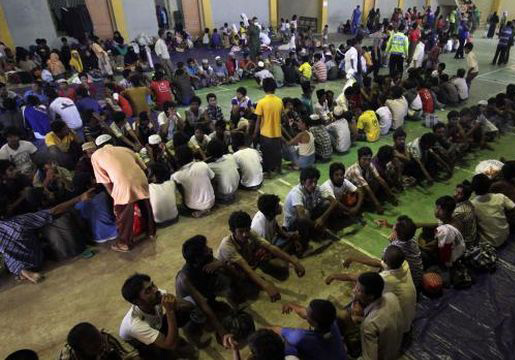
“Criminal prosecution of speech is a violation of international law, and the Thai Navy’s relentless pursuit of this case seems even more misguided as it comes at a time when journalists have played a vital role in uncovering mass graves on the Thailand-Malaysia border and thousands of migrants and refugees, including Rohingya, left stranded on boats in the Andaman Sea,” he added.
On 16 December 2013, the Royal Thai Navy lodged complaints of criminal defamation and offences against Thailand’s Computer Crimes Act (CCA) against the journalists.
On 17 April 2014, the journalists were charged with criminal defamation under articles 326 and 328 of the Thai Criminal Code, which carry a maximum penalty of two years imprisonment and a fine of up to 200,000 Baht (USD $6,000); and violation of article 14(1) of the CCA, which carries a maximum penalty of five years imprisonment and a fine of up to 100,000 Baht (USD $3,000).
“The absurdity of these prosecutions was emphasized when the Office of Thailand’s Prime Minister recently asked one of the two journalists, Chutima Sidasathian, who is working towards a Ph.D. on the Rohingya, to suggest a solution to the ‘boat people’ crisis,” Zarifi further said.
“It is not too late to follow that request with an unconditional withdrawal of all charges as an official recognition of the important work by Alan Morison and Chutima Sidasathian in raising these issues and as a concrete gesture of Thailand’s purported commitment to addressing them,” he added.
Contact:
Sam Zarifi, ICJ Asia Pacific Regional Director (Bangkok), t: +66 807819002; e: sam.zarifi(a)icj.org
Background:
Article 19 of the International Covenant on Civil and Political Rights (ICCPR), to which Thailand is a State Party, guarantees the right to freedom of expression, which includes the right to impart information. The UN Human Rights Committee, which monitors State compliance with the ICCPR, has expressed its concern at the misuse of defamation laws to criminalize freedom of expression and has said that such laws should never be used when expression is made without malice and in the public interest.
The ICJ, an increasing number of governments, the Human Rights Committee and other international authorities, believe that criminal defamation laws should be abolished. Such laws are inherently incompatible with the ICCPR and other international laws and standards on freedom of expression. Criminal penalties are always a disproportionate means to protect against reputational harm and pose an impermissibly severe impediment to the exercise of free expression.
Thailand was criticized in May 2014 when the United Nations Committee Against Torture expressed its concern “at the numerous and consistent allegations of serious acts of reprisals and threats against human rights defenders, journalists, community leaders and their relatives, including verbal and physical attacks, enforced disappearances and extrajudicial killings, as well as by the lack of information provided on any investigations into such allegations.”
The Committee recommended that Thailand “should take all the necessary measures to: (a) put an immediate halt to harassment and attacks against human rights defenders, journalists and community leaders; and (b) systematically investigate all reported instances of intimidation, harassment and attacks with a view to prosecuting and punishing perpetrators, and guarantee effective remedies to victims and their families.”
Thailand-Letter to PM Prayuth re Phuket Wan-Advocacy-open letters-2015-ENG (full text of the letter, in PDF)
Thailand-Phuketwan cases-News-Press release-2015-THA (full text of press release in PDF, Thai)
Thailand-Letter to PM Prayuth re Phuket Wan-Advocacy-open letters-2015-THA (full text of the letter, in PDF, Thai)
Jul 8, 2015 | News
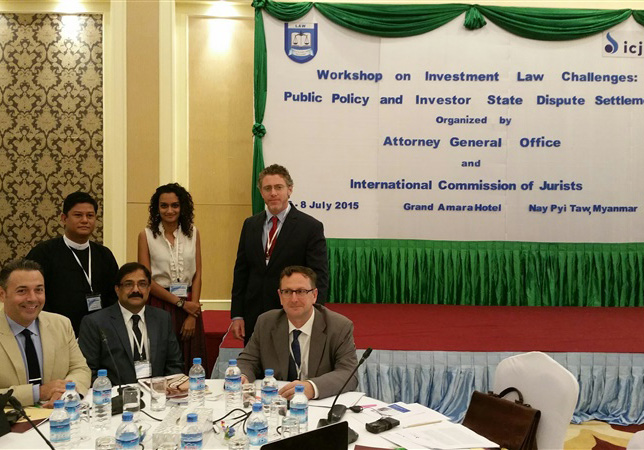
The ICJ held a successful workshop with the Office of the Attorney General (OAG) on ‘Investment Law Challenges: Defending Public Policy in Investor State Arbitration’.
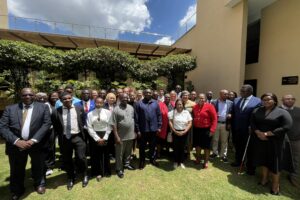
The event took place in Nay Pyi Taw from 6 to 8 July 2015 and was attended by 60 participants from the OAG and other Ministries.
The workshop was designed to raise awareness about Myanmar’s human rights obligations in relation to investment and to build the OAG’s capacity to draft law that carves out regulatory space for public policy making.
The workshop also prepared the OAG for challenges to public policy through arbitration with a moot court exercise.
The topic is timely as Myanmar rushes to draft new investment law and sign Bilateral Investment Treaties that give investors standing to challenge public policy promoting and protecting human rights.
In opening the workshop, Director General U Kyaw San spoke of the rapid increase of investment in Myanmar and the corresponding changes in its regulatory system.
Dr. Na Chi Oo, a speaker for the OAG, outlined the challenges this poses to the drafting of new public policy.
Participants heard from ICJ Commissioner Prof Andrew Clapham who discussed globalization, investment arbitration and public policy.
He examined the use of human rights law in investment arbitrations.
Guest speaker Prof. Anthony Daimsis introduced bilateral investment treaties and highlighted provisions that can restrict state regulatory space.
Prof. Errol Mendes gave examples of international cases in which public policy has been challenged.
Ms. Harpreet Kaur Dhillon, from the Centre for International Law, National University of Singapore gave practical advice for drafting law that protects the regulatory role of the state.
Dr. Daniel Aguirre, ICJ Legal Adviser, added that “Myanmar needs to update its regulatory system to protect the environment and human rights. It must make sure it does not sign away its regulatory role through investment law and bilateral treaties.”
The event culminated with a moot arbitration exercise where OAG participants engaged in a mock consultation process and a simulated arbitration over a public health policy.
The ICJ was impressed by the interest and genuine commitment of the participants to promote the rule of law and public policy in Myanmar.
The ICJ staff enjoyed open and frank discussion with the Attorney General and is Director Generals on relevant legal developments and looks forward to further discourse.
The ICJ remains committed to provide support in this field in line with the promotion and protection of human rights.
Jul 8, 2015 | News
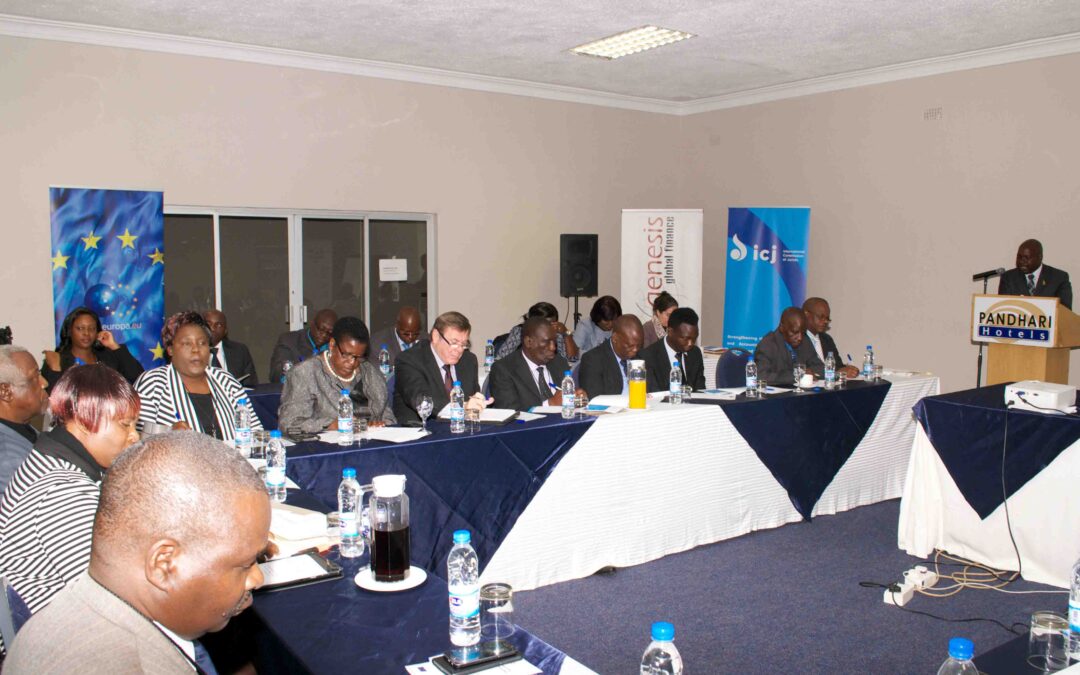
The National Prosecuting Authority (NPA) of Zimbabwe convened its first strategic planning workshop with technical support from the ICJ, under recently launched European Union (EU) funded project to contribute to an improvement in administration of justice in Zimbabwe.
The strategic planning workshop took place in Harare from 6 to 8 July 2015.
The NPA is established under section 259 of the 2013 Constitution as a separate, independent and accountable institution responsible for instituting and undertaking criminal prosecutions on behalf of the State, promoting a just and fair system for all persons approaching the courts and protecting the rights of the arrested and detained persons as provided for by the Constitution.
The strategic plan will allow the NPA to set its vision, objectives and including stakeholders’ expectations as guided by the Constitution and the National Prosecuting Authority Act for the next 5 years.
The NPA held this strategic plan as its first ever strategic stakeholder’s engagement since its establishment under the Constitution in May 2013.
To validate and ground the strategic plan and outputs, the NPA invited civil society organizations, law based institutions, human rights advocates, women lawyers associations, legal aid institutions, the Parliament Thematic and Standing Committee representatives, law enforcement agencies, and law professors, among others.
The Judicial Service Commission and Law Society of Zimbabwe, ICJ’s partners in EU funded project on improvement in the administration of justice, also attended the NPA strategic planning session.
The strategic plan will inform further interventions and activities for strengthening the observance of the rule of law, fair trial and access to justice by the NPA with support from ICJ’s EU funded project.
Once developed and adopted, the strategic plan will further open opportunities for other technical partnerships and funding opportunities for the NPA.
Contact:
Arnold Tsunga, ICJ Regional Director for Africa, t: +27 73 131 8411, e: arnold.tsunga(a)icj.org

Jul 4, 2015 | Artículos, Noticias
Venezuela está intimidando y hostigando a defensores y defensoras de derechos humanos y les ha acusado infundadamente de que estarían intentando desestabilizar la democracia en el país, indicaron hoy 28 organizaciones de derechos humanos internacionales y latinoamericanas.
Los señalamientos de las autoridades se refieren a las funciones legítimas que ejercen estas organizaciones al documentar abusos y representar a víctimas ante organismos internacionales de derechos humanos.
Las autoridades venezolanas deberían desistir inmediatamente de esta táctica, expresaron las organizaciones. Los gobiernos que participarán en la Cumbre de las Américas, que tendrá lugar en Panamá el 10 y 11 de abril de 2015, deberían exigir al gobierno de Nicolás Maduro que asegure que las defensoras y los defensores de derechos humanos puedan realizar su labor sin temor a sufrir represalias, dijeron las organizaciones.
La persecución del gobierno apunta claramente a desacreditar e intimidar a organizaciones que documentan violaciones de derechos humanos, indicaron las organizaciones.
Venezuela-Harassment of HRDs-News-web stories-2015-SPA
Venezuela-Harassment of HRDs-News-web stories-2015-POR (em Português)