

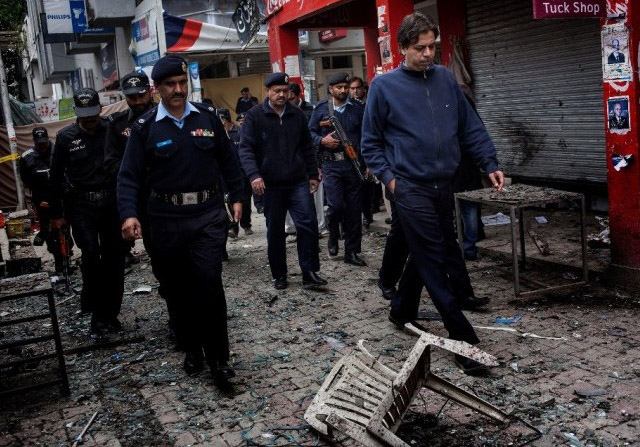
Pakistan: ICJ condemns bombing of Islamabad Court and assassination of Judge Rafaqat Awan
The shooting and bombing at an Islamabad Court today should be condemned as a presumed attack against the judicial officials and the independence of the judiciary in Pakistan, says the ICJ.
The attack resulted in the killing of Additional Sessions Judge Rafaqat Ahmad Khan Awan and at least ten other persons, including several lawyers.
According to reports, armed gunmen forced their way into a court complex in Islamabad, openly firing on judges and lawyers before at least two of the men blew themselves up inside the court complex.
One of the attackers detonated himself outside the door of a judge’s office, while the other targeted the office of the Lawyers’ Union President.
Another gunmen entered Judge Rafaqat Awan’s courtroom, where he shot and killed him.
“An intentional killing of a member of the judiciary can be seen as nothing other than an attack against the independence and impartiality of the judiciary as a whole,” said Sam Zarifi, ICJ Asia Pacific Regional Director.
“In addition to personal tragedy that has befallen the slain victims and their families, this attack and those like it are devastating for the people of Pakistan,” he added. “Courthouses, which should be places where justice is administered, are instead becoming slaughterhouses.”
This is the third armed attack against members of the judiciary in Pakistan in under a year. In March 2013, a judicial compound was attacked in Peshawar, killing four people.
In June 2013, a Sindh High Court judge’s convoy was attacked in Karachi, killing nine people.
As set out in the UN Principles on the Independence of the Judiciary, Pakistan must take steps to protect and ensure the safety of members of the judiciary from threats and violence from any quarter for any reason.
The Beijing Statement of Principles on the Independence of the Judiciary in the LAWASIA region further elaborates that the executive branch must at all times ensure the security and physical protection of judges and their families.
As a State party to the International Covenant on Civil and Political Rights, Pakistan is under a general obligation to ensure the safety of all persons within its territory at all times.
“If judges are under constant fear of violence from insurgent groups, they cannot function as an independent and impartial judiciary – an indispensible requirement for preserving rule of law and democracy,” Zarifi said.
The ICJ calls on the Government of Pakistan to take steps to immediately investigate and bring to justice those persons responsible for the armed attack on the Courthouse.
Contact:
Sam Zarifi, ICJ Asia-Pacific Regional Director, (Bangkok), t:+66(0) 807819002; email: sam.zarifi(a)icj.org
Reema Omer, ICJ Legal Advisor, Pakistan (London), t: +447889565691; email: reema.omer(a)icj.org
Photo credit: MYRA IQBAL

Guatemala: la CIJ lamenta la muerte del Magistrado de la Corte Suprema de Justicia César Ricardo Crisóstomo Barrientos Pellecer
La CIJ lamenta la muerte del Sr. Magistrado de la Corte Suprema de Justicia César Ricardo Crisóstomo Barrientos Pellecer, ocurrida el día de ayer domingo 2 de marzo.
Así mismo, expresa sus más sinceras condolencias a su familia, a sus colegas del Organismo Judicial, gremio de abogados y abogadas y al pueblo de Guatemala en general.
La muerte del magistrado César Barrientos deja un vacío muy grande en el ámbito de la justicia y lucha contra la impunidad en Guatemala, ya que siempre se distinguió como un defensor de la independencia judicial y del Estado de Derecho.

Guatemala: la CIJ lamenta la muerte del Magistrado de la Corte Suprema de Justicia César Ricardo Crisóstomo Barrientos Pellecer
La CIJ lamenta la muerte del Sr. Magistrado de la Corte Suprema de Justicia César Ricardo Crisóstomo Barrientos Pellecer, ocurrida el día de ayer domingo 2 de marzo.
Así mismo, expresa sus más sinceras condolencias a su familia, a sus colegas del Organismo Judicial, gremio de abogados y abogadas y al pueblo de Guatemala en general.
La muerte del magistrado César Barrientos deja un vacío muy grande en el ámbito de la justicia y lucha contra la impunidad en Guatemala, ya que siempre se distinguió como un defensor de la independencia judicial y del Estado de Derecho.

Brunei: Sultan must allow debate on new Penal Code
A statement by Sultan Hassanal Bolkiah suggesting that critics of Brunei Darussalam’s new Penal Code may be criminally prosecuted for slander is clearly meant to curb freedom of expression and opinion in the country, the ICJ said.
The ICJ urged the Government of Brunei to ensure full respect for the right of freedom of opinion and expression.
In a speech marking Brunei’s 30th National Day on 23 February 2014, Sultan Hassanal Bolkiah said that social media had been used to express opposition to the implementation of the new Penal Code.
He said that those who use social media to express their opinions against the new Penal Code may be committing offences under the General Offences Chapter of the new law. He reportedly characterized some of this expression as amounting to slander, including of the King and of Ulamas, or Muslim scholars. The Sultan also warned that these critics “cannot continue to be allowed to inflict insults” and that they “can be brought to court.”
“Sultan Hassanal Bolkiah’s statement illustrates that human rights, particularly respect for freedom of opinion and expression, is widely disregarded by the authorities in Brunei,” said Sam Zarifi, ICJ’s Regional Director for Asia and the Pacific.
The ICJ has criticized the new Penal Code for being an affront to human rights and at odds with international standards.
The ICJ reiterates its concern that provisions in the new Penal Code are not in accord with the commitment made by Brunei Darussalam as a member of the Association of Southeast Asian Nations (ASEAN) to promote and protect human rights in the region.
“Free, unhindered debates on issues like the enactment or implementation of a law are important cornerstones of a democratic society,” said Zarifi.
Freedom of opinion and expression is a right that is affirmed in the Universal Declaration of Human Rights and guaranteed under the Convention on the Elimination of All Forms of Discrimination against Women (CEDAW) and the Convention on the Rights of the Child (CRC), to both of which Brunei Darussalam is a party. Under international law, any restrictions or limitations must be exceptional, in accordance with the principles of the proportionality and necessity.
The ICJ urged the Government of Brunei to allow free discussion, particular on matters of public importance such as State law and policies and to fully respect the right to freedom of opinion and expression.
Contact:
Emerlynne Gil, ICJ International Legal Adviser for Southeast Asia, t +66 2 619 8477; email: emerlynne.gil(a)icj.org
Craig Knowles, ICJ Media Consultant, t +66 81 9077653; email:craig.knowles(a)icj.org
Recent News
 HRC63: ICJ Calls for Renewal and Strengthening of the Venezuela Fact-Finding Mission21 Sep 2026
 Joint Statement: Attacks on the Rule of Law, Judicial Independence and Access to Justice in Zambia17 Sep 2026
 HRC63: ICJ Raises Concern over Widespread and Systematic Arbitrary Detention in Egypt16 Sep 2026
 Myanmar: As armed conflict rages and military rule continues, critical measures can be taken towards eventual justice and accountability for victims of Enforced Disappearance10 Sep 2026