Training on migration and human rights in Serbia

Training on migration and human rights in Serbia

The ICJ, OSCE and Group 484 are holding a training on migration and international human rights law starting on Tuesday 16 October in Kladovo (Serbia).

The training has been organised by the Organisation for Security and Cooperation in Europe (OSCE) and the Serbian NGO “Group 484” and will be given by the International Commission of Jurists. It will focus on international protection of migrants and asylum seekers, the principle of non-refoulement, and human rights in expulsion procedures, drawing from the jurisprudence of the European Court of Human Rights, of the UN human rights systems and from EU law. The training will be centered on the ICJ Practitioners Guide no. 6: Migration and International Human Rights Law.

Serbia-agenda-migration-2012 (download the agenda of the training)

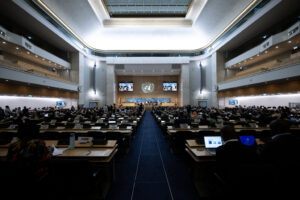
Photo credit: © Stabilisation Unit/DFID (the DFID has no involvement in nor does support this event)

Guatemala: estándares internacionales relativos a la aplicación de la pena de muerte

Guatemala: estándares internacionales relativos a la aplicación de la pena de muerte

Hoy, 58 países conservan la pena de muerte. Entre estos países se encuentra Guatemala.

Dentro de su acción en defensa y promoción de los derechos humanos, la CIJ aboga por la abolición de la pena de muerte en el mundo y apoya los esfuerzos para alcanzar este objetivo.

Desde la óptica de los derechos humanos, la pena de muerte constituye una pena inhumana y degradante por su carácter irreversible e irreparable y por atentar contrael bien jurídico fundamental del derecho a la vida.

Existe actualmente una tendencia generalizada a la abolición de la pena capital; según Amnistía Internacional más de dos tercios de los países la han erradicado de sus sistemas de administración de justicia.

Sin embargo, Guatemala conserva aún la pena de muerte. El país atraviesa por un período de moratoria de hecho en la ejecución de la pena de muerte de 14 personas debido a la ausencia de regulación normativa del indulto.

Es necesario mencionar como avance en la materia, la conmutación de 12 penas de muerte por la pena de prisión máxima dentro del período 2006-2010, lo cual significa un primer paso en el camino hacia la erradicación de esta sanción dentro de la legislación interna.

El presente documento tiene por objeto sistematizar los estándares internacionales establecidos en la aplicación de la pena de muerte en aquellos países que aún la conservan, con énfasis en Guatemala.

Para ello, se utiliza el marco normativo internacional, específicamente instrumentos y jurisprudencia del sistema universal de protección de derechos humanos, del sistema europeo y del sistema interamericano.

El enfoque tiene dos aspectos principales: la pena de muerte como una violación del derecho a la vida; y las normas internacionales que deben respetarse al momento de emitir una condena de este tipo y al ejecutarla.

Guatemala-Estandares internacionales relativos a la aplicacion de la pena de muerte-publications-2012-spa (full text in pdf)

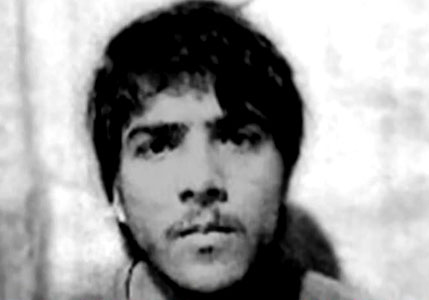
World Day against the Death Penalty:  ICJ urges India to grant clemency to Ajmal Amir Kasab

World Day against the Death Penalty: ICJ urges India to grant clemency to Ajmal Amir Kasab

On the tenth annual World Day against the Death Penalty, the ICJ urges the President of India to grant clemency to Mohammed Ajmal Amir Kasab.

“There is no doubt that Kasab’s crimes were heinous causing immeasurable suffering but execution is not the answer,” said Sam Zarifi, ICJ Asia Pacific Regional Director. “Putting him to death would be a significant step backwards for India. It would end the eight-year hiatus on executions and disregard the call in repeated UN General Assembly Resolutions that all States should observe an immediate moratorium on the death penalty with a view towards full abolition.”

October 10, 2012 is the World Day against the Death Penalty.  The ICJ considers the death penalty to constitute a violation of the right to life and a form of cruel and inhuman punishment.

The ICJ calls on all countries to abolish the death penalty.

“The death penalty violates the inherent dignity of the person,” Zarifi added. “And as we have seen in India as well as all over the world, it is not possible to administer capital punishment without some degree of inconsistency, subjectivity and arbitrariness.”

More than 150 of 192 United Nations member states have either abolished the death penalty or do not practice it.

In South Asia, Nepal abolished the death penalty in its 1997 Constitution and Sri Lanka has not carried out an execution since 1976.

Kasab, a 25-year old Pakistani national, was sentenced to the death for his role in the Mumbai terrorist attack in 2008.

The Supreme Court confirmed Kasab’s death sentence on 29 August 2012, upholding the judgment of the Bombay High Court on 21 February 2011 and the sentence handed down by a lower court in May 2010. On 18 September 2012, Kasab sent a four-line handwritten mercy plea to the President of India.

The Maharashtra Home Ministry recommended rejecting the mercy plea on 24 September 2012 and Governor of Maharashtra, K Sankaranarayan, advised the same on 29 September 2012. The petition has now been forwarded to the Union Government.

CONTACT:

Sam Zarifi, ICJ Asia-Pacific Regional Director, t: +41(0)22 979 38 00; sam.zarifi(at)icj.org

Sheila Varadan, ICJ Legal Advisor, South Asia Programme, t: +66 857200723; sheila.varadan(at)icj.org

International seminar on child rights and the business sector

International seminar on child rights and the business sector

Under the title “Urging States and private companies to meet their obligations”, the workshop is taking place from 14 to 17 October 2012 in Sion, Switzerland.

The ICJ is sponsoring this international seminar that will provide all stakeholders with a space to discuss businesses’ impacts on the rights of the child and the international obligations of States in this context, identify practices, instruments and models as well as relevant partners to work for the promotion of the rights of the child in the context of business activities.

The programme of the workshop can be downloaded here:

Universal – Business and Child Rights – Workshop Programme – Event-2012

Universal – Business and Child Rights – Workshop Programme- Event – 2012 – Fr (English)

Sri Lanka: ICJ deplores attack on the Secretary of the Judicial Services Commission

Sri Lanka: ICJ deplores attack on the Secretary of the Judicial Services Commission

The Sri Lankan government must immediately provide justice for the physical assault on Manjula Tillekaratne and cease public efforts to undermine the independence of the country’s judiciary, the ICJ said today.

Unidentified persons assaulted the Secretary of the Judicial Services Commission on 7 October 2012. Lawyers and judges held a strike to protest recent and escalating threats to judicial independence in Sri Lanka.

“This physical assault is another terrible step downward in the ongoing effort to undermine the judiciary and the rule of law in Sri Lanka,” said Sam Zarifi, ICJ’s Asia Director. “The Sri Lankan government has to investigate this event and bring the perpetrators to justice, and ensure that the country’s judges are secure from assault and intimidation.”

Earlier in September, the Sri Lankan President Mahinda Rajapksa had demanded a meeting with the Chief Justice and two members of the JSC. The JSC refused the request, citing the implications of such a meeting on the independence of the judiciary.

The request came in the wake of the Supreme Court striking down a pending bill before the parliament – the “Divi Neguma Department Bill,” which proposed to establish a new department by amalgamating the Samurdhi Authority, Southern Development Authority and the Udarata Development Authority.

If passed, the bill would confer wide powers to the Economic Development Minister as well as access to funds.

State-controlled print and electronic media then engaged in a public campaign of vilifying the Chief Justice and other members of the JSC who are also sitting Supreme Court Justices.

On 18 September 2012, the JSC directed its Secretary to issue a public statement citing the baseless criticism of its members in the state electronic and print media.

The JSC indicated that it had been subjected to threats and intimidation.

Notably, the JSC said it was subjected ‘to various influences after the Commission initiated disciplinary action against a judge.’

On 28 September 2012, JSC Secretary Manjula Tillekaratne expressed concern for ‘the security of all of us and our families beginning from the person holding the highest position in the judicial system.’

“The effort to use State-controlled media to browbeat and intimidate judges is an egregious assault on the independence and impartiality of Sri Lanka’s judiciary. An independent judiciary is a necessary precondition to safeguard human rights,” Zarifi added.

The United Nations Basic Principles on the Independence of the Judiciary makes clear that it is the responsibility of the State to respect and observe the independence of the judiciary, protecting judges from any improper influences, inducements, pressures, threats or interference.

In recent months, the independence of the judiciary has come under attack in Sri Lanka.

In July 2012, Government Minister Rishad Bathiudeen threatened a Magistrate in Mannar and then orchestrated a mob to pelt stones and set fire to part of the Mannar courthouse.  Lawyers and judges held a nation-wide strike to protest the incident.

The Bar Association of Sri Lanka as well as the Judges Association of Sri Lanka issued public statements condemning the attacks.

Contact:

Sam Zarifi, ICJ Asia-Pacific Regional Director, t: +66 26198477; email: sam.zarifi@icj.org

Sheila Varadan, ICJ Legal Adviser, South Asia Programme, t: +66 857200723; email: sheila.varadan@icj.org

Picture by Nuwan Amarawansha

Translate »