
Aug 2, 2009 | Events
The meeting on reform of the legal system in Zimbabwe convened by the ICJ and other human rights institutions adopted a final resolution containing a clear analysis of the situation and recommendations for reforms.
Zimbabwe-Seminar reform legal system-event-2009 (full text in English, PDF)

Jul 22, 2009 | News
The ICJ releases the electronic version of Practitioners’ Guide No. 4: Sexual Orientation, Gender Identity and International Human Rights Law.
Around the world, people of diverse sexual orientations and gender identities are singled out for abuse. In states with laws that criminalize same-sex sexual conduct, LGBT people are arrested, detained, tortured, and, in some cases, executed.
Even in states with no official penal sanctions, LGBT people are the target of violent hate crimes, harassment, and ostracism. They live in fear of losing their jobs, their housing, and their families, all because of how they live and whom they love.
For the past five years, ICJ has worked on promoting the applicability of human rights law to violations based on sexual orientation and gender identity. Together with the International Service for Human Rights, ICJ facilitated the development of the Yogyakarta Principles.
This document, drafted by a distinguished group of human rights experts, articulates the human rights principles that apply to sexual orientation and gender identity, and identifies the legal sources of States’ obligations to protect, promote and fulfil rights.
Drawing on the Yogyakarta Principles, the ICJ wrote the Practitioners’ Guide to provide judges, lawyers, and activists a detailed understanding of the legal foundations for the protection of people victimized on the basis of their sexual orientation or gender identity.
The Practitioners’ Guide offers a comprehensive review of the principles of non-discrimination, equality, and privacy. It then analyzes the scope and nature of the legal prohibition against some of the most severe violations – torture, deprivation of liberty, extrajudicial and arbitrary executions, and denial of the rights to freedom of expression, association, and assembly.
Through the Practitioners’ Guide, the ICJ hopes to increase awareness of human rights principles that protect people of all sexual orientations and gender identities, as well as to encourage legal advocacy.
For the text of this Practitioners guide, see Sexual orientation, gender identity and international human rights law – Practitioners’ guide, no. 4

Jul 9, 2009 | Communiqués de presse, Nouvelles
La CIJ déplore la suspension des pouvoirs de la Cour Constitutionnelle, l’éviction de ses sept juges et la modification des modalités de nomination du juge constitutionnel.
La CIJ condamne énergiquement ces actes qui portent gravement atteinte à l’indépendance du pouvoir judiciaire et compromettent sérieusement les acquis de l’état de droit au Niger.
La CIJ exhorte les autorités compétentes nigériennes de tout mettre en oeuvre en vue du retrait immédiat de ces décrets présidentiels et le rétablissement de l’état de droit en République du Niger.
La CIJ fait observer que ces décrets présidentiels sont la réponse à deux arrêts de la Cour Constitutionnelle jugeant anticonstitutionnelle la convocation d’un referendum constitutionnel ayant essentiellement pour effet de modifier la constitution en vue d’accorder au Président de la République sortant la possibilité de briguer un troisième mandat consécutif.
Pourtant, la Constitution limite en son article 36 le mandat présidentiel à cinq ans renouvelables une seule fois et prescrit à l’article 105 l’inamovibilité et l’irrévocabilité des juges de la Cour Constitutionnelle.
La CIJ soutient fermement que les décrets présidentiels, en ce qu’ils privent la plus haute juridiction nigérienne de ses prérogatives constitutionnelles de garant de l’état de droit et des droits humains, violent sérieusement le principe de l’indépendance du pouvoir judiciaire garanti à l’article 98 de la Constitution nigérienne.
Ils constituent également une violation flagrante de l’article 14 du Pacte international relatif aux droits civils et politiques et l’article 26 de la Charte Africaine des Droits de l’Homme et des Peuples, auxquels la République du Niger est un État partie.
Lesdits décrets constituent aussi une violation flagrante des Principes fondamentaux relatifs à l’indépendance de la magistrature, des Nations Unies, et des Principes et directives sur le droit à un procès équitable et à l’assistance judiciaire en
Afrique, de l’Union Africaine.
La exhorte les autorités compétentes nigériennes de tout mettre en oeuvre pour le retrait immédiat et inconditionnel de ces décrets présidentiels. L’ICJ demande aussi au Gouvernement nigérien de respecter scrupuleusement l’indépendance du pouvoir judiciaire et l’état de droit tels que prescrits par la constitution nigérienne et ses engagements régionaux et internationaux.

Jul 9, 2009 | News
L’ICJ déplore la suspension des pouvoirs de la Cour Constitutionnelle, l’éviction de ses sept juges et la modification des modalités de nomination du juge constitutionnel.
Jun 18, 2009 | News
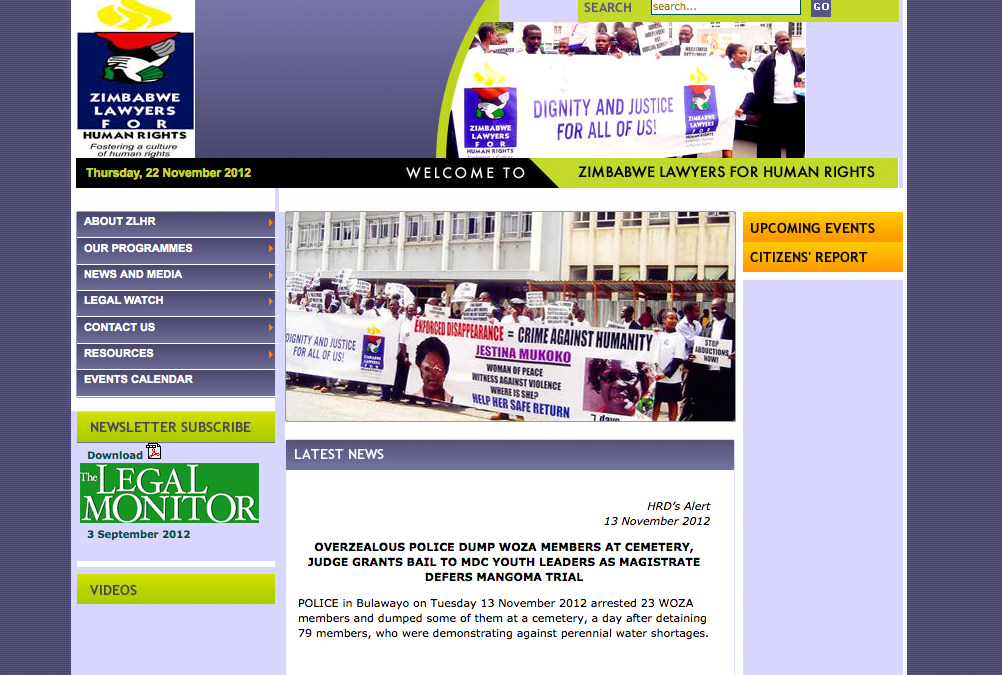
The ICJ is delighted to learn that the 2009 American Bar Association Rule of Law Award will be bestowed upon its affiliate, Zimbabwe Lawyers for Human Rights (ZLHR).
The ICJ wishes to congratulate ZLHR for winning this prestigious and well-deserved award for their considerable and persistent work in the promotion and protection of human rights and the Rule of Law in Zimbabwe.
Zimbabwe-awardZLHR-web story-2009 (full text, PDF)