Mar 5, 2019 | News
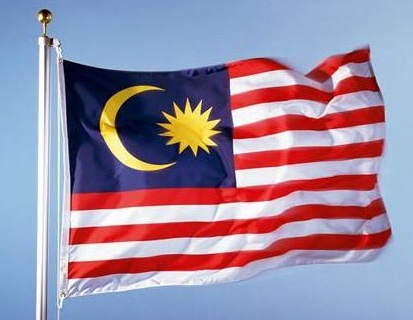
On 4 March 2019, Malaysia acceded to the Rome Statute of the International Criminal Court (ICC), making it the 124th State Party to the ICC.
“The decision by Malaysia’s government to become party to the Rome statute should be commended as a positive sign of its commitment to the rule of law and acceptance to work with the global community to end impunity and ensure accountability for some of the gravest crimes under international law,” said Frederick Rawski, the ICJ’s Asia-Pacific Director.
The ICJ considers the establishment of the ICC as a watershed achievement in the development of international law and the will and capacity of States to act in concert to address atrocities around the world that carry devastating consequences for the victims.
The aim to end impunity on a global scale requires that the Rome Statute be ratified universally.
The ICC was established in 2002 as a permanent international criminal court to investigate and, where warranted, put on trial individuals charged with the some of the most serious crimes of international concern, particularly the crime of genocide, crimes against humanity, war crimes and the crime of aggression.
The Rome Statute operates on the principle of complementarity, meaning that the ICC can only become engaged when the responsible States are unable or unwilling to investigate and prosecute allegations at the national level.
“Malaysia’s accession serves as an example for the entire Asian region, which has been significantly underrepresented at the ICC,” said Rawski.
“It sends a timely message of support for international accountability, at a moment when the actions of two of Malaysia’s neighboring countries – Myanmar and the Philippines – are the focus of preliminary investigations by the ICC, and after Philippines announced its intent to withdraw from the Statute last year,” he added.
In March 2018, the ICC was formally notified by Philippines of its intention to withdraw from the Rome Statute after the court initiated a preliminary examination into allegations of crimes committed in the context of the Philippines’ government’s “war on drugs” campaign since July 2016. The ICJ condemned this move as a blow to international justice.
In September 2018, the ICC launched a preliminary examination into allegations of forced deportations of Rohingya Muslims from Myanmar into Bangladesh, on the basis that the court had jurisdiction because Bangladesh is a State Party and the deportations occurred in part on Bangladeshi territory. The ICJ submitted an amicus curiae in support of such jurisdiction.
Contact
Frederick Rawski, ICJ Asia and Pacific Regional Director, e: frederick.rawski(a)icj.org
See also
Philippines: the Government should reconsider withdrawal from ICC
ICJ submits Amicus Curiae Brief to International Criminal Court
Mar 1, 2019 | Advocacy, Non-legal submissions
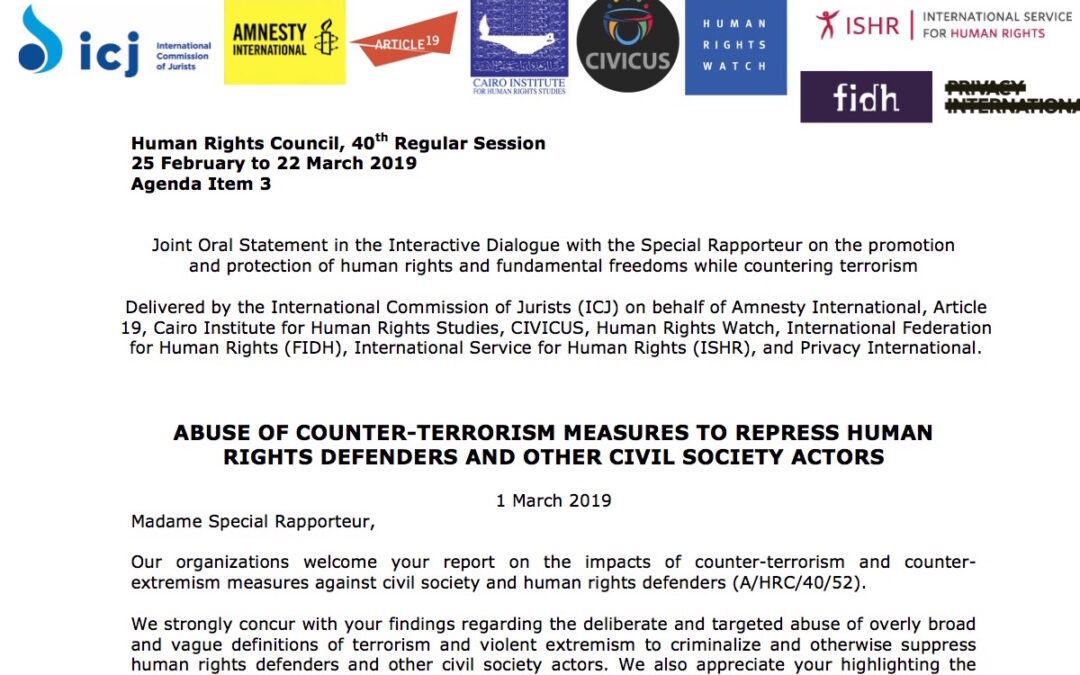
The ICJ today delivered a joint oral statement to the UN Human Rights Council, addressing the abuse of counter-terrorism measures to repress human rights defenders and other civil society actors, and highlighting deep concerns about possible moves to allow Egypt a significant role over the UN’s independent expert on human rights and counter-terrorism.
The statement was delivered in an interactive dialogue with the UN Special Rapporteur on the promotion and protection of human rights and fundamental freedoms while countering terrorism. The ICJ made the statement jointly on behalf of Amnesty International, Article 19, Cairo Institute for Human Rights Studies, CIVICUS, Human Rights Watch, International Federation for Human Rights (FIDH), International Service for Human Rights (ISHR), and Privacy International.
The organisations had earlier sent a joint letter to all States’ delegations to the Council in Geneva, highlighting Egypts appalling record of abuse of counter-terrorism measures, and urging States to strongly oppose any attempts to weaken the mandate of the Special Rapporteur, whether by diluting or distorting it by importing the flawed Egyptian-led approach into the Mexican-led resolution for its renewal, or any moves by longstanding leader Mexico to share co-leadership of the mandate renewal resolution with Egypt or other States with such an appalling record in relation to the very issues the mandate is to address.
The joint oral statement to the Council read as follows (check against delivery):
“Madame Special Rapporteur,
Our organizations welcome your report on the impacts of counter-terrorism and counter-extremism measures against civil society and human rights defenders (A/HRC/40/52).
We strongly concur with your findings regarding the deliberate and targeted abuse of overly broad and vague definitions of terrorism and violent extremism to criminalize and otherwise suppress human rights defenders and other civil society actors. We also appreciate your highlighting the need to prevent indirect impacts on civil society.
Among those States with a particularly appalling record of deliberate and targeted abuse, Egypt, which is mentioned in your report (paras 53 and 56), is a prominent example. As Human Rights Watch recently stated: “Using counterterrorism as a guise to crush all forms of dissent could be Egypt’s hallmark of 2018… There’s simply not much room left to peacefully challenge the government without being detained and unfairly prosecuted as a ‘terrorist’.”[1] Other examples from the reports before the Council include Turkey (para 53), Saudi Arabia (A/HRC/40/52/Add.2 paras 21-29), and China particularly as regards Uyghurs and Kazakhs (paras 55 and 57).
We share your concern about the elements lost from the previous Human Rights Council and General Assembly resolutions on “protection of human rights and fundamental freedoms while countering terrorism” in their March 2018 merger with the deeply flawed Egyptian-led initiative on “effects of terrorism” (para 29). We reiterate our call from March 2018 for future versions of the resolution to address the relevant issues exclusively and comprehensively from the perspective of the effective protection of human rights.[2] We strongly oppose any attempts to dilute your mandate, including by importing the flawed Egyptian-led approach into the resolution for its renewal, or any sharing of co-leadership of the mandate renewal resolution with States that have such an appalling record in relation to the very issues the mandate is to address.
Madame Rapporteur, beyond the particular cases mentioned in your report (para 53), what are your views on the broader situation within Egypt in terms of abuse of counter-terrorism measures and what can States, the United Nations, civil society, and other stakeholders do to stop such abuses in the name of counter-terrorism in Egypt and other egregious situations?
Thank you.
[1] https://www.hrw.org/news/2019/01/17/egypt-new-moves-crush-dissent (17 January 2019). See also among others: Human Rights Watch World Report 2019, https://www.hrw.org/world-report/2019/country-chapters/egypt; EuroMed Rights, Egypt – Finding Scapegoats: Crackdown on Human Rights Defenders and Freedoms in the Name of Counter-terrorism and Security (Feb 2018) https://euromedrights.org/wp-content/uploads/2018/03/EuroMed-Rights-Report-on-Counter-terrorism-and-Human-Rights.pdf; Joint NGO Statement, Egypt: Civil society faces existential threat (23 June 2016) https://www.icj.org/wp-content/uploads/2016/06/Egypt-Advocacy-JointNGOStatement-2016.pdf.
[2] Joint NGO end-of-session statement (23 March 2018) https://www.icj.org/hrc37-endofsession/.”
The statement can be downloaded in PDF format here: HRC40-JointOralStatement-SRCTHR-2019-EN
For more information email un(a)icj.org.
Mar 1, 2019 | News
On 28 February and 1 March, the ICJ met with senior officials of the Myanmar Police Force (MPF) and the Union Attorney General’s Office (UAGO) in Nay Pyi Taw.
The purpose of these talks was to promote the conduct of effective investigations into potentially unlawful deaths and enforced disappearance in accordance with international human rights law and standards, particularly the Minnesota Protocol on the Investigation of Potentially Unlawful Deaths (“Minnesota Protocol”).
Under customary international law, the right to life, and the right to be free from torture and other ill treatment, is not to be restricted even during an armed conflict or declared public emergency. All States are obliged to investigate, prosecute and punish acts that constitute violations of the right to life, and to provide effective remedies and reparations to victims.
Published by the United Nations Office of the High Commissioner for Human Rights, the Minnesota Protocol provides guidance to authorities on investigating acts amounting to human rights violations, including when State actors may have been involved. Drawing upon international law and standards, including in relation to the rights of victims and their families, the Protocol includes detailed guidelines on crime scene investigation, interviews, exhumations and autopsies.
Since December 2017, the ICJ has co-hosted four regional workshops in Thailand focused on this topic. Attendees have included lawyers, academics and State authorities from Thailand, Cambodia, Nepal, India and Myanmar.
Frederick Rawski, Director for Asia and the Pacific, Sean Bain, Legal Adviser, and Ja Seng Ing, Legal Researcher, composed the ICJ delegation in Myanmar’s capital.
Frederick Rawski proposed opportunities to continue these discussions on international standards into investigative procedures and processes. The ICJ Team also provided updates about related activities undertaken regionally and in Myanmar.
The ICJ has worked with the UAGO since 2014 to provide assistance on prosecutorial independence and human rights in the context of Myanmar’s broader democratic and legal reforms. This was the third meeting with the MPF over the last twelve months to discuss the conduct of investigations inline with international human rights law and standards.
Members of UAGO and MPF received copies of the Minnesota Protocol and indicated these would be shared with officials involved in the conduct of investigations or in setting the standards for them under national law in Myanmar.
Feb 28, 2019 | Events, News
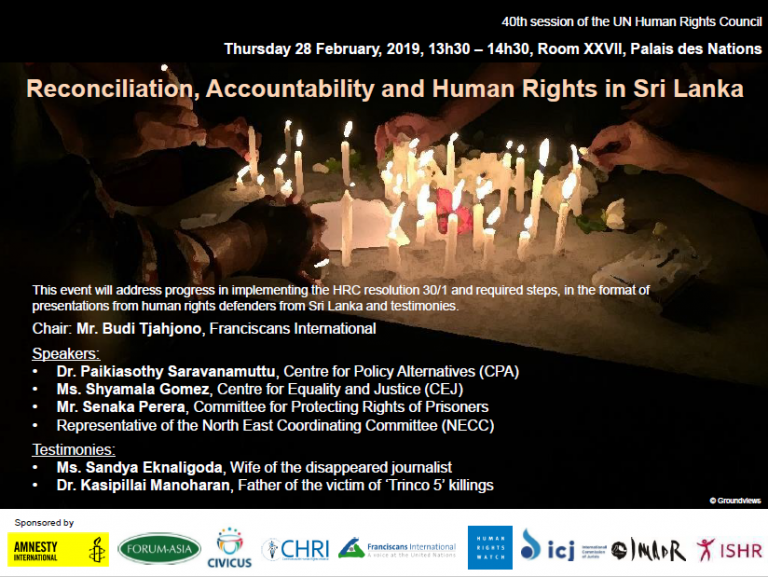
This event will address progress in implementing Human Rights Council resolution 30/1 and required steps, in the format of presentations from human rights defenders from Sri Lanka and testimonies.
Date: Thursday, 28 February 2019
Time: 13.30 – 14.30
Venue: Room XXVII, Palais des Nations
Chair: Mr. Budi Tjahjono, Franciscans International
Speakers:
- Dr. Paikiasothy Saravanamuttu, Centre for Policy Alternatives (CPA)
- Ms. Shyamala Gomez, Centre for Equality and Justice (CEJ)
- Mr. Senaka Perera, Committee for Protecting Rights of Prisoners
- Representative of the North East Coordinating Committee (NECC)
Testimonies:
- Ms. Sandya Eknaligoda, Wife of the disappeared journalist
- Dr. Kasipillai Manoharan, Father of the victim of ‘Trinco 5’ killings
Sponsors:
- Asian Forum for Human Rights and Development (FORUM-ASIA)
- Amnesty International
- CIVICUS
- Commonwealth Human Rights Initiative (CHRI)
- Franciscans International
- Human Rights Watch (HRW)
- International Commission of Jurists (ICJ)
- International Movement Against all forms of Discrimination and Racism (IMADR)
- International Service for Human Rights (ISHR)
Feb 28, 2019 | Advocacy, News
The ICJ made a submission to Mr. Léo Heller, the United Nations Special Rapporteur (Special Rapporteur) on the human rights to water and sanitation, in response to a call for submission in advance of the Special Rapporteur’s 2019 Human Rights Council Report on the human rights to water and sanitation in spheres of life beyond the households, in particular in public spaces.
The ICJ’s submission focuses on the status and the impact of inadequate access to water and sanitation on lesbian, gay, bisexual, transgender and queer individuals (LGBTQ), and more specifically on transgender persons and non-binary persons, in India.
ICJ’s submission draws on its ongoing work on the human rights of LGBTQ persons in India, where from 2017 to date, the ICJ has studied LGBTQ persons’ access to and enjoyment of economic, social, and cultural rights, focusing on access to adequate housing, decent work, and public spaces and services including water and sanitation. The goal is to reveal, address, and reduce discriminatory treatment against LBGTQ persons in accessing economic, social and cultural rights as a result of discriminatory laws and practice through advocacy with the Indian State and with the United Nations.
Read the full submission here.