Oct 24, 2018 | News
The three finalists who will compete for this prestigious award given to human rights defenders having shown deep commitment and facing great personal risk are: Eren Keskin (Turkey), Marino Córdoba Berrio (Colombia) and Abdul Aziz Muhamat (Papua New Guinea/Australia). The ICJ is member of the MEA Jury.
The finalists were selected by the International Human Rights Community (members of the jury are the ICJ, Amnesty International, Human Rights Watch, Human Rights First, International Federation for Human Rights, World Organisation Against Torture, Front Line Defenders, EWDE Germany, International Service for Human Rights and HURIDOCS).
Nominees and laureates of the Martin Ennals Award for Human Rights Defenders (MEA) are human rights defenders that have demonstrated a deep commitment to human rights, often working under threat of imprisonment, torture, or worse.
The international recognition provided by the Award, on top of raising their profile and their work, often provides significant protection.
The 2019 Martin Ennals Award will be presented on 13 February 2019 at a ceremony hosted by the City of Geneva, which for many years has strongly supported the Award.
Eren Keskin (Turkey)
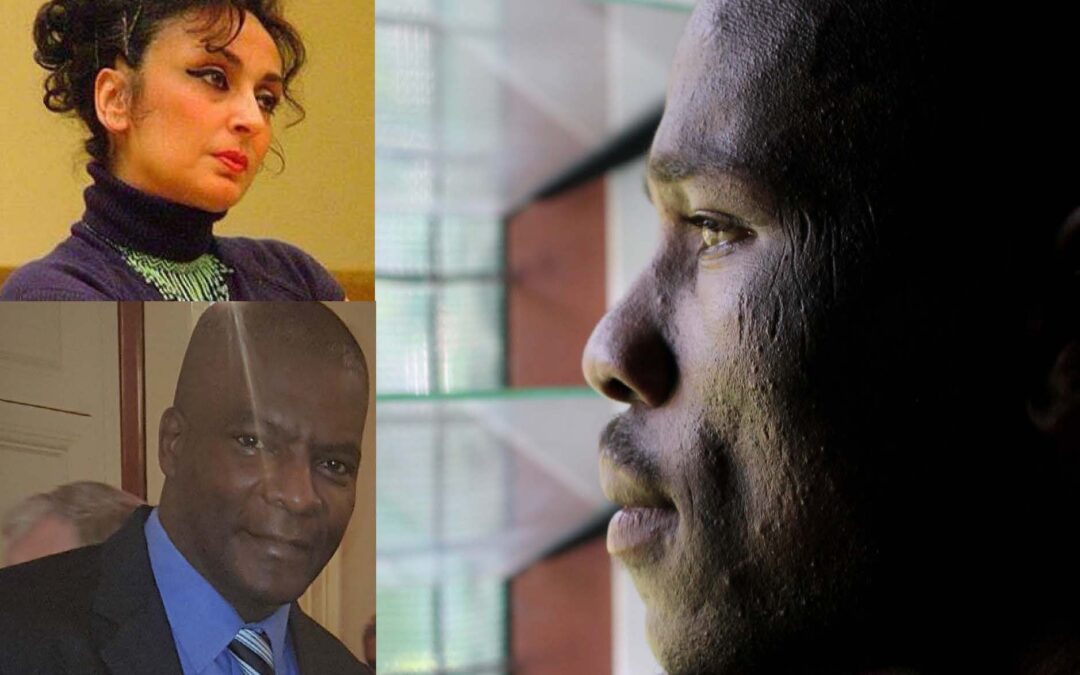
Eren Keskin (upper left corner of the picture) is a lawyer and human rights activist.
For more than thirty years, she has struggled for fundamental rights and freedoms in Turkey, especially for the Kurds, women and the LGBTI+ community.
Within the context of the worsening human rights situation in Turkey, Keskin is once again at the centre of intimidation attempts.
As part of a solidarity campaign to support the Özgür Gündem newspaper, Keskin held the title of “editor-in-chief” of the newspaper from 2013 to 2016, when it was closed by the authorities.
On 30 March 2018, she was convicted and sentenced to 12.5 years in jail for having published articles deemed to have “degraded” the Turkish nation and “insulted” the Turkish president.
She is currently free while the case is appealed.
She said: “To defend human rights is not easy in our territory. I am being prosecuted with 143 charges for my solidarity with an opposition newspaper in the context of freedom of expression. International awards and solidarity have “protective” characteristics and reassure those of us in repressive societies. It also it gives us a morale boost and helps our motivation for the struggle. Thank you for not forgetting us. Your solidarity and protection mean so much.”
Marino Córdoba Berrio (Colombia)
A member of the Afro-Colombian ethnic group, Marino Córdoba Berrio (bottom left corner of the picture) led his community as they faced the loss of their land to powerful commercial interests, notably in logging and mining.
After successfully working towards the legal recognition of their community’s land rights, much of his community was driven out by force in 1996.
Constant threats and attacks drove him to seek asylum in the United States in 2002 where he built a network of supporters.
He returned to Colombia in 2012 and worked to ensure a role for ethnic communities in the peace agreement, notably as a member of “Ethnic Commission for Peace and the Defense of Territorial Rights ” that provides input as the peace agreement is implemented.
He has regularly received death threats and is under constant armed guard.
He said: “We have historically been excluded politically, socially and economically, also affected by war, providing measures of overcoming is a primary responsibility of the State. I believe in the power of my mind and my hands as a determinant to do what is right, therefore the justice that is applied to my people is crucial for their survival. It is also in our hands to promote those changes so this effort involves exposing my own life.”
Abdul Aziz Muhamat (Papua New Guinea/Australia)
Abdul Aziz Muhamat (Aziz, on the right-hand side of the picture), from Sudan, is a compelling and tireless advocate for refugee rights.
Seeking asylum, he has been held in Australian immigration detention on Manus Island, Papua New Guinea since October 2013, when his boat was intercepted by the Australian authorities.
Aziz has seen friends die. He has been shot at by local police. He was also sent to a local prison for refusing to eat in protest at the cruelty and suffering being inflicted on others.
Aziz is one of the primary public voices among the men held on Manus Island. Despite the isolated location, he has exposed the harsh conditions there through podcasts and media interviews.
He has paid a price for this as he is seen as a “ring leader” by both the PNG and Australian authorities.
He stated: “My work to expose this cruel system helps preserve my self-respect and inherent human dignity. It helps me fight for the rights of every refugee around the universe, which I’ll do until my last breath. It is not always easy when living under conditions of fear and persecution. Yet even under the most crushing state machinery, courage rises up again and again, for fear is not the natural state and I will do everything to keep going.”
Contact
Olivier van Bogaert, Director Media & Communications, ICJ representative in the MEA Jury, t: +41 22 979 38 08 ; e: olivier.vanbogaert(a)icj.org
Michael Khambatta, Director, Martin Ennals Foundation, t: +41 79 474 8208 ; e: khambatta(a)martinennalsaward.org
TUR-Eren Keskin_Bio-News-2018-ENG (Eren Keskin full bio in PDF)
COL-Marino Cordoba Bio-News-2018-ENG (Marino Córdoba Berrio full bio in PDF)
AUS-Abdul Aziz Muhamat Bio-News-2018-ENG (Abdul Aziz Muhamat full bio in PDF)
Oct 21, 2018 | News
On 21 October, the ICJ, together with Cross Cultural Foundation (CrCF), organized a lawyers’ meeting in Bangkok on the admissibility of evidence in the context of application of special security laws in Thailand.
Attendees included 30 human rights lawyers, paralegal officers, documentation officers, human rights defenders and journalists from Bangkok and other regions in Thailand.
The objectives of the meeting were:
- To discuss about the challenges that lawyers currently face regarding the admissibility of evidence in criminal proceedings, both in law and in practice, in the context of existing special security laws. These laws include the Martial Law, Emergency Decree, and the Internal Security Act that are applied in the southern border provinces, and certain repressive National Council for Peace and Order (NCPO) Orders that are applied nationwide;
- To discuss how to address the adverse effects on human rights and the administration of justice as a consequence of the implementation of these laws and how lawyers, members of civil society, and other stakeholders, at national and international levels, may work together to address such challenges; and
- To gather recommendations from participants and discuss future advocacy strategies to tackle identified challenges.
The ICJ’s Legal Memorandum on Hearsay Evidence and International Fair Trial Standards was used as one of the main reference materials during the meeting.
A main recommendation of the Workshop, echoed the ICJ’s assessment in the Legal Memorandum, namely that Thailand should review existing standards in all special security laws and relevant articles in the Criminal Procedure Code regarding the admissibility of evidence that are not compatible with international fair trial standards to ensure safeguards required to protect individuals from unfair trials.
Read also
Thailand : legal memorandum – hearsay evidence and international fair trial standards
Oct 14, 2018 | News
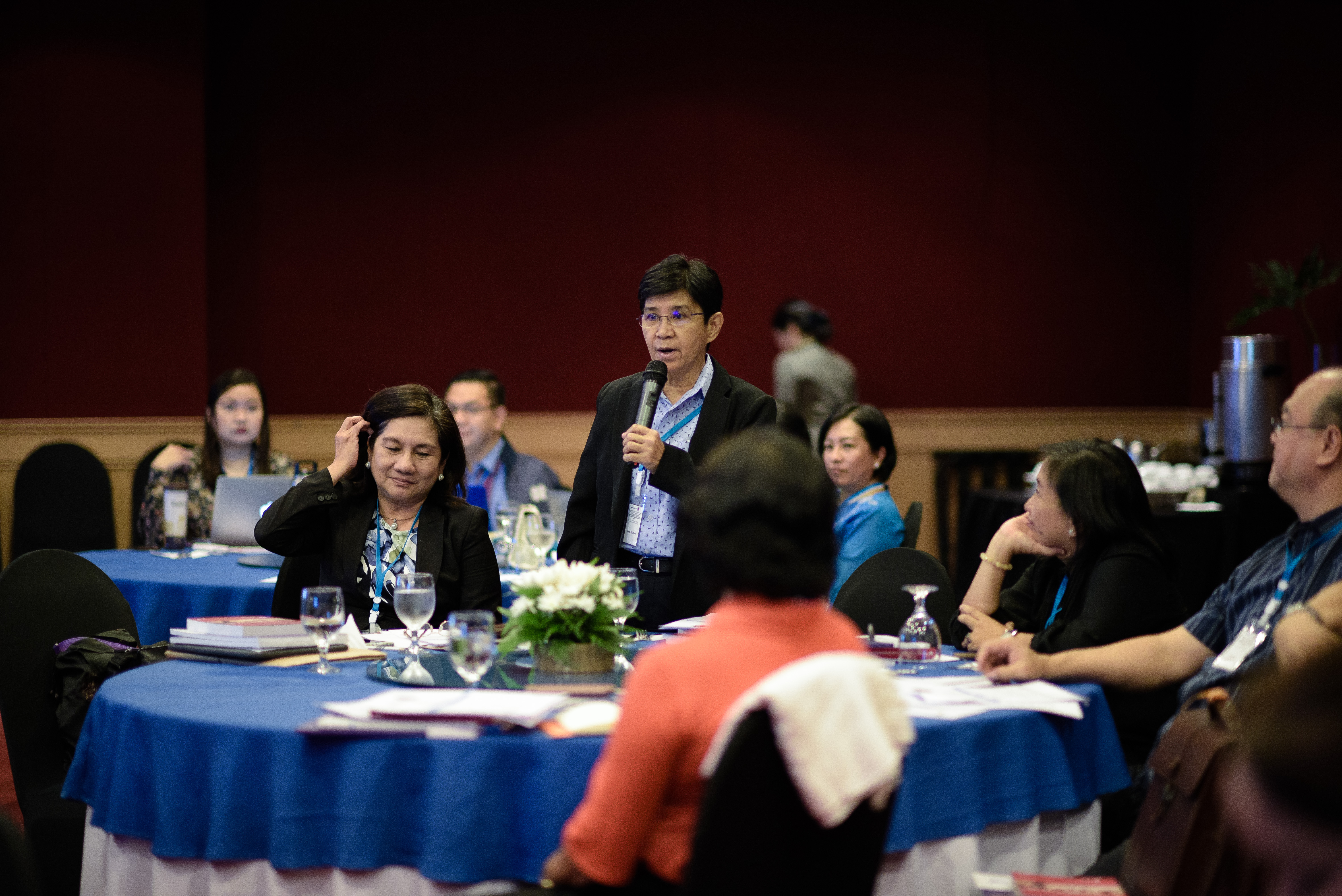
From 12 to 13 October 2018, the ICJ and the Integrated Bar of the Philippines (IBP) held its second national workshop on eliminating gender discriminatory attitudes and behaviours towards women.
Participants at the workshop were members of IBP’s Board of Governors and Committee on Bar Discipline. The workshop was held in Cebu City, Philippines.
Emerlynne Gil, ICJ’s Senior International Legal Adviser opened the workshop by emphasizing that it is crucial for lawyers of all areas of expertise to engage in dialogues such as this in order to further enhance women’s access to justice.
Gil pointed out that gender stereotypes incorporated in laws and perpetuated in the administration of justice impair the capacity of women to exercise their right to access to justice.
She emphasized that lawyers, as frontline formal justice actors, play a key role in eliminating these stereotypes.
Marienne Ibadlit, IBP’s Governor for Western Visayas, spoke about the establishment of the Gender and Development (GAD) Committee as a standing committee of the IBP.
The establishment of the GAD Committee is expected to advance gender and women’s human rights within the IBP.
It is also expected to institutionalize within the IBP efforts to build the capacity of lawyers in the Philippines to assist women in accessing justice.
The participants recognized during the opening session that recourse to gender stereotypes in the practice of law and administration of justice is widespread in the Philippines and that gender stereotypes directly impact women’s access to justice.
A range of stereotypes were identified, including the idea of women being the ‘weaker sex’ and the perception that female lawyers are not suited for litigation of controversial political or criminal cases.
During the workshop, participants discussed how they could maximize their role as lawyers in facilitating women’s access to justice, specifically in the areas of domestic violence, sexual violence, family law, and employment law.
Some of the participants noted that they themselves had been influenced by gender stereotypes and committed to be more consciously gender sensitive in their work and personal life.
While acknowledging that much more must be done to bring about systematic change, it was agreed that incremental measures could be impactful.
Abdiel Dan Fajardo, National President of the IBP, expressed support for more action by lawyers in the Philippines on women’s human rights.
Both the ICJ and IBP reinforced their commitment to joint collaboration in furthering the advancements in women’s access to justice in the country.
Contact
Emerlynne Gil, Senior International Legal Adviser for Southeast Asia, t: +662 619 8477 (ext. 206) ; e: emerlynne.gil(a)icj.org
Oct 8, 2018
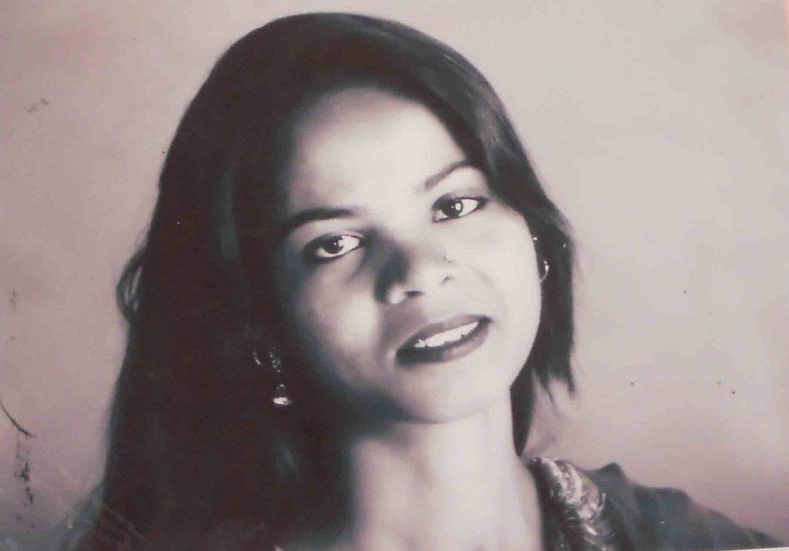
An opinion piece by Reema Omer, Legal Adviser, ICJ South Asia Programme
A special bench of the Supreme Court of Pakistan, headed by the Chief Justice, is scheduled to hear Asia bibi’s appeal against her conviction and death sentence under section 295-C of the Pakistan Penal Code (PPC) today.
Even if the Supreme Court now goes on to acquit Asia bibi, she has already spent eight years in prison, mostly on death row; Salman Taseer and Shahbaz Bhatti have lost their lives advocating for her release; and her family has been subjected to continuous threats and harassment, solely because of their relationship with someone accused of blasphemy.
This is the truth of how the blasphemy law operates in Pakistan – the accused has to suffer prolonged periods of pretrial detention, which in many cases is followed by years on death row before their appeals are decided.
Additionally, lawyers and judges in blasphemy cases live in a climate of fear and face very real threats of violence.
This results in a denial of the accused’s right to an effective defence and to a fair trial before an independent, impartial judiciary – which is now recognized as a fundamental right in Pakistan’s Constitution.
Asia bibi’s trial is particularly illustrative of these flaws.
The allegations against her are that she made three “defamatory and sarcastic” statements about the Prophet Muhammad (Peace Be Upon Him) on June 14, 2009, during an argument with three Muslim women while the four of them were picking fruit in a field.
The prosecution also claims Asia bibi “admitted” making these statements at a “public gathering” on June 29, 2009, and asked for forgiveness.
In her defence, Asia bibi stated she had a “quarrel” with Mafia and Asma in 2009, following their refusal to drink water brought for them by Asia bibi because she was Christian.
She claimed “some hot words were exchanged” during the argument, after which Mafia and Asma, alongside Qari Muhammad Salaam and his wife (who taught Asma and Mafia the Quran), fabricated the blasphemy case against her.
Asia bibi also stated that she had “great respect and honour for the Holy Prophet Muhammad (Peace Be Upon Him) and the Holy Quran” and never made the alleged blasphemous remarks.
A trial court convicted Asia bibi for blasphemy in November 2010 and sentenced her to death. The Lahore High Court upheld her conviction and confirmed her death sentence in October 2014. The Supreme Court admitted her appeal in July 2015.
The first hearing of the appeal before the Supreme Court was scheduled to take place on October 13, 2016, but one of the judges recused himself from the bench on the day of the hearing, citing “conflict of interest”.
The trial court’s, as well as Lahore High Court’s judgments, contain a number of flaws.
For example, in its judgment on Asia bibi’s appeal, the LHC conceded that “the defence has not defended its case with the required seriousness…” Yet, despite acknowledging possible violations of the right of a fair trial, particularly the right to an adequate defence, the Court went on to uphold Asia bibi’s conviction and death sentence.
Further, the trial court used Asia bibi’s statement against her as an admission of guilt, finding that the “hot words” exchanged between her and “the Muslim ladies” were “switched into a religious matter”, and concluding that the “hot words” must have been “nothing other than the blasphemy”.
Curiously, however, the trial court rejected the possibility that the altercation over water could be a motive for the prosecution eyewitnesses to falsely implicate Asia bibi for blasphemy, which was Asia bibi’s defence.
The Lahore High Court too did not probe further into Asia bibi’s statement and held that there was no possible “ill will” between the eyewitnesses and the accused for them to fabricate the blasphemy allegations.
Both courts also disregarded discrepancies in the accounts of the witnesses regarding the “public gathering” where Asia bibi allegedly “admitted” her guilt.
These discrepancies included significant differences in the number of people allegedly present at the “public gathering” (ranging from 100 to 2,000 in the different testimonies); how Asia bibi was brought to the “public hearing”, and how long the “hearing” lasted.
The courts also failed to apply “tazkia-tul-shahood” (inquiry undertaken by the court to establish the credibility of witnesses), without which defendants cannot be convicted or punished in hadh (capital punishment) cases for certain offences under Pakistani law.
During the entire course of the proceedings, neither court considered which of the three statements attributed to Asia bibi were “blasphemous” and why, or what was the “reasonable person” standard in the interpretation of section 295-C to meet the threshold of blasphemy.
Additionally, both courts did not consider whether Asia bibi possessed the requisite criminal intent to commit the crime of blasphemy, despite the Federal Shariat Court’s ruling that blasphemy is an “intentional or reckless wrong”.
The prosecution’s failure to prove all elements of the offence, including the requisite intent to defame the Prophet Muhammad (Peace Be Upon Him), calls into question the convictions by the trial court and the Lahore High Court.
In another case, the Supreme Court held that individuals accused of blasphemy “suffer beyond proportion or repair” in the absence of adequate safeguards against misapplication or misuse of such blasphemy laws.
This includes the long periods of time the accused spend in detention, in some cases with the threat of execution hanging over their heads, and the impact this has on their lives, their families, their professions, and their mental and physical well-being.
Confirming the Supreme Court’s findings, a 2015 study by the ICJ on the implementation of blasphemy laws in Pakistan found that more than 80 per cent of convictions by trial courts are overturned on appeal, very often because appellate courts find evidence and complaints fabricated based on “personal or political vendettas.”
A number of proposals to check against the misuse of blasphemy laws have been pending before Parliament, but given the sensitivities around the issue, they have not come to fruition.
Blasphemy laws have remained a hugely sensitive issue in Pakistan.
Today, all eyes are on the Supreme Court to see if it will decide Asia bibi’s appeal expeditiously, fairly and impartially and whether it will try to clean up some of the manifest injustices of the blasphemy law and how it’s being applied today.
Oct 5, 2018 | News
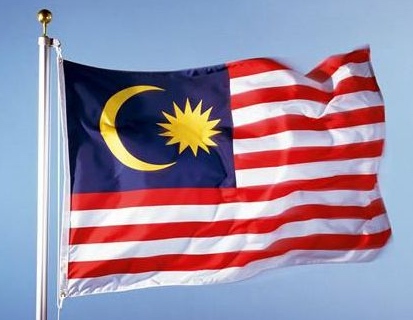
The proposal to implement caning on those found guilty of corruption would directly violate the absolute prohibition of torture and other cruel, inhuman or degrading punishment under international law, said the ICJ today.
The Malaysian Anti-Corruption Commission (MACC) called on the Government of Malaysia last week to consider caning as a punishment for those convicted of corruption to underline the efforts of eliminating corruption in the country.
Malaysia currently implements caning in a wide range of offences, including the Immigration Act 1959/63, the Penal Code (rape, criminal breach of trust), and the Dangerous Drugs Act 1952.
At present, under the Malaysian Anti-Corruption Commission (MACC) Act 2009, the punishment for those found guilty of bribery is payment of a fine and imprisonment for up to twenty (20) years.
“Malaysia must immediately and completely abolish caning as a form of punishment. The proposals to implement caning for those found guilty of corruption, bribery, or any other offence is a significant setback for the country.
If this proposal is implemented, it will violate Malaysia’s obligations to prevent, prohibit and prosecute all forms of torture and other cruel, inhuman or degrading treatment or punishment, as.” said Emerlynne Gil, ICJ’s Senior International Legal Adviser.
After Malaysia’s historic election results on 9 May 2018 and the corruption charges levied against its former Prime Minister, Najib Razak, it would be superficial for Malaysia to view the implementation of severe punishments for the crime of corruption as the panacea to the deeply-rooted culture of corruption among those that have held public office and state authorities.
The ICJ also emphasizes that all forms of torture and other cruel, inhuman or degrading treatment are absolutely prohibited by customary international law, as well as international treaties binding on Malaysia, including the Convention on the Rights of the Child (CRC), the Convention on the Elimination of All Forms of Discrimination Against Women and the Convention on the Rights of Persons with Disabilities (CRPD).
The UN Special Rapporteur on Torture has stated that “any form of corporal punishment is contrary to the prohibition of torture and other cruel, inhuman or degrading treatment or punishment.” It cannot be considered a “lawful sanction” under international law.
The ICJ urges the Government of Malaysia to abandon any proposal to implement caning as a form of punishment for any crime. The ICJ also calls on the Government of Malaysia to immediately abolish the practice of caning as it constitutes a form of cruel, inhuman or degrading punishment prohibited under international human rights law and standards.
Contact:
Emerlynne Gil, Senior International Legal Advisor, International Commission of Jurists,
mobile: +66 840923575, email: emerlynne.gil@icj.org
Background:
At a press conference on 1 October 2018, Malaysia’s Anti-Corruption Commission’s Chief Commissioner Datuk Seri Mohamad Shukri Abdul had proposed that the Malaysian government consider implementing caning for bribery offenders.
Section 288 of the Criminal Procedure Code states the mode of executing the sentence of ‘whipping’, in Section 288(3) it defines the ‘Rattan used for whipping shall not be more than half of an inch in diameter’ (the word caning is not mentioned), while Section 289 of the Criminal Procedure Code states that the sentence of whipping is forbidden in the case of ‘females’, males sentenced to death and males whom the Court considers to be more than fifty years of age, except males sentenced to whipping under Section 376, 377, 377CA or 377E of the Penal Code.