Jul 26, 2018 | News, Op-eds
An opinion piece by Kingsley Abbott, ICJ Senior Legal Adviser in Bangkok, Thailand.
Over recent decades, international observers have tended to view the human rights and political situation in Cambodia as a series of predictable cycles that does not warrant too much alarm.
The conventional wisdom has been that Prime Minister Hun Sen and his government routinely tightens their grip on the political opposition and civil society in advance of elections before relaxing it again after victory has been secured.
But that analysis is no longer valid.
The reason is simple: During the course of ensuring it will win the national election scheduled for this Sunday (29 July), Hun Sen’s ruling Cambodian People’s Party (CPP) has, since the last election, systematically altered the country’s constitutional and legal framework – and these changes will remain in place after the election has passed.
Through the passage of a slew of new laws and legal amendments inconsistent with Cambodia’s obligations under international law, and the frequent implementation of the law to violate human rights, the legal system has been weaponized to overwhelm and defeat the real and perceived opponents of the CPP, including the political opposition, the media, civil society, human rights defenders and ordinary citizens.
This misuse of the law is a significant development in the history of modern Cambodia and represents a determined move away from the vision enshrined in the historic 1991 Paris Peace Agreements that ended years of conflict and sought to establish a peaceful and democratic Cambodia founded on respect for human rights and the rule of law.
And it risks cementing the human rights and rule of law crisis that now exists within Cambodia for years to come.
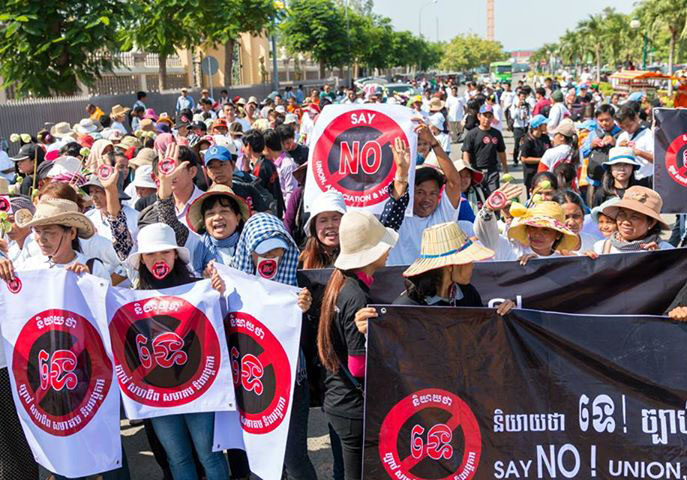
To facilitate the closure of civil society space, and contrary to international law and standards, in 2015 the Law on Associations and Non-Governmental Organizations (LANGO) was passed, which requires the mandatory registration of all NGOs and Associations, provides the government with arbitrary powers to deny or revoke registration, and places a vaguely worded duty on NGOs and associations to “maintain their neutrality towards political parties”.
The biggest blow to the political opposition has been the amendment last year of the Law on Political Parties (1997), amended twice within four months, which empowers the Supreme Court to dissolve parties, and four election laws, which permits the redistribution of a dissolved party’s seats in the country’s senate, national assembly, and commune and district councils.
Last November, the Supreme Court, presided over by a high-ranking member of the CPP, used the amended Law on Political Parties to dissolve the main opposition party, the Cambodia National Rescue Party (CNRP), which had received just under 44% of the vote – or about 3 million votes – in communal elections held in June 2017.
After the CNRP’s dissolution, the amended election laws were then used to redistribute CNRP seats at every level of government, from the commune to the senate, to the CPP and minor parties.
To silence the media, the country’s media and taxation laws have been invoked – local radio stations have been ordered to stop broadcasting Radio Free Asia and Voice of America “in order to uphold the law on media” and the independent Cambodia Daily was forced to close after being presented with a disputed US $6.3 million tax bill which the Daily claimed was “politically motivated” and not accompanied by a proper audit or good faith negotiations.
To curb the exercise of freedom of expression, the Constitution has received vaguely worded amendments placing an obligation on Cambodian citizens to “primarily uphold the national interest” while prohibiting them from “conducting any activities which either directly or indirectly affect the interests of the Kingdom of Cambodia and of Khmer Citizens”.
Meanwhile individual journalists, members of the political opposition including the CNRP’s leader, Kem Sokha, human rights defenders and an Australian documentary filmmaker have been charged with any number of a kaleidoscope of crimes ranging from intentional violence and criminal defamation to treason and espionage.
And Cambodia lacks an independent and impartial judiciary.
In 2014, three “judicial reform laws” were passed which institutionalized the prosecution and judiciary’s lack of independence from the executive.
At the same time, the government perversely uses the doctrine of the “rule of law” to justify its actions.
Just hours after the Supreme Court dissolved the CNRP, Hun Sen announced that the decision was made “in accordance with the rule of law.”
When members of the diplomatic community and senior UN officials meet government officials to express concern at the increasing misuse of the law they receive an absurdist legal lecture on the “importance of the rule of law”.
What is happening in Cambodia is the opposite of that.
The International Commission of Jurists, UN authorities and others have been defining the rule of law since the Universal Declaration of Human Rights was pronounced in 1948.
All agree that that the rule of law entails passing and implementing laws consistent with a country’s international human rights obligations.
It is time for the international community to recognize that a frank and fresh analysis of the situation in Cambodia is urgently required which acknowledges the way the country’s underlying legal and constitutional framework has been deliberately altered, and the way in which this will impact the country adversely long past this month’s election.
This acknowledgment must be accompanied by a coherent and, where possible, joint, plan of action that clearly sets out, with a timeline, what is required to bring Cambodia back on track with the agreed terms of the Paris Peace Agreements – including necessary legal and justice sector reforms – and the political and economic consequences for not doing so.
As long as Hun Sen’s Government deploys increasingly sophisticated justifications for its repressive actions, a more refined, multilayered and vigorous response from the international community is required – grounded on a proper application of the rule of law and Cambodia’s international human rights obligations.
Jul 26, 2018 | News
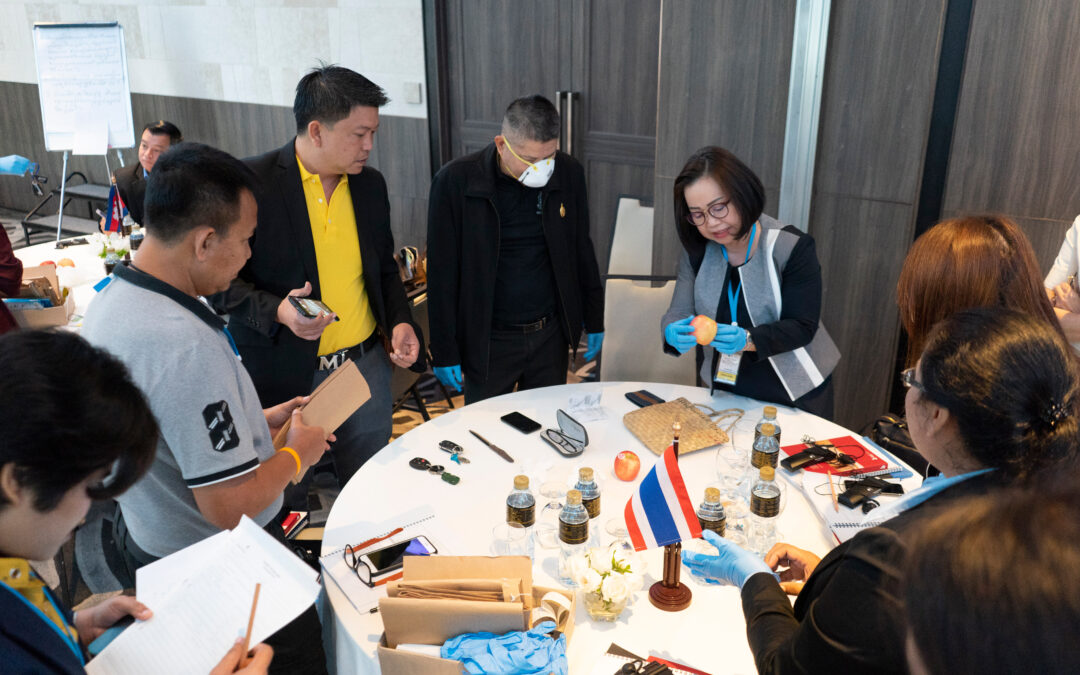
From 24 to 26 July 2018, the ICJ co-hosted a workshop for authorities from Thailand, Cambodia, and Myanmar.
The theme of the workshop was on conducting investigations of potentially unlawful deaths and enforced disappearance in accordance with international human rights law and standards.
The workshop was co-hosted with Thailand’s Ministry of Justice, the United Nations Office of the High Commissioner for Human Rights (OHCHR) and the New Zealand Embassy in Bangkok.
The participants included 25 criminal investigators, public prosecutors and representatives of the Cambodian Ministry of Justice and the Thai Ministry of Justice.
The event commenced with opening remarks by James Andersen, Deputy Head of Mission, Embassy of New Zealand in Bangkok; Aim-orn Siangyai, Deputy Director General of Thailand’s Rights and Liberties Protection Department, Ministry of Justice; Frederick Rawski, Asia Pacific Regional Director, ICJ; and Shivani Verma, Human Rights Officer, OHCHR Regional Office for South-East Asia.
Kingsley Abbott, Senior Legal Adviser at the ICJ, gave a summary of the international human rights legal framework that applies to the investigation of unlawful deaths and enforced disappearance.
He then provided an outline of the revised Minnesota Protocol on the Investigation of Potentially Unlawful Death (2016), which was launched in Thailand on 25 May 2017 and which formed the core of the materials used at the workshop.
Other speakers included Glenn Williams, Detective Inspector, Field Crime Manager, New Zealand Police National Headquarters, who addressed the investigation process including crime scene management; Sean Buckley, International Investigator, who addressed witness interviews; Shivani Verma of the Office of the High Commissioner for Human Rights who addressed Witness Protection; and Dr. Pornthip Rojanasunan, Adviser of Thailand’s Central Institute of Forensic Science (CIFS), who addressed the issue of forensic pathology.
This workshop followed three workshops the ICJ co-hosted between 5 to 8 December 2017 and 30 May to 1 June 2018 in Thailand on the investigation of potentially unlawful deaths and enforced disappearance for lawyers from Thailand and India, academics and State authorities from Thailand, Cambodia, Myanmar and Nepal.
Contact
Kingsley Abbott, Senior International Legal Adviser, ICJ Asia Pacific Regional Office, t: +66 94 470 1345, e: kingsley.abbott(a)icj.org
Jul 24, 2018 | Events, News
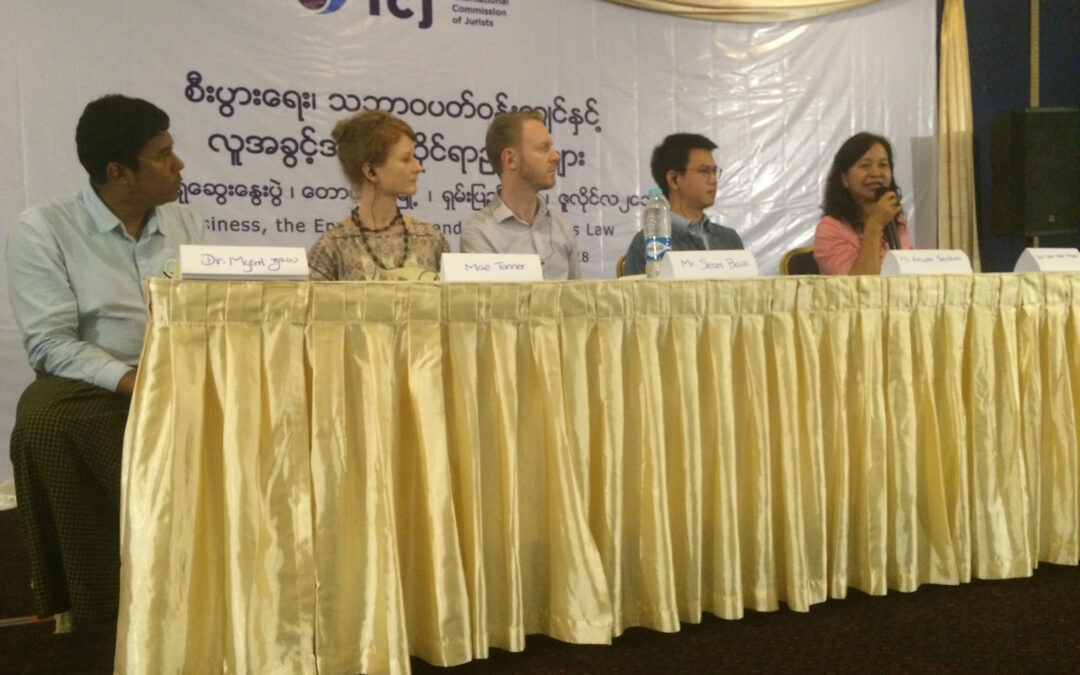
On 22 and 23 July the ICJ convened a workshop on Business, the Environment and Human Rights Law in Taunggyi, the capital of Myanmar’s Shan State.
This followed meetings between the ICJ’s legal advisers and the Shan State High Court and also with the State Advocate General on 13 July, to discuss rule of law developments.
The workshop aimed to identify ways to address the impacts of business activities on human rights and the environment, through legal advocacy including strategic litigation, and to provide a forum for cooperation and experience sharing among participants.
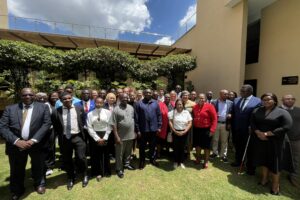
More than 50 lawyers, parliamentarians, human rights defenders and civil society representatives attended from Shan, Kayah and Mon states – provinces that together border Thailand, Laos and China.
An overview of the investment context was provided by Dr Myint Zaw of Paung Ku Myanmar, who also shared lessons from environmental activism in Myanmar.
As well as highlighting weaknesses in domestic law and policy, he presented concerns around lack of transparency and information sharing between the legislature and executive branches of government.
Australian lawyer and ICJ consultant Mae Tanner gave an overview of international human rights law and standards relevant to business activities and environmental protection, particularly emphasizing the obligations assumed by Myanmar in ratifying the International Covenant on Economic, Social and Cultural Rights.
She offered insights as to how UN mechanisms can be used by civil society to advance their advocacy on business and human rights in Myanmar.
Senior Advocate U Myint Thwin drew on his extensive litigation experience to share perspectives on the complex and confusing array of land laws in Myanmar and emphasized the importance of legal knowledge and training to combat corruption and achieve accountability.
The ICJ’s legal adviser Mr Sean Bain outlined the domestic laws relevant to investment and environmental protection in Myanmar and highlighted some key provisions that offer protection against human rights violations and abuses.
He noted the government’s stated aim of promoting the rule of law in Myanmar and emphasized the importance of demanding accountability, transparency and justice in this context.
Amarin Saichan, lawyer with Thai NGO EnLAW, shared experiences of pursuing strategic litigation to address unlawful and harmful business activities in Thailand, stressing the need for creativity in using the law to seek justice and accountability.
He also raised concerns around the use by government of strategic litigation against public participation in Thailand and explained how Thai lawyers are using the courts to guarantee the right protest against harmful development projects.
Participants had the opportunity to discuss how the strategies they shared could be used in the context of issues faced by their communities.
These included human rights and environmental concerns raised by energy and extractive projects, restrictions on shifting agriculture, and violations of the right to freedom of expression and assembly faced by communities who oppose state-backed developments.
They considered advocacy strategies for four case studies selected by participants from across Shan, Kayah and Mon states.
Throughout the workshop speakers and participants highlighted the importance of cooperation between civil society and lawyers, and the need to use Myanmar’s legal system more proactively as part of their broader advocacy strategies.
This workshop is part of the ICJ’s ongoing support to lawyers and civil society in Myanmar.
Jul 24, 2018 | Advocacy, Open letters
The ICJ has submitted recommendations to Thailand’s Criminal Justice Reform Committee concerning the Draft Amending Criminal Procedure Code Act and the Draft Act On Judicial Process Timeframe, which were scheduled for public consultation today.
The ICJ welcomed the Criminal Justice Reform Committee’s efforts to enhance the effectiveness and fairness of the criminal justice system in Thailand, through proposed amendments to Thailand’s Criminal Procedure Code B.E. 2551 (2008) and the Judicial Process Timeframe Act.
The ICJ noted, however, that modifications would be necessary to some of these amendments to ensure they optimally served the ends of justice and were in conformity with international standards.
In particular, the ICJ commended the Committee’s inclusion within the Draft Amending Criminal Procedure Code Act of the following provisions and made recommendations as to how these provisions could be further strengthened:
- Section 13/1. Video and audio recordings of arrests and/or searches
- Section 13/2. Prohibitions against violation of the presumption of innocence
- Sections 121/2, 123 and 124/2. Lodging of criminal complaint with the public prosecutor, at any location and through email or other online medium
- Section 136. Video and audio recordings of inquiry or interrogation
- Section 161/1. Right of the court to dismiss a case where it is filed in bad faith or with misrepresentation of facts in order to harass or take advantage of a defendant
- Section 165/1. Allowing the defendant to submit a defence plea and produce supporting evidence in court
- Section 179/1. Trial in absentia
Contact
Kingsley Abbott, ICJ Senior Legal Adviser, e: kingsley.abbott(a)icj.org
Full letter in English (PDF): Thailand-CPC-Amendments-Advocacy-Open-letters-2018-ENG
Full letter in Thai (PDF): Thailand-CPC-Amendments-Advocacy-Open-letters-2018-THA.pdf

Jul 20, 2018
Supreme Court’s reconsideration of Section 377’s constitutionality is a watershed opportunity to uphold the rights to freedom and equality of every LGBT person, the ICJ said today.
As India’s Supreme Court concludes a week of hearings on the constitutionality of Section 377 of the Indian Penal Code, the ICJ expressed hope that the Court will take the opportunity to invalidate the provision, and take a further step toward the recognition and protection of the full breadth of human rights of LGBT individuals.
In a Briefing Paper issued today by the ICJ on Navtej Singh Johar et al v. Union of India and Others the ICJ further urged the Indian Parliament to repeal the provision entirely.
The Section 377, in effect, criminalizes not a sexual act, but the identity of every LGBT person in India.
The importance of this case emerges from the recognition in international law and in India’s constitutional law that every human being has a right to be free and equal, regardless of one’s real or imputed sexual orientation, gender identity, and expression
The Court has heard arguments in Navtej Singh Johar et al v. Union of India and Others, in which it will reconsider its decision in Suresh Kumar Koushal that upheld the constitutional validity of Section 377, which criminalizes consensual same-sex relations.
The petitioners have argued that the existence of Section 377 deprives them of a number of rights and that the provision is vague, excessive, arbitrary and unreasonable.
“A ruling that Section 377 is unconstitutional would be truly momentous from a human rights perspective,” said Frederick Rawski, ICJ Asia-Pacific Director.
“Such a ruling would not only have impact in India, but would have transnational value, especially across other common law countries, and will provide an impetus to other countries to critically consider the lawfulness of similar provisions that criminalize consensual sexual relations, as being per se contrary to human rights,” he added.
On its face, and in its unjust and arbitrary application, Section 377 is incompatible with India’s international human rights law obligations.
In its 2017 report Unnatural Offences: Obstacles to Justice in India Based on Sexual Orientation and Gender Identity, the ICJ documented how the Indian justice system discriminated against people based on sexual orientation and gender identity, and documented the challenges queer persons face trying to access justice. In the report, it called for the repeal of Section 377.
Under international law, discrimination on the grounds of sexual orientation and/or gender identity is strictly prohibited.
As set out by the Office of the UN High Commissioner of the Human Rights (Born Free and Equal: Sexual Orientation and Gender Identity in International Human Rights Law, OHCHR, 2012), States have five core international human rights law obligations to protect LGBTI rights:
(1) protecting individuals from homophobic and trans-phobic violence; (2) preventing torture and cruel, inhuman, and degrading treatment of LGBTI persons; (3) decriminalizing homosexuality; (4) prohibiting discrimination based on sexual orientation and gender identity; and (5) respecting the freedom of expression, association and peaceful assembly of LGBTI persons. Section 377 violates them all.
“It is encouraging to note the increasing import of international human rights standards, including the Yogyakarta Principles, in relation to sexual orientation and gender identity, in Indian Courts’ jurisprudence,” said Rawski, noting the landmark cases of Naz Foundation v. Government of NCT of Delhi and Others, and National Legal Services Authority v. Union Of India and Others, which cited the Yogyakarta Principles.
The Yogyakarta Principles were also relied upon by petitioners in Navtej Singh Johar et al v. Union of India and Others.
Contact
Maitreyi Gupta (Delhi), ICJ International Legal Advisor for India, e: maitreyi.gupta(a)icj.org, t: +91 7756028369
Read also
ICJ Practitioners’ Guide No. 4: Sexual Orientation, Gender Identity and International Human Rights Law which provides legal practitioners, activists and policy-makers with detailed and practical references on international standards on sexual orientation, gender identity, gender expression, and sexual characteristics.
ICJ Comparative Law Casebook: Sexual Orientation, Gender Identity, and Justice: A Comparative Law Casebook, which provides legal practitioners, activists and policy-makers a compilation of cases and analyses on sexual orientation, gender identity, gender expression, and sexual characteristics.
ICJ India 2017 Report: “Unnatural Offences” Obstacles to Justice in India Based on Sexual Orientation and Gender Identity which provides a legal analyses of the discriminations and abuse faced by the LGBTI community in India based on over 100 interviews with LGBTI persons.
Briefing Paper on Navtej Singh Johar in English (PDF): India-Briefing Paper Navtej-Advocacy-Analysis-2018-Eng