Mar 14, 2018 | News
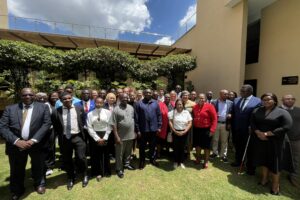
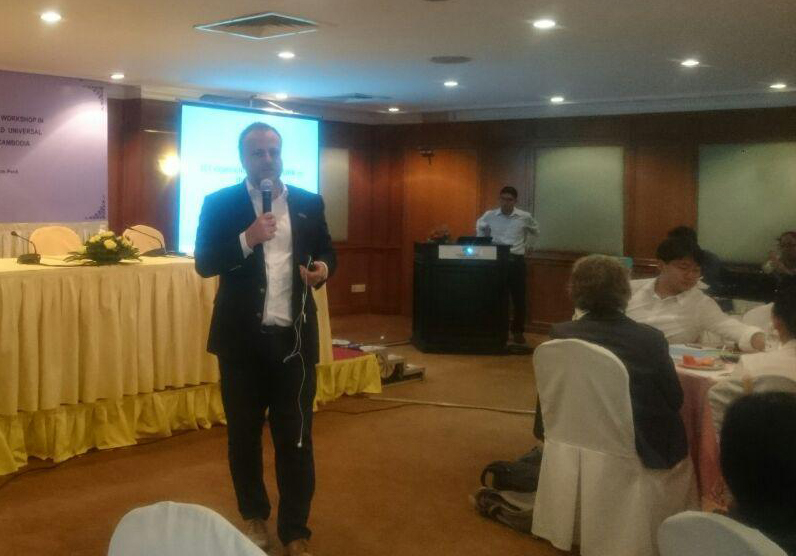
On 12 and 13 March 2018, the ICJ participated in and presented at a workshop for Cambodian civil society on the Universal Periodic Review (UPR).
The workshop was organized by the Cambodian Center for Human Rights (CCHR), UPR Info and the Cambodia Country Office of the United Nations Office of the High Commissioner for Human Rights (OHCHR).
This workshop aimed to prepare participants ahead of the deadline for civil society submissions to the UPR in July 2018.
The Royal Government of Cambodia (RGC) will undergo the third cycle of its UPR in January 2019.
The objectives of the workshop were to:
- 1. Introduce the UPR to newcomers, identifying where the UPR fits within the UN’s human rights framework and demonstrating how civil society organizations (CSOs) can utilize the UPR to further their human rights objectives;
- 2. Share experiences of national stakeholders in the UPR process and discuss developments since the second cycle and priorities for the third cycle;
- 3. Learn from the experiences of CSOs in the region on developing UPR CSO submissions;
- 4. Provide technical training regarding the drafting of UPR CSO submissions;
- 5. Establish thematic groups to begin developing joint submissions and establish a timeline for the drafting process.
On 12 March 2018, Kingsley Abbott, Senior International Legal Adviser for Southeast Asia for the ICJ, delivered a presentation on submissions drafting and advocacy techniques for the UPR and also spoke about the experiences of CSOs in Thailand in developing UPR CSO submissions.
Contact
Kingsley Abbott, ICJ Senior International Legal Adviser for Southeast Asia, e: kingsley.abbott(a)icj.org
Mar 13, 2018 | News
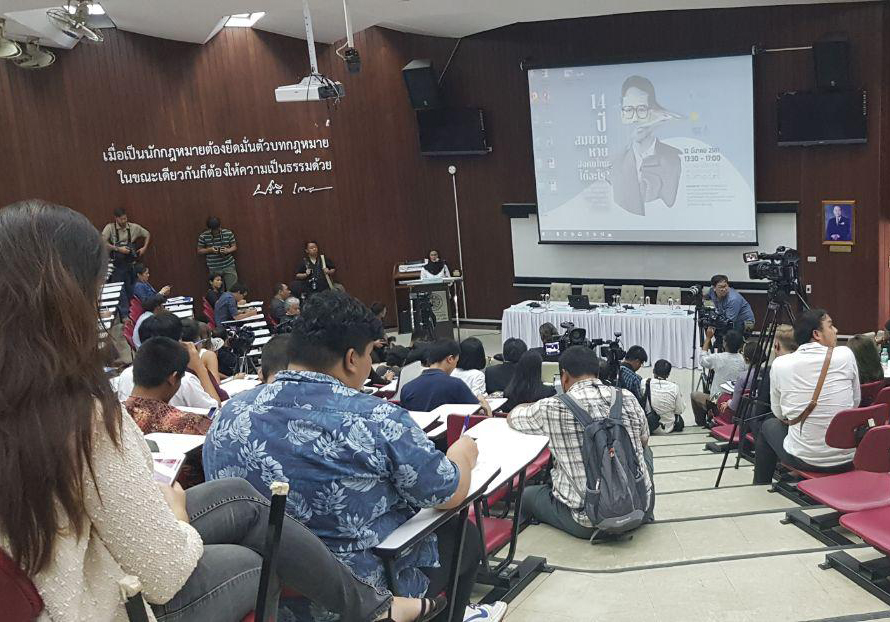
On 12 March 2018, the ICJ co-hosted the forum “14 Years after Somchai’s Disappearance, What Have We Learned?” to commemorate the 14th anniversary of the enforced disappearance of prominent lawyer and human rights defender Somchai Neelapaijit.
The forum was held at the Faculty of Law in Thammasat University’s Tha Pra Chan campus.
More than 80 participants attended the event, including alleged torture victims, family victims of torture and enforced disappearance, students, lecturers, lawyers, civil society organizations, diplomats, members of the Thai authorities and media.
The objectives of the forum were to (i) mark the 14th anniversary of the enforced disappearance of Somchai Neelapaijit and the lack of progress in the investigation (ii) raise awareness and discuss the latest amendments to the Draft Prevention and Suppression of Torture and Enforced Disappearances Act (‘Draft Act’) and its deficiencies; and (iii) discuss the newly constituted Committee managing complaints of torture and enforced disappearance, which was established by the Prime Minister on 23 May 2017.
Opening remarks were delivered by Angkhana Neelapaijit, wife of Somchai Neelapaijit, and Laurent Meillan, OHCHR’s Deputy Regional Representative.
Sanhawan Srisod, the ICJ’s National Legal Advisor, spoke during the first panel discussion on recent amendments to the Draft Act, which was moderated by Poonsuk Poonsukcharoen from Thai Lawyers for Human Rights (TLHR) and also included the following panelists:
- Nongporn Rungpetchwong, Human Rights Expert, Rights and Liberties Protection Department, Ministry of Justice
- Assistant Professor Dr. Ronnakorn Bunmee, Faculty of Law, Thammasat University
- Somchai Homlaor, Lawyer and Senior Advisor to Cross Cultural Foundation (CrCF)
The second panel discussion on the roles and duties of the Committee Managing Complaints for Torture and Enforced Disappearance Cases was moderated by. Yingcheep Atchanont from Internet Law Reform Dialogue (iLaw) and included the following speakers:
- Manunpan Rattanacharoen, Office of Foreign Affairs and International Crimes, Department of Special Investigation (DSI), Ministry of Justice
- Professor Narong Jaihan, Chair, Sub-committee on Prevention of Torture and Enforced Disappearance Cases
- Angkhana Neelapaijit, Family of “disappeared” person
- Isma-ae Tae, Alleged victim of torture and ill-treatment
During the event, the ICJ also highlighted its open letter to Thailand’s Minister of Justice, dated 12 March 2018, on the recent amendments to the Draft Act, which sets out concerns that the recent amendments would, if adopted, fail to bring the law into compliance with Thailand’s international human rights obligations.
The forum was co-organized with the Neelapaijit family, Thammasart University’s Faculty of Law, Amnesty International Thailand, Cross Cultural Foundation (CrCF), together with the United Nations’ Office of the High Commissioner for Human Rights (OHCHR) Regional Office for South East Asia.
Read also
ICJ and Amnesty International, Open letter to Thailand’s Minister of Justice on the amendments to the Draft Prevention and Suppression of Torture and Enforced Disappearances Act, 12 March 2018
English
Thai
ICJ and Thai Lawyers for Human Rights, Joint submission to the UN Committee against Torture, 29 January 2018
ICJ and Amnesty International, Recommendations to Thailand’s Ministry of Justice on the Draft Prevention and Suppression of Torture and Enforced Disappearances Act, 23 November 2017
To mark the 10-year anniversary of Somchai Neelapaijit’s ‘disappearance’, the ICJ released a report documenting the tortuous legal history of the case, Ten Years Without Truth: Somchai Neelapaijit and Enforced Disappearances in Thailand, 7 March 2014
Contact
Kingsley Abbott, ICJ Senior International Legal Adviser for Southeast Asia, e: kingsley.abbott(a)icj.org
Thailand-Amendments-to-Prevention-and-Suppression-of-Torture-2018-ENG (Full text in ENG, PDF)
Thailand-Amendments-to-Prevention-Suppression-of-Torture-2018-THA (Full text in THA, PDF)
Mar 12, 2018 | Advocacy, Non-legal submissions
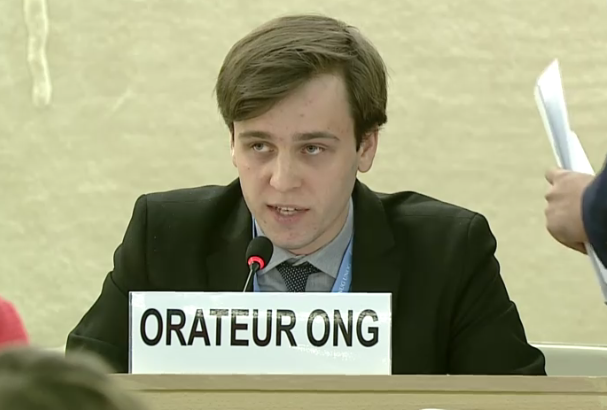
The ICJ today delivered a statement at the UN Human Rights Council calling on Myanmar to cooperate with UN mechanisms and for all UN agencies in the country to make human rights central to their approach.
The statement, made in the interactive dialogue with the international Fact Finding Mission on Myanmar, and the Special Rapporteur, read as follows:
“The International Commission of Jurists (ICJ) welcomes the update of the Independent International Fact Finding Mission. In relation to crimes under international law, the ICJ encourages the experts to continue to develop further specific recommendations for securing criminal accountability and providing redress.
The ICJ also welcomes the report of the Special Rapporteur, and strongly supports the renewal of her mandate and tenure.
As a UN Member State, the Government of Myanmar should fully cooperate with all the organs and mechanisms of the UN, in accordance with its obligations under the UN Charter.
At this session, the government asked for ‘concrete evidence’ of alleged human rights violations, and committed to taking action against perpetrators, but permission to enter the country is still refused to the Fact Finding Mission, to the Special Rapporteur and to the Office of the High Commissioner for Human Rights.
To demonstrate a genuine commitment to truth and accountability, the Government must allow them full access to areas of concern, particularly to Rakhine State and to conflict areas in Kachin State and Shan State.
Humanitarian actors and independent media must also be immediately allowed full and unimpeded access, particularly to Rakhine State, as recommended by the government’s own Advisory Commission.
The current situation in Rakhine State is incongruous to voluntary returns of Rohingya refugees. At the same time, the UN High Commissioner for Human Rights must be included in repatriation planning with a full mandate to protect refugees. This is contemplated in current repatriation arrangements with the Government of Bangladesh, and the Government of Myanmar must now formalize this relationship with UNHCR.
Experts, what can be done to ensure all UN agencies present in Myanmar actually put ‘human rights up front’ in the line with the mandate of every UN organ under the UN Charter?”
Mar 9, 2018 | Events, News
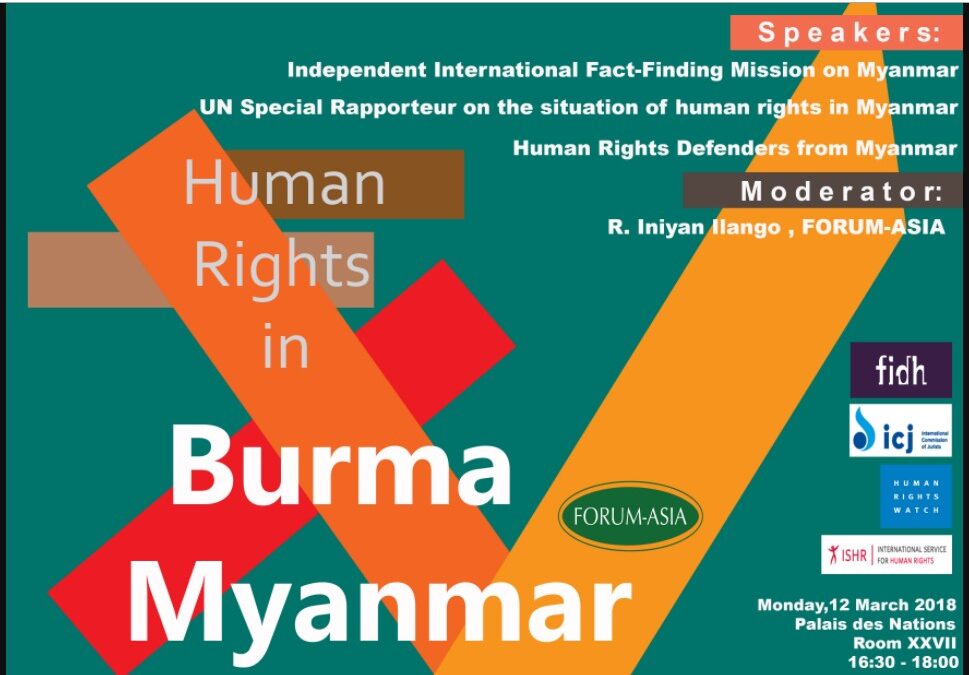
This side event at the Human Rights Council takes place on Monday, 12 March, 16:30-18:00, room XXVII of the Palais des Nations. It is organized by Forum-Asia, and co-sponsored by the ICJ.
Speakers:
Independent International Fact-Finding Mission on Myanmar
UN Special Rapporteur on the situation of human rights in Myanmar
Human Rights Defenders from Myanmar
Moderator:
R. Iniyan Ilango, Forum – Asia
Mar 8, 2018 | Multimedia items, News, Video clips
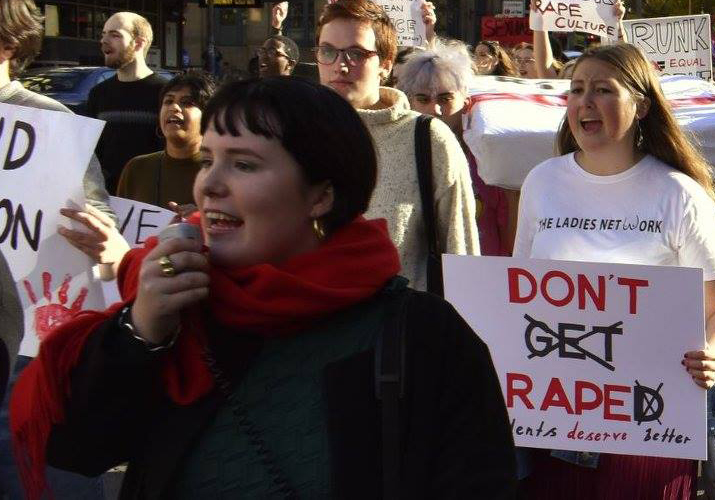
Today on International Women’s Day the world looks to celebrate the achievements of women and advances made towards the realization of women’s human rights but the day is also an opportunity to address the issues that continue to disadvantage women.
In the 70th anniversary year of the Universal Declaration of Human Rights many women around the world have seen States failing to live up to their obligations to ensure that they are able to exercise their human rights.
Where women’s human rights are violated many women face discrimination, denial of equal protection of the law and other impediments in accessing the justice that they deserve.
“The ICJ has a strong commitment to addressing the obstacles women face in accessing justice,” said ICJ Acting Vice-President, Justice Radmila Dragicevic-Dicic.
“The judiciary has an important role in protecting the rights of women, but in many States there is a lack of proper awareness and understanding of issues such as gender based-violence. Many judges would benefit from judicial education on specific gender-based issues to ensure that women victims are made visible and their rights protected by domestic laws and relevant international standards,” she added.
For several years the ICJ has worked on women’s access to justice issues in different countries in all regions with a variety of stakeholders, including human rights defenders, lawyers, judges, governmental authorities and international rights experts and mechanisms.
For example, in Tunisia, the ICJ issued a memorandum calling on authorities to remove the obstacles women face in accessing justice.
The ICJ has held regional dialogues in Africa and Asia with judges and lawyers.
In Asia, one outcome of this was The Bangkok General Guidance for Judges in Applying a Gender Perspective, designed to assist judges in employing a gender perspective in deciding cases before them, which has since been adopted for use by judiciaries in Indonesia and the Philippines.
In Africa, the need for gendered perspectives in judicial decision-making was also raised in a regional report evaluating sexual and gender based violence (SGBV) and fair trial rights.
The ICJ has undertaken substantial work on women’s access to justice in the context of SGBV, including a report calling for an eradication of harmful gender stereotypes and assumptions and a Practitioners’ Guide on Women’s Access to Justice for Gender-Based Violence.
Both have been used as training tools in Asia, Africa and MENA, most recently at a workshop on SGBV in Swaziland.
Last year the ICJ released a memorandum on effective investigation and prosecution of SGBV in Morocco.
The ICJ has also undertaken trial observations during hearings in the landmark Sepur Zarco case, the first case that resulted in a conviction for sexual crimes that had occurred during Guatemala’s internal conflict in the early 1980s.
The ICJ regularly engages with the UN Human Rights Council and the UN Committee on the Elimination of all Forms of Discrimination against Women to highlight issues around women’s access to justice and call on the international community to be vigilant in upholding women’s rights protections.
“The ICJ is lucky to count among its number some very impressive women human rights defenders, who bring a great deal of expertise to the work of the organization,” said Dragicevic-Dicic.
“The five most recent additions to the ICJ have further strengthened the organization’s ability to speak authoritatively on women’s rights, and I look forward to working with my new colleagues to enhance women’s access to justice,” she added.
The new additions to the ICJ include Dame Silvia Cartwright, Former Governor of New Zealand; Professor Sarah Cleveland, Constitutional and Human Rights Professor at Columbia Law School in the USA; Justice Martine Comte who has over 30 years judicial experience in France; Mikiko Otani, member of the UN Committee on the Rights of the Child from Japan; and Justice Lillian Tibatemwa-Ekirikubinza from the Supreme Court of Uganda.
In an interview with the ICJ, Commissioner Justice Elizabeth Evatt, a distinguished Australian lawyer, jurist and trailblazer for women in the legal profession in her country, spoke about the importance of women being able to access justice.
One of the architects of Australia’s Family Law Act of 1975, Justic Evatt told the ICJ how the Act made divorce more accessible and abolished the Common Law relics that gave men greater rights over women, however new problems have emerged since then.
Justice Evatt explained that “(the Act) was an extremely important reform for women. It made it far easier for men and women to access divorce and have their matters dealt with because the court had conciliation and counselling services and also legal aid was more readily available. But I am afraid that since those days, thing have changed. The Family Court is now beset with delays and obstacles and it is impossible for people to get legal aid. People have to take their case on their own or face huge legal costs, so having begun well, it hasn’t continued well. More resources are needed.”
Justice Evatt also considers that there is a need for the government and the judiciary to take more action to address domestic violence.
However, she noted, “there has been a change over the years with a growing awareness of both the police and the local courts, which are the main ones dealing with violence. They have become far more aware of the need to take action to protect women and prevent violence but the cure for domestic violence does not lie just with the courts but also with the whole of society.”
Watch the interview: