Feb 10, 2017 | News
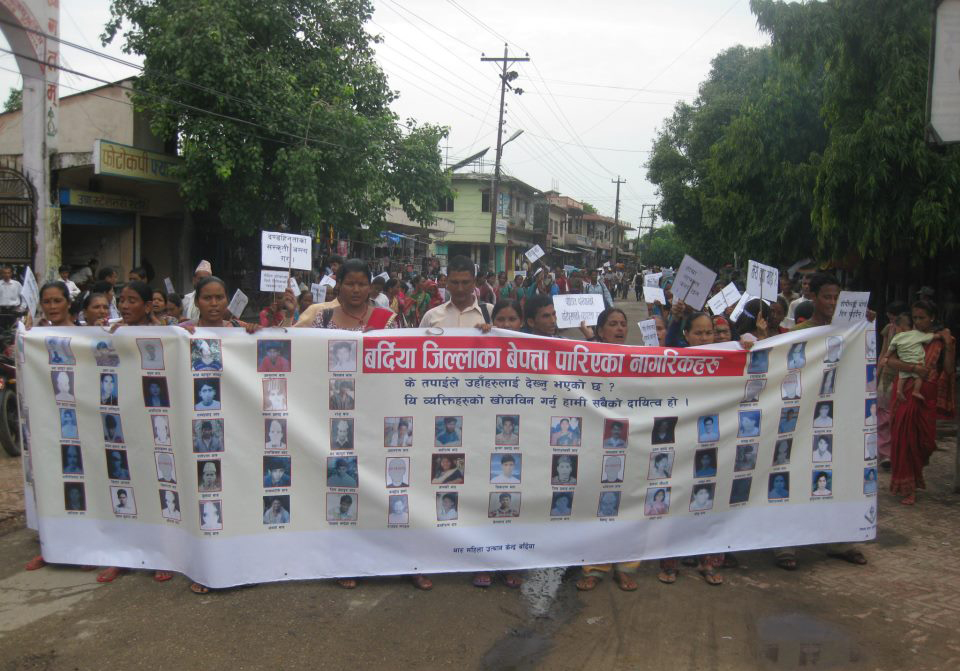
Extending the mandate of the Truth and Reconciliation Commission (TRC) and Commission on Investigation of Disappeared Persons (COID) without accompanying legal amendments to the TRC Act, 2014, in line with Nepal’s international legal obligations, will be meaningless, the ICJ said today.
It will fail to empower the commissions to address the root causes of the conflict and provide justice to victims, the ICJ added.
On 9 February 2017, the Government of Nepal formally extended the mandate of the TRC and COID for another year.
The TRC and COID were established on 10 February 2015 through the Commission on Investigation of Disappeared Persons, Truth and Reconciliation Act, 2014 (TRC Act), with the mandate to investigate alleged human rights abuses committed by both sides of Nepal’s decade-long armed conflict between the Government of Nepal and Communist Party of Nepal-Maoist (CPN-M) rebels.
However, due to a flawed legal mandate, resource and capacity limitations, and lack of political will, the commissions have been unable to carry out their work effectively.
“Unless the government of Nepal is prepared to amend the TRC Act in line with the Nepal Supreme Court’s rulings and international law, and to take other concrete steps to address the persistent challenges that have plagued the commissions’ ability to complete their work over the past two years, the extension of their mandate will be meaningless,” said Sam Zarifi, the ICJ’s Asia-Pacific Director.
In two separate rulings, the Nepal Supreme Court has previously ruled that the TRC Act and its predecessor TRC Ordinance were in violation of Nepal’s international legal obligations, as they allowed for amnesties for gross human rights abuses and serious violations of international humanitarian law amounting to crimes under international law.
Despite repeated calls by the ICJ, as well as other human rights and victims groups, to ensure a credible transitional justice process by amending the TRC Act in line with Nepal’s Supreme Court order and international standards, and by providing adequate resources to enable the commissions to carry out their work effectively and independently, the Government of Nepal has thus far failed to take any steps to implement the Supreme Court’s orders.
Nevertheless, the commissions finally commenced their work in February 2016, one year into their two-year mandate, and despite a severe lack of public faith in the commitment of the government and the ability of the commissions to deliver justice, victims came forward to submit more than 60,000 complaints to the two commissions combined.
“The government of Nepal must demonstrate its commitment to deliver justice to victims of Nepal’s armed conflict,” said Zarifi. “Victims have already waited more than a decade to receive justice and are losing hope in the transitional justice process.”
“The Nepal government and political parties must not once again betray the trust of victims by perpetuating a fundamentally flawed transitional justice process without concomitant reforms that will address victims’ rights to truth, justice and reparation,” he added.
While extending the mandate of the TRC and COID, the Government of Nepal must immediately establish a credible transitional justice process that ensures victims’ rights to truth, justice and reparation by: amending the TRC Act in line with the Supreme Court rulings and international law; empowering the TRC and COID with adequate resources to function independently, transparently and in a victim-centred manner; and, adopting necessary legislation to criminalize serious international crimes, including enforced disappearance, torture and other ill-treatment, and rape and other sexual violence, with retroactive effect and without any limitations period for conflict-era cases.

Feb 9, 2017 | Advocacy, News
The ICJ today welcomed the indefinite suspension of the hearings on the death penalty bills by the Philippine Senate’s Committee on Justice and Human Rights.
The Committee’s Chairman, Senator Richard Gordon, indicated the suspension was needed until the Department of Justice is able to submit its opinion on the Philippines’ obligations under the Second Optional Protocol to the International Covenant on Civil and Political Rights (ICCPR).
That instrument requires the Philippines to maintain its abolition.
“Abolitionist States may not return to the use of the death penalty generally under the ICCPR, and States that become party to the Second Optional Protocol assume very specific obligations to that effect,” said Emerlynne Gil, ICJ’s Senior International Legal Adviser for Southeast Asia. “There really is no inconsistency between the Second Optional Protocol and the Philippine Constitution.”
“As a general rule, the Philippine Constitution prohibits the death penalty except for compelling reasons involving heinous crimes. But in no way does it mandate that the death penalty be put into effect,” she added.
By ratifying the Second Optional Protocol, the Philippines has voluntarily chosen to be bound by an international obligation not to impose the death penalty – which it might otherwise have had the option to do under the Constitution.
As the ICJ explains in a memorandum on this issue, this is the very essence of treaty making.
“To announce long after ratification that a treaty is inconsistent with the Constitution and so not to be treated as binding, would call into question virtually every treaty to which Philippines is a party,” Gil said.
“This would contradict the most basic foundations of the international legal system and would lead other countries to view the Philippines as virtually incapable of making a reliable international legal agreement,” she added.
The ICJ emphasized that if the Philippines brings back the death penalty into its domestic laws, it would also be in violation of its obligations under the ICCPR, which effectively prohibits States from bringing back the death penalty once it has been abolished in domestic laws.
The Philippines cannot withdraw from Second Optional Protocol, which has no denunciation or withdrawal clause, the ICJ says.
The UN Human Rights Committee has explained that a denunciation clause was deliberately omitted because once the people are accorded the protection of the rights under the Second Optional Protocol, they shall not be deprived of such protection.
Background
On 7 February 2017, the Senate Committee on Justice and Human Rights held its first hearing on the proposed measure reintroducing the death penalty for illegal drugs and other crimes.
A similar bill to restore the death penalty is also currently being debated in plenary at the House of Representatives.
At the Senate hearing, senators opposing the proposed measure recalled that the Philippines is a State Party to the Second Optional Protocol, and thus, it is obliged not to execute any person within its jurisdiction.
Senator Richard Gordon, who chairs the Committee, thereafter, called for the indefinite suspension of the hearings on this matter until there could be clarity on the ramifications on the Philippines if it breaches its obligations under the Second Optional Protocol.
Contact
Emerlynne Gil, ICJ’s Senior International Legal Adviser, t +66 840923575 ; e: emerlynne.gil(a)icj.org
Philippines-Memo OP2 and Const-Advocacy-2017-ENG (Memo in English, PDF)

Feb 7, 2017 | News
Cambodian authorities should immediately drop the politically motivated criminal investigation of human rights defenders Am Sam-at and Chan Puthisak, the ICJ, Amnesty International and Human Rights Watch said today.
Cambodian officials have accused Sam-at, a respected human rights monitor at the Cambodian League for the Promotion and Defense of Human Rights (LICADHO) for nearly 20 years, and Puthisak, a land rights activist from Boeung Kak Lake and former prisoner of conscience, of instigating violence at a 10 October 2016 demonstration.
Para-police forces, who are regularly used to suppress demonstrations, violently dispersed what had been a peaceful protest in Phnom Penh.
When Puthisak attempted to prevent para-police from confiscating a drum that was being used by a demonstrator, four or five para-police attacked him, repeatedly beating him on the head with their fists, according to a video of the incident.
When Sam-at tried to stop the assault, the para-police attacked him, also beating him on the head. Both men sustained injuries that needed medical attention.
“The investigation of Sam-at and Puthisak by the Cambodian authorities is a typically absurd and undisguised case of judicial harassment,” said Champa Patel, Southeast Asia and Pacific Director at Amnesty International.
“As usual, unnecessary and excessive use of force by the para-police goes unpunished, and those who work to promote and protect human rights find themselves subject to criminal proceedings.”
On 4 November, two members of the para-police filed a complaint with the Phnom Penh Court of First Instance, alleging that they were injured during the dispersal of the demonstration.
The authorities are investigating Sam-at and Puthisak for instigating intentional violence, under Articles 27 and 217 of Cambodia’s Criminal Code, which carry penalties of up to three years in prison.
Both men are due for questioning on 8 February by Phnom Penh Court of First Instance Deputy Prosecutor Ngin Pich.
There has been no indication that complaints filed against para-police by Sam-at and Puthisak after the incident on 10 October 2016 are being investigated.
The 10 October demonstration involved approximately 150 participants peacefully calling for respect for housing and land rights in Freedom Park, an area designated for demonstrations.
The protestors were marching on a street adjacent to the park when the incident took place.
Videos of the incident establish that the demonstration was peaceful and that Sam-at was wearing a blue human rights monitor vest when the para-police attacked him.
The case investigation of the two falls within a wider pattern of judicial intimidation in Cambodia.
There are currently as many as 26 human rights and political activists in prison on charges which have all the hallmarks of being politically motivated.
This includes 14 political activists who were jailed following a demonstration in July 2014, when para-police violently clashed with participants.
No efforts have been reported of the authorities’ efforts to bring to justice the para-police responsible for the unlawful use of force.
“The case against Sam-at and Puthisak is part of an extensive effort by the Cambodian authorities to discredit the legitimate work of human rights organisations and to make clear the threat of prison for everyone working to promote and protect rights in the country,” said, Phil Robertson, Asia Deputy Director at Human Rights Watch.
“This campaign of intimidation against rights advocates has to stop now.”
Para-police, often referred to as “district security guards,” are auxiliary security forces that are regularly used to violently suppress demonstrations in Cambodia.
No single legal document sets out the rules governing their functions and powers. Rather, their legal basis and the rules governing their activities are set out in a confusing combination of government statements and policies, and by instructions from the Ministry of Interior.
They work in tandem with police, under the authority of district governors.
“The Cambodian government should be commending people like Sam-at and Puthisak for their work to promote and protect human rights rather than trying to intimidate them,” said Kingsley Abbott, Senior International Legal Advisor at the ICJ.
“The case should be immediately and formally closed and a genuine investigation initiated into wrongful use of force by the para-police.”
Jan 30, 2017 | News
It is with great sadness that the ICJ has learned of Lawyer U Ko Ni’s death at Yangon International Airport today.
An armed man in the crowded airport reportedly shot him in the head at close range, along with U Nay Win a taxi driver who had tried to intervene.
The suspect was reportedly apprehended at the scene.
The ICJ stresses the need for a prompt, thorough and impartial investigation into the killing.
“It is vital that in the current climate of inter-religious tension that the rule of law is seen to prevail and for those responsible to be held criminally accountable,” said Sam Zarifi, the ICJ’s Asia-Pacific Regional Director.
“We await the results of the ongoing investigation,” he added.
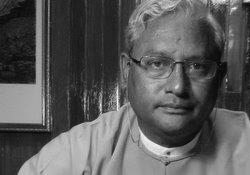
U Ko Ni (photo) was a prominent and well-respected legal figure in Myanmar.
He was a respected veteran of the democracy movement, an adviser to the National League for Democracy and Aung Sang Su Kyi.
He was a rare outspoken voice against discrimination and had recently advocated for laws against hate speech and for inter-communal harmony.
U Ko Ni was returning from an official visit to Indonesia with senior Buddhist and Muslim figures aimed at sharing experiences and overcoming inter-religious tensions when the attack occurred.
U Ko Ni was also a patron of the recently formed Myanmar Muslim Lawyers Association.
He was an outspoken critic of the “race and religion laws”, a legislative package of four bills supported by hardline nationalists, as well as a champion of religious tolerance.
“U Ko Ni was a principled lawyer. He was committed to protecting human rights, preventing hate crimes and the rule of law in Myanmar, and his presence as leading advocate will be deeply missed,” Zarifi added.

Jan 19, 2017 | News
The Sri Lankan government must deliver on the clear demand for justice from Sri Lankans nationwide by implementing the Consultation Task Force recommendations without further delay, the ICJ said today.
Among these recommendations, the calls for a special court with international judges and a bar against amnesties for crimes under international law are of particular importance, the ICJ added.
The Consultation Task Force on Reconciliation Mechanisms (CTF), a panel of 11 independent eminent persons appointed by Prime Minister Ranil Wickremesinghe in January 2016, publicly released its final report on 3 January 2017.
The report, reflecting the views of people across the country gathered through island-wide public consultations on transitional justice, highlights the lack of public confidence in the justice system’s capacity and will to deliver justice for victims of Sri Lanka’s nearly 30-year armed conflict that ended in 2009.
“The CTF report highlights a widespread lack of trust among Sri Lankans across the country, regardless of region, ethnicity, religion or language, in the ability of the criminal justice system in its current form to address serious human rights abuses stemming from the conflict,” said Nikhil Narayan, the ICJ’s South Asia senior legal adviser.
The report also calls upon the Government of Sri Lanka to take necessary steps to ensure a credible transitional justice process in line with the October 2015 UN Human Rights Council resolution 30/1 that it co-sponsored.
“If the Sri Lankan government wants to restore public confidence in the system, it must seriously consider victims’ voices and implement the CTF recommendations on truth, justice and reparation consistent with the commitments it voluntary undertook at the Human Rights Council,” Narayan added.
Importantly, the CTF report reiterates the commitments pledged in HRC resolution 30/1, calling for active international participation in a special judicial mechanism established to deal with accountability for human rights abuses committed during the conflict by both sides, and for a bar against amnesties for international crimes.
According to the ICJ, the Sri Lankan government took an important first step towards reconciliation when it adopted the UN resolution and later established the CTF to carry out public consultations to hear a cross section of voices on transitional justice.
“Unfortunately, since then, it has been disappointing in its lack of urgency in implementing much of those stated promises and in its apparent disregard for the CTF recommendations,” Narayan said.
Several members of the government have dismissed the CTF’s recommendations, especially with regard to the inclusion of at least one international judge on every bench of the special judicial mechanism.
The Minister of Foreign Affairs recently spoke of the need for “an independent and credible domestic mechanism” without alluding to any international participation, as has been reiterated by those seeking redress as a crucial element to ensure faith in the justice mechanism.
The ICJ has in the past highlighted Sri Lanka’s culture of impunity in the justice system looking at a number of emblematic cases, and called into question the State’s capacity and political will to use the criminal justice system and other ad-hoc measures to deliver justice and accountability to victims and survivors of serious human rights abuses.
“As the situation of Sri Lanka comes before the UN Human Rights Council again this March, the Sri Lankan government is in a position to demonstrate both to the UN Member States but more importantly to its own people at home its seriousness in pursuing truth, justice, reparation and non-recurrence for conflict victims who have been waiting for justice for decades. It must seize this opportunity before it is one more of many missed opportunities,” Narayan added.
Contact:
Nikhil Narayan, ICJ South Asia senior legal adviser, t: +91-8939325204 (Chennai); +94-758898067 (Sri Lanka); +1-562-261-3770 (Whatsapp) ; e: nikhil.narayan(a)icj.org
Download the full text with additional background info, in PDF:
Sri Lanka-CTF recommendations-News-Press release-2016-ENG