Mar 12, 2017 | Events, News
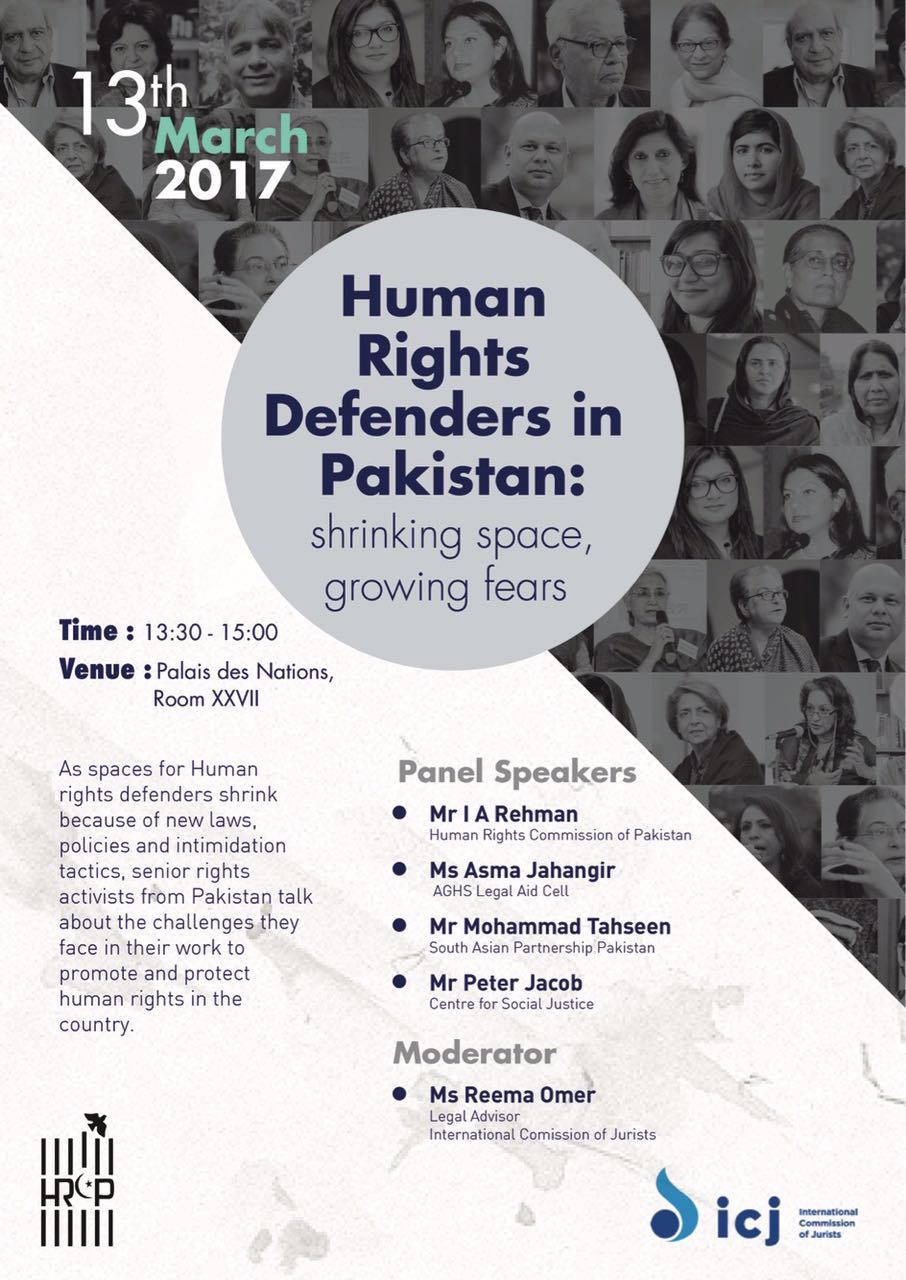
A side event at the UN Human Rights Council, 13 March 2017.
13 March, 13:30-15:00
Palais des Nations, Room XXVII
As spaces for human rights defenders shrink because of new laws, policies and intimidation tactics, senior rights activists from Pakistan talk about the challenges they face in their work to promote and protect human rights in the country.
Panelists:
Mr I. A. Rehman: Human Rights Commission of Pakistan
Ms Asma Jahangir: AGHS Legal Aid Cell
Mr Mohammad Tahseen: South Asia Partnership Pakistan
Mr Peter Jacob: Center for Social Justice
Moderator:
Ms Reema Omer: International Commission of Jurists
Flyer available here.
Mar 12, 2017 | Advocacy, Non-legal submissions
The ICJ has made an oral statement to the UN Human Rights Council on a range of measures needed to ensure truth, justice, reparations and non-repetition of past violations, in Nepal.
The statement read as follows:
TRUTH, JUSTICE, REPARATION, AND GUARANTEES OF NON-RECURRENCE IN NEPAL
10 March 2017
Mr. President
Without effective measures to ensure truth, justice, reparation and guarantees of non-recurrence, countries in situations of transition or post-conflict fail victims and put future reconciliation, peace and stability at risk. One example is Nepal.
Nepal’s Truth and Reconciliation Commission and Commission of Investigation on Disappeared Persons have not been effective. Changes are needed to bring their legal frameworks and operations in line with international standards and Supreme Court jurisprudence. These bodies require adequate resources. Trust-building measures including consultation processes must address the perspectives and needs of victims and for victims to feel ownership over the transitional justice process in Nepal.
Nepal must ensure prompt, independent and impartial investigation and prosecutions for serious human rights violations, including those committed during the armed conflict.
It must ensure justice and reparation for victims, including as provided for in the UN Basic Principles and Guidelines on the Right to a Remedy and Reparation.
It must criminalize serious crimes under international law in a manner that is consistent with international law, to help prevent such violations ever occurring again.
Nepal should also issue a standing invitation to all thematic special procedures of the Council.
Thank you, Mr. President.
Mar 9, 2017 | News
Amnesty International and the ICJ regret the decision of Thailand’s National Legislative Assembly (NLA) to further delay the passage of essential legislation criminalizing torture and enforced disappearances.
Our organizations call on the Thai government to cease its stalling measures and instead prioritize the amendment of the Draft Prevention and Suppression of Torture and Enforced Disappearance Act (Draft Act) in order to bring it into line with international law. The government should then ensure its passage into law without undue delay.
On 28 February, the Office of the High Commissioner for Human Rights announced that it had been informed that the NLA would not enact the Draft Act. The following day, an NLA official speaking to BBC Thai confirmed that the draft would be “returned [to the Thai Cabinet] for more consultations… with Interior officials, police authorities, the national security sector, military authorities and prosecutors.”
The Draft Act is the result of years of effort by government authorities, including by Ministry of Justice officials who consulted with our organizations and took account of many of our recommendations in elaborating it. The draft was approved by Thailand’s Cabinet in May 2016.
The recent decision by the NLA has indefinitely delayed the enactment of this important piece of legislation, which would represent a significant step towards preventing torture and enforced disappearances in Thailand.
The slow-tracking of this law in the face of all the commitments Thailand has made over the years right up to last year is extremely disappointing, especially for the victims of torture and enforced disappearances who have struggled to obtain justice in the absence of a clear legal framework.
The most recent version of the Draft Act addresses many existing gaps in Thailand’s current legal framework and could support Thailand’s compliance with its obligations under international human rights law. However, further amendments are needed to address significant shortcomings in the Draft Act.
In particular, the Draft Act omits key elements from the definitions of torture and enforced disappearances, does not criminalize acts of cruel, inhuman or degrading treatment, and fails to define enforced disappearance as a continuing crime. Additionally, the Draft Act does not extend criminal liability beyond the direct commission of the act and fails to unequivocally bar the use as evidence in court proceedings of statements obtained by torture.
Thailand should make it a top priority to address these and other concerns and to enact the law as soon as possible. The urgent need to amend and enact the Draft Act is underscored by recent reports alleging the use of torture and other ill-treatment by state security forces and the continued failure to hold accountable perpetrators of torture, other ill-treatment and enforced disappearances.
Our organizations remain committed to providing any necessary assistance to the Thai government in amending the Draft Act or otherwise acting to prevent torture and enforced disappearances in Thailand.
Background
Thailand is a state party to the International Covenant on Civil and Political Rights (ICCPR), the Convention against Torture and other Cruel, Inhuman or Degrading Treatment or Punishment (CAT), and has signed, but not ratified, the International Convention for the Protection of All Persons from Enforced Disappearance (ICPPED).
The expert UN bodies overseeing the implementation of these treaties have consistently called upon states parties to criminalise torture and enforced disappearance as specific crimes.
On 13 and 14 March 2017, the UN Human Rights Committee will review Thailand’s compliance with the ICCPR.
In Thailand’s 15 November 2016 reply to the Committee’s List of Issues,[1] it noted that it was in the process of passing the Draft Law which would “provide clear definition and set up specific offence on torture to be in line with the terms set forth under CAT” and “serve as an implementing legislation for ICPPED.”
It also noted that the Draft Act “aims to strengthen the prevention, suppression, and prosecution mechanism and to ensure remedy for victims as well as address the problem of misuse, and abuses of power by government authorities with regard to torture and enforced disappearances.”
It concluded by noting that “[o]n 24 May 2016, the Cabinet approved the draft Act in principle. The draft has been reviewed by the Council of State and is currently waiting to be submitted to the legislative branch for consideration.”
[1] Human Rights Committee, “Replies of Thailand to the List of Issues,” U.N. Doc. CCPR/C/THA/Q/2/Add.1, para 51.
Thailand-Joint Statement-Torture Legislation-News-2017-ENG (Press release in PDF)
Contact
Kingsley Abbott, Senior International Legal Adviser for Southeast Asia, Tel: +66 94 470 1345, E-mail: Kingsley.abbott(a)icj.org
Mar 7, 2017 | News
The ICJ welcomes Thailand’s decision to drop spurious criminal defamation complaints against three prominent human rights defenders who had raised allegations of torture by security forces in Thailand’s restive deep South.
“It’s good news that the Thai military has dropped these unfounded complaints, but these charges should never have been brought. Thailand should now ensure the allegations of torture and ill-treatment are independently and effectively investigated,” said Sam Zarifi, the ICJ’s Asia Director.
“Thailand should also work to repair the considerable damage that was caused to alleged victims of torture and civil society who have been intimidated into silence by the prosecutions,” Zarifi continued.
On 10 February 2016, three Thai organizations, the Cross Cultural Foundation (CrCF), Duay Jai Group (Hearty Support Group), and the Patani Human Rights Organization (HAP), issued a report that documented 54 cases of alleged torture and ill-treatment by the Thai security forces in the deep South since 2004.
In response, the Internal Security Operations Command (ISOC) brought criminal defamation complaints against the three co-editors, Ms. Pornpen Khongkachonkiet (Director of the CrCF), Mr. Somchai Homlaor (Senior legal advisor to CrCF and Hearty Support Group), and Ms. Anchana Heemmina (founder and Director of the Hearty Support Group).
On 26 July 2016, the Thai police charged the three human rights defenders with criminal defamation by means of publication under Article 326 and 328 of the Penal Code, and importing false information to a computer system under Article 14 (1) of the Computer-Related Crime Act B.E. 2550 (2007).
The ICJ has been concerned by the abuse of criminal laws, including the already problematic criminal defamation law, as a means of effectively silencing human rights defenders.
“Thailand should now drop other outstanding criminal complaints against human rights defenders, including the complaint of sedition made against human rights lawyer Sirikan Charoensiri, and ensure that they are protected from retaliation,” Zarifi said. “We look forward to the ISOC following through on its commitment to working with civil society to end torture and ill-treatment and bring any perpetrators to justice.”
Background
On 7 March 2017, the ISOC 4 Forward Command – created to resolve the situation in the deep South – and the three human rights defenders, held a joint press conference.
The ISOC 4 Forward Command announced the ISOC will drop the complaints, citing the need for authorities and NGOs to work together collaboratively to address alleged human rights violations. ISOC 4 Forward Command also announced the establishment of a “joint fact-finding committee” which will be made up of officials and NGOs to look into allegations of human rights violations and to explore preventative measures.
The dropping of the charges occurs against the backdrop of the National Legislative Assembly (NLA) referring a draft law criminalizing torture and enforced disappearance back to the Cabinet, effectively delaying its passage indefinitely, despite Thailand’s repeated assurances on the international stage that it will pass the law in the near future.
On 13 and 14 March 2017, the UN Human Rights Committee will review Thailand’s compliance with the International Covenant on Civil and Political Rights (ICCPR), to which it is a State Party.
In a joint submission to the Committee, the ICJ and Thai Lawyers for Human Rights (TLHR) called for an end to the legal harassment of human rights defenders and for all allegations of torture, ill-treatment and enforced disappearance to be independently, impartially, and effectively investigated.
Further reading
https://www.icj.org/thailand-stop-use-of-defamation-charges-against-human-rights-defenders-seeking-accountability-for-torture/
https://www.icj.org/thailand-immediately-withdraw-criminal-complaints-against-human-rights-defenders/
Contact
Kingsley Abbott, Senior International Legal Adviser for Southeast Asia, ICJ, email: kingsley.abbott(a)icj.org or mobile: +66 94 470 1345
Thailand-HRD dropped charges-news-2017-THA (Statement in Thai, PDF)
Mar 7, 2017 | News
The ICJ today condemned the move of the Philippines’ House of Representatives to reintroduce the death penalty for drug-related crimes.
The ICJ has called on the country’s Senate to block this serious threat to human rights.
Earlier today, the House of Representatives approved House Bill 4727 on third and final reading by 216 votes. 54 voted “no”, and one abstained. The bill as amended reinstates the death penalty for drug-related crimes, more than 10 years after the Philippines had legally abandoned executions.
The approved bill will be transmitted to the Senate, where it will go through the same procedure of three readings.
“The passage of the death penalty bill in the Philippine House of Representatives represents a turning point in the country, but one that is for the worse. It puts the Philippines in direct conflict with its international legal obligations,” said Emerlynne Gil, ICJ’s Senior International Legal Adviser for Southeast Asia.
“Now it’s up to the Philippine Senate to stop this terrible and unconscionable move and preserve the Philippines’ status as a regional leader against the death penalty,” Gil added.
Since 2007, the Philippines has been a Party to the Second Optional Protocol to the International Covenant on Civil and Political Rights (ICCPR), requiring all parties to abolish the death penalty in law and practice. Under the ICCPR and the Second Protocol, States are prohibited from bringing back the death penalty once it has been abolished in domestic laws.
“Passing this law will send a negative message to the international community that the Philippines is incapable of observing in good faith the international obligations it has expressly bound itself to,” Gil said.
Ever since it abolished the death penalty in 2006, the Philippines has been viewed by many observers as a regional and global leader on the drive to abolish capital punishment. Not only was it the very first Southeast Asian country to ratify the Second Optional Protocol to the ICCPR, it also played an instrumental role in advocating for the abolition of the death penalty worldwide.
Since 2007, the Philippines has consistently co-sponsored multiple UN General Assembly resolutions calling for a moratorium on the use of the death penalty with a view to its total abolition. These resolutions have been adopted with large majorities.
“The Duterte administration had already engaged in hundreds, if not thousands, of extrajudicial killings justified by unsubstantiated claims that such wholesale crimes will somehow respond to the country’s drug problem. The resumption of the death penalty compounds the horrors of this bloody campaign without any evidence whatsoever that this odious practice will in any way improve the alleged drug problem in the country,” Gil said.
Rather than the death penalty, studies have demonstrated that heightened enforcement efforts which increase the chances of actually being caught and punished are more effective in deterring criminal conduct.
The ICJ therefore calls on the Senate of the Philippines to reject in full the bill seeking to re-impose the death penalty in the country in accordance with the Philippines’ international obligations.
Background
The bill approved by the House of Representatives (Lower House) will be transmitted to the Senate (Upper House), where it will go through the same procedure of three readings.
If the bill is approved upon the third reading at the Senate without amendments, it will be presented to the President. The bill would become a law if and when it is signed by the President.
If, however, there are amendments on the bill at the Senate and the House of Representatives do not agree with these amendments, the differences would be settled by a Conference Committee of both Houses.
The recommendations of the Conference Committee would have to be approved by both Houses.
Contact
Ms. Emerlynne Gil, ICJ’s Senior International Legal Adviser, tel. no. +66 840 923 575, email: emerlynne.gil(a)icj.org