Jun 21, 2016 | News
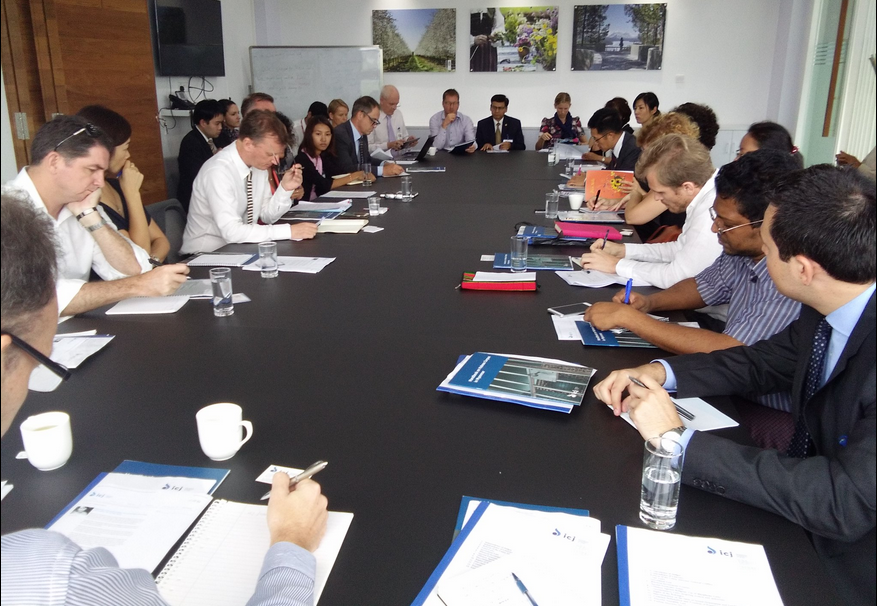
The ICJ urged the diplomatic community in Myanmar to assist, and assess, the new government’s efforts to improve the protection and promotion of human rights in the country at a diplomatic dialogue today.
The ICJ shared its 14 General Recommendations to the new Government and Parliament, with ambassadors and high-level diplomatic representatives, and discussed specific, actionable recommendations to the Government to effectively address human rights violations immediately and in the long term and to provide redress to those whose rights have been violated.
Access to justice for victims of human rights violations has been severely curbed in Myanmar during decades of military rule.
Most of the population has been consistently denied access to the courts and effective remedies as a result of unfair and discriminatory laws and poor court decisions.
With an improper regulatory regime for investment and environmental protection, and an ineffective judiciary to enforce laws and provide access to justice, economic development has risked undermining human rights protection and negatively impacting on economic, social and cultural rights.
Vani Sathisan, ICJ’s International Legal Adviser for Myanmar, stated that while the new government is more receptive than its predecessor to international human rights laws and standards, it should urgently establish a clear plan on strengthening rule of law reform and that all legislation must be guided by the principles of non-discrimination, greater accountability, transparency and justice.
Among the key recommendations the ICJ shared are:
- Supporting the committing of resources to the judiciary as well as the Attorney General’s Office to improve the state of legal education, court facilities, and safeguards to prosecutors to undertake investigations independently;
- Pushing for the passage of new land laws in consultation with civil society modeled on international standards and best practices;
- Ensuring that a new investment law conforms to the new land law that protects all forms of land tenure and provides access to justice when human rights occur;
- Seeking more clarity on the Government’s ability to monitor and regulate the conduct of businesses and their impacts on human rights;
- Supporting and strengthening the capacity of the Myanmar National Human Rights Commission to undertake investigations on human rights violations independently and impartially;
- Repealing or amending laws that are abused to violate the right to freedom of expression and opinion; and
- Encouraging the Government to consult and engage more closely with civil society and the international human rights community.
The diplomatic dialogue aimed to provide the international human rights organizations with an opportunity to clarify their various policy guidelines and provide updates to assist the diplomatic community with their multilateral lobbying efforts in Myanmar with the Executive, Legislative and Judiciary, and civil society.
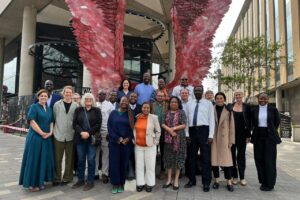
The Embassy of Denmark hosted the event. Members of the diplomatic community included those from the EU, UK, Canada, Denmark, Sweden, Finland, Australia, The Philippines and Bangladesh.
The ICJ was joined in a panel by the Office of the High Commissioner for Human Rights and Human Rights Watch.

Jun 20, 2016
Myanmar’s new government, led by the National League for Democracy of Aung San Suu Kyi, must establish a clear plan for strengthening the rule of law and protection of human rights, said the ICJ today as it released its 14 General Recommendations to the new Government and Parliament.
“The NLD has a tremendous opportunity and obligation to reverse years of official rejection and neglect of the rights of the people of Myanmar,” said Sam Zarifi, ICJ’s Asia Director.
“Myanmar’s severe human rights problems can’t be solved immediately, or even for years to come, but it’s crucial for the new Government to announce its strategy and show its commitment to improving the lives and livelihoods of all people in Myanmar,” he added.
After close discussions with all branches of the Government, as well as civil society and international experts, the ICJ has identified areas in which the Government can immediately and in the long-term address human rights violations in Myanmar and outlines measures to be taken to ensure that all legislation is guided by the principles of non-discrimination, greater accountability, transparency and justice.
Among the key recommendations of the ICJ are:
- Strengthening the independence and competence of the judiciary as well as the Attorney General’s Office;
- Improving the Government’s ability to monitor and regulate the conduct of businesses and their impact on the rights and well-being of people;
- Repealing or amending laws and practices that discriminate on the basis of religious or ethnic identity (particularly at-risk groups such as the Rohingya), or sexual orientation and gender identity; and
- Ensuring accountability and redress for violations of human rights, especially when committed by State security forces.
“Access to justice for victims of human rights violations has been severely curbed in Myanmar over the past decades, with most of the population being consistently denied access to the courts and effective remedies as a result of unfair and discriminatory laws as well as poor court decisions,” said Zarifi.
“The military remains dominant in Myanmar, wielding undue influence over various sectors in the country, including the judiciary, and continues to enjoy impunity for gross violations of human rights and serious violations of international humanitarian law,” he added.
The ICJ says Myanmar should immediately engage with the international human rights community.
It must accede to the International Covenant on Civil and Political Rights, ratify the International Covenant on Economic, Social and Cultural Rights, and expedite accession to the Convention against Torture and the Optional Protocol thereto, and ratification of the Optional Protocol to the Convention on the Rights of the Child on the involvement of children in armed conflict, the ICJ adds.
Contact:
Sam Zarifi, ICJ Regional Director for Asia and the Pacific, t: +66807819002; e: sam.zarifi(a)icj.org
Vani Sathisan, ICJ International Legal Adviser for Myanmar, t: +95(0)9250800301; e: vani.sathisan(a)icj.org
Additional Information:
The ICJ’s General Recommendations relate to the following matters:
1. Independence of judges;
2. Independence of lawyers;
3. Reform of the Union Attorney General’s Office;
4. Land laws;
5. Investment law;
6. Bilateral investment treaties;
7. Special Economic Zones;
8. Offenses against religion;
9. Discriminatory laws targeting women and minorities;
10. Rights of the Rohingya;
11. Discrimination on the basis of sexual orientation and gender identity;
12. Criminal defamation and freedom of expression;
13. Peaceful assembly law; and
14. Ending impunity for violations of human rights.
Myanmar-Recommendation to NLD Gvt-Advocacy-Analysis Brief-2016-ENG (full text, in PDF)
Jun 9, 2016 | News
The Thai military must immediately withdraw its abusive criminal complaints against three leading human rights defenders for raising allegations of torture in Thailand’s restive deep South, said the ICJ today.
“It is simply astonishing that the Thai government is lodging these complaints at a time when Thailand has just promised to adopt important anti-torture legislation and has publicly reaffirmed its commitment to protect human rights defenders,” said Sam Zarifi, ICJ Asia Regional Director.
“The military must immediately withdraw its complaints and instead ensure all allegations of torture and ill-treatment are promptly and effectively investigated in line with Thailand’s international legal obligations,” he added.
On 10 February 2016, three Thai organizations, the Cross Cultural Foundation (CrCF), Duay Jai Group (Hearty Support Group), and the Patani Human Rights Organization (HAP), issued a report that documented 54 cases of alleged torture and ill-treatment by the Thai authorities in the deep South since 2004.
On 17 May 2016, the Internal Security Operations Command (ISOC) Region 4, responsible for national security operations in the Southern Border Provinces, responded to the report by filing complaints of criminal defamation and violations of the Computer Crime Act B.E. 2550 (2007) against the report’s three co-editors, Somchai Homlaor and Pornpen Khongkachonkiet of CrCF, and Anchana Heemmina of Hearty Support Group.
Criminal defamation carries a maximum penalty of two years imprisonment and a fine of up to 200,000 Baht (USD $5,600). Violation of article 14(1) of the Computer Crime Act, carries a maximum penalty of five years imprisonment or a fine of up to 100,000 Baht (USD $2,800), or both.
It is the second time since 2014 that the Thai military has filed criminal defamation complaints against Pornpen Khongkachonkiet and Somchai Homlaor for raising allegations of torture in the deep South.
“The Thai military should also take heed of the recent decision of the Phuket Provincial Court in the Phuketwan case, which found that the Computer Crime Act was not intended to cover allegations of defamation,” said Zarifi.
On 1 September 2015, the Phuket Provincial Court acquitted two journalists of criminal defamation and violations of the Computer Crime Act after the Royal Thai Navy complained the journalists defamed it when, on 17 July 2013, the journalists reproduced a paragraph from a Pulitzer prize-winning Reuters article that alleged “Thai naval forces” were complicit in human trafficking.
The use of criminal defamation laws, carrying penalties of imprisonment, against human rights defenders reporting on alleged human violations, constitutes a violation of Thailand’s obligations under the International Covenant on Civil and Political Rights (ICCPR), to which it is a state party.
As affirmed in the UN Declaration on Human Rights Defenders, “Everyone has the right, individually and in association with others:… freely to publish, impart or disseminate to others views, information and knowledge on all human rights and fundamental freedoms.”
Background
On 17 December 2015, Thailand joined 127 other states at the UN General Assembly in adopting a UN Resolution on human rights defenders. The Resolution calls upon states to refrain from intimidation or reprisals against human rights defenders.
Last month, Thailand informed the Human Rights Council during its Universal Periodic Review that the Cabinet was considering a draft Act on Prevention and Suppression of Torture and Enforced Disappearance. It was reported that the Cabinet approved the draft law on 24 May 2016.
At the conclusion of the review, Thailand also adopted several recommendations to protect human rights defenders and investigate reported cases of intimidation, harassment and attacks against them.
The right to an effective remedy against torture and other ill-treatment and to have complaints promptly, fully and impartially investigated is guaranteed under international treaties to which Thailand is party, including the Convention against Torture and Other Cruel, Inhuman or Degrading Treatment or Punishment and the ICCPR.
Thailand has an obligation under both treaties to conduct such investigations where there are allegations of torture and ill-treatment and to bring to justice those responsible in fair criminal proceedings.
Thailand was criticized in May 2014 for its failure to address violations when the United Nations Committee Against Torture expressed its concern “at the numerous and consistent allegations of serious acts of reprisals and threats against human rights defenders, journalists, community leaders and their relatives, including verbal and physical attacks, enforced disappearances and extrajudicial killings, as well as by the lack of information provided on any investigations into such allegations.”
The Committee recommended that Thailand “should take all the necessary measures to: (a) put an immediate halt to harassment and attacks against human rights defenders, journalists and community leaders; and (b) systematically investigate all reported instances of intimidation, harassment and attacks with a view to prosecuting and punishing perpetrators, and guarantee effective remedies to victims and their families.”
Contact:
Sam Zarifi, Asia Regional Director, t: +66 80 781 9002; e: sam.zarifi(a)icj.org
Kingsley Abbott, Senior International Legal Adviser, t: +66 94 470 1345; e: kingsley.abbott(a)icj.org
Thailand-Retaliation HRDs-News-web stories-2016-ENG (full story in Thai, PDF)

Jun 6, 2016
The ICJ has urged the ASEAN Intergovernmental Commission on Human Rights (AICHR) to ensure that civil society organizations that apply for consultative status with the AICHR are provided with notice and an opportunity to respond to any objections before a decision is taken.
The AICHR was established in 2009 to promote human rights within the ASEAN region. As part of its mandate, the Commission regularly enters into formal consultative relationships with civil society organizations.
These consultative relationships allow civil society organizations to engage in dialogue with the AICHR in order to keep the AICHR apprised of human rights issues in the ASEAN region and to work jointly to advance human rights.
However, the ICJ is concerned that the AICHR, unlike other human rights bodies, has not explicitly provided in its procedures that civil society organizations should have an opportunity to respond to objections prior to any decision being taken, and in practice AICHR has denied consultative status to organizations (including the ICJ), without providing such an opportunity.
As a result, key voices may be excluded from contributing to important discussions on human rights, the ICJ says.
“Engagement with civil society organizations is central to the AICHR’s mandate,” said Prof. Sir Nigel Rodley, President of the ICJ.
“When the AICHR decides whether to extend consultative status to a civil society organization, it should make its decision based on all available information,” he added.
In a letter to the AICHR, the ICJ called on the human rights body to create a fairer and more effective process by granting civil society organizations applying for consultative status the right to respond to any objections made against them.
The ICJ noted that many intergovernmental organizations already provide this right to civil society organizations.
The United Nations Economic and Social Council, the Organization of American States and the Council of Europe all permit civil society organizations to respond to objections.
The ICJ also noted that a process of response would allow the AICHR to make more informed decisions regarding its consultative relationships and would reduce the administrative costs and increase the efficiency of the AICHR.
Under the current system, civil society organizations that are denied consultative status with the AICHR must submit a full revised application, and the AICHR must review the revised application in its entirety.
In its letter, the ICJ observed that this process is unnecessarily burdensome for both civil society organizations and the AICHR.
The ICJ’s letter comes after the AICHR denied an earlier request by the ICJ for reconsideration. On 16 February 2016, the ICJ received notice that its application for a consultative relationship with the AICHR had been denied.
On 24 March, the ICJ submitted a request for reconsideration addressing comprehensively the concerns raised by the AICHR. On 3 June 2016, the ICJ received a letter from the AICHR stating that the AICHR process does not provide an appeal procedure.
The ICJ has therefore clarified in its latest letter that it is not seeking an appeal but rather for the AICHR to enhance and adapt its existing working methods to incorporate a fairer and more transparent practice of notice and opportunity to respond, and to reconsider its decision concerning the ICJ in line with such working methods.
Contact:
Emerlynne Gil, ICJ’s Senior International Legal Adviser for Southeast Asia, t: +66 840923575; e: emerlynne.gil(a)icj.org
ASEAN-Letter to AICHR-Advocacy-Open Letters-2016-ENG (full text of letter, in PDF)
Jun 5, 2016
An opinion piece by Kingsley Abbott, ICJ Senior International Legal Adviser for Southeast Asia and Sutharee Wannasiri, a Thailand Human Rights Specialist with Fortify Rights.
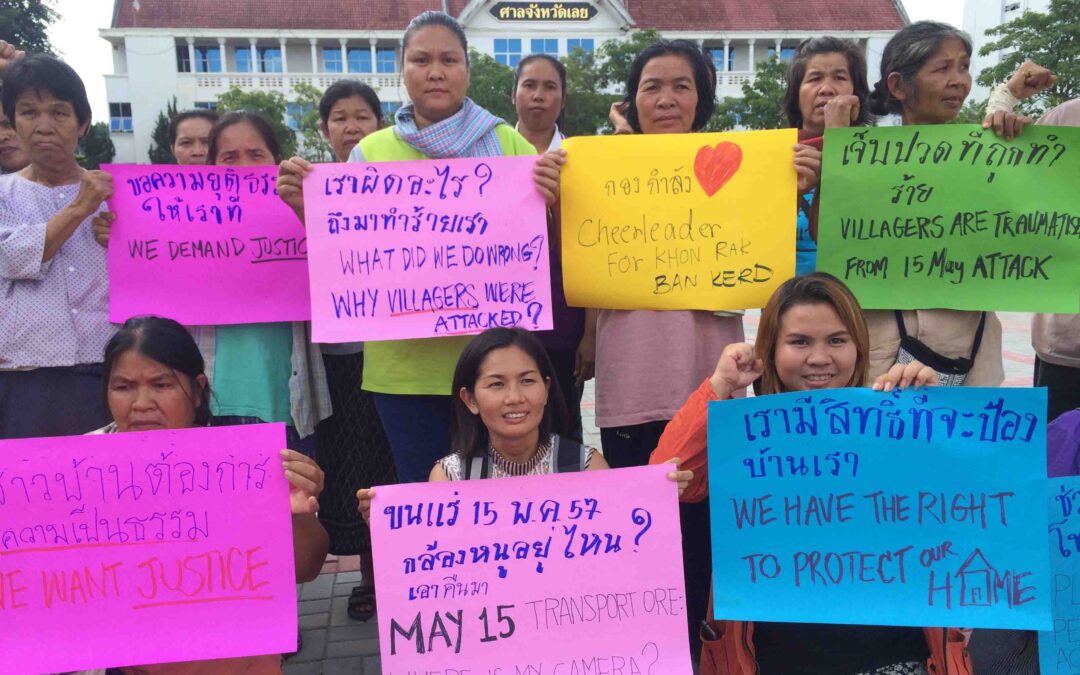
Late in the evening of 15 May 2014, more than 100 men, most of them armed and wearing black masks, stormed a small village in Loei Province, northeast Thailand and assaulted more than a dozen men and women who oppose a local copper-gold mine.
After testing in 2007 showed contamination of the local water supplies, villagers in six communities surrounding the mine in Loei Province formed a network—Khon Rak Ban Kerd Group (KRBKG)—to advocate for the mine’s closure and rehabilitation of the local environment.
The communities went so far as to barricade the road to the mine in 2014. That’s when the armed men arrived, unlawfully detaining scores of villagers and injuring at least a dozen in a fit of violence that lasted six hours.
Despite the villagers’ calls for help, no police intervened.
Only two of more than 100 assailants were brought up on criminal charges for the attack: a retired Royal Thai Army officer and his son, who is still serving in the Army.
On 31 May 2016, the Loei Provincial Court convicted the two military personnel on criminal charges including causing bodily harm, deprivation of liberty, and the unnecessary use of firearms in public.
They were sentenced to just under two years and three years’ imprisonment, respectively, and ordered to pay nine villagers more than 160,000 Thai Baht (US$4,475) in compensation. The two men have been released on bail.
The company operating the gold mine—Tungkum Ltd.—has vehemently denied wrongdoing and has brought at least 19 criminal and civil complaints against villagers protesting the mine, including most recently a criminal defamation complaint against a 15-year-old girl who narrated a Thai PBS broadcast that touched on the question of the gold mine and the environment.
Sadly, this has been the pattern of “development” in Thailand. Throughout the country, communities face threats, violence, and judicial harassment.
Consider the situation in Surat Thani Province. In the early afternoon of 8 April 2016, an unidentified gunman opened fire on land-rights activist Supoj Kansong as he returned home in his vehicle in Chaiburi District.
He sustained serious injuries in the attack and was fortunate to survive.
But other land-rights activists have not been as fortunate.
Supoj Kansong is the fifth member of the Southern Peasant Federation of Thailand (SPFT)—a group advocating for the land rights of farmers who are in a dispute with the Government and a palm oil company operated by Thai-owned Jiew Kang Jue Pattana Co., Ltd–to have been attacked since 2010.
Four members were shot and killed. To date, only one man faced trial for one of the four killings. He was acquitted.
More recently, in March 2016, Akara Resources Public Company Limited, a Thai gold mining subsidiary of the Australian firm Kingsgate Consolidated Limited, filed complaints of criminal defamation against two human rights defenders who opposed the company’s mining operations in Pichit Province and allegedly posted negative comments about the company on Facebook.
On Thailand’s western border in Tak Province, on 15 May 2015, Thai authorities ordered members of the Mae Sot Rak Thin Group—a network of villagers in Mae Sot District—to vacate their land to make room for the Government’s plan to develop a Special Economic Zone.
Villagers told us that state security forces blocked them from submitting complaints about the eviction to the authorities on multiple occasions.
In all these cases, human rights defenders demanding justice are being sidelined and silenced.
But Thailand has a legal obligation to protect all human rights defenders from retaliation for exercising their rights.
On 17 December 2015, Thailand joined 127 other states at the UN General Assembly in adopting a UN Resolution on human rights defenders.
The Resolution calls upon states to refrain from intimidation or reprisals against human rights defenders and to allow for the peaceful and free expression of dissent.
It calls upon businesses to respect the rights of human rights defenders and to identify and address any adverse human rights impacts related to their activities through meaningful consultation with potentially affected groups and other relevant stakeholders.
In addition, in May 2016, Thailand accepted recommendations from six UN member states related to protecting human rights defenders during its Second Universal Periodical Review at the UN.
Thailand agreed to promptly and thoroughly investigate reports of intimidation, harassment, and attacks against human rights defenders and to hold perpetrators accountable.
Thailand’s support for these principles on the world stage is heartening, but it means little without concrete action at home.
Thailand has a long way to go to ensure its international obligations are met and human rights defenders are protected.
As a start, Thailand should guarantee access to effective remedies and reparations for individuals and communities whose rights have been violated.
The Government should ensure that meaningful legal frameworks are available and effectively implemented to facilitate the Free, Prior, and Informed consent of local communities with regard to development projects, and it should ensure companies are held accountable for any environmental damage and human rights abuses.