Feb 22, 2021 | Advocacy, News
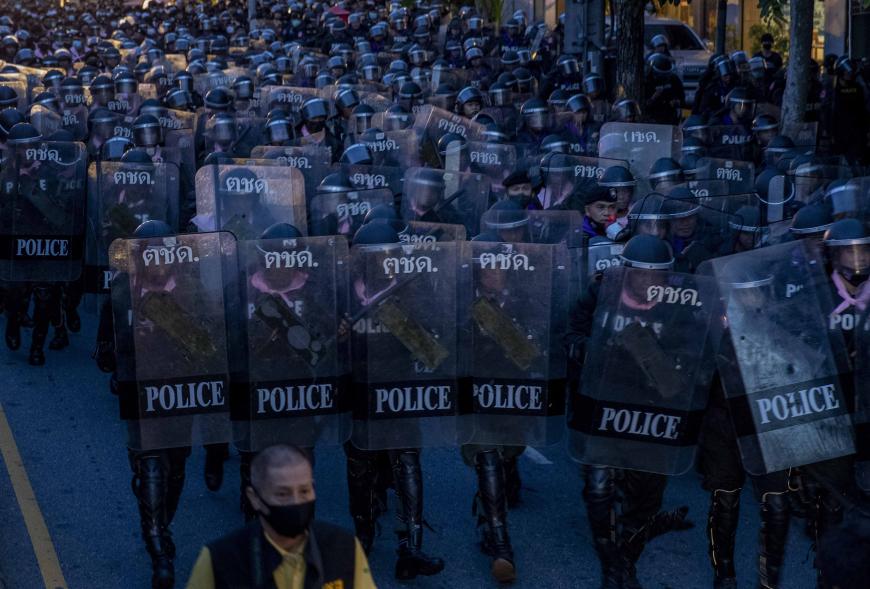
On 13 and 20 February 2021, the ICJ, jointly with Centre for Civil and Political Rights (CCPR Centre), held two consultative sessions on international law and standards relating to the right to freedom of expression, peaceful assembly and the use of force in law enforcement operations.
The discussions took place against the backdrop of recent widescale protests in Thailand, in which people exercising the rights to peaceful assembly and freedom of expression were met with sometimes unlawful force by security units.
Twenty-five Thai and international lawyers, civil society representatives and academics attended both discussion sessions, some participants in person and others online.
The 13 February session focused on relevant international law and standards relating to the rights to freedom of expression, peaceful assembly and the use of force in law enforcement operations, including the International Covenant on Civil and Political Rights (ICCPR), to which Thailand is a party, The sessions were led by Daisuke Shirane, CCPR Centre Asia Pacific Coordinator; Badar Farrukh, OHCHR Regional Office for South-East Asia Human Rights Officer; and Chonlathan Supphaiboonlerd, ICJ Associate Legal Adviser.
Participants considered the exercise in practice of the rights to freedom of expression and information, rights that have recently been unduly restricted in Thailand. Such restrictions were said to have resulted in violations of the rights of individuals who increasingly rely on online platforms, particularly social media platforms such as Facebook and Twitter, to share information on the protests and to express their opinions on the reform movement.
The session included a Q&A session with Christof Heyns, former member of the UN Human Rights Committee and Special Rapporteur on summary, arbitrary and extrajudicial executions. The discussion focused on the scope of the right of peaceful assembly, COVID-19 related restrictions, the State’s duty to facilitate peaceful assembly, and the international legal requirements of legality, necessity and proportionality on State’s response against the protesters.
In the 20 February consultation, Aram Song, attorney of the MINBYUN-Lawyers for a Democratic Society from South Korea, shared with the participant his experiences representing victims of human rights violations arising from police responses to protesters. He discussed the unlawful use of force and the constitutionality of regulations and ordinance that restricting the right to expression and peaceful assembly in the courts. Thereafter, Gayoon Baek, Chief Secretary of the Truth and Reconciliation Commission of the Republic of Korea, gave her views on how to conduct advocacy through international human rights mechanisms to ensure the right to freedom of expression and peaceful assembly.
This workshop is part of the ICJ’s ongoing efforts to bring existing Thai laws in compliance with international laws and standards that regulating the right to freedom of expression and peaceful assembly.
Further reading
Thailand: ICJ co-hosts round-table on right to peaceful assembly

Feb 17, 2021 | News, Non-legal submissions
In a joint letter to the President of the Lawyers Council of Thailand, the ICJ and Lawyers for Lawyers raised concerns on the disbarment proceeding against Mr. Anon Nampha, a lawyer and human rights defender. The organisations believe that the proceedings unduly interfere in his work as a lawyer and serves to impair the exercise of his human rights, including the right to freedom of expression.
Dear President of the Lawyers Council of Thailand,
Re: Disbarment Proceedings Against Mr. Anon Nampha
Lawyers for Lawyers is an independent and non-political foundation that seeks to promote the proper functioning of the rule of law by pursuing freedom and independence of the legal profession.
International Commission of Jurists (ICJ), a global non-governmental organization composed of 60 eminent judges and lawyers, works to advance understanding and respect for rule of law as well as the legal protection of human rights throughout the world.
We write to your office concerning the disbarment proceeding against Mr. Anon Nampha, a lawyer and human rights defender, that is taking place before the Investigative Committee that was established by the Committee on Professional Ethics of the Lawyers Council of Thailand during the Meeting No. 1/2564 on 13 January 2021. We are concerned that the proceeding unduly interferes in his work as lawyer, including in representation of clients, and serves to impair the exercise of his human rights, including the right to freedom of expression.
According to our information, we understand that the proceeding against lawyer Anon Nampha is related to a complaint motion filed to the Lawyers Council of Thailand on 7 August 2020 by Mr. Aphiwat Khanthong, Assistant Minister in the Office of the Prime Minister, claiming to be acting in his capacity as a private attorney at Or Amporn Na Takua Tung and Friends Law Office. Mr. Aphiwat Khanthong alleged that lawyer Anon Nampha’s behaviour violated the Lawyers Council of Thailand’s disciplinary rules as, he claims, it would “incite, intend to cause unrest, distort information and insult on the monarchy”. The alleged speech in question apparently called for reform of the monarchy, during a Harry Potter-themed protest at the Democracy Monument on Ratchadamnoen Avenue on 3 August 2020.
Under international law and standards, lawyers, like other individuals, enjoy the right to freedom of expression, belief, association and assembly. A lawyer should be able to draw the public’s attention to issues relating to public affairs in their official capacity as well as in their private capacity. Suspensions or revocations of lawyer licenses as a result of exercise of their legitimate rights and freedoms do not only impact on the exercise of the rights of the lawyers, but also on the rights of their clients to be represented by the lawyer of their choosing.
Download the full letter in English and Thai.
Feb 12, 2021 | Advocacy, Non-legal submissions
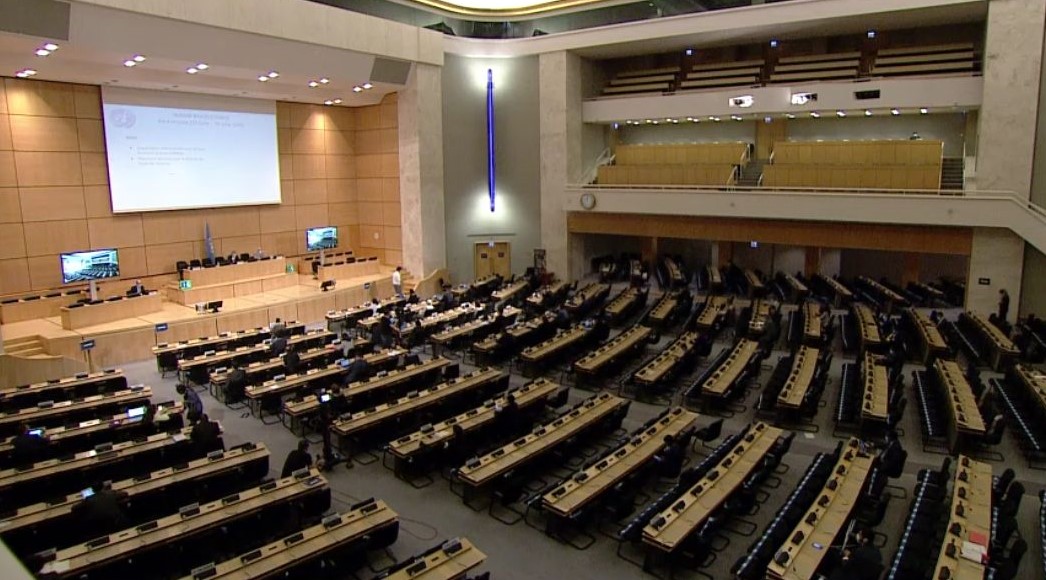
The ICJ today addressed an emergency Special Session of the UN Human Rights Council on Myanmar, outlining violations to human rights and the rule of law occurring in the country since the coup d’état of 1 February.
The Special Session is expected to adopt a resolution to address “The human rights implications of the crisis in Myanmar.”
The ICJ statement read as follows:
“Madame President,
The International Commission of Jurists condemns the Myanmar military’s unlawful seizure of authority and the unconstitutional declaration of a state of emergency on 1 February.
These actions defy core rule of law principles and provide an illegitimate basis for the suspension and erosion of human rights.
Nearly 200 people, including human rights defenders, have been arbitrarily detained, some in unknown locations. Security forces have used excessive force against peaceful protesters, causing serious injuries.
Regulations imposed pursuant to the state of emergency grant military forces nearly complete impunity. Furthermore, these regulations suspend crucial judicial remedies for violations of rights, such as the writ of habeas corpus.
Judges, including from the Supreme Court, have been illegally removed and replaced, undermining the independence of an already embattled judiciary.
The military takeover further endangers the already grave situation of the Rohingya community.
The ICJ calls on the Human Rights Council to urge the military to immediately return authority to the civilian government and allow immediate access to the Special Rapporteur on Myanmar and other special procedures, the OHCHR, and the Independent Investigative Mechanism for Myanmar, whose mandate includes investigating all serious human rights violations.
Member States should take necessary measures to ensure truth, justice and accountability for crimes under international law, including by supporting all relevant accountability mechanisms.
Thank you.”
Feb 12, 2021 | Advocacy, News
The Myanmar military should immediately abandon the draft Cyber Security Law and end Internet restrictions it has imposed since taking power in a coup on 1 February, said ARTICLE 19, Open Net Association, and the ICJ today.
“It is telling that controlling cyberspace is one of the top priorities of the Myanmar military, which seized power through an illegitimate coup d’etat only last week,” said Sam Zarifi, ICJ’s Secretary General. “The military is used to having total power in Myanmar, but this time they have to face a population that has access to information and can communicate internally and externally.”
Under international law, the rights to freedom of expression and information may only be restricted if prescribed by law, in pursuit of a legitimate aim, and necessary and proportionate to that aim. This right applies equally online. In 2018, the UN Human Rights Council condemned ‘all undue restrictions on freedom of opinion and expression online that violate international law’.
“Having illegally seized control of government, the military is trying to ram through a hugely problematic law that would imperil the Myanmar public’s ability to share and access information online,” said Matthew Bugher, ARTICLE 19’s Head of Asia Programme. “The draft law is further evidence of the military’s intent to control online discourse and permanently undermine Internet freedom in the country.”
Human rights bodies and experts have repeatedly condemned Internet shutdowns, which are inherently unnecessary and disproportionate irrespective of their purported objectives. Four UN special procedures with mandates from the Human Rights Council stated in their 2011 Joint Declaration on Freedom of Expression and the Internet that, ‘Cutting off access to the Internet, or parts of the Internet, for whole populations or segments of the public (shutting down the Internet) can never be justified, including on public order or national security grounds’. The UN Human Rights Council has repeatedly called on Myanmar to lift Internet restrictions in the country.
Anonymity is furthermore crucial to protecting the right to freedom of expression and other human rights, including the right to privacy. UN Human Rights Council Resolution 38/7 recognizes that ‘privacy online is important for the realization of the right to freedom of expression and to hold opinions without interference, and the right to freedom of peaceful assembly and association’. The UN Special Rapporteur on freedom of expression in a 2015 report stated that restrictions on encryption must confirm to the three-part test on restrictions to the freedom of expression noted above.
“The ban on online anonymity in the cybersecurity law is not just bad for Myanmar but sets a dangerous precedent for the whole of Asia”, said Kyung Sin Park, Executive Director of Open Net Association, whose founders spearheaded a successful constitutional challenge against a similar law in South Korea in 2012. “The content takedown provisions and criminalization of online speech in the draft law are extremely broad and utterly lacking due process even in comparison to other Asian countries. The proposal smacks of a legislative attempt to extend the powers the military had taken in an unlawful, anti-democratic coup.”
ISPs, online service providers (as defined by the draft law to mean content providers) and other stakeholders have only been given until 15 February for input. This is a clear indication that the military has no intention of engaging in meaningful consultation.
On 10 February, a group of 158 Myanmar civil society organizations released a statement rejecting the draft Cyber Security Law, while reiterating their view that the Myanmar military could not legitimately exercise legislative authority.
“All online service providers inside and outside the country should be alarmed at this intrusion of military authority into cyberspace and refuse to implement these hugely problematic restrictions,” said ICJ’s Sam Zarifi.
SPECIFIC PROBLEMATIC PROVISIONS OF THE DRAFT CYBERSECURITY LAW (based on an unofficial translation of the draft law):
Many provisions in the draft law are vague and overbroad, in contravention of the principle of legality. If enacted, the draft law would greatly extend the powers of military authorities to restrict and punish online expression.
The law provides overarching control to the military’s ‘State Administration Council’, a newly-formed body appointed by the Commander-in-Chief. The direct military control of Internet service provision and its role in the policing of content online is in and of itself cause for alarm. Further, the military should in no circumstances be charged with protecting personal data.
Section 29 of the draft law is overly broad as it demands the prevention, removal, destruction and cessation of a broad and vaguely defined range of expression, including online comments deemed ‘misinformation’ or ‘disinformation’, any expression that causes hate and risks disrupting unity, stability, and peace, and ‘written and verbal statements against any existing law’.
Under section 64, any person convicted of creating ‘misinformation’ and ‘disinformation’ with the intent of causing public panic, loss of trust or social division in cyberspace is punishable by three years’ imprisonment, a fine, or both.
International human rights bodies have repeatedly urged governments against laws that create ‘false news’ offences, warning about their potential abuse by governments to suppress criticism and other forms of speech protected by international human rights law.
Section 30 threatens the right to online anonymity by requiring online service providers to retain usernames, IP addresses, national IDs, and other personal data for up to three years, and to provide this information to authorities upon request. For this purpose, Section 28 requires an online service provider to ensure that any device that stores the user’s information must be kept in a place designated by the relevant Ministry.
The draft law also has overly broad catch-all provisions in Sections 61 and 73 respectively whereby online service providers that fail to comply with any provisions of the draft law face a maximum penalty of three years’ imprisonment and a fine and individuals failing to comply with any rules, regulations, notifications, orders, directives, and procedures issued under the draft law are subject to one year’s imprisonment and a fine. These sanctions which are punitive in purpose and effective are non-compliant with the requirement of proportionality under international human rights law and standards on freedom of expression.
The draft law also provides for enhanced power to control the Internet without the benefit of judicial review by independent civilian courts. In the ‘public interest’, a ministry approved by the State Administration Council may temporarily prohibit any online service or take control of devices related to online service provision, as well as permanently ban any online service provider. This is a less stringent standard than that provided under the problematic and much-criticized section 77 of the Telecommunications Act, which allows for shut downs or control of telecommunications in an ‘emergency situation’.
Download
Statement in Burmese.
Contact
Osama Motiwala, ICJ Asia-Pacific Communications Officer, e: osama.motiwala(a)icj.org
Feb 11, 2021
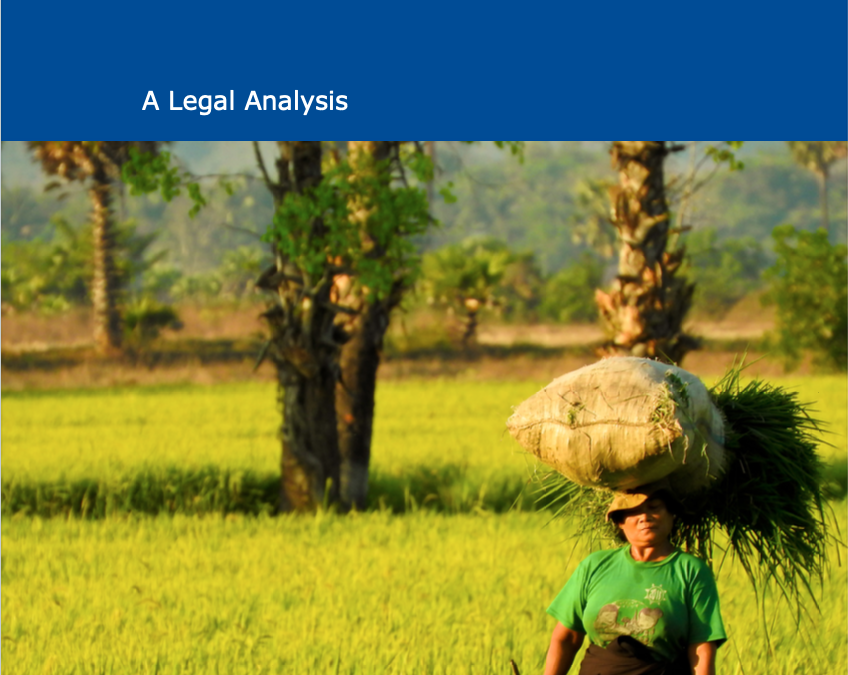
In a new report published today, the ICJ called on the Thai Government to review and amend its laws, policies and practices to remove obstacles in holding Thai companies accountable for wrongdoing outside the country’s borders.
The recommendations of the report, addressing business activities of a transnational character, include a request for the Government to ensure that its laws and actions are in alignment with Thailand’s international legal obligations and international human rights standards.
Some of obstacles that are identified include: limitations on liability owing to the status of companies as legal persons as opposed to natural persons; the legal nature of corporations as distinct juridical entities; evidentiary challenge of access to corporate documentation; jurisdictional challenges in the home state; conflict of laws; and statutes of limitation.
The report also looks at the aspects of complexities in civil and administrative liability and the use of collective complaints for redress.
The report analyses Thailand’s legal framework governing corporate legal accountability for outbound investments and the remedies available and accessible to affected persons.
It recalls the obligations of Thailand to protect the human rights of persons not only within its territory, but also, to some measure, extraterritorially. This obligation extends to activities of Thai business entities, especially in cases where the remedies available to victims before the domestic courts of the State where the harm occurs are unavailable or ineffective.
Key recommendations to the Government of Thailand, the Parliament of Thailand and justice sector actors include:
- Extending the jurisdiction of Thai courts to cover claims against corporations and State enterprises that are domiciled or which principally conduct their business affairs in Thailand, regardless of whether alleged human rights abuses by the companies or their subsidiaries occurred in another country;
- Expanding liability for certain abuses caused by the conduct of a company’s subsidiaries over which it exerts control;
- Providing legal and procedural guarantees in domestic law to increase access to information about corporations and their activities, particularly in relation to cross-border enterprise activities;
- Relaxing the rule governing statutes of limitations to ensure that it will not be unduly restrictive to injured persons seeking to bring claims relating to human rights abuses committed abroad by corporations, including – by providing that a statute of limitation shall not be effective against civil or administrative actions brought by victims seeking reparation for serious human rights abuses;
- Facilitating access to justice of victims and their representatives in ensuring their agency in choosing the appropriate jurisdiction and justice mechanism before which they can litigate their case or otherwise seek remedy or reparation;
- Processing class action trials without undue delay and allowing class suit for cases filed in a Thai court by plaintiffs from another country who may not have the resources or capacity to otherwise pursue a claim individually before Thai courts;
- Ensuring that the division between administrative and civil jurisdiction, particularly for State enterprises, should not be used as a reason to obstruct victims or their representatives in accessing justice;
- Strengthening the role of the National Human Rights Commission of Thailand (NHRCT) to investigate, document, and expose instances of human rights abuse committed by Thai transnational corporations abroad, even in the absence of express powers;
- Providing training for members of the legal and judicial professions in handling cases involving corporate human rights abuse, and particularly abuse arising from cross-border business activities; and
- Providing legal aid and other funding schemes to claimants who are citizens and non-citizens in relation to cases of rights abuses arising from business activities.
Download
Southeast-Asia-Access-to-Justice-Thai-companies-Publication-ENG (English)
Southeast-Asia-Access-to-Justice-Thai-companies-Publication-THA (Thai)




