Mar 4, 2020 | News
Following the arrest on 28 February of at least three persons, the ICJ has called on the Hong Kong authorities to drop criminal charges of taking part in an “unauthorized assembly” against them and to reform the Public Order Ordinance in compliance with international human rights obligations.
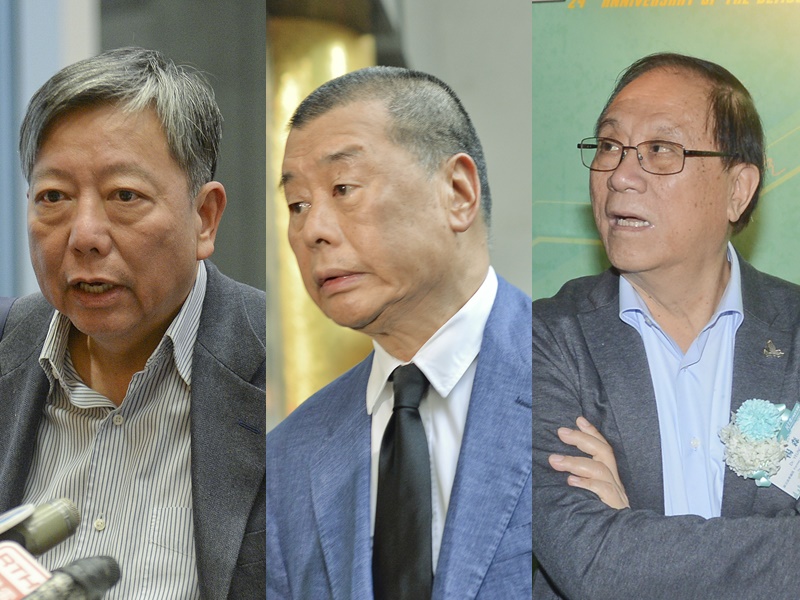
On 28 February, Hong Kong police arrested publisher Jimmy Lai, the founder of Next Media, which publishes the Apple Daily newspaper, and two pro-democracy activists, Lee Cheuk-yan, the vice-chairman of the Labour Party, and Yeung Sum, a former chairman of the Democracy Party, for taking part in a march banned by police on 31 August 2019. The Police prohibited the march on the stated grounds that the Civil Human Rights Front could not guarantee the march would be peaceful and orderly, shifting responsibility of maintaining order to the organizer.
“We are extremely concerned about the way in which the unauthorized assembly provisions of the Public Order Ordinance has been used to silence lawful expressions of political opinion since the Umbrella Movement of 2014,” said Frederick Rawski, ICJ’s Asia Pacific Director. “These most recent arrests, made for allegedly participating in a largely peaceful protest more than six months ago, are part of a troubling pattern of bringing legal action to harass activists involved in peaceful acts of protest.”
The arrests were made pursuant to the Hong Kong SAR Public Order Ordinance (Cap. 245) Section 17A(3)(a). Under the ‘unauthorized assembly’ provisions of the law, every person who, without lawful authority or reasonable excuse, knowingly takes or continues to take part in or forms or continues to form part of any such unauthorized assembly is guilty of an offence and can be sentenced up to five years imprisonment.
The authorities have wide discretion to prohibit public meetings, and prosecute those who are alleged take part in them. These overbroad provisions have been used to restrict the proper exercise of free assembly and association rights – including onerous requirements to obtain a “notice of no objection” from the government for even small gathering under a threat of a maximum five years imprisonment for violations.
“The ICJ calls upon the Hong Kong SAR government to take measures to protect the right to peaceful assembly and create an environment in which people can safely express diverse ideas and dissenting voices – consistent with international legal obligations,” said Rawski. “This includes ensuring that the law is not used to harass pro-democracy activists and human rights defenders.”
The ICJ underscores that any restrictions to the right of peaceful assembly must be narrowly drawn to be permissible under international law. Restrictions are not permissible unless they have been provided by law, and are necessary and proportionate to a legitimate purpose enumerated in article 21 of the ICCPR, such as public order. However, imposing criminal charge on people exercising their right of peaceful assembly who fail to comply with a procedural requirement, such as notification, unduly restricts freedom of peaceful assembly by adding unnecessary barriers to public gatherings. Furthermore, the sentencing guidelines of the Ordinance, which include the possibility of a peaceful participant of a public assembly being sentenced to five years in prison if the organizers fail to comply with the notification requirement, are extreme, disproportionate and open to abuse.
Hong Kong SAR, though not the rest of the PRC, is legally bound by the ICCPR. Article 21 of the ICCPR and Article 27 of the Basic Law in Hong Kong both recognize and protect the right of peaceful assembly. The UN Human Rights Committee, the supervisory body responsible for the ICCPR and other UN independent authorities, have repeatedly urged the authorities to ensure that the Public Order Ordinance is implemented in conformity with Hong Kong’s obligations under the ICCPR.
To download the full statement with additional information, click here.
See also: Hong Kong: ensure police do not use excessive force against protesters
https://www.icj.org/hong-kong-ensure-police-do-not-use-excessive-force-against-protesters/
Contact:
Frederick Rawski, ICJ’s Asia Pacific Regional Director, t: +66 2 619 84 77; e: frederick.rawski(a)icj.org
Boram Jang, ICJ Legal Adviser, Asia & the Pacific Programme, e: boram.jang(a)icj.org
Mar 2, 2020 | News
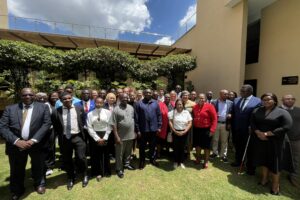
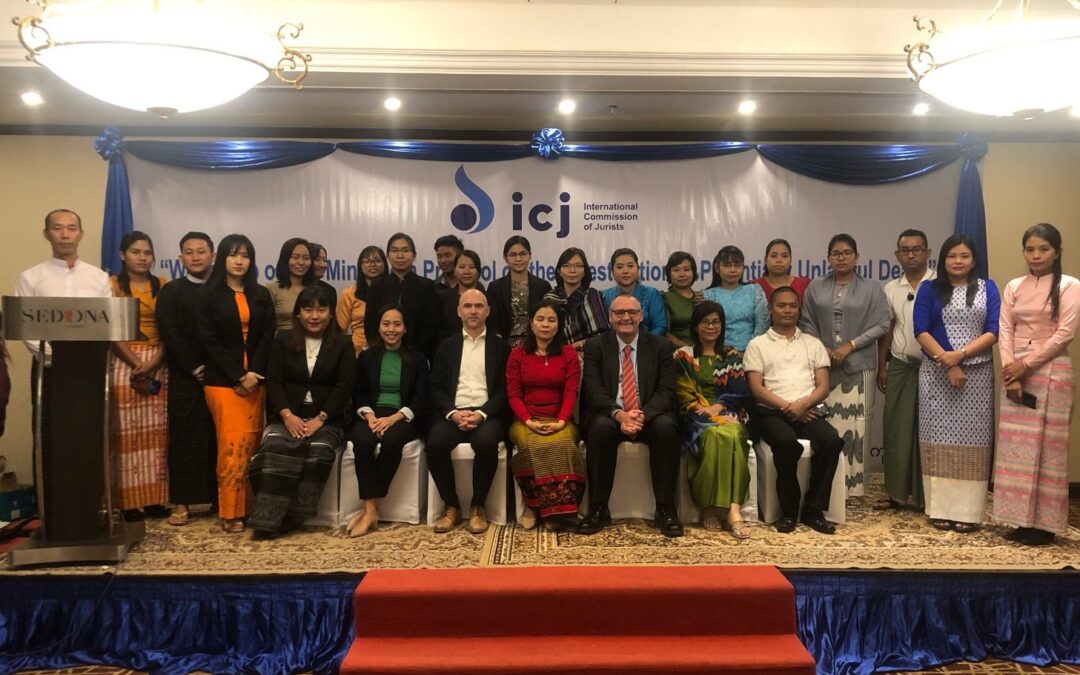
The ICJ hosted a two-day workshop on 29 February and 1 March 2020 in Yangon, Myanmar entitled “Workshop on the Minnesota Protocol on the Investigation of Potentially Unlawful Death.”
Some 25 lawyers attended the event, including criminal lawyers handling murder cases and human rights lawyers. The workshop was opened with remarks by Frederick Rawski, Director of the ICJ’s Asia & Pacific Programme. He emphasized the importance of conducting investigations consistent with international standards in holding perpetrators accountable for unlawful killings.
The Minnesota Protocol provides guidance on the State’s implementation of its duty under international law to investigate potentially unlawful killings, including when State actors may have been involved. It applies to deaths under custody, suspicious deaths and enforced disappearances. Myanmar has experienced widespread incidents of such deaths, including in recent years those constituting serious crimes under international law.
An overview of the international human rights law framework was provided by ICJ Associate Legal Adviser Jenny Domino, highlighting how the conduct of prompt, effective and impartial investigations into unlawful killings is a core component of the State’s obligation to uphold the right to life. Drawing from her previous work in the Philippines, she also discussed the applicability of Minnesota Protocol standards to the human rights investigations of the killings arising from the Philippine ‘war on drugs’. ICJ Legal Adviser Hnin Win Aung then introduced the Minnesota Protocol and its 2016 revision before discussing the role of lawyers in ensuring that the State conducts investigations in accordance with international standards.
Glenn Williams, an experienced international criminal investigator and Detective Inspector (Retired) of the New Zealand Police Force, discussed how to properly secure a crime scene and chain of custody in order to preserve the integrity of the evidence. Participants applied these skills in a group exercise based on a real-life case scenario. He also presented on the proper conduct of witness interviews and the investigative challenges of dealing with telecommunications evidence.
Dr Porntip Rojanasunan, a forensic pathologist in Thailand and Member of the Expert Advisory Panel during the Minnesota Protocol revision process, shared her forensic expertise through illustrative cases that she had worked on in Southeast Asia in the past two decades. Dr Porntip stressed the importance of forensic pathology in determining the true cause of death and of conducting an autopsy in potential cases of human rights violations.
The workshop is part of the ICJ’s ongoing promotion of international human rights law and standards globally. In Asia, this has included engagement with Myanmar authorities as well as authorities in neighboring countries on the Minnesota Protocol.
See also
Myanmar: ICJ co-hosts Minnesota Protocol workshop with government authorities
Myanmar: ICJ discusses the Minnesota Protocol with prosecutors
Statement: Five years without justice for journalist Ko Par Gyi
Related material
Minnesota Protocol (English)
Minnesota Protocol (unofficial Burmese translation)
Feb 28, 2020 | Advocacy, Non-legal submissions
At the UN Human Rights Council, the ICJ today urged renewed international action to ensure justice and accountability for crimes under international law in Sri Lanka.
The statement, delivered during a discussion of updates and reports from the High Commissioner for Human Rights, read as follows:
“The ICJ deeply regrets the Sri Lankan Government’s withdrawal of support for the process under resolutions 30/1 and 40/1. ICJ supports the joint statement read by IMADR.
The Sri Lankan legal system and judicial institutions have for decades demonstrated a chronic inability to address systemic and entrenched impunity for crimes under international law perpetrated by the military and security forces.[1] The new President’s promises to protect the military from accountability, and senior command appointments of individuals credibly accused of crimes under international law, only deepen the concern.
As the High Commissioner notes,[2] the failure to deal comprehensively with impunity and to reform institutions may lead to more human rights violations.
The Tamil population have consistently and rightly rejected any reconciliation process that ignores justice and accountability, and it is obvious that no justice or accountability process that is left to domestic Sri Lankan institutions alone can be credible. The compromise national-international “hybrid” judicial accountability mechanism foreseen by resolution 30/1 already fell far short of what the situation actually warrants.
If the Government seeks now to abandon even that compromise, purely international processes, whether before the ICC or through creation of another international accountability mechanism by the Council, and the exercise of universal jurisdiction by other States, are the only remaining options for securing the justice required by international law and indispensable to any credible reconciliation process for Sri Lanka.”
[1] International Commission of Jurists, Authority without Accountability: The Crisis of Impunity in Sri Lanka, 2012, https://www.icj.org/sri-lanka-new-icj-report-documents-crisis-of-impunity/; Human Rights Council must respond to ongoing failure of Sri Lankan justice system to ensure accountability for human rights violations, 2014, https://www.icj.org/human-rights-council-must-respond-to-ongoing-failure-of-sri-lankan-justice-system-to-ensure-accountability-for-human-rights-violations/; Sri Lanka: the need for an international inquiry, 2014, https://www.icj.org/sri-lanka-the-need-for-an-international-inquiry/; Sri Lanka: Joint Open Letter to the Ambassadors of UN Human Rights Council Member States, 2015, https://www.icj.org/wp-content/uploads/2015/07/SriLanka-JointOpenLetter-Accountability-Advocacy-2015.pdf; Sri Lanka’s victims demand and deserve credible justice, 2016, https://www.icj.org/sri-lankas-victims-demand-and-deserve-credible-justice/.
[2] UN Doc A/HRC/43/19, para 36.
Feb 27, 2020 | Events, News
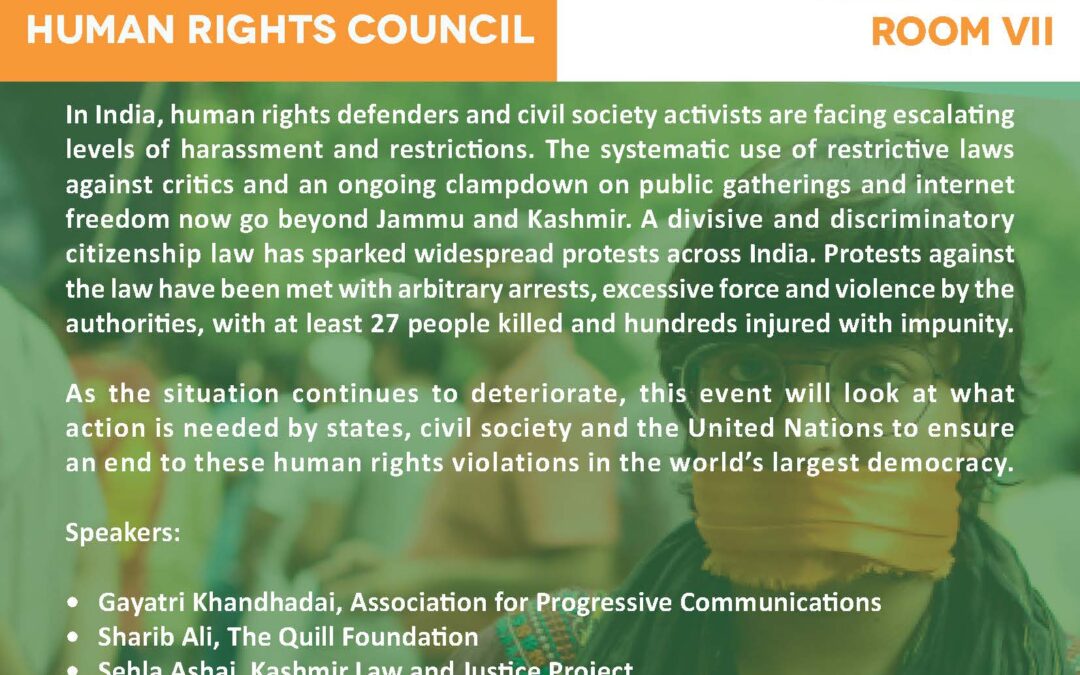
On 2 March, the ICJ and other NGOs will present discussion of the situation for human rights in India at a side event to the UN Human Rights Council in Geneva.
The event takes place Monday 2 March 2020, 14:00 – 15:00, in Room VII, Palais des Nations, Geneva.
In India, human rights defenders and civil society activists are facing escalating levels of harassment and restrictions. The systematic use of restrictive laws against critics and an ongoing clampdown on public gatherings and internet freedom now go beyond Jammu and Kashmir. A divisive and discriminatory citizenship law has sparked widespread protests across India. Protests against the law have been met with arbitrary arrests, excessive force and violence by the authorities, with at least 27 people killed and hundreds injured with impunity.
As the situation continues to deteriorate, this event will look at what action is needed by states, civil society and the United Nations to ensure an end to these human rights violations in the world’s largest democracy.
A flyer for the event can be downloaded here in PDF format: UN-Event-India-2019
Feb 27, 2020 | Events, News
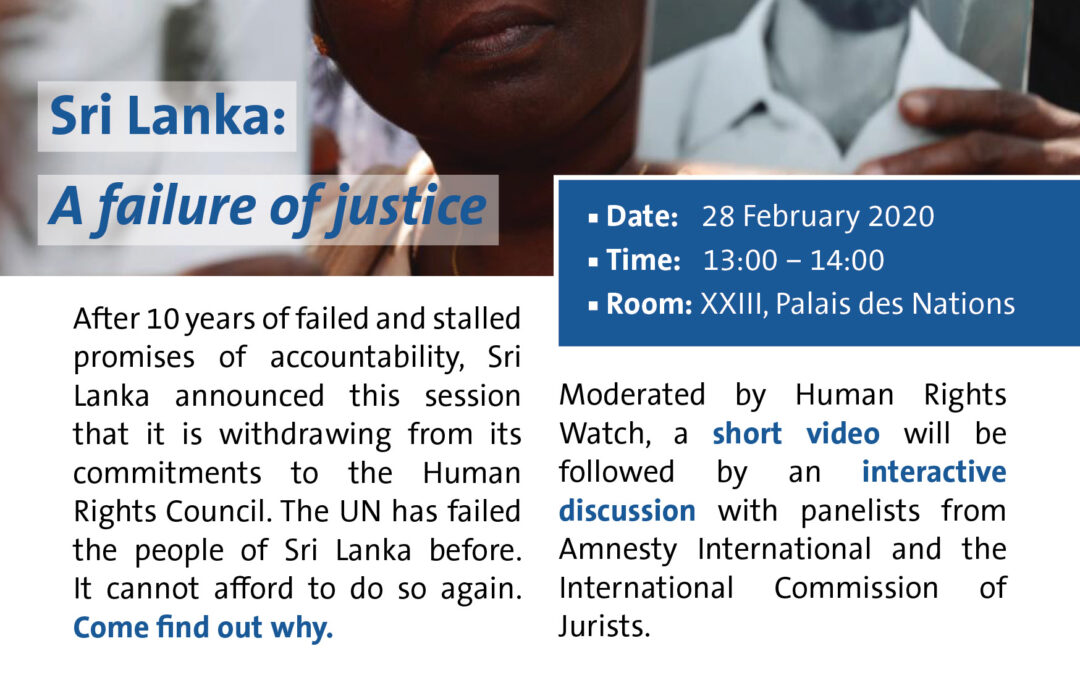
An event at the UN Human Rights Council on 28 February will highlight the continuing failure of Sri Lanka to secure justice for crimes under international law, and discuss ways forward for international efforts to fill the gap.
The event will take place 28 February 2020, 13:00 – 14:00, in Room XXIII of the Palais des Nations in Geneva.
It will be moderated by Human Rights Watch, with a short video will be followed by an interactive discussion with panelists from Amnesty International and the International Commission of Jurists.
A flyer for the event can be downloaded in PDF format here: HRC43 – Sri Lanka