Feb 2, 2016
The report, published today, assesses the current state of the independence and accountability of the Serbian judiciary and prosecution service, and, in particular, the self-governance of the two professions under the High Judicial Council and the State Prosecutors’ Council.
Following ICJ’s visit to Serbia on 26-30 October 2015, the report Serbia’s judges and prosecutors: the long road to independent self-governance concludes that a culture of dependency from the Executive still exists in the Serbian judiciary and that the system is affected by a stress of reform, due to the continued introduction of new judicial reforms without proper implementation.
The ICJ considers that the self-governance of the judiciary and of the prosecution service, entrusted respectively to the High Judicial Council and to the State Prosecutorial Council, is relatively weak.
The ICJ mission has identified considerable shortcomings in these bodies, including:
- excessive dependence in practice on the political branches of government;
- lack of effective procedures and of sufficient will in the Councils to defend the independence, autonomy and professional integrity of their professions and of individual judges and prosecutors;
- appointment, selection and dismissal procedures open to direct and indirect political influence;
- lack of effective procedures of evaluation of the work of judges and prosecutors;
- misuse of such procedures to impose conformity in decisions;
- a strong hierarchical system in the prosecution service and, in practice, in the judiciary, that undermines internal independence and risks undermining independence of investigations and prosecutions.
The mission, aimed to assess the situation of self-governance of the judiciary and of the prosecutorial service at a critical juncture in their development, took place in the context of the ICJ’s global objective to advance the effective administration of justice and the independence of judges and lawyers.
Serbia-Long Road to Indep Self-Gov-Publications-Reports- Fact-Finding Mission Report-2016-ENG (full report in PDF, English)
Serbia-Long Road to Indep Self-Gov-Publications-Reports- Fact-Finding Mission Report-2016-SER (full report in PDF, Serbian)

Feb 1, 2016
Today is the first of a four-day hearing at the UK Supreme Court in joined appeals from the High Court (Al-Waheed v Ministry of Defence) and the Court of Appeal (Ministry of Defence v Mohammed and Others), in which the ICJ intervened.
The case concerns the detention of persons in Iraq and Afghanistan during the non-international armed conflict phases of British military operations in those countries. Together with Human Rights Watch, Amnesty International and Open Society Justice Initiative, the ICJ submitted an intervention in the joined appeal, addressing:
- The complementary application of international humanitarian law (IHL) and international human rights law (IHRL) in situations of armed conflict.
- The lack of authority under IHL, whether treaty or customary law, for internment in situations of non-international armed conflict (NIAC), including consideration of the inapplicability in NIAC of internment rules that govern situations of international armed conflict.
- The requirement that detention in NIACs is compliant with IHRL, the implications of this and the key means by which internment can be lawful while also responsive to the exigencies of the situation.
UK-GlobalSecurity-DetentionArmedConflict-Advocacy-Legal submissons-2016-ENG (download the joint intervention)

Jan 15, 2016
Today, the ICJ submitted a third-party intervention in the case of M.B. v. Spain before the European Court of Human Rights.
The case arose from the attempted removal of a lesbian asylum applicant to Cameroon. The ICJ’s written submissions focus on the relevance of the Refugee Convention, as interpreted by a number of domestic courts, and the EU asylum acquis and the EU Charter of Fundamental Rights, to the determination of the scope and content of non-refoulement obligations under Article 3 of the European Convention on Human Rights (ECHR) of those Contracting Parties that are also EU Member States.
The ICJ’s intervention, in particular, addresses the following:
- the requirement of coerced (including self-enforced) concealment of one’s same-sex sexual orientation, which constitutes persecution under refugee law and is incompatible with the ECHR, in particular Article 3; and,
- the criminalization of consensual same-sex sexual conduct, which gives rise to a real risk of Article 3 prohibited treatment, thus triggering non-refoulement obligations under that provision of the ECHR.
Spain- ECtHR MB v Spain – advocacy – legal-submissions-2016-ENG
Dec 18, 2015 | Events, News
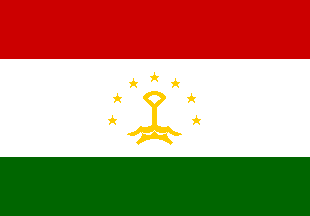
Today the ICJ held a round table “Organisation and operation of the Legal Profession: International Comparative Perspective” in Dushanbe, Tajikistan.
The ICJ invited experts to speak about comparative experiences from their countries to inform the national debate about the reform of the legal profession currently underway in Tajikistan.
Experts contributing to the discussion included: Tamara Morschakova, an ICJ Commissioner and former Justice of the Constitutional Court of the Russian Federation; Olga Swartz, a legal scholar from the Russian Federation; Daniyar Kanafin, a lawyer from Kazakhstan; Gulniza Kozhomova, President of the Bar Association of the Kyrgyz Republic; Almaz Osmanova, Member of the Board of the Bishkek Bar Association (Kyrgyz Republic); Jeroen Brower, Chair of the Ethics Commission of the Dutch Bar Association; and lawyers and other stakeholders from Tajikistan.
Participants discussed the principles and practice of the independence and self-governance of bar associations, as well as other issues of significance for the independence of lawyers, including the qualification process and disciplinary action.
Programme of the event in English and in Russian:
Tajikistan_roundtable_ agenda_Eng (PDF, English)
Tajikistan_roundtable_ agenda_Rus (PDF, Russian)
Dec 18, 2015 | Новости, Событие, Статьи
Сегодня в Душанбе, Таджикистане состоялся круглый стол «Организация и деятельность юридической профессии: международная сравнительная перспектива».
МКЮ пригласила экспертов рассказать о сравнительном опыте своих стран для информирования национальных дебатов о реформе юридической профессии, которые в настоящее время проводются в Таджикистане.
В дискуссии участвовали: Тамара Морщакова, комиссар МКЮ и бывший судья Конституционного Суда Российской Федерации; Ольга Сварц, юрист из Российской Федерации; Данияр Канафин, юрист из Казахстана; Гульница Кожомова, президент Ассоциации юристов Кыргызской Республики; Алмаз Османова, член Правления Бишкекской коллегии адвокатов (Кыргызская Республика); Джероун Броуэр, председатель Комиссии по этике Ассоциации юристов Нидерландов; и юристы и другие заинтересованные стороны из Таджикистана.
Участники обсудили принципы и практику независимости и самоуправления коллегий адвокатов, а также другие вопросы, имеющие значение для независимости адвокатов, включая процесс квалификации и дисциплинарные меры.
Программа мероприятия на русском языке:
Tajikistan_roundtable_ agenda_Rus