Mar 6, 2019 | News
Today, the ICJ expressed concern at the initiation of disbarment proceedings by the Ministry of Justice of Kazakhstan against Sergey Sizintsev, former Executive Director of the National Bar Association and the newly-elected head of the Scientific-Consultative Board of the National Bar Association.
The official ground for disbarment of Sizintsev is his work as the Director the National Bar Association in 2016-2018 while continuing his legal practice at the same time.
On his facebook public account, however, Sizintsev alleged that this initiative is not related to the officially stated grounds, and that in fact continuing to practice while working as Director of the Bar Association is clearly permitted by the Kazakhstan’s law. Rather, he alleges, he is being pursued for his criticism of the law “On lawyers’ activity and legal aid” as well as his public statements in different international and national fora in regard to issues related to the independence of the legal profession.
The ICJ recalls that freedom of expression and association, in particular, constitute essential requirements for the proper and independent functioning of the legal profession and must be guaranteed by law and in practice.
According to Principle 23 of the UN Basic Principles on the Role of Lawyers, lawyers “[…] have the right to take part in public discussion of matters concerning the law, the administration of justice and the promotion and protection of human rights and to join or form local, national or international organizations and attend their meetings, without suffering professional restrictions by reason of their lawful action or their membership in a lawful organization. In exercising these rights, lawyers shall always conduct themselves in accordance with the law and the recognized standards and ethics of the legal profession.”
Sergey Sizintsev as Executive Director of the National Bar Association and as a member of the Parliament working group on the Law on Lawyers’ Activities, was expected to voice concerns of members of the legal position including on the new law which the legal profession consider to be restrictive.
Moreover, his position demanded that he expresses his position on behalf of the National Bar Association including to draw attention to legislative developments which can jeopardise the independence of the legal profession in Kazakhstan.
The ICJ is concerned that this initiative appears to constitute an attack on the independence of lawyers in Kazakhstan and may have a chilling effect on members of the legal profession.
The ICJ therefore calls on the Ministry of Justice to end this lawsuit immediately.
The ICJ will closely follow the case of Sergei Sizintsev and the proceedings at the Rayon Court in Petropavlovsk.
In December 2017, the ICJ organized a mission to Kazakhstan and raised concerns over the then planned reform.
In November 2018, the ICJ raised concern at the disbarment proceedings against Presidents of Aktybinsk and Pavlodar Bar Association as well as resignation of Anuar Tugel, the President of the National Bar Association of Kazakhstan, allegedly as a result of the pressure from the Ministry of Justice.
Mar 4, 2019 | News
Today, the ICJ expressed concern at the disciplinary proceedings against lawyer Elchin Sadigov who was sanctioned with a reprimand on 25 February 2019 by the Presidium of the Bar Association of Azerbaijan.
The ICJ called on the Bar Association to reverse this sanction and take measures to end interference with the independent exercise of the representation of victims of human rights violations.
The decision to hold the lawyer accountable for actions taken in accordance with professional ethics and responsibilities jeopardizes the independence of lawyers and their capacity to protect human rights, and is likely to have a chilling effect on the independent exercise of lawyers’ duties in Azerbaijan, the ICJ said.
Elchin Sadigov represented Yunis Safarov, who was charged with the attempted murder of Elmar Valiyev, former mayor of Ganja City in Azerbaijan. According to Sadigov, he informed his client in a confidential conversation in detention, of the right to complain about torture or ill treatment.
Shortly afterwards, he was told that he had violated the law by persuading his client to complain about the ill-treatment which, the Prosecutor General’s Office officials “decided” in an official document, never took place.
On 5 September 2018, the Prosecutor General’s Office removed Elchin Sadigov as Safarov’s representative and complained to the Bar Association, seeking disciplinary action against the lawyer, among others, on the basis of “[…] creating false grounds to file a complaint to the European Court of Human Rights […], clearly knowing that it is not true, proposed his client to complain about torture inflicted by the police and investigative authorities, despite the fact that the accused told him that he had not been tortured, Sadigov continued psychological influence on his client again – as if he had been tortured – to refuse giving testimony, to refuse services of the State appointed lawyer […]”.
The complaint referred to the confidential conversation between the lawyer and his client, which was apparently overheard and possibly recorded by law enforcement officials. It also refers to a letter which appeared during the disciplinary proceedings, in which Sadigov’s client complained that his lawyer had tried to convince him to complain about use of torture in custody.
According to Elchin Sadigov, however, this letter may have been signed by his former client under pressure from the detention authorities.
The ICJ recalls that according to the UN Basic Principles on the Role of Lawyers, it is indispensable that lawyers “always loyally respect the interests of their clients.”
The Principles specify that they assist their clients “in every appropriate way, and taking legal action to protect their interests”. In the present case, as submitted by Elchin Sadigov and evident from the publicly available materials including photos and videos of Safarov with clear and multiple signs of severe beatings, the lawyer had every reason to believe that his client had been subjected to torture and ill treatment in custody.
Therefore, he had not only the right, but an affirmative professional duty to advise his client to use available remedies for this violation of human rights through procedural means such as a complaint. A failure to do this would be a breach of professional ethics and duties on the part of the lawyer as a trusted representative of his client. The ICJ is concerned that in this case a lawyer was held accountable for attempting to discuss with his client, in a confidential manner, issues related to the human rights of his client.
The ICJ is furthermore concerned that the principle of lawyer-client confidentiality has been violated in this case.
This principle is a fundamental component of the right to a fair trial, as protected under the International Covenant on Civil and Political Rights and the European Convention of Human Rights, to both of which Azerbaijan is a party.
According to the UN Basic Principles on the role of lawyers “[a]ll arrested, detained or imprisoned persons shall be provided with adequate opportunities, time and facilities to be visited by and to communicate and consult with a lawyer, without delay, interception or censorship and in full confidentiality…”
The ICJ is also concerned that lawyer Sadigov’s conversations may have been monitored in violation of the guarantees of professional secrecy with his client and contrary to international law and national procedure.
The ICJ considers it essential that the Bar Association send a strong signal in support of independent lawyers by lifting the sanction against lawyer Sadigov and consider legislative and practical improvements to ensure that confidentially of lawyers and their clients in detention is effectively guaranteed in practice.
Azerbaijan-Statement Sadigov-News-web stories (full story with additional information, in PDF)
Mar 1, 2019 | Events, Multimedia items, News, Video clips
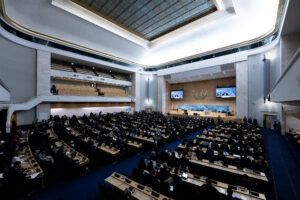
This event took place today at the Palais des Nations, United Nations, in Geneva. Watch it on video.
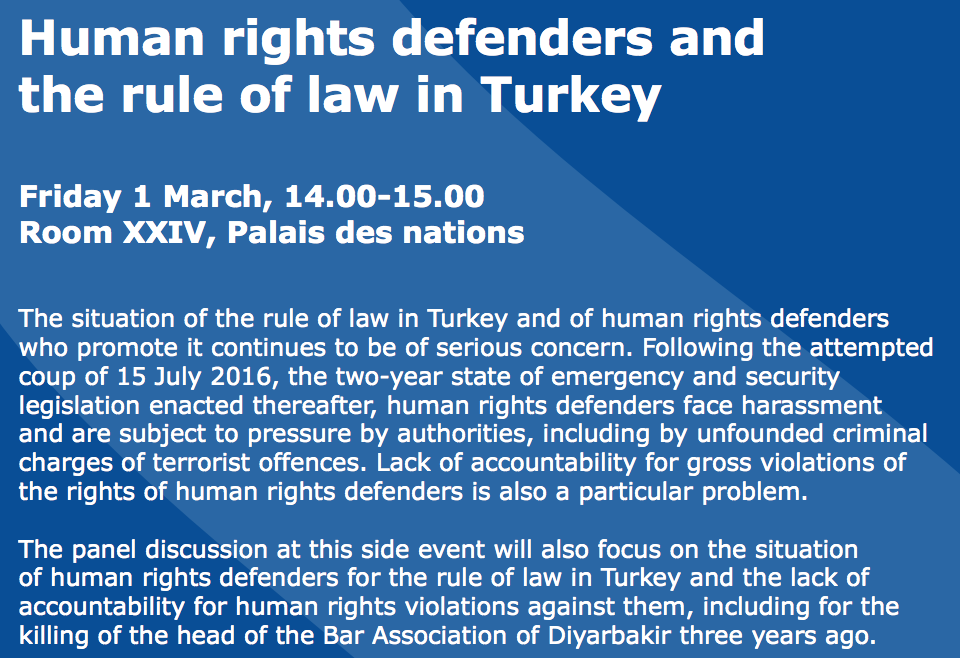
The situation of the rule of law in Turkey and of human rights defenders who promote it continues to be of serious concern.
Following the attempted coup of 15 July 2016, the two-year state of emergency and security legislation enacted thereafter, human rights defenders face harassment and are subject to pressure by authorities, including by unfounded criminal charges of terrorist offenses. Lack of accountability for gross violations of the rights of human rights defenders is also a particular problem.
The panel discussion at this side event will also focus on the situation of human rights defenders for the rule of law in Turkey and the lack of accountability for human rights violations against them, including for the killing of the head of the Bar Association of Diyarbakir three years ago.
The event is organized by the ICJ jointly with the International Bar Association’s Human Rights Institute.
Speakers:
– Michel Forst, UN Special Rapporteur on human rights defenders
– Feray Salman, Coordinator of the Human Rights Joint Platform (IHOP)
– Kerem Altiparmak, ICJ Legal Consultant
– Jurate Guzeviciute, International Bar Association’s Human Rights Institute
Chair:
Saman Zia-Zarifi, ICJ Secretary General
Event Flyer:
Turkey- HRD side event HRC40-News-Events-2019-ENG
https://www.facebook.com/ridhglobal/videos/795507517477571/

Feb 19, 2019 | Advocacy, Cases, Legal submissions
On 19 of February the ICJ submitted a third party intervention to the European Court of Human Rights in the case of Telek and others v. Turkey.
In its intervention, the ICJ addresses two main questions considering the effectiveness of domestic remedies concerning passport cancellation as a consequence of dismissal under emergency decrees:
- Whether the State of Emergency Commission and/or judicial remedies subsequent to the decision of the Commission might constitute an effective remedy.
- Whether separate remedies for passport cancellation can provide effective relief for the applicants’ claims.
In that respect of mentioned systemic issues the ICJ presents the Court the observations concerning the capacity of the Turkish legal system to provide effective remedies for violations under the European Court of Human Rights, in light of its Convention obligations, in particular obligations under Article 13.
The ICJ submission includes analysis of the Turkish legal system based in part on an ICJ mission to Turkey undertaken in May 2018 that focused on the functioning of the State of Emergency Commission created by Legislative Decree no. 685.
Turkey-icj-Telek&Others-Advocacy-legal submission-2019-ENG (download the intervention in Telek and others v. Turkey).
Feb 19, 2019 | News
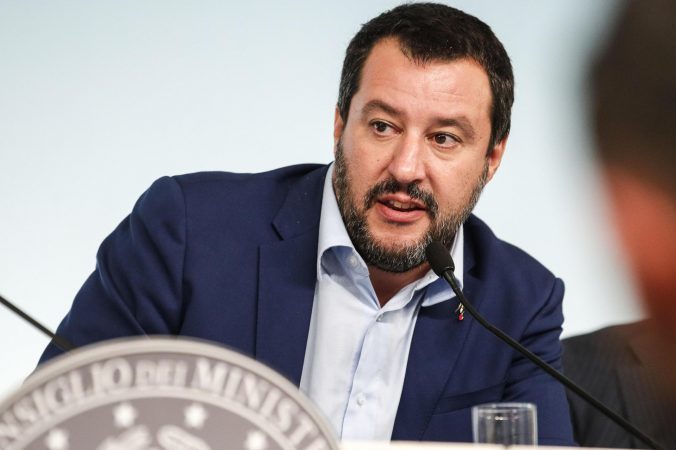
The ICJ today called for the Italian Senate to allow for the investigation of the Minister of Interior and Vice-President of the Council of Ministers, Matteo Salvini, for his role in the alleged arbitrary deprivation of liberty of some 177 persons, including potential refugees, held for five days on the “U-Diciotti” boat last summer.
The ICJ said that the Italian Senate’s Commission on Elections and Immunities should recommend the authorization of the criminal investigation to the full Senate, where Matteo Salvini also sits as a Senator.
“The decision on investigation of gross human rights violations such as mass and arbitrary deprivation of liberty should not be subject to political scrutiny but be left to the assessment of the judiciary,” said Massimo Frigo, Senior Legal Adviser for the ICJ Europe Programme.
The indictment for “kidnapping” against Minister Salvini has already been approved at the judicial stage by the Tribunal of Ministers of Catania, which affirmed that Minister Salvini is alleged to have abused his administrative power in this matter for the political goal of negotiating resettlements with other European countries.
“No human being should effectively be made hostage for the purpose of political negotiations,” said Massimo Frigo.
“It does not matter which country may have been primarily responsible for the rescue at sea. No authority may arbitrarily restrict of the right to liberty of 177 human beings,” he added.
The ICJ considers that it is highly problematic for the principle of the rule of law that the decision on prosecution for a crime underlying a gross violation of human rights, such as kidnapping, be entrusted to a political body.
This decision should be left to the judiciary based on legal and not political grounds.
Under international human rights law, including the European Convention on Human Rights and the International Covenant on Civil and Political Rights, States have an obligation to investigate, prosecute, try and, if found guilty, convict persons responsible of gross violations of human rights, among which counts the arbitrary deprivation of liberty.
This applies to all State officials, irrespective of their position of authority.
Contact
Massimo Frigo, ICJ Senior Legal Adviser, t: +41 22 979 38 05 ; e: massimo.frigo(a)icj.org
Background
The Italian “U. Diciotti” boat was at the centre of a political scandal last August when the Minister of Interior Matteo Salvini refused disembarkation of 177 people for several days in order to negotiate their resettlement with other European countries.
While the boat entered Italian waters on 20 August, they were eventually disembarked in the night between Saturday 25 and Sunday 26 August after some countries and the catholic church made some nominal declaration of resettlement or reception.
Minister Salvini was later accused of “kidnapping” for having arbitrarily deprived of their liberty the 177 persons on board the “U.Diciotti”. While the prosecutor in the case asked for the dismissal of the charges, the Tribunal of Ministers, composed of ordinary judges, that is responsible for the legal assessment of the indictment, held the indictment to be in accordance with the law and that sufficient suspicion existed to warrant an investigation.
According to article 96 of the Constitution and articles 8-9 of the Constitutional Law no. 1 of 16 January 1989, it is up to the Parliament to authorize the investigation and prosecution of a Minister. The decision would therefore be up to the Senate in the case of Minister Salvini, as he is a Senator. The Senate may refuse by absolute majority, if it considers “that the person has acted for the protection of a State interest that is constitutionally relevant or for the pursuance of a preminent public interest in the function of Government” (unofficial translation). No appeal is possible against this decision.
Reportedly, the President of the Council of Ministers, Giuseppe Conte, the Vice-President of the Council of Ministers, Luigi Di Maio, and the Minister Danilo Toninelli, have submitted observations to the Senate’s Committee holding that the decision in the case was the reflecting the line of the whole Government and not only of the Minister of Interior.