Nov 16, 2018 | News
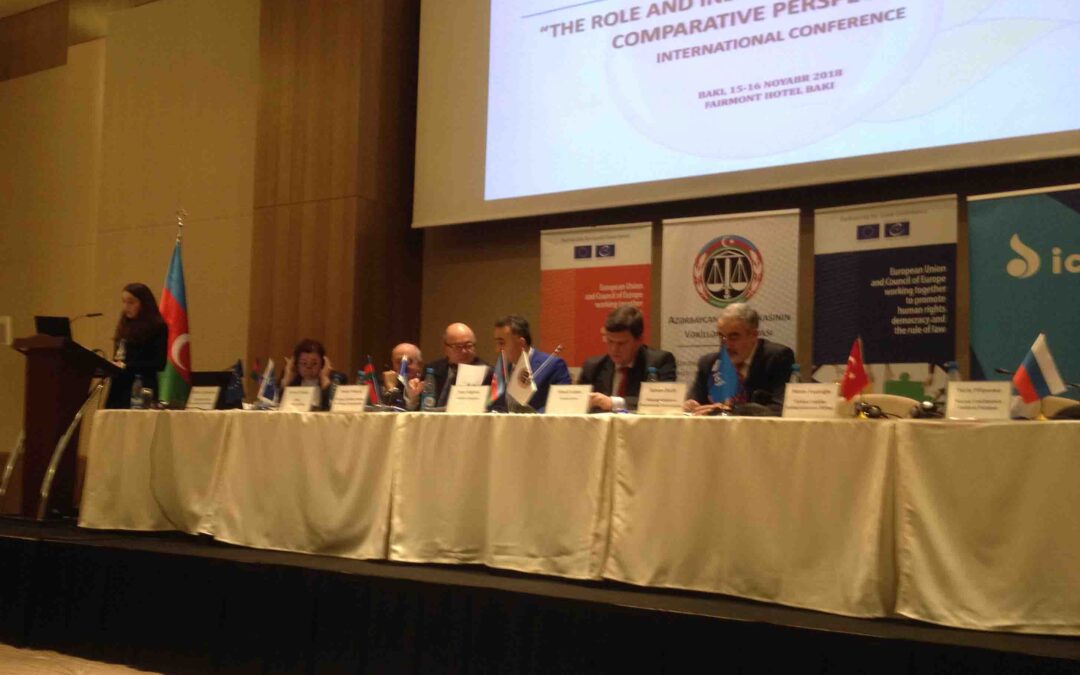
On 15 and 16 November, the ICJ, jointly with the Council of Europe (CoE) and the Azerbaijan Bar Association (ABA), is holding an international conference in Baku on “the Role and Independence of Lawyers: comparative perspectives”.
The conference, which is the first such event on the role and independence of the legal profession organized in the country, aims to bring together perspectives on the governance and role of the legal profession from international experts and representatives of bar associations from a wide range of countries, including the Council of Europe countries, Central Asian as well as representatives of international organizations.
The interventions provide a comparative view on the conditions and requirements that lawyers should comply with while carrying out their professional duty of protection of human rights of their clients.
Participants of the Conference will address in particular the organization and governance of the legal profession, lawyers’ ethics and qualification of lawyers.
Contact:
Temur Shakirov, Senior Legal Adviser, Europe and Central Asia Programme, temur.shakirov@icj.org
Live cast: https://youtu.be/POVlaKXjUrg
Azerbaijan-Conference Independence Lawyers-News-Agenda-2018-ENG (Agenda of the Conference, in PDF)
Nov 14, 2018 | Advocacy, Cases, Legal submissions
The ICJ intervened today before the European Court of Human Rights in the cases of a judge and a scholar that were arrested in the wake of the state of emergency in Turkey.
Mr Hakan Baş is a judge who was dismissed and arrested under emergency legislation following the attempted coup of 15 July 2016.
Mr Seyit Ali Ablak is a teacher and was arrested in 2017 also during the state of emergency declared following the attempted coup.
They claim, among others, the violation of their right to a judicial review of detention under articles 5.3 and 5.4 of the European Convention on Human Rights (ECHR).
In this intervention, the ICJ addressed the following issues:
- the international legal and normative framework on the independence of the judiciary and the role of judges, in particular in implementation of obligations under articles 5.3 and 5.4 ECHR;
- the current situation of the independence, governance and administration of the judiciary in Turkey, with particular regard to the Council of Judges and Prosecutors and the role of the peace judges, and their conformity with State obligations under articles 5.3 and 5.4 ECHR. The situation will be assessed with reference to the findings of an ICJ mission undertaken in May 2018 and contained in the mission report Justice Suspended.
Turkey-icj-Bas-Advocacy-legal submission-2018-ENG (download the intervention in Baş v. Turkey)
Turkey-icj-Ablak-Advocacy-legal submission-2018-ENG (download the intervention in Ablak v. Turkey)
Nov 9, 2018 | News
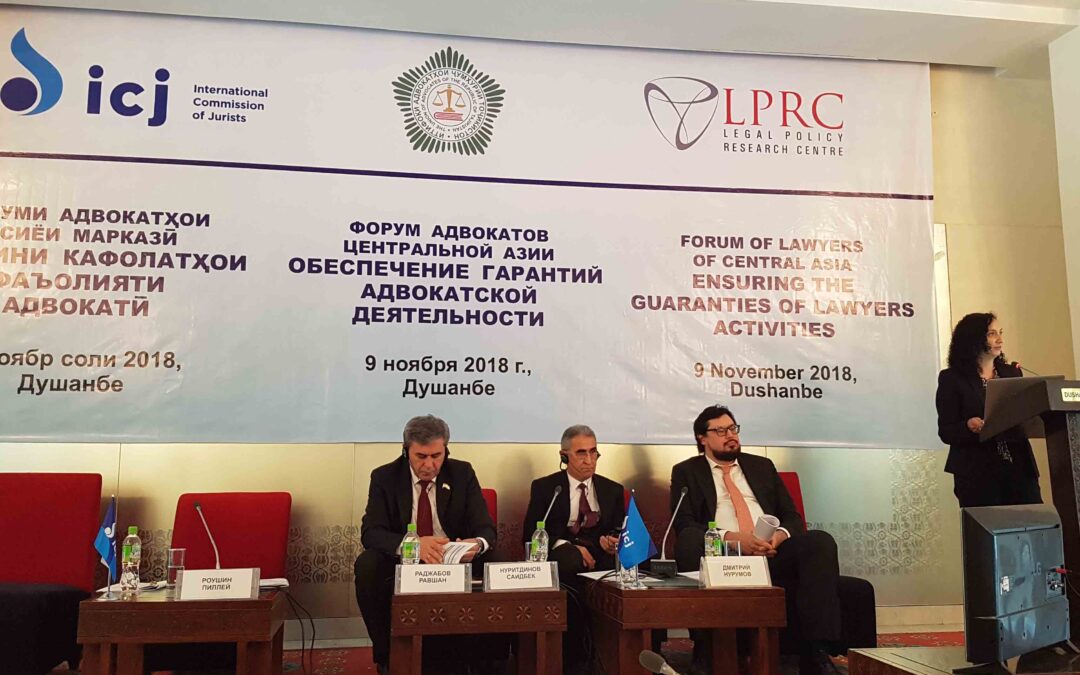
Today the ICJ, in co-operation with the Legal Policy Research Centre and the Union of Lawyers of Tajikistan, is holding a regional conference on the independence and role of lawyers, in Dushanbe.
Lawyers from Tajikistan as well as other countries of Central Asia, the Commonwealth of Independent States and Europe will discuss the legal safeguards that should apply to lawyers to ensure that they can defend the human rights of their clients and the role of bar associations in protecting the security and independence of lawyers.
They will consider the role of committees to protect the rights of lawyers, which have been established within the bar associations of several countries in the region, and how these specialized bodies can work most effectively.
A set of recommendations on the protection of lawyers in the region will be produced following the conference.
Contact:
Temur Shakirov, Senior Legal Advisor, Europe and Central Asia Programme, temur.shakirov(a)icj.org
Tajikistan-Lawyers Conference-News-Agenda-2018-ENG (Agenda, in PDF)
Nov 2, 2018 | Advocacy, Cases, Legal submissions
The ICJ intervened today before the European Court of Human Rights in the case of a detained Member of the Turkish Parliament from the HDP party, Ms Burcu Çelik, arrested in 2017 under “terrorism charges”.
In this submission, the ICJ provides the Court with observations concerning the capacity of the Turkish legal system to provide effective remedies for violations under the ECHR with regard to detention, in particular detention of Members of Parliament, in light of its Convention obligations, in particular obligations under Article 5.4.
The ICJ presents its analysis of these aspects of the Turkish legal system based, in part, on information ascertained during a mission to Turkey undertaken in May 2018 and in its report Justice Suspended.
Specifically, the ICJ addresses the question as to whether the remedies of individual application before the Constitutional Court (CC) and under article 141.1 (a) and (d) of the Code of Criminal Procedure (CCP) may be considered as effective in light of the State’s obligations under articles 5.4 and 35.1 ECHR.
Turkey-icj-Celik-Advocacy-legal submission-2018-ENG (download the intervention)
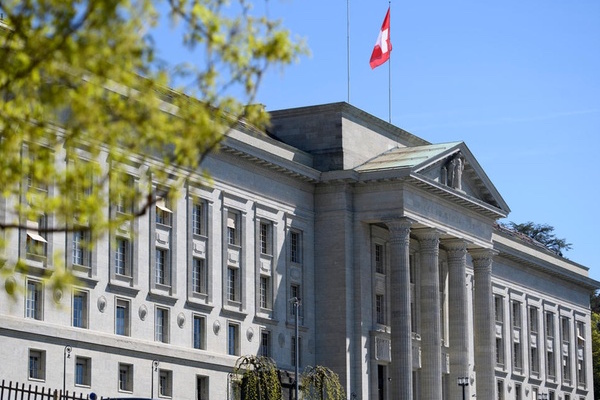
Oct 31, 2018 | Communiqués de presse, Nouvelles
Le 25 novembre 2018, les citoyens suisses seront appelés à voter sur l’initiative populaire dite “le droit suisse au lieu de juges étrangers (initiative pour l’autodétermination)”. La Commission Internationale de Juristes (CIJ) et la Section suisse de la CIJ ont appelé aujourd’hui le peuple suisse à considérer attentivement les conséquences néfastes que pourrait avoir cette initiative si elle était adoptée.
La campagne contre l’initiative la considère en effet comme une initiative “anti-droits de l’Homme”.
“Si elle était approuvée, cette initiative rendrait plus difficile l’accès aux tribunaux suisses pour toute personne revendiquant ses droits humains”, affirme Massimo Frigo, conseiller juridique principal de la CIJ. “Le peuple suisse perdrait une défense importante contre les abus qui pourraient être commis par l’Etat ou par des privés.”
Contrairement à ce que son titre suggère, cette initiative est dirigée contre le droit international en général (à l’exception des rares règles impératives du droit international), qui inclut les traités multilatéraux internationaux ou les accords administratifs et commerciaux bilatéraux.
Ainsi, l’initiative irait manifestement à l’encontre du principe juridique fondamental de l’Etat de droit, lequel stipule que les Etats ne peuvent pas invoquer une disposition de leur droit interne pour justifier la non exécution de leurs obligations de droit international.
“La Suisse, qui accueille nombreuses institutions responsables de l’élaboration du droit international, a une longue et prestigieuse histoire en tant que promoteur du droit international. L’adoption de cette initiative nuirait gravement à la réputation de ce pays et à son leadership dans ce domaine”, ajoute Massimo Frigo.
“Le rôle accordé au droit international par la constitution suisse et la jurisprudence du Tribunal fédéral suisse est essentiel pour assurer non seulement la fidélité de la Suisse en tant qu’Etat partie des traités internationaux, mais aussi son rôle d’acteur central et de promoteur dans plusieurs domaines du droit international, comme le commerce international, ainsi que la sécurité juridique en Suisse,” déclare le professeur Marco Sassòli, Commissaire de la CIJ et membre du Comité exécutif de sa section suisse.
“Une grande partie du succès économique et diplomatique de la Suisse résulte de son adhésion et de son soutien sans faille au droit international. Des valeurs suisses essentielles telles que la neutralité ou son engagement en faveur de la protection des victimes de la guerre trouvent leurs fondement dans le droit international,” ajoute le professeur Sassòli.
Bien que son titre le laisse entendre, cette initiative n’est pas dirigée contre les “juges étrangers” mais contre la pratique des juges suisses, ceux du Tribunal fédéral, estiment la CIJ et sa Section suisse.
Selon elles, l’initiative ignore que l’auto-détermination des peuples les soumet au droit international et que la conclusion des traités n’est pas contraire à la souveraineté de l’Etat, mais en est l’expression.
Le texte de cette initiative, si approuvé, pourrait amener à l’érosion de la primauté du droit international parmi les sources du droit en Suisse, disent encore la CIJ et sa Section suisse.
Elles rejoignent les multiples ONGs, syndicats, acteurs économiques, partis politiques, Suissesses et Suisses qui veulent assurer leurs droits et ceux de toutes les personnes en Suisse, et appellent les électeurs à prendre sérieusement en considération les arguments développés ci-dessus avant d’exprimer leur vote et de ne pas baser leur décision sur la base de slogans tels que “auto-détermination”, “démocratie” ou “juges étrangers”.
Contact:
Massimo Frigo, conseiller juridique pricipal, t: +41 22 979 38 05 ; e: massimo.frigo(a)icj.org