Oct 31, 2018 | News
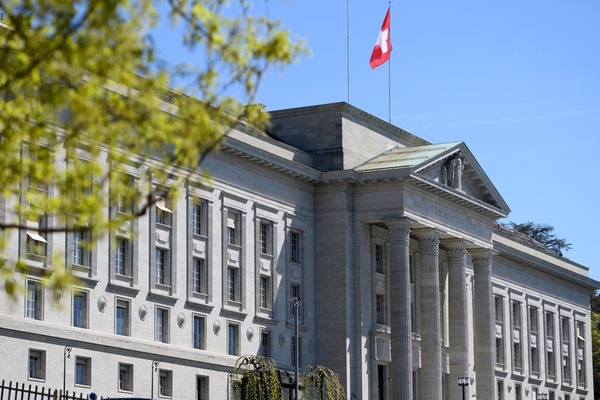
The ICJ and the Swiss Section of the ICJ called today on Swiss people to seriously consider the adverse implications, if adopted, of the popular initiative called the “Swiss law instead of foreign judges – initiative for self-determination” by its proponents. On 25 November 2018, Swiss citizens will be called to vote on this initiative.
The campaign against the initiative has identified it as an “anti-human rights” referendum.
“The initiative, if approved, would have the effect of making it very difficult for people in Switzerland to access Swiss courts to vindicate their human rights,” said Massimo Frigo, ICJ Senior Legal Adviser.
“Swiss people would lose important defences against abuses by the State or private entities,” he added.
Unlike the title suggests the scope of the initiative is directed against international law in general (except for very few existing peremptory norms) which includes international multilateral treaties or bilateral commercial and administrative agreements.
The initiative would therefore fly in the fact of a fundamental legal principle essential to the rule of law, namely that individual States cannot use their national arrangements as an excuse to avoid their international legal obligations.
“Switzerland, as home to numerous international law-making institutions, has a long and distinguished history of championing international law. Adoption of this initiative would be a blow to the country’s reputation and leadership in this area,” said Massimo Frigo.
“The role accorded to international law by the Swiss Constitution and the jurisprudence of the Swiss Supreme Court is essential to uphold reliability of Switzerland as party to international treaties, its role as central actor and generator in many fields of law including international trade, but also legal certainty in Switzerland”, said Professor Marco Sassoli, board member of the Swiss Section of the ICJ and ICJ Commissioner.
“Much of the economic and diplomatic success of Switzerland is based on its faithful adherence and promotion of international law. Essential Swiss values such as its neutrality or its commitment to the protection of war victims are based upon international law,” said Professor Sassoli.
Contrary to its title the initiative is not directed against “foreign judges” but against the practice of Swiss judges, those of the Swiss Federal Supreme Court, and neglects that the self-determination of peoples leads to their direct submission to international law and that the conclusion of treaties is an expression of and not contrary to the sovereignty of the State.
The text of this initiative if approved could lead to the erosion of primacy of international law among the sources of law in Switzerland.
The ICJ and ICJ-Swiss Section join the several NGOs, trade unions, economic actors, political parties and people of Switzerland that want to secure their rights and those of everyone in Switzerland and appeal to the voters before casting their vote to seriously consider the above arguments and not to decide based upon mere slogans such as “self-determination”, “democracy” or “foreign judges”.
Contact:
Massimo Frigo, ICJ Senior Legal Adviser, t: +41 22 979 38 05 ; e: massimo.frigo(a)icj.org
PDF available in Italian: Switzerland-25 November Referendum-News-Press Release-2018-ITA
PDF available in German: Switzerland-25 November Referendum-News-Press Release-2018-GER
Oct 19, 2018 | News
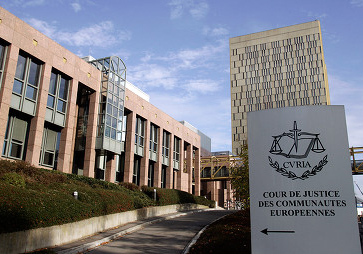
The ICJ welcomes the interim measures prescribed today by the Court of Justice of the EU as a necessary step in stemming the evident erosion of the rule of law in Poland.
The Court provisionally ordered Poland to preserve the composition of its Supreme Court of 3 April 2018, before a law forcing into retirement a third of the Court’s members entered into force.
The ICJ urges the Polish authorities to comply with the EU Court order by maintaining in office the Supreme Court judges .
“In accordance with today’s court’s order, Polish authorities should immediately rescind all measures taken since April 2018 that modify the composition of the Supreme Court. They are obliged to do this under EU law as it is binding on Polish authorities and by the fundamental principle of the rule of law that decisions of the judiciary must be respected and implemented.” said Róisín Pillay, Director of the ICJ Europe and Central Asia Programme.
On 10 October, President Andrzej Duda appointed 27 judges to the Supreme Court in place of those forcibly “retired” last July. The ICJ condemned this act of the President of Poland because it contravened an order of the Supreme Court suspending the law under which these appointments were made, pending a decision by the EU Court. Critically, the mass and forced retirement of sitting judges before the end of the established terms of tenure undermines their security of tenure, a key principle regarding the independence of the judiciary.
Background
The independence of the judiciary in Poland has been systematically undermined by the Polish executive and legislative authorities.
Earlier this year Poland issued a new law on the Supreme Court that attempts to force the “retirement” of one third of the Supreme Court judges, including the First President, by lowering the mandatory retirement age for its judges from 70 to 65. This measure clearly contravenes international human rights law and standards.
The European Commission has launched an infringement procedure for lack of compliance of this law with EU law.
In the absence of satisfactory reforms by Poland, on 24 September, the Commission referred Poland to the Court of Justice of the European Union (CJEU) and asked for interim measures to restore Poland’s Supreme Court to its situation before 3 April 2018. Today’s decision by the Court of Justice granted this interim measures request.
At the same time, the Supreme Court of Poland submitted a preliminary ruling request to the CJEU seeking its interpretation on the compliance of the legislation on retirement ages of judges with EU law, in particular with the prohibition of discrimination on grounds of age under Directive 2008/78.
An ICJ letter of 11 July 2018, signed by 22 senior judges from all regions of the world, urged the Polish government to act immediately to reinstate the forcibly retired judges in office.
Oct 11, 2018 | News
The ICJ today condemned the appointment by President Andrzej Duda of 27 judges to the Supreme Court in place of those forcibly “retired” last July.
“These appointments are patently illegitimate and deal a severe blow to the rule of law in Poland,” said Róisín Pillay, Director of the ICJ Europe and Central Asia Programme.
The new appointments purport to replace the Supreme Court Justices including President of the Supreme Court Małgorzata Gersdorf, whose forced “retirement” is in clear violations of international standards on the security of tenure and independence of judges.
The decision of the President is even more concerning since it contravenes an order of the Supreme Court suspending the law under which these appointments were made, pending a decision by the Court of Justice of the European Union.
It is a fundamental tenet of the rule of law and principles on the independence of the judiciary that the executive respect decisions duly made by the judiciary.
“In announcing these appointments now, while cases on the forced retirement of Supreme Court judges are still pending at the EU Court, President Duda has disregarded the proceedings of the EU’s apex judicial body,” Róisín Pillay added.
The ICJ considers that the legality of the appointments of the new judges is further compromised by the role played by the now politicized National Council for the Judiciary, whose independence and impartiality has been seriously compromised following recent legislative amendments.
The ICJ urges the Polish authorities to cease all interference with the Supreme Court in carrying out its legitimate functions, and to reverse the measures taken to force the retirement of Supreme Court judges.
Background
This attack against the actions of the Supreme Court occurs amid a systematic undermining of the independence of the judiciary in Poland by the Polish executive and legislative authorities, which attempt to increase political influence in the judiciary and which the ICJ has repeatedly condemned.
Earlier this year Poland issued a new law on the Supreme Court that attempts to force the “retirement” of one third of the Supreme Court judges, including the First President, by lowering the mandatory retirement age for its judges from 70 to 65. This measure clearly contravenes international human rights law and standards.
The European Commission has launched an infringement procedure for lack of compliance of this law with EU law.
In the absence of satisfactory reforms by Poland, on 24 September, the Commission referred Poland to the Court of Justice of the European Union (CJEU) and asked for interim measures to restore Poland’s Supreme Court to its situation before 3 April 2018.
At the same time Supreme Court of Poland submitted a preliminary ruling request to the CJEU seeking its interpretation on the compliance of the legislation on retirement ages of judges with EU law, in particular with the prohibition of discrimination on grounds of age under Directive 2008/78.
Following the jurisprudence of the CJEU, the Supreme Court suspended the effect of national law on the forcible retirement of the judges.
An ICJ letter of 11 July 2018, signed by 22 senior judges from all regions of the world, urged the Polish government to act immediately to reinstate the forcibly retired judges in office.
Oct 11, 2018 | Nouvelles
La CIJ a condamné aujourd’hui la nomination par le président Andrzej Duda de 27 juges à la Cour suprême en remplacement de ceux qui ont été mis «à la retraite forcée» en juillet dernier.
«Ces nominations sont manifestement illégitimes et portent gravement atteinte à l’état de droit en Pologne», a déclaré Róisín Pillay, directrice de programme de la CIJ pour l’Europe et l’Asie centrale.
Les nouvelles nominations visent à remplacer les juges de la Cour suprême, y compris la présidente de la Cour suprême, Małgorzata Gersdorf, dont la «retraite forcée» constitue une violation flagrante des normes internationales relatives à la sécurité du mandat et à l’indépendance des juges.
La décision du président est d’autant plus préoccupante qu’elle enfreint une décision de la Cour suprême suspendant la loi en vertu de laquelle ces nominations ont été faites, dans l’attente d’une décision de la Cour de justice de l’Union européenne.
L’un des principes fondamentaux de l’état de droit et des principes relatifs à l’indépendance du pouvoir judiciaire est que l’exécutif respecte les décisions dûment prises par le pouvoir judiciaire.
«En annonçant ces nominations maintenant, alors que des cas relatifs à la retraite forcée de juges de la Cour suprême sont toujours pendants à la Cour européenne, le président Duda a ignoré les procédures de l’instance judiciaire suprême de l’Union européenne», a ajouté Róisín Pillay.
La CIJ considère que la légalité de la nomination des nouveaux juges est d’avantage compromise par le rôle joué par le Conseil national de la magistrature, désormais politisé, dont l’indépendance et l’impartialité ont été gravement compromises par les récentes modifications législatives.
La CIJ exhorte les autorités polonaises à cesser toute ingérence envers la Cour suprême dans l’exercice de ses fonctions légitimes, et à inverser les mesures prises de contraindre les membres de la Cour suprême à prendre leur retraite.
Contexte
Cette offensive contre les agissements de la Cour suprême a lieu dans le cadre d’un travail de sape systématique de l’indépendance du pouvoir judiciaire en Pologne par les autorités exécutives et législatives polonaises, dans le but d’accroître leur influence politique sur le pouvoir judiciaire, ce que la CIJ a maintes fois condamné.
Plus tôt cette année, la Pologne a adopté une nouvelle loi sur la Cour suprême qui tente de contraindre un tiers des juges à la Cour suprême « à prendre leur retraite », y compris son Premier président, en abaissant l’âge de la retraite obligatoire de ses juges de 70 à 65 ans. Cette mesure contrevient clairement au droit et aux standards internationaux relatifs aux droits de l’Homme.
La Commission européenne a lancé une procédure d’infraction pour non-conformité de cette loi avec le droit européen.
En l’absence de réformes satisfaisantes de la part de la Pologne, la Commission a saisi la Cour de justice de l’Union européenne (CJUE) le 24 septembre et a demandé des mesures provisoires pour rétablir la Cour suprême de ce pays dans sa situation antérieure au 3 avril 2018.
Au même moment, la Cour suprême de Pologne a adressé à la CJUE une demande de décision préliminaire visant à obtenir son interprétation sur la conformité de sa législation sur l’âge de la retraite des juges au regard du droit européen, en particulier en ce qui concerne l’interdiction de la discrimination basée sur l’âge, et ce en vertu de la Directive 2008/78. .
Conformément à la jurisprudence de la CJUE, la Cour suprême a suspendu l’application du droit national sur la retraite forcée des juges.
Une lettre de la CIJ du 11 juillet 2018 (uniquement disponible en anglais), signée par 22 hauts magistrats de toutes les régions du monde, a exhorté le gouvernement polonais à agir immédiatement pour réintégrer les juges mis de force à la retraite.
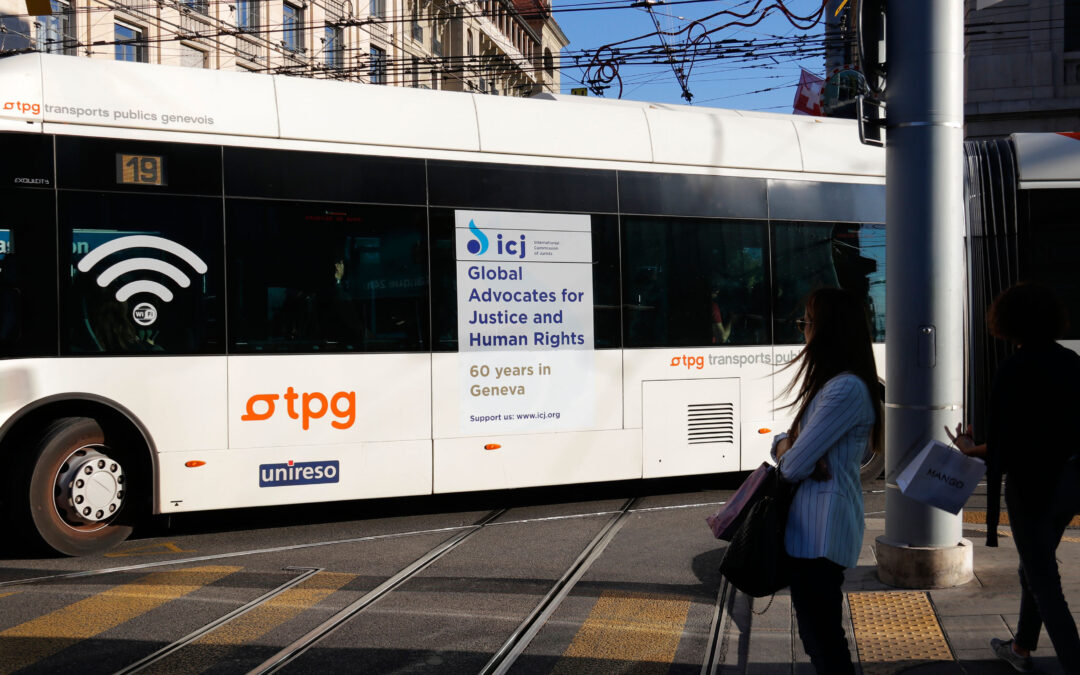
Oct 5, 2018 | News
2018 marks the 60th anniversary of the ICJ’s move to Geneva thanks to the great Swiss jurist Jean-Flavien Lalive, who was ICJ’s Secretary General in 1958.
This makes the ICJ one of the earliest international organizations to establish its headquarters in Geneva.
At the 1959 ICJ Congress in New Delhi, Dr. Lalive helped breathe new life into the rule of law and human rights.
The Delhi Declaration is, to date, a fundamental instrument interpreting the rule of law as a living concept, and underscoring the primary role of lawyers in its safeguard and in the advancement of human rights.
The ICJ plays a unique and preeminent role as a non-governmental organization seeking to defend human rights and the rule of law worldwide.
The ICJ will mark this event with two major initiatives:
- A visibility campaign from 26th September to 9th October: the TV screens on the Geneva public transport network and five vehicles will carry the slogan “Global Advocates for Justice and Human Rights – 60 years in Geneva”
- The launch of the “60th Anniversary Appeal” to all lawyers in the Republic and canton of Geneva to support the ICJ and, in turn, their less privileged colleagues, victims of persecution on five continents.
“Geneva can be proud of its image as the world human rights capital. It is a beacon for justice advocates around the world. We must continue to make it shine,” said Sam Zarifi, Secretary General of the ICJ.
“Through its 60-year history, the ICJ has contributed significantly to Geneva’s human rights record: the campaigns that led to the creation of the post of UN High Commissioner for Human Rights in 1993 and the UN Human Rights Council in 2006, as well as the adoption of the United Nations Convention against Torture in 1984 are some emblematic examples,” said Olivier Coutau, Head of La Genève Internationale.
“In the face of repeated attacks on human rights, the world needs, more than ever the ICJ’s competent, rigorous and effective defense of the rule of law,” Sam Zarifi added.
The Republic and canton of Geneva support the ICJ 60th Anniversary Appeal.
Additional information
The international reputation of the ICJ rests on these pillars:
- 60 Commissioners – eminent judges and lawyers – from all regions of the world and all legal systems – with unparalleled knowledge of the law and human rights;
- Cooperating with governments committed to improving their human rights performance;
- Effective balance of diplomacy, constructive criticism, capacity building, and if necessary, ‘naming and shaming’;
- Unmatched direct access to national judiciaries, implementing international standards and improved legislation impacting millions;
- Guiding, training and protecting judges and lawyers worldwide to uphold and implement international standards;
- Working for access to justice for victims, survivors and human rights defenders, in particular from marginalized communities;
- Following a strict result based management in project delivery.
In recognition of this effective approach, the ICJ has been awarded, during its long history, some of the most prestigious international awards: the Council of Europe Human Rights Prize, the United Nations Award for Human Rights, Erasmus Prize, Carnegie Foundation Wateler Peace Prize.
In 2018, the ICJ provided local trainings on five continents to assist 4,300 judges, lawyers and prosecutors strengthen their ability to protect and promote fundamental rights.
The ICJ has consultative status with the United Nations Economic and Social Council, UNESCO, the Council of Europe and the African Union.
Contact :
Michaël W. Sombart, Director Philanthropy & Strategic Partnerships, t: +41 22 979 38 31 ; m: +41 77 965 98 45 ; e: michael.sombart(a)icj.org