Oct 2, 2013 | News
The ICJ welcomes the endorsement today by the Parliamentary Assembly of the Council of Europe of the Tshwane Principles on National Security and the Right to Information.
The ICJ was one of a number of civil society groups and government representatives who contributed to the development of the Principles.
Headline stories such as the Bradley Manning, Edward Snowden, and David Miranda cases, and the large number of other similar cases and situations around the world that do not necessarily receive the same media attention, demonstrate the timeliness and relevance of the Principles.
The ICJ hopes that the precedent set by the PACE will now be followed by other inter-governmental organisations at the global and regional levels, recognizing and endorsing the Principles.
Links to the resolution and recommendation by the PACE:
http://assembly.coe.int/nw/xml/XRef/Xref-DocDetails-EN.asp?fileid=20190&lang=EN
http://assembly.coe.int/nw/xml/XRef/Xref-DocDetails-EN.asp?fileid=20194&lang=EN
Global-Tshwane Principles on right to information-position paper-2013 (full text in pdf)

Sep 25, 2013
The ICJ today joined an open letter to Permanent Representatives to the UN Human Rights Council calling for rejection of proposed revisions to resolutions affecting the work of human rights defenders.
During the course of the Human Rights Council’s 24th regular session (9 to 27 September 2013), two draft resolutions affecting the work of human rights defenders are being negotiated by representatives to the Council: A/HRC/24/L.24 on ‘civil society space’; and A/HRC/24/L.17 on ‘cooperation with the United Nations’. Both are essential to efforts to promote and protect civil society space and to address the issue of reprisals and intimidation against those who cooperate with the UN human rights system.
Amendments to those resolutions – proposed by Cuba, Pakistan and the Russian Federation – run counter to the spirit and purpose of these important resolutions. The International Service for Human Rights, the ICJ and 18 other nongovernmental organisations therefore joined in writing to Permanent Representatives to the Council to reject the proposed amendments.
The resolutions will be considered for adoption during the last two days of the Council session.
HRC24-HumanRightsDefenders-NGOJointLetter-2013 (download letter in PDF)

Sep 16, 2013
The ICJ today called on adherence by all States with the obligation to ensure effective and independent judicial supervision as a fundamental safeguard against arbitrary detention, and torture and other forms of ill-treatment.
Reflecting on the Secretary-General’s report on the protection of all persons deprived of their liberty, the ICJ’s statement was made during the General Debate under Item 3 of the Human Rights Council’s agenda (promotion and protection of all human rights) during the 24th regular session of the Council (9 to 27 September 2013).
HRC24-Item3-OralStatement-AdministrationJustice-LegalSubmission-2013 (download full statement in PDF)
A-HRC-24-28 (download Secretary-General’s report)
Sep 12, 2013 | News
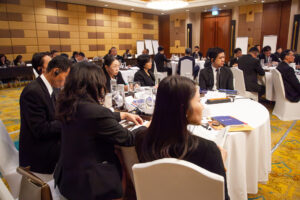
Yesterday, during the 24th session of the UN Human Rights Council, the ICJ and TRIAL (Swiss Association against Impunity) jointly held a parallel event on promoting accountability through human rights mechanisms in Geneva.
The event was co-sponsored by the Permanent Missions of Switzerland, Estonia and Costa Rica to the United Nations Office at Geneva.
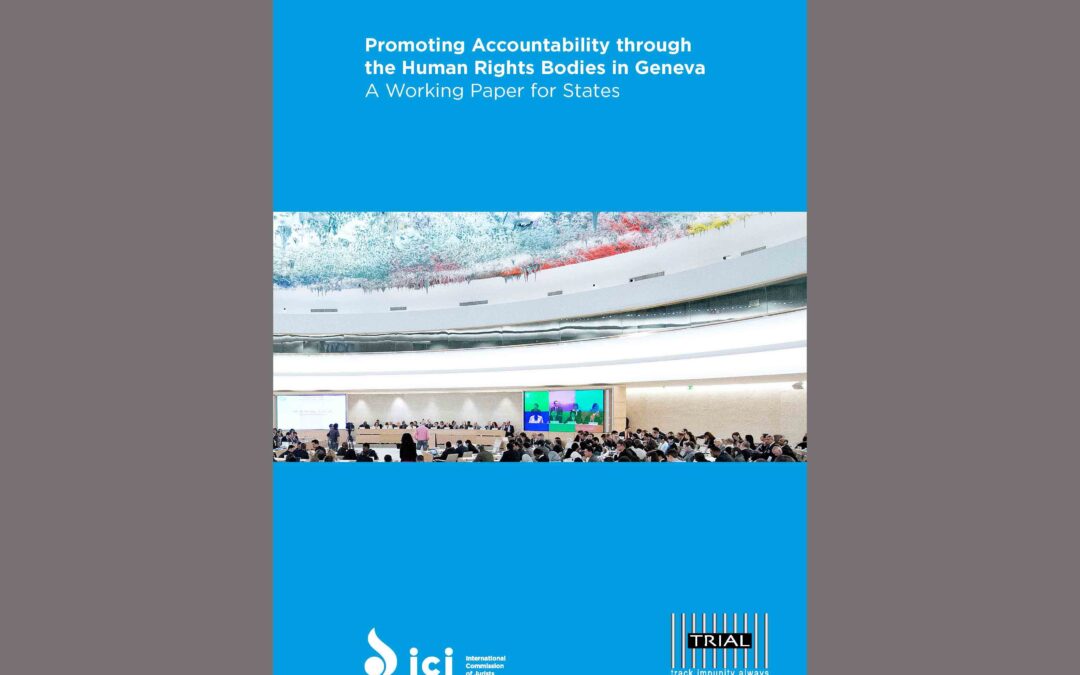
A corresponding report produced by ICJ and TRIAL was also launched at this event in two versions, one aimed at civil society and another aimed at States.
Panellists at this event included Ian Seiderman of the ICJ, Gabriella Citroni of TRIAL and Theo van Boven, former Special Rapporteur on torture and other cruel, inhuman or degrading treatment or punishment and ICJ Honorary Commissioner.
Mona Rishmawi of the Office of the High Commissioner for Human Rights (OHCHR) chaired the event.
The main topic of this event was the ICJ-TRIAL report, which reviews the legal framework for promoting accountability and suggests possible action by civil society and States to engage with the human rights mechanisms in Geneva to better promote and achieve accountability for human rights violations.
The role of national mechanisms, such as national human rights institutions, working in cooperation with the UN mechanisms was also highlighted.
The report focuses specifically on the Human Rights Council and its subsidiary bodies, such as the Universal Periodic Review and the special procedures mechanisms.
OHCHR’s role was further emphasised in regards to sharing best practices as well as ensuring follow-up to issues of accountability as they come to the attention to the UN.
Sep 11, 2013
TRIAL (Track Impunity Always) and the ICJ presented a new publication on the potentials of Geneva-based human rights bodies in the fight against impunity and in promoting accountability of individuals responsible for crimes under international law and gross human rights violations.
The publication Promoting Accountability through the Human Rights Bodies in Geneva focuses on bodies such as the Human Rights Council, the Universal Periodic Review (UPR), Special Procedures and Treaty Bodies.
The report proposes initiatives through which States, civil society and other stakeholders can better engage the Human Rights Council and other Geneva-based human rights mechanisms promoting better accountability. They include:
- Ensuring that the Human Rights Council focuses more consistently on accountability, for instance through the introduction of a periodic resolution on international justice and accountability and with greater attention given to international criminal law and the International Criminal Court;
- Ensuring that accountability-related action points are systematically taken up by the Human Rights Council in thematic and country-specific resolutions, as well as in recommendations made within the UPR mechanism;
- Ensuring that Special Procedures and Commissions of Inquiry engage on a deeper basis with accountability-related issues, formulating appropriate recommendations and conducting studies where needed and appropriate.
“Although the UN human rights system has made great strides over the years in the promotion and protection of human rights, one area in which it has fallen short of its potential is in the area of combating impunity,” said Ian Seiderman, ICJ’s Legal & Policy Director. “As long as perpetrators of gross human rights violations avoid facing justice, human rights can never be fully realized.”
Gabriella Citroni, TRIAL’s Senior Legal Adviser added: “promoting and mainstreaming issues related to the fight against impunity requires cooperation between all stakeholders, in particular States and civil society organizations. The publication aims at fostering joint efforts to make accountability a key issue in the discussions and activities undertaken by Geneva-based human rights bodies.”
Contacts
Gabriella Citroni, Senior Legal Adviser, TRIAL,: +41 22 321 61 10 ; email: gabriella.citroni(a)trial-ch.org
Ian Seiderman, Director, Legal & Policy, ICJ, t: +41 22 979 3837; email: ian.seiderman(at)icj.org
Universal-ICJTRIAL-Geneva bodies-impunity-Publications-report-2013 (full text of version for States in pdf)
Universal-ICJTRIAL-Geneva bodies-impunity-Publications-report.2013 (full text of version for NGOs in pdf)
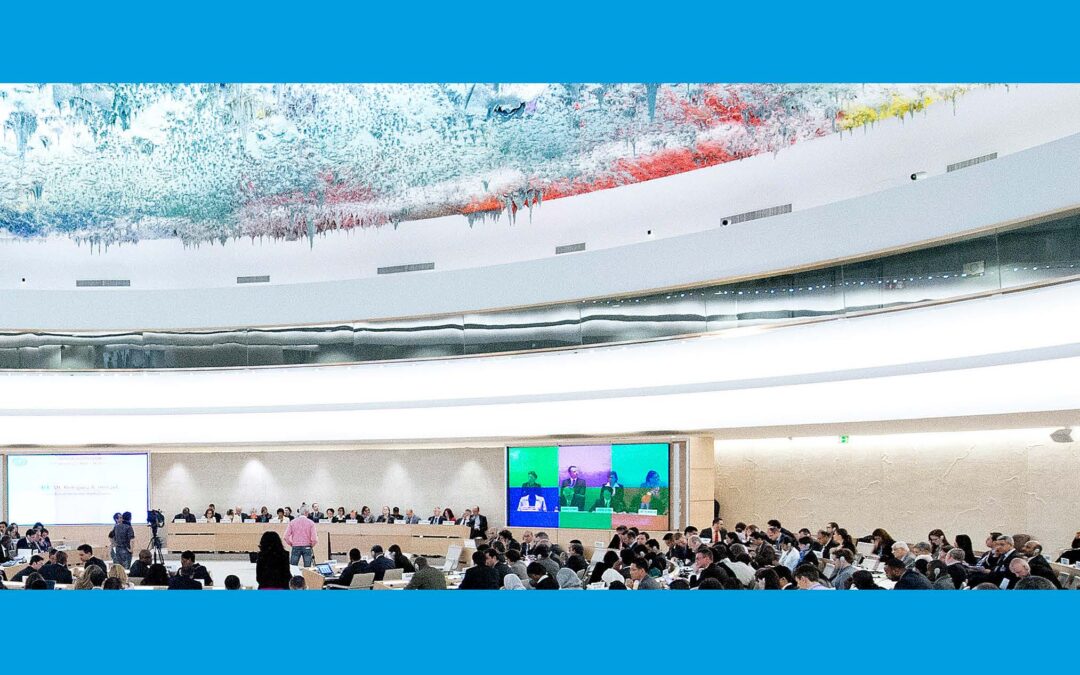
Photo: UN/Jean-Marc Ferré