Attacks on Justice 2005: Peru
The transition towards democracy has been a difficult process but, despite the difficulties, there have been some efforts to improve the judiciary as well as human rights protection.

The transition towards democracy has been a difficult process but, despite the difficulties, there have been some efforts to improve the judiciary as well as human rights protection.
In Argentina, the Constitution grants the President broad powers with regard to the appointment of judges to the Supreme Court of Justice and federal courts.
For many years, the judiciary has been regarded as subordinate to the executive. At provincial level, complaints of executive interference in the judiciary are also frequent. Recent judicial reforms adopted mainly during 2003 as a result of two presidential decrees, and new legislation adopted in some provinces in response to a general lack of confidence in the justice system, have ensured that there is greater consultation and outside scrutiny with regard to appointments to the Supreme Court and the prosecution service.
Some provinces have adopted similar reforms ensuring that there is a degree of scrutiny in the appointment of judges. Also during 2003, impeachment proceedings initiated by Congress resulted in the removal or resignation of four Supreme Court justices who were generally perceived as being subordinate to the government of former President Carlos Menem (1989-1999).
During 2004, concern about increasing crime rates and lack of security has become one of the most debated judicial reform issues. On 14 June 2005, the notorious amnesty laws (the Full Stop and Due Obedience Laws) were declared unconstitutional and null and void by the Supreme Court of Argentina. This ruling should pave the way for the prosecution of perpetrators of serious human rights violations during the military dictatorship (1976-1983).
Argentina-Attacks on Justice 2005-Publications-2008 (full text, PDF)
Although an independent judiciary largely functions in practice in Jamaica, it operates within an overburdened system with inadequate resources.
The government has launched a three-year reform plan to modernize and improve the court system and the effectiveness of the judiciary. Legislation was enacted in 2004 to abolish appeals to the Judicial Committee of the Privy Council and make the Caribbean Court of Justice Jamaica’s highest appellate authority.
The Privy Council declared this legislation unconstitutional in February 2005 on procedural grounds. New legislation was under discussion as of April 2005.
In March 2004, the Social Conflict and Legal Reform, a five-year-long initiative to foster mediation and alternative dispute resolution methods at both the institutional and community levels, came to an end. It succeeded in establishing mediation centres in several deprived areas.
Budgetary and political constraints have severely undermined the effectiveness and impartiality of the Police Public Complaints Authority (PPCA) in investigating alleged abuses by state security forces.
Jamaica-Attacks on Justice 2005-Publications-2008 (full text, PDF)
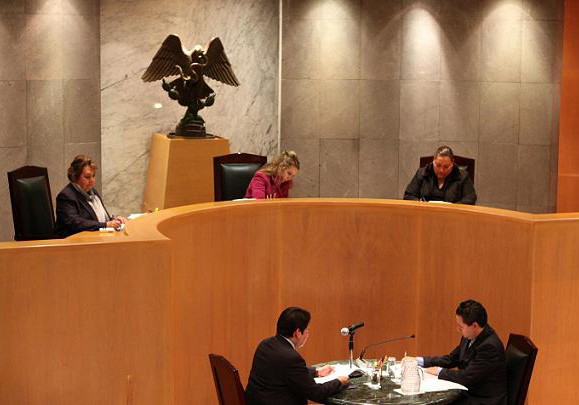
Una misión de expertos nacionales e internacionales visitó la ciudad de Oaxaca para recabar información sobre la administración de justicia en el estado, con especial atención a la independencia del Poder Judicial.
Con base en la información recibida con anterioridad a la visita y durante ella se concluye preliminarmente que existen condiciones estructurales y prácticas que ponen seriamente en riesgo que el poder judicial ejerza sus funciones de manera independiente.”
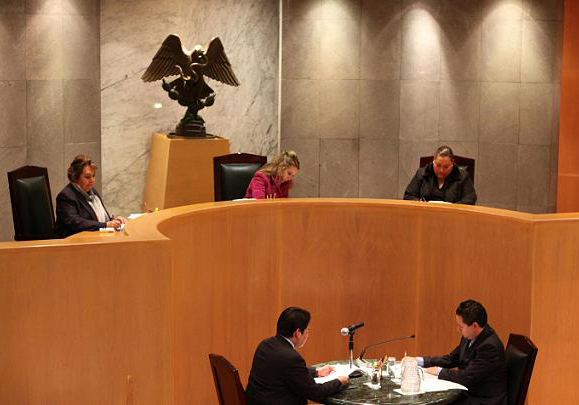
Una misión de expertos nacionales e internacionales visitó la ciudad de Oaxaca para recabar información sobre la administración de justicia en el estado, con especial atención a la independencia del Poder Judicial.
 HRC63: ICJ Calls for Renewal and Strengthening of the Venezuela Fact-Finding Mission
 Joint Statement: Attacks on the Rule of Law, Judicial Independence and Access to Justice in Zambia
 HRC63: ICJ Raises Concern over Widespread and Systematic Arbitrary Detention in Egypt
 Myanmar: As armed conflict rages and military rule continues, critical measures can be taken towards eventual justice and accountability for victims of Enforced Disappearance