Sep 8, 2020 | Noticias
Jueces de seis países latinoamericanos constataron que existían serios obstáculos, pero también posibilidades de justicia, que enfrentan los poderes judiciales de la región en su trabajo de protección de los derechos humanos de quienes han sido afectados negativamente por la actividad de las entidades empresariales.
Los jueces debatieron en el contexto del Diálogo Judicial Regional sobre Empresas y Derechos Humanos organizado por la CIJ el 7 de septiembre.
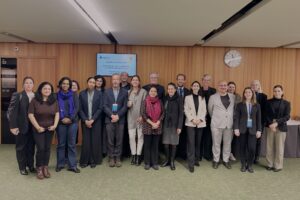
El Diálogo, moderado por la profesora Mónica Pinto, comisionada de la CIJ, reunió a 17 jueces de Centro y Sudamérica para considerar el papel de los jueces en la garantía del derecho de acceso a la justicia y reparación. Los jueces también consideraron la necesidad de garantizar la independencia del poder judicial y la seguridad de los jueces, abogados y defensores de derechos humanos en el contexto de las actividades empresariales en la región.
La sesión contó con presentaciones de un miembro del Grupo de Trabajo de las Naciones Unidas sobre Empresas y Derechos Humanos y de la Oficina del Alto Comisionado de las Naciones Unidas para los Derechos Humanos. El Diálogo se desarrolló en el marco del V Foro Regional de Empresas y Derechos Humanos para América Latina y el Caribe que tuvo ligar entre el 7 y 11 de Setiembre 2020 de forma virtual.
En el debate sobre el acceso a la justicia y la reparación, los jueces compartieron experiencias y jurisprudencia en casos relacionados con delitos graves, incluidos los de lesa humanidad, cometidos durante el régimen militar argentino, así como casos de corrupción y malversación graves en Guatemala.
En Argentina, en un caso relativo al secuestro y tortura en 1976 de 24 trabajadores empleados por la rama local de la empresa Ford Motor en su fábrica de Buenos Aires durante la dictadura militar de 1976-83, un Tribunal Federal de Primera Instancia oral en lo penal condenó a tres personas, un ex militar y dos ex ejecutivos de Ford a prisión de entre 10 y 12 años, por su participación cómplice en los delitos.
Ex ejecutivos de Ford fueron acusados de brindar información detallada y apoyo logístico a agentes de seguridad que derivaron en el secuestro y tortura de las víctimas, y también permitieron que se instalara un centro de detención dentro de las instalaciones de dicha fábrica. Los tres magistrados del Tribunal en este caso asistieron a la reunión para compartir las lecciones aprendidas y reflexiones sobre la trascendencia del proceso penal en el contexto de los esfuerzos por hacer justicia y reparar los crímenes del pasado.
El proceso y la sentencia definitiva es un hito en la lucha contra la impunidad en Argentina y un mensaje importante a todos para que estos crímenes no se vuelvan a cometer. El caso esclareció las formas en que los particulares (ex ejecutivos de la empresa) participaron en la comisión de los delitos por parte de agentes del Estado (militares y agentes de seguridad), profundizando en las modalidades de atribución de los hechos a los autores accesorios.
También fue una innovación en la forma en que recopiló y evaluó el valor probatorio de las pruebas disponibles de los delitos cometidos hace más de 30 años para que aún pudieran atribuirse a los perpetradores.
La reparación ordenada por el Tribunal en este caso fue “simbólica e histórica”, consistente en el reconocimiento de los hechos por parte del Estado y de los actores privados. Las víctimas pueden exigir ahora otras formas de reparación al Estado, pero no a las personas. La empresa como tal no formó parte del proceso penal ni fue sancionada en sentencia firme, ya que la ley argentina no acepta la responsabilidad penal de las personas jurídicas como las corporaciones.
Un juez participante de un Tribunal de Alto Riesgo en Guatemala compartió un caso sobre delitos económicos de corrupción, fraude, asociación ilícita y lavado de activos en una ciudad provincial de Guatemala. Aquí, la experiencia y los resultados fueron algo diferentes. El caso involucró al alcalde de la ciudad y varios de sus familiares, así como a unas 20 empresas de las cuales casi 20 personas y siete empresas recibieron sanciones en la sentencia final.
El caso es de especial importancia en Guatemala como uno de los pocos casos de corrupción a gran escala que ha llegado a su etapa final con condenas. En la investigación y recolección de pruebas consideradas durante el juicio, participaron varias oficinas públicas y la entonces Comisión Internacional Contra la Impunidad en Guatemala (CICIG), que ya no funciona. Gracias a las recientes leyes sobre corrupción y blanqueo de capitales, es posible imponer sanciones a la empresa, en tanto persona jurídica.
En el presente caso, dichas sanciones consistieron en multas pecuniarias, pero no en la suspensión o disolución de la persona jurídica para permitir que prosigan otros procesos administrativos contra las mismas empresas. De acuerdo con las leyes nacionales y los estándares internacionales, los jueces ordenaron la reparación integral, incluyendo los daños, medidas de satisfacción como declaraciones públicas de disculpas y publicaciones a realizar por los condenados.
Citando una constatación gráfica contenida en la sentencia final, el juez Pablo Xitumul, quien presidió el Tribunal, dijo que “la corrupción y la impunidad son aún más letales que un cáncer o una pandemia, ¡y deben combatirse sin demoras ni excusas!”.
Para leer el artículo completo: Americas-Judges and BHR-News-Feature article-2020-SPA

Sep 8, 2020 | Feature articles, News
Judges from six Latin American countries revealed that there were serious obstacles, but also possibilities for justice, facing regional judiciaries as they try to protect the human rights of those who have been adversely affected by the activity of business entities.
The judges gathered as part of the Regional Judicial Dialogue on Business and Human Rights organized by the ICJ of Jurists on September 7.
The Dialogue, moderated by ICJ Commissioner Professor Monica Pinto, brought together 17 judges from Central and South America to consider the role of judges in guaranteeing the right of access to justice and remedy and reparation. The judges also considered the need to guarantee the independence of the judiciary and the security of individual judges, lawyers, and human rights defenders in the context of business activities in the region.
The session featured presentations from a member of the UN Working Group on Business and Human Rights and the Office of the UN High Commissioner for Human Rights. The Dialogue took place in the context of the 5th Regional Forum on Business and Human Rights for Latin America and the Caribbean.
Discussing access to justice and remedy and reparation, the judges shared experiences and jurisprudence in cases related to serious crimes, including against humanity committed during the Argentine military regime, as well as cases of serious corruption and embezzlement in Guatemala.
In Argentina, in a case concerning the 1976 kidnapping and torture of 24 workers employed by the local Ford Motor company at their factory in Buenos Aires during the 1976-83 military dictatorship, a Federal Trial Tribunal sentenced three persons, a former military officer and two former Ford executives to prison of between 10 and 12 years, for their complicit involvement in the crimes.
Former Ford executives were accused of providing detailed information and logistical support to security agents that led to the abduction and torture of the victims, and also allowed a detention centre to be set up inside the premises of that factory.
The three judges of the Tribunal in this case attended the meeting to share the lessons learned and the significance of the criminal proceedings in the context of efforts to bring justice and reparations for the crimes of the past.
The process and the final sentence is a landmark in the fight against impunity in Argentina and an important message to all so that these crimes are not committed again. The case clarified the ways in which private individuals (the former company executives) participated in the commission of the crimes by State agents (military and security agents), elaborating upon modalities of attribution of the acts to the accessory perpetrators.
It is also an innovation in the ways it gathered and assessed the probatory value of the available evidence of crimes committed more than 30 years ago so that the crimes could still be attributed to the perpetrators.
The reparation ordered by the Tribunal in this case was “symbolic and historical”, consisting on an acknowledgment of the facts by the State and the private actors. The victims may demand now other forms of reparation from the State, but not from individuals.
The company as such was not part of the criminal proceedings nor was it sanctioned in the final sentence, since Argentinian law does not accept the criminal responsibility of legal entities such as corporations.
A participant judge from Guatemala shared a case concerning economic crimes of corruption, fraud, illicit association and assets laundering in a provincial town in Guatemala. Here, the experience and outcomes were somewhat different.
The case involved the town major and several of his relatives as well as some 20 companies out of which nearly 20 individuals and seven companies received penalties in the final sentence.
The case is of special significance in Guatemala as one of the few, large scale, corruption cases that has reached its final stage with convictions. In the investigation and collection of evidence considered during the trial, participated several public offices and the then International Commission Against Impunity in Guatemala (CICIG), which is no longer in operation.
Thanks to recent laws on corruption and money laundering, it is possible to impose sanctions on the company, as a legal entity. In the instant case, those sanctions consisted of monetary fines but not suspension or dissolution of the legal entity to allow other administrative proceedings against the same companies to continue.
In accordance with national laws and international standards, the judges ordered full reparation, including for damages, measures of satisfaction such as public statements of apologies and publications to be made by the convicted.
Citing a graphic statement contained in the final sentence, the judge Pablo Xitumul who presided the Tribunal said “corruption and impunity are even more lethal than a cancer or a pandemic, and should be combated without delay or excuses!”
Read the full story here: Americas-Judges and BHR-News-Feature article-2020-ENG
Sep 1, 2020 | Noticias
Hoy, la CIJ llamó a la Organización de los Estados Americanos (OEA) a respetar la autonomía e independencia de la Comisión Interamericana de Derechos Humanos (CIDH), como órgano encargado de promover la observancia de los derechos humanos en las Américas, incluso respecto de sus funciones administrativas básicas.
El Secretario General de la OEA se ha negado a respaldar la decisión unánime tomada por la Comisión Interamericana en enero de 2020, de renovar el mandato del Secretario Ejecutivo de la CIDH, Paulo Abrão, cuyo mandato expiró el 15 de agosto.
La negativa a renovar un mandato no puede hacerse sobre la base de denuncias presentadas, sino que éstas deben ser previamente resueltas en un plazo razonablemente breve, con base en los principios del debido proceso para todas las partes interesadas.
La CIJ señala la importancia de tramitar oportunamente las quejas realizadas por el personal conforme a los principios del debido proceso para todas las partes, y de contar con procedimientos transparentes e independientes para ello.
La CIJ recuerda que es fundamental asegurar la independencia y la autonomía de la Comisión Interamericana, lo que necesariamente incluye su Secretaría Ejecutiva y las funciones relacionadas con el proceso de nombramiento de su titular.
El Secretario General de la CIJ, Sam Zarifi, mencionó que “la CIDH ha desempeñado un papel fundamental en las Américas para promover los derechos humanos y proteger a las víctimas de violaciones de derechos humanos”. Agregó que “la situación requiere una resolución urgente que garantice el respeto de los principios de independencia y autonomía de la CIDH”.
Sep 1, 2020 | Advocacy, News
Today the ICJ called on the Organization of American States (OAS) to respect the autonomy and independence of the Inter-American Commission on Human Rights (IACHR) as the body in charge of promoting the observance of human rights in the Americas, including in respect of its core administration functions.
The OAS Secretary-General has declined to endorse the unanimous decision taken in January by the seven-person IACHR to renew the mandate of its Executive Secretary, Paulo Abrão, whose term expired on 15 August.
The Secretary General indicated that his action was motivated by concern at internal complaints that are still to be resolved.
The refusal to renew this mandate, however, must not be made on the basis of pending complaints, which must nonetheless be resolved in a reasonably short period of time, based on the principles of due process for all parties concerned
The ICJ recognizes the importance of processing the staffs’ complaints in a timely manner which respects the due process rights of the parties concerned through an independent and transparent process.
The ICJ recalls that it is essential to ensure the independence and autonomy of the Inter-American Commission, which necessarily includes the functions related to the appointment process of the Executive Secretary.
“The IACHR has played a critical role in the Americas to advance human rights and to protect victims of human rights violations,” said ICJ Secretary General Sam Zarifi.
He also mentioned that “the situation requires an urgent resolution that guarantees respect for the principles of independence and autonomy of the IACHR.”
Aug 30, 2020 | News, Publications, Reports, Thematic reports
The ICJ marked the International Day of the Victims of Enforced Disappearances today by releasing a baseline study (in Spanish) which identifies key obstacles to accountability for serious human right violations in Colombia.
“The report finds that although Colombia has a comprehensive legal framework aimed at providing accountability for serious human rights violations, victims still face many challenges in obtaining access to justice,” said Kingsley Abbott, Coordinator of the ICJ’s Global Accountability Initiative.
“A robust domestic legal framework is important, but without effective Government implementation at every level full accountability for these violations will remain out of reach,” added Abbott.
Among other challenges, some victims still encounter difficulties in participating in criminal proceedings or obtaining information about investigations and prosecutions of those alleged to be responsible for violations.
The study recommends steps Colombia should take to improve the implementation of the domestic legal framework, including:
- raising the awareness of civil servants, including judicial employees, of victims’ rights and the appropriate legal mechanisms employed to search for “disappeared” persons;
- improving coordination between the State’s institutions, including the Search Unit for Persons Presumed Disappeared in the context and by Reason of the Armed conflict, the Special Jurisdiction for Peace, and the Office of the Attorney General; and
- ensuring that the investigation and prosecution of enforced disappearances and extrajudicial killings take place within the civilian rather than the military justice system.
The study also stresses the importance of Colombia recognizing the competence of the UN Committee on Enforced Disappearances (CED) to receive and consider individual communications. Considering the high levels of impunity, the recognition has been requested by Colombian civil society organizations and victims to improve the protection and guarantee of rights of victims of enforced disappearances.
The baseline study has been produced as part of the ICJ’s regional project addressing justice for extrajudicial killings and enforced disappearances in Colombia, Guatemala and Peru, sponsored by the European Union.
The baseline study is available in Spanish.
Background
The ICJ has long been monitoring laws, policies and practices concerning the investigation and prosecution of serious human rights violations and abuses in Colombia, including enforced disappearances and extrajudicial killings, as part of its efforts to promote accountability, justice and the rule of law around the world.
Enforced disappearances and extrajudicial killings are among the most prevalent human rights violations committed in Colombia, particularly in the context of the ongoing internal armed conflict. In Latin America, Colombia has one of the highest figures of people who have been subject to enforced disappearance or unlawfully killed.
The project is implemented under the ICJ’s Global Accountability Initiative which has also produced baseline studies for Eswatini, Nepal, Myanmar, Venezuela, Cambodia, Tajikistan and Tunisia.
Contacts
Kingsley Abbott, Coordinator of the Global Accountability Initiative, e: kingsley.abbott(a)icj.org
Carolina Villadiego, Legal and Policy Adviser, Latin America, and Regional Coordinator of the Project, e: carolina.villadiego(a)icj.org
Rocío Quintero M, Legal Adviser, Latin America, e: rocio.quintero(a)icj.org
Download
Colombia-GRA-Baseline-Study-Publications-Reports-Thematic-reports-2020-SPA (full report, in Spanish, PDF)