Jul 8, 2019 | News
The ICJ welcomes the report issued today by the United Nations Office of the High Commissioner for Human Rights (OHCHR) documenting human rights violations and abuses in Indian administered Kashmir and Pakistan administered Kashmir.
The ICJ called upon both India and Pakistan to take immediate measures to implement the Report’s main recommendations, and to hold security forces as well as non-state actors accountable for human rights violations and abuses.
The Report follows a June 2018 report that documented similar violations, as well as the widespread impunity for human rights violations by Indian security forces and armed groups allegedly supported by Pakistan. The Indian Government has rejected both reports as a violation of its “sovereignty and territorial integrity”. The Pakistan government has welcomed the report and called for the establishment of a United Nations Commission of Inquiry.
“It is unfortunate that India has again refused to acknowledge the facts set out in the OHCHR report, or to pledge action on its recommendations,” said Frederick Rawski, Asia Pacific Director for the ICJ.
“This is an opportunity for India, a member of the Human Rights Council, to lead by example. It can start by repealing the Armed Forces Special Powers Act and launching an investigation into rights abuses in line with international standards and the guidelines set out by the Indian Supreme Court,” he added.
The Report documents human rights violations by Indian security forces including extrajudicial killings, arbitrary detentions, unlawful custodial deaths, enforced disappearances, and ill-treatment and torture, including rape and sexual violence, in Indian-administered Kashmir.
According to the Report, based on data from civil society organization Jammu and Kashmir Coalition of Civil Society (JKCCS), 71 extrajudicial killings were allegedly committed by security forces in 2018 (for a total of 1081 between 2008 and 2018). Between 2016 and 2018, 1253 people have been blinded by pellet guns.
The Report highlights how the extraordinary powers granted to security forces by the Armed Forces (Jammu and Kashmir) Special Powers Act, 1990 has been wielded arbitrarily and led to near total impunity from prosecution. In addition, it documents human rights abuses committed by non-state armed groups in Indian-administered Kashmir including kidnappings, killings and rape.
The Report also documents rights violations in Pakistan-administered Kashmir, including restrictions on freedom of expression and opinion, assembly and association, and the abuse of vague and overbroad anti-terrorism laws in contravention of international human rights law.
The Report documents cases of arbitrary arrest by local authorities and intelligence agencies, including charging 19 activists with treason for organizing a rally in November 2018, and the arbitrary detention of 30 members of the Jammu Kashmir National Students Federation in March 2019 by Pakistani law enforcement. The Report notes the particular vulnerability of journalists to threats, harassment and arbitrary arrest.
“While we commend Pakistan for welcoming the Report, the fact remains that the Government has done little to prevent the continuation of human rights violations by its security forces, or to implement the recommendations of the previous report,” Rawski said.
“Pakistan must take action to hold perpetrators of rights violations accountable, and take action to end threats and violence targeted at human rights defenders and journalists,” he added.
The ICJ called on both Pakistan and India to grant unconditional access to the OHCHR and Special Procedures of the UN Human Rights Council, and to ensure that human rights defenders and journalists can carry out their work without threats or reprisals from security forces and non-State armed groups.
The ICJ also underscores the importance of the OHCHR recommendation that the United Nations set up an independent commission of inquiry into allegations of rights violations by all parties to the conflict.
The ICJ urged both the Indian and Pakistan governments to respect, protect and fulfill their international human rights obligations in Kashmir, to accept the Report’s findings and take immediate and effective action to implement its recommendations.
Jun 29, 2019 | News
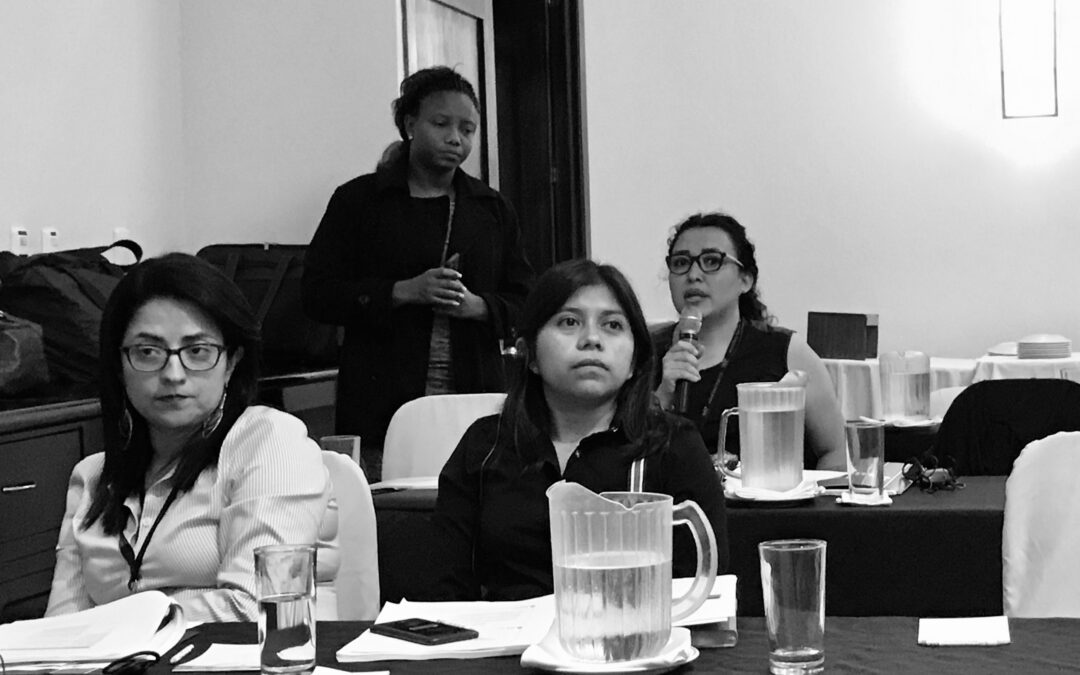
Between 26 and 29 June 2019, in Guatemala City, ICJ and its partner, Fundación de Antropología Forense de Guatemala (FAFG), with the support of the Asociación Guatemalteca de Jueces por la Integridad (AGJI) and the Bufete de Derechos Humanos (BDH), undertook trainings of more than 12 judges and 20 prosecutors on the international law and standards that apply to the investigation of unlawful death and enforced disappearances.
The workshops were conducted as part of the project under the ICJ’s Global Accountability Initiative entitled, Promoting justice for extrajudicial killings and enforced disappearances in Colombia, Guatemala and Peru, supported by the EU European Instrument for Democracy and Human Rights (EIDHR).
Opening remarks were given by Tomás Pallás Aparisi, Head of Cooperation at the EU Delegation to Guatemala, Delia Dávila, Magistrate from the Supreme Court of Guatemala and Haroldo Vasquez, President of the Asociación Guatemalteca de Jueces por la Integridad AJGI.
Ramón Cadena, Director of the ICJ’s Central America Office, addressed the international law and standards that apply to the investigation and prosecution of unlawful death and enforced disappearances and their relevance to Guatemala. Edgar Pérez, director of Bufete de Derechos Humanos (BDH) discussed the situation of enforced disappearances in Guatemala and the value and applicability of international law and standards. Marco García, a representative of FAFG, outlined the role of forensic science in the investigation of unlawful death and enforced disappearances.
Kingsley Abbott, Senior Legal Adviser & Coordinator of the ICJ’s Global Accountability Initiative, provided an overview of the revised Minnesota Protocol on the Investigation of Potentially Unlawful Death (2016), which formed the core of the materials used at the workshops.
The ICJ took the opportunity of the workshops to visit the office of its partner, the Asociación de Familiares de Detenidos-Desaparecidos de Guatemala (FAMDEGUA) and meet with Justice Delia Marina Davila Salazar of the Supreme Court of Justice of Guatemala.
Contacts:
Kingsley Abbott, Senior Legal Adviser & Coordinator of the ICJ’s Global Accountability Initiative, email: kingsley.abbott(a)icj.org
Carolina Villadiego Burbano, ICJ Legal and Policy Adviser, Latin America, and Regional Coordinator of the Project, email: carolina.villadiego(a)icj.org
Jun 15, 2019 | News
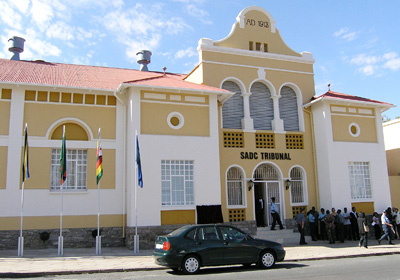
The ICJ welcomes the recent judgment of the Tanzanian High Court condemning the Tanzanian government’s actions leading to the suspension of the SADC Tribunal and the denuding of its crucial role in maintaining the rule of law and protecting human rights in the Southern African region.
Following on a decision of the South African Constitutional Court in December 2018, the decision brings increased scrutiny to the legality and legitimacy of the decision of the SADC Summit to effectively disband the SADC Tribunal in 2010 and thereby “eviscerate the possibility of the States ever being held to account for perceived human rights violations, non-adherence to the rule of law or undemocratic practices”.
“The Tanzanian court’s decision once again raises fundamental questions about the legality and legitimacy of the SADC Summit’s attempt to strip the SADC Tribunal of its powers, following on decisions relating to land reform in Zimbabwe that upset leaders of SADC states. The ICJ endorses the views of the Tanzanian and South African courts that all decisions taken by SADC States must comply with the SADC Treaty, the right of victims of human rights abuses to access justice and the rule of law,” said Arnold Tsunga, the ICJ’s Africa Director.
The Tanzanian Court’s decision is premised on the finding that the SADC Treaty is, in terms of the Vienna Convention on the Law of Treaties, binding on all SADC member States and obligations in terms of it must be performed in good faith by all executive officials.
Having set up and empowered the SADC Tribunal to adjudicate disputes in terms of the Treaty, the Court held that “State parties including Tanzania are obliged to give effect to the Tribunal, without which the existence of the Community itself remains doubtful”.
The Court likened the system of governance set out in the Treaty to a domestic doctrine of separation of powers, noting that the Tribunal is part of an intricate set of checks and balances set out in the Treaty.
The case was brought to Court by the Tanganyika Law Society in order to hold the Tanzanian government accountable to the Constitution, the SADC Treaty and “other international law human rights norms”.
The Law Society alleged that the Tanzanian government’s actions violate the right to access to justice and are therefore “inimical to the rule of law”.
The Court’s decision makes repeated reference to international human rights law norms including United Nations Basic Principles and Guidelines on the Right to a Remedy and Reparation, the Universal Declaration on Human Rights and the African Charter concluding that crucial commitments in terms of the standards set out in these documents were violated by the Tanzanian government.
The Court reasoned that in terms of international law the State is obliged to “ensure observance of [international human rights law principles] in the conduct of its international relations”.
This, crucially, meant that State parties to the SADC Treaty must, in their conduct pertaining to international relations “ensure protection of fundamental human rights of the individual” (emphasis in original).
The SADC Summit’s attempts to protect individuals from accessing the SADC Tribunal for the purposes of vindicating their rights therefore amounted to an unlawful encroachment on individuals’ rights in terms of domestic and international human rights law.
“The Court’s decision is a strong endorsement of the universality of international human rights principles as well as the need for strong checks and balances on power in all domestic, regional and international platforms established to ensure access to remedies for rights violations. The ICJ encourages the SADC leaders to individually and collectively take note of the decisions of the Tanzanian and South African courts and take immediate action to ensure full and effective operation of an independent SADC Tribunal capable of receiving and adjudicating individual complaints,” Tsunga added.
Contact:
Arnold Tsunga, ICJ Africa Director, t: +263777283249 ; e: arnold.tsunga(a)icj.org
Timothy Fish Hodgson, ICJ Legal Adviser, t: +27828719905 ; e: timothy.hodgson(a)icj.org
May 30, 2019 | News
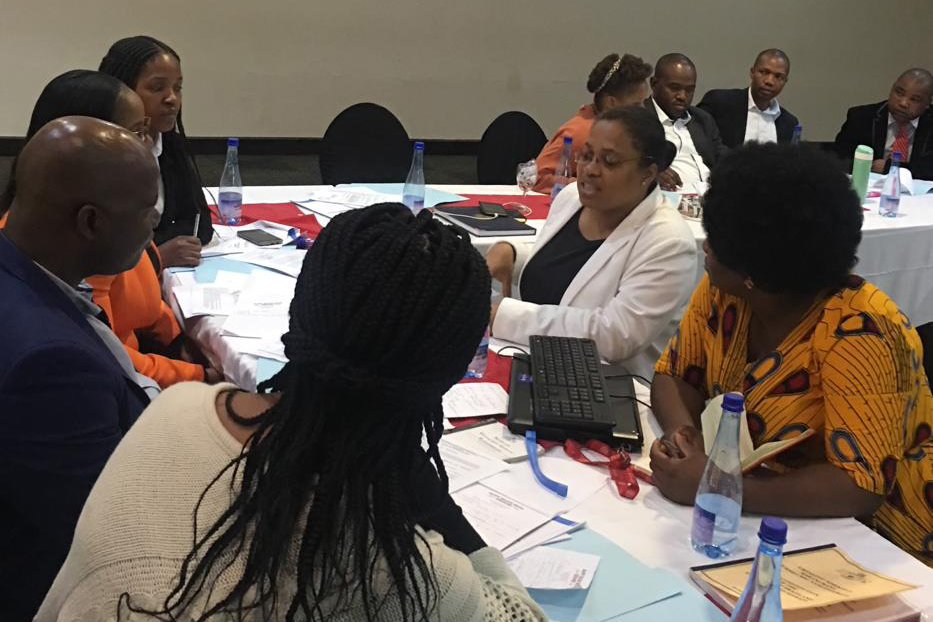
On May 29 2019, the ICJ facilitated a workshop with a number of justice sector officials and stakeholders who are active in the implementation of the Sexual Offenses and Domestic Violence Act (SODVA).
Building on previous engagements in 2018 and 2019, the participants decided on a clear plan of action for further coordination towards the eradication of sexual and gender based violence (SGBV) in Eswatini.
Participants in the meeting included representatives from the Office of the Director of Public Prosecutions, the Office of the Deputy Prime Minister, the police, correctional services, the judiciary and the Medical and Dental Association of Eswatini.
The meeting, was opened by ICJ Commissioner and Principal Judge of the High Court of Eswatini, Justice Qinisile Mabuza.
“For too many years, the clamour for this law has been loud; now that we have it, we have to interrogate how efficiently we are using it and check for the gaps that we need to address. Its implementation is in our hands, and we cannot allow ourselves to fail those that need our protection; we cannot fall foul of failing in our duty,” said Judge Mabuza.
A draft report, commissioned by the ICJ, was presented by Nonhlanhla Dlamini, the Director of Swaziland Action Group Against Abuse (SWAGAA).
The report, provided participants with a contextual analysis of challenges faced by survivors of SGBV in accessing the justice system in Eswatini.
ICJ Legal Adviser Timothy Fish Hodgson discussed key provisions of the SODV Act and the need for their interpretation and application consistently with the Convention on the Elimination of Discrimination Against Women.
SWAGAA’s draft report revealed that despite the enactment of the SODV Act significant barriers to access to justice for survivors of SGBV remain.
These include:
- Underreporting of SGBV;
- Stereotyping and discrimination faced by survivors when reporting;
- Partial application of SODV Act due to lack of knowledge on the part of key justice sector actors;
- Under-resourcing, lack of infrastructure and services presupposed by SODV Act which prevents full implementation;
- Continued stereotype-driven assumptions made by courts despite the outlawing of such approaches in the SODV Act;
- Lack of due diligence in the collection of medical evidence;
- A perception on the part of survivors that perpetrators are better taken care of in the prosecution process than survivors; and
- A growing and inaccurate perception of the SODV Act and its purposes, which has been facilitated by misleading media reports.
Participants made practical recommendations of how challenges could be addressed in their particular environments. Stressing the need to ensure continued collaboration and momentum in the implementation of the SODV Act, ICJ Africa Director Arnold Tsunga observed that: “Whether this process actually builds towards better protection from SGBV for the marginalized in Eswatini and the SODV Act’s impact is dependent on how participants in this platform and other officials are able to adopt practical measures and implement them effectively.”

May 15, 2019 | News
The ICJ today condemned a series of the acts of violence directed against the Muslim community in the aftermath of the Easter attacks on 21 April in Sri Lanka directed at churches and other places.
In the most recent attacks on 13 May, at least one person was killed in anti-Muslim mob violence in Nattandiya. In addition, various attacks have resulted in the looting and destruction of mosques, Muslim-owned businesses and houses in several parts of the island including Negombo, Chilaw, Kurunegala and Gampaha.
The ICJ called upon the State authorities to conduct independent, impartial and effective investigations into the attacks and bring all perpetrators to justice in line with international standards. Furthermore, the ICJ urges the Government of Sri Lanka to send a clear public message that acts of violence against any religious minorities are not tolerated.
“Attacks perpetrated against religious minorities are more likely to occur in a climate of impunity” said Fredrick Rawski, ICJ’s Regional Director for Asia and the Pacific. “The fact that Sri Lanka has a history of serious violations of human rights of religious minorities makes it even more urgent that the Government act to safeguard the human rights of all persons and take immediate measures to protect members of religious minorities from further violence.”
Delayed action or inaction on the part of law enforcement authorities during and in the immediate aftermath of the attacks has further exacerbated the situation. Given the recurring patterns of mob violence against religious minorities in Sri Lanka, a handful of arrests will not suffice. It must be followed up by independent and impartial investigations and, where warranted, prosecutions as part of an effective preventive strategy to counter such collectively organized violence.
Under international human rights law, including the International Covenant on Civil and Political Rights, to which Sri Lanka is a party, States have a duty to protect freedom of religion, which includes persons from religious minorities against abuses committed against them by any person or group.
The Government of Sri Lanka must take appropriate security measures in response to the worst terror attack in recent years. However, it must ensure that the volatile situation is not made worse by inaction to prevent anti-Muslim violence and vigilantism. Moreover, the State must ensure that any counter-terrorism measure is adopted and implemented in line with its international human rights law obligations and does not explicitly or implicitly target a particular community.