Sep 10, 2018 | Events, News
The legal profession plays a crucial role in ensuring access to justice for all, transparency and accountability of the state, Rule of law and the respect for human rights.
Yet, instead of being perceived as a vital player to the justice sector, today lawyers are often targeted by the governments in many OSCE countries for seeking truth and justice. As a result, lawyers often face high risks of persecution, harassment as well as severe sanctions for doing their job.
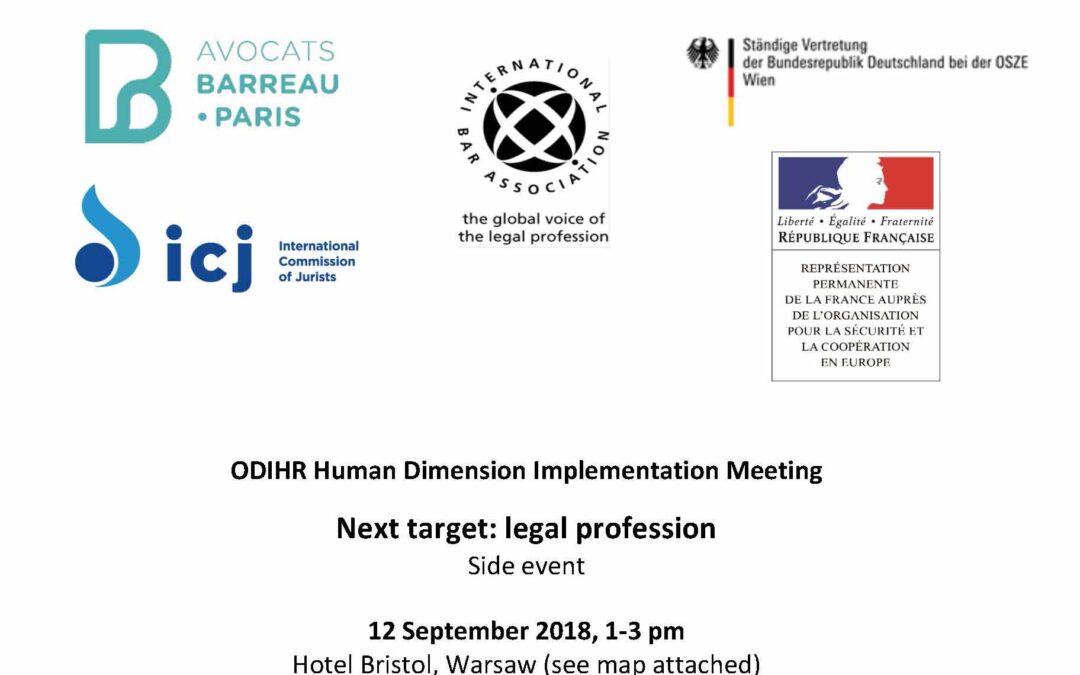
This side-event aims to specifically discuss the situation of lawyers in Belarus, Russia, Azerbaijan, Tajikistan and Kazakhstan. The discussion will extend to consider the latest developments related to the rights of lawyers and their independence in the respective countries, and what impact this has on the overall rule of law and human rights situation.
This side event will take place on 12 September 2018, from 13.00 -15.00 at Hotel Bristol, Warsaw
Moderator: Jurate Guzeviciute, Programme Lawyer, International Bar Association’s Human Rights Institute
Presentations and Discussions:
Independence of the legal profession and harassment of lawyers in Eastern Europe and Central Asia:
- Tajikistan: Dilrabo Samadova, lawyer, Tajikistan
- Azerbaijan: Nijat Mammadbayli, lawyer, Azerbaijan
- Kazakhstan: Snezhanna Kim, lawyer, Kazakhstan
- Russia: Róisín Pillay, Director of the Europe Regional Programme, International Commission of Jurists
- Belarus: Anne Souléliac, Head of the Human Rights section, Paris Bar Association
Organizers: Permanent Mission of the Federal Republic of Germany to the OSCE, Permanent Representation of France to the OSCE, International Bar Association’s Human Rights Institute, Paris Bar Association, International Commission of Jurists.
Poland-HDIM_Side event-News-event-2018-ENG (flyer of the event in PDF)
Sep 5, 2018 | Events, News
The ICJ will participate in the side event “Accountability and the need to end impunity for human rights violations in Yemen,” organized by the CIVICUS, FIDH, CIHRS in cooperation with Mwatana for Human Rights and the Gulf Centre for Human Rights (GCHR).
This side event at the Human Rights Council will take place on Monday, 10 September 2018 from 12:00 – 13:00 in room XXIV of the Palais des Nations.
The issue of human rights defenders including bloggers, Internet activists, and journalists who are at extreme risk of persecution will be discussed.
Speakers:
- Radhya Al-Mutawakel, Co-founder and Chairperson of Mwatana for Human Rights
- Khalid Ibrahim, Executive Director, Gulf Centre for Human Rights (GCHR)
- Vito Todeschini, Associate Legal Adviser, International Commission of Jurists (ICJ)
- Miriam Puttick, Head of MENA Programmes, Ceasefire for Civilians Rights
Moderator:
Antoine Madelin, International Advocacy Director, International Federation for Human Rights (FIDH)
Yemen-Side event at HRC-News-events-2018-ENG (download the flyer)

Jul 30, 2018 | News
On 25 July 2018, the ICJ facilitated an integrated meeting of governmental stakeholders in the justice chain involved in different aspects of combatting sexual and gender-based violence (SGBV) in the Kingdom of Eswatini (Swaziland), the first meeting of its kind.
The meeting was convened by ICJ Commissioner and Principal Judge of the High Court of Eswatini, Justice Q. M. Mabuza. It followed a meeting held in February 2018 on combating SGBV in Eswatini and an ICJ report on key challenges to achieving justice for gross human rights violations in Eswatini, the latter of which recommended that justice sector stakeholders involved in the investigation, prosecution and sanctioning of, and provision of redress to victims for, acts of SGBV should convene six-monthly meetings so as to develop a common and integrated approach to the effective combating of SGBV.
The integrated meeting involved senior officials from the Office of the Deputy Prime Minister, the Office of the Attorney General, the Office of the Director of Public Prosecutions, the police, correctional services, and the judiciary.
The meeting discussed the fight against SGBV in the context of the Guidelines on Combating Sexual Violence and its Consequences in Africa, and other international standards. It considered the national legal and policy framework on SGBV; practices and challenges in the investigation and prosecution of SGBV; the sanctioning of SGBV offences; and the rehabilitation of sexual and domestic violence offenders by correctional services. Perspectives of the Office of the Deputy Prime Minister, the police and the judiciary were emphasized during discussions.
Stakeholders discussed issues with a view to identifying gaps and challenges in national law, policy and practice when measured against regional and global standards and best practices, as well as with a view to considering potential solutions to those gaps and challenges. The meeting agreed on next steps, including on concrete action that aligns with and/or augments the National Strategy to End Violence. Stakeholders agreed that they should all be involved in the early stages of cases involving SGBV.
Stakeholders also agreed that the recently enacted Sexual Offences and Domestic Violence Act will only be effectively implemented if justice sector stakeholders are well coordinated. Stakeholders agreed that integrated meetings should be held regularly, at intervals of no less than six months including, if possible, before the end of 2018.

Jul 19, 2018 | News
His Majesty King Mswati III of the Kingdom of Eswatini (formerly known as the Kingdom of Swaziland) yesterday gave his royal assent to the Sexual Offences and Domestic Violence Act, a milestone in the fight against sexual and gender-based violence (SGBV) in the country.
In its May 2018 report on key challenges to achieving justice for human rights violations in Swaziland, the ICJ identified the widespread occurrence of SGBV, with discriminatory practices based on customary laws and traditional beliefs undermining equality between men and women and the access by victims of such violence to effective remedies and reparation, as well as the holding to account of perpetrators of such violence.
Eswatini’sNational Strategy to End Violence in Swaziland 2017-2022, produced by the Office of the Deputy Prime Minister in collaboration with the UN Population Fund, itself pointed to an alarming rate of increasing violence in all its forms, noting that its most common form was gender-based violence, disproportionately affecting women and girls.
The new law follows a protracted legislative process, first initiated in 2009; then resumed in 2015. It has also been accompanied by increasing attention and concern by international human rights mechanisms, including the UN Human Rights Committee and the Committee on Elimination of Discrimination against Women.
Building on ICJ initiatives to bring together international, regional and local SGBV experts in 2015, and on sustainable development goals on access to justice and gender equality in 2017, the ICJ with local partners convened a workshop on combatting SGBV in Swaziland in February 2018. In consultations during and around this most recent workshop, interlocutors signaled fears that the Senate of Swaziland was equivocating on passage of the 2015 Bill. Responding to local partners’ requests, the ICJ made a submission to the Senate in March 2018, bringing to its attention to the global and regional obligations of the Kingdom to enact the legislation, as well as the Government’s own commitments to do so. The Senate soon after voted to adopt the legislation.
The new law for the first time criminalizes marital rape and other domestic violence offences; makes provision for Specialised Domestic Violence Courts; creates mechanisms and avenues for reporting of offences; and requires medical examination and treatment of victims. These are issues that had not been previously provided for.
Enactment of the law is significant, incorporating into domestic law a very large part of Eswatini’s international human rights obligations, including those arising from the Africa region, to criminalize and sanction the perpetrators of SGBV. It also discharges commitments made by His Majesty’s Government during the 2016 Universal Periodic Review.
Just as important will be the effective implementation of the new law to combat SGBV by bringing perpetrators to account and providing victims with access to justice.
With a view to enhancing the prospects of an effective and comprehensive approach to that end, the ICJ’s Commissioner, and Principal Judge of the High Court, Justice Qinsile Mabuza, will next week be coordinating a meeting of governmental justice sector stakeholders involved in combatting SGBV in the country. This first coordinated meeting of governmental actors will focus on issues of investigation, prosecution and sanctioning of sexual and gender-based violence crimes, including the role of social and medical services.
The ICJ is also commissioning a report on the access of victims of SGBV to effective remedies and reparation. Focused on case studies, the report will include attention to lack of justice through acquittals that have been prompted by inadequate laws or procedures and/or through lack of prompt or sufficient forensic or medical evidence. This report will feed into discussions at a second meeting of governmental justice sector stakeholders, intended for 2019.
Jul 15, 2018 | News
On 14 July 2018, the ICJ co-organized a discussion on extrajudicial killings in Thailand, focusing on the cases of Chaiyaphum Pasae and Abe Saemu.
The discussion was held at the Student Christian Centre in Bangkok.
Chaiyaphum Pasae, a Lahu youth activist, was killed by a military officer in the Chiang Dao district of Thailand’s northern Chiang Mai province in March 2017. The killing took place during an attempt to arrest him as an alleged drug suspect. Officials claimed Chaiyaphum Pasae had resisted arrest and was subsequently shot in “an act of self-defence”.
Abe Saemu, from the Lisu hill tribe, was killed by a military officer in February 2017 in the Chiang Dao district of Chiang Mai province in an attempt to arrest him on allegations of drug coffences. Officials claimed Abe Saemu had resisted arrest and was killed in “self-defence”.
During the discussion, ICJ’s National Legal Adviser Sanhawan Srisod addressed the audience to set out the international law and standards that apply to investigating potentially unlawful deaths, including the rights of victims and family members, referring to the standards set out in the revised Minnesota Protocol on the Investigation of Potentially Unlawful Death (2016), which was launched in Thailand on 25 May 2017.
Participants in the event included members of the families of Chaiyaphum Pasae and Abe Saemu, the lawyers in both of their cases, interested members of the public, media representatives, students and academics.
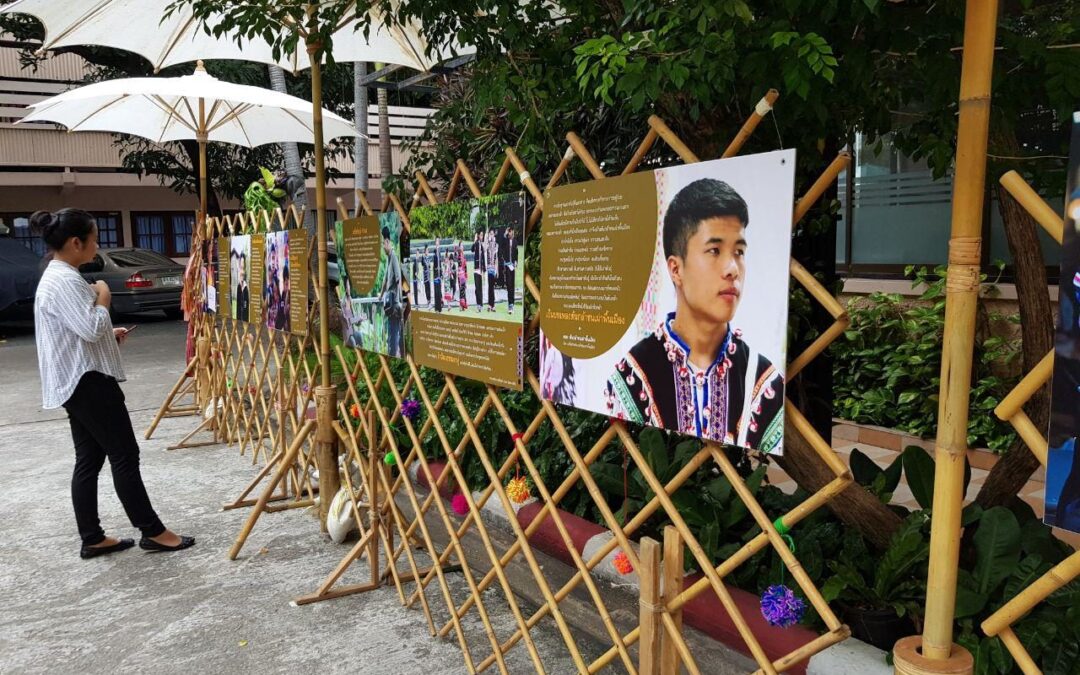
The discussion opened with an art exhibition and Lahu dance show by the Save Lahu group. Human Rights Commissioner Angkhana Neelapaijit then made a presentation on challenges in seeking accountability for extrajudicial killings in Thailand.
A panel discussion on the latest updates in the cases of Chaiyaphum Pasae and Abe Saemu followed, moderated by Pranom Somwong from Protection International.
The panel included relatives of Chaiyaphum Pasae and Abe Saemu; Ratsada Manuratsada, a lawyer representing the families in both cases and Krissada Ngamsiljamras, a representative from the National Human Rights Commission of Thailand.
A second panel considered challenges on the administration of criminal justice in the context of unlawful deaths.
Moderated by Pratubjit Neelapaijit of UN Office of the High Commissioner for Human Rights, the panel included Malee Sittikreangkrai (Chiang Mai University); Sumitchai Hattasan (Human Rights Lawyers’ Association); Namtae Meeboonsalang (Provincial Chief Public Prosecutor, Office of the Attorney-General); Kritin Meewutsom (Forensic doctor, Ranong Hospital); and Sanhawan Srisod (ICJ).
The event was conducted in collaboration with Cross Cultural Foundation (CrCF); Protection International (PI); UN OHCHR; Human Rights Lawyers’ Association (HRLA); Thai Volunteer Services (TVS); Dinsorsee Creative Group; Center for Ethnic Studies and Development, Chiang Mai University (CESD); Legal Research and Development Center, Chiang Mai University (LRDC) and Network of Indigenous Peoples in Thailand (NIPT).
Contact
Kingsley Abbott, Senior Legal Adviser, ICJ Asia Pacific Regional Office, kingsley.abbott(a)icj.org