May 27, 2017 | News
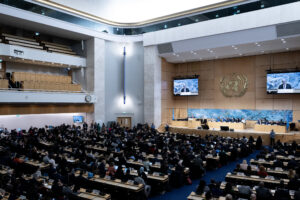
On 24 May 2017, States at the UN reached an agreement to prepare an “international regulatory framework” to protect human rights and ensure accountability for violations and abuses relating to the activities of private military and private security companies (PMSCs).
The agreement, reached at Working Group level, has still to be ratified by the full UN Human Rights Council.
It would be the first universal international instrument on human rights and private security companies negotiated and adopted at the UN.
This could pave the way to further developments towards increased monitoring and accountability of the private security industry.
The agreement constitutes a landmark achievement. The intergovernmental Working Group over the past six years have been mired in circular debates as to whether or not it is desirable to develop a legally binding instrument on PMSCs.
Last’s week agreement leaves aside for the moment the decision about the nature of the instrument and will instead allow for a constructive focus on the contents of the future instrument.
Activities of private and military security companies became the object of heightened international scrutiny particularly after events in the context of the armed conflict in Iraq over the past decade.
These include unlawful killings at Nisoor Square and torture and ill-treatment at Abu Graib prison.
A Working Group of experts on mercenary activity appointed by the UN Human Rights Council started to look at the issues in 2007, generating proposals for international instruments to fill perceived regulatory gaps.
Many States have now accepted that the absence of an international regulatory framework combined with limited or non-existent regulation at national level offers a “breeding ground” for human rights abuses committed by PMSCs.
The main clients of these companies are governments that contract them to carry out specific functions, including some that many believe should remain firmly in the hands of public officials.
One key issue that the future instrument should address is the circumstances under which PMSCs can be considered to act on behalf of the State when they are contracted to perform functions that are typically State functions.
International law already governs some aspects of PMSC activity. International human rights law provides for a general obligation of States to protect against the adverse consequences of PMSC activity.
There has also been other international regulatory activity outside of UN auspices in this area.
In 2008 a select group of mostly Western States led by the Government of Switzerland and the International Committee of the Red Cross (ICRC) elaborated the Montreux Document on pertinent obligations for States regarding PMSCs.
Other initiatives such as a Code of Conduct for the PMSCs themselves followed suit. But many States and civil society organizations regard these initiatives as insufficient and lacking the universality afforded by UN processes.
One notable weakness in current approaches is the dearth of standards and mechanisms squarely addressing accountability of private security industry and to ensure access to remedy for those victims of abuse.
Experience shows that States legal frameworks have limited effectiveness when abuses occur at the cross-border level, involving more than one company in more than one jurisdiction, especially in conflict or post-conflict environments.
The prospective international regulatory framework should surely build on existing initiatives, research and findings.
To that end, broad participation by all stakeholders should be ensured.
In this regard, participation of civil society and NGOs specialized in human rights has not been optimal so far.
States leading this new process should make all and every effort to fill that gap, ensuring that international and national civil society receive timely information and facilities for meaningful participation.
May 8, 2017 | Advocacy
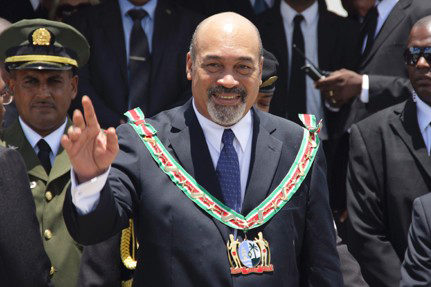
The following document updates a report issued by the ICJ on 29 May 2012 as part of an on-going trial observation mission concerning the trial of Suriname President Desiré Delano Bouterse, accused of crimes involving unlawful killings.
Download the update below:
Suriname-Justice delayed Bouterse case-Advocacy-2017-ENG (in PDF)

Apr 20, 2017 | News
Nepali authorities should immediately take effective steps to enforce the landmark Kavre district court murder verdict for the 2004 torture and killing of teenage Maina Sunuwar, the ICJ, Amnesty International, and Human Rights Watch said today.
On 16 April 2017, the Kavre district court sentenced three army officers to life imprisonment for the murder of Maina Sunuwar, a 15-year-old girl (photo) who was tortured in army custody and died as a result in February 2004.
Maina’s killing took place during the decade-long armed conflict between the Maoists and government forces that ended in 2006.
A court martial in 2005 found that Maina had died in army custody, convicted the three officers of torture and murder, but only sentenced the three perpetrators to six months’ imprisonment for minor offences, and promptly released them on grounds that they had already served the six months while confined to army barracks during the period of investigation.
“These convictions are an important development in Nepal’s slow-paced justice system’s ability to deal with grave conflict-era human rights abuses,” said Sam Zarifi, the ICJ’s Secretary General.
“What we need now is for the government to demonstrate its commitment to the rule of law and enforce them,” he added.
The trial before the Kavre district court took place in the absence of any of the four accused, despite repeated court summonses, including an arrest warrant, to notify them of the charges and compel them to appear in court.
The three accused army officers who were convicted of Maina Sunuwar’s murder, Bobi Khatri, Amit Pun and Sunil Adhikari, are no longer in the army and are believed to have fled abroad after the court martial proceedings.
The fourth accused, who was acquitted, Major Niranjan Basnet, is still in the army and was repatriated to Nepal from a UN peacekeeping assignment in Chad in 2009 due to the indictment against him.
Maina Sunuwar’s case has become emblematic of the shortcomings in Nepal’s justice system that have repeatedly frustrated efforts of Nepali conflict victims to secure justice for wartime abuses.
Maina Sunuwar’s mother first filed a report with the police in November 2005.
Since then, there have been numerous procedural and political hurdles, and a lack of cooperation by the military as it sought to protect its own.
An arrest warrant issued in 2008 was never enforced by Nepali authorities, with the police telling the court they were unable to trace them.
“Maina Sunuwar’s case was a true test case for the Nepal criminal justice system, but the government has a habit of simply ignoring court orders,” said Brad Adams, Asia director of Human Rights Watch. “This is the first sign of hope for victims after more than ten years since the end of the conflict—and now we need to see all those convicted of murder behind bars.”
The human rights organizations expressed concern that the government might refuse to seek to take measures to enforce the Kavre court’s verdict given its prior record on this and thousands of other conflict-era cases.
In a disturbing example, the police have yet to implement a 13 April 2017 Supreme Court order to arrest Bal Krishna Dhungel, a Maoist politician convicted of a 1998 murder.
Dhungel has yet to serve out his life sentence handed down by the courts.
The court gave the police a week to execute its order and present Dhungel before it.
“The Kavre district court has done its job, reaffirming the independence of the judiciary from political and military pressure, and holding perpetrators of serious crimes committed during the conflict to account,” said Biraj Patnaik, Amnesty International South Asia Regional Office Director. “Now the authorities must do their job by breaking with the practice of successive past governments that ignore and undermine the courts’ decisions. We expect the government to promptly implement this week’s ruling.”
Contact
Nikhil Narayan, ICJ’s South Asia Senior International Legal Adviser, e: Nikhil.narayan@icj.org
Sam Zarifi, ICJ’s Secretery General, e: sam.zarifi@icj.org
Mar 23, 2017 | News
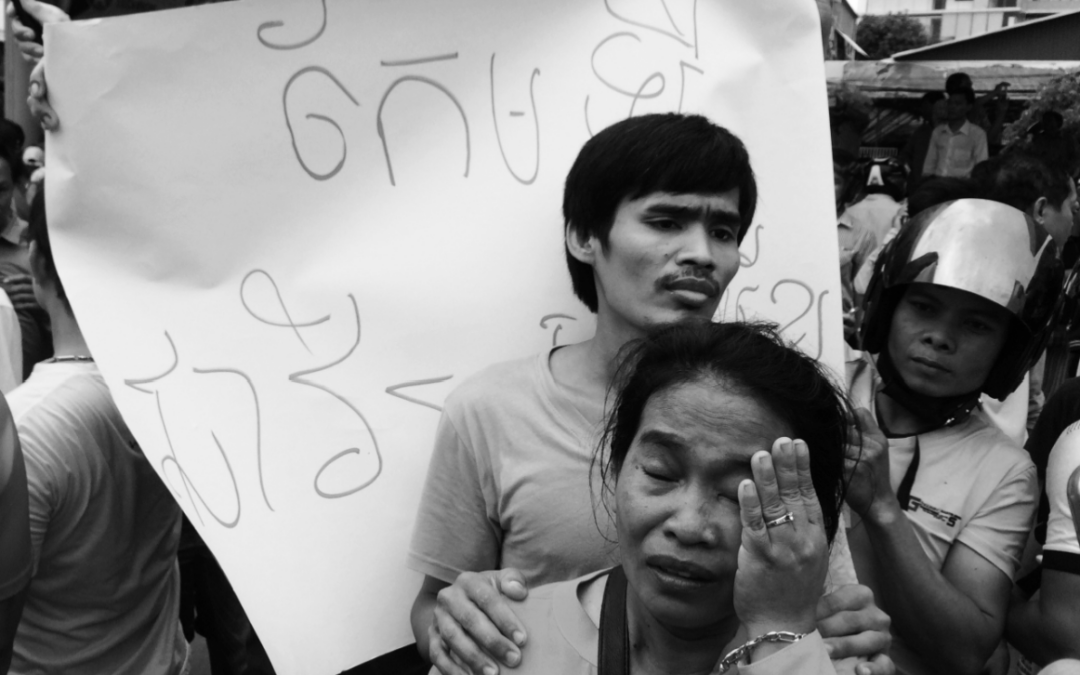
Cambodia should continue to investigate the killing of prominent political commentator Kem Ley in order to address key aspects of the case that appear to have been inadequately investigated, said the ICJ, Amnesty International, and Human Rights Watch today.
On 23 March 2017, the Phnom Penh Municipal Court found Oeuth Ang guilty of the premeditated murder of Kem Ley on 10 July 2016 and sentenced him to life imprisonment.
Prior to the half-day trial, which took place on 1 March 2017, the authorities released almost no information about the investigation.
“The trial revealed that the investigation appeared to be deficient in several important respects,” said Kingsley Abbott, the ICJ Senior International Legal Adviser who observed the trial.
“Until there is an independent, impartial and effective investigation to establish whether anyone else was involved in the killing, the victims of this serious crime, including Kem Ley’s wife and children, will be unable to obtain justice,” he added.
Even the very identity of the defendant was at issue. At trial, Oeuth Ang maintained he is 39-years-old, unmarried, and named “Chuob Samlab” – which translates in English as “Meet to Kill” – from Banteay Meanchey province.
However, the prosecutor submitted that based on the fingerprint on the ID card of Oeuth Ang, he is satisfied that the defendant is in fact Oeuth Ang, married, born in 1972, from Siem Reap province.
“The proceedings may have established that Oeuth Ang pulled the trigger, but the investigation does not seem to have considered whether someone else loaded the gun,” said Champa Patel, the Amnesty International Director for Southeast Asia and the Pacific. “It is clear that the authorities want to close the book on this case and move on but failures in the investigation of this heinous act can only serve to compound the injustice already suffered by the family of Kem Ley”.
The hearing commenced at 8:40 and concluded at 13:00. After Oeuth Ang gave evidence, ten witnesses gave oral testimony including two Caltex workers, seven officials who were involved in the investigation in different capacities, and a doctor who examined Kem Ley’s body at the scene of death.
Official reports and the statements of several witnesses were also read into evidence, and the prosecution played eight videos from different locations, including one captured by a closed circuit television (CCTV) camera inside the Caltex station where Kem Ley was killed.
Kem Ley’s widow, who was named as a civil party, did not appear at the trial but her civil party statement was read into evidence.
“The authorities’ failure to investigate so many clear gaps in the defendant’s story and the court’s unwillingness to examine them suggest that a quick conviction rather than uncovering all involved was the main concern,” said Phil Robertson, Deputy Asia Director at Human Rights Watch. “Kem Ley’s family have been outspoken in their disbelief that Oeuth Ang was solely responsible for the murder, and the trial’s conduct lends credence to their skepticism.”
Contact
Kingsley Abbott, ICJ Senior International Legal Adviser for Southeast Asia, t: +66 94 470 1345 ; email: kingsley.abbott(a)icj.org
Cambodia-KemLey Verdict-News-Press releases-2017-ENG (full story, in PDF)
Mar 9, 2017 | News
Amnesty International and the ICJ regret the decision of Thailand’s National Legislative Assembly (NLA) to further delay the passage of essential legislation criminalizing torture and enforced disappearances.
Our organizations call on the Thai government to cease its stalling measures and instead prioritize the amendment of the Draft Prevention and Suppression of Torture and Enforced Disappearance Act (Draft Act) in order to bring it into line with international law. The government should then ensure its passage into law without undue delay.
On 28 February, the Office of the High Commissioner for Human Rights announced that it had been informed that the NLA would not enact the Draft Act. The following day, an NLA official speaking to BBC Thai confirmed that the draft would be “returned [to the Thai Cabinet] for more consultations… with Interior officials, police authorities, the national security sector, military authorities and prosecutors.”
The Draft Act is the result of years of effort by government authorities, including by Ministry of Justice officials who consulted with our organizations and took account of many of our recommendations in elaborating it. The draft was approved by Thailand’s Cabinet in May 2016.
The recent decision by the NLA has indefinitely delayed the enactment of this important piece of legislation, which would represent a significant step towards preventing torture and enforced disappearances in Thailand.
The slow-tracking of this law in the face of all the commitments Thailand has made over the years right up to last year is extremely disappointing, especially for the victims of torture and enforced disappearances who have struggled to obtain justice in the absence of a clear legal framework.
The most recent version of the Draft Act addresses many existing gaps in Thailand’s current legal framework and could support Thailand’s compliance with its obligations under international human rights law. However, further amendments are needed to address significant shortcomings in the Draft Act.
In particular, the Draft Act omits key elements from the definitions of torture and enforced disappearances, does not criminalize acts of cruel, inhuman or degrading treatment, and fails to define enforced disappearance as a continuing crime. Additionally, the Draft Act does not extend criminal liability beyond the direct commission of the act and fails to unequivocally bar the use as evidence in court proceedings of statements obtained by torture.
Thailand should make it a top priority to address these and other concerns and to enact the law as soon as possible. The urgent need to amend and enact the Draft Act is underscored by recent reports alleging the use of torture and other ill-treatment by state security forces and the continued failure to hold accountable perpetrators of torture, other ill-treatment and enforced disappearances.
Our organizations remain committed to providing any necessary assistance to the Thai government in amending the Draft Act or otherwise acting to prevent torture and enforced disappearances in Thailand.
Background
Thailand is a state party to the International Covenant on Civil and Political Rights (ICCPR), the Convention against Torture and other Cruel, Inhuman or Degrading Treatment or Punishment (CAT), and has signed, but not ratified, the International Convention for the Protection of All Persons from Enforced Disappearance (ICPPED).
The expert UN bodies overseeing the implementation of these treaties have consistently called upon states parties to criminalise torture and enforced disappearance as specific crimes.
On 13 and 14 March 2017, the UN Human Rights Committee will review Thailand’s compliance with the ICCPR.
In Thailand’s 15 November 2016 reply to the Committee’s List of Issues,[1] it noted that it was in the process of passing the Draft Law which would “provide clear definition and set up specific offence on torture to be in line with the terms set forth under CAT” and “serve as an implementing legislation for ICPPED.”
It also noted that the Draft Act “aims to strengthen the prevention, suppression, and prosecution mechanism and to ensure remedy for victims as well as address the problem of misuse, and abuses of power by government authorities with regard to torture and enforced disappearances.”
It concluded by noting that “[o]n 24 May 2016, the Cabinet approved the draft Act in principle. The draft has been reviewed by the Council of State and is currently waiting to be submitted to the legislative branch for consideration.”
[1] Human Rights Committee, “Replies of Thailand to the List of Issues,” U.N. Doc. CCPR/C/THA/Q/2/Add.1, para 51.
Thailand-Joint Statement-Torture Legislation-News-2017-ENG (Press release in PDF)
Contact
Kingsley Abbott, Senior International Legal Adviser for Southeast Asia, Tel: +66 94 470 1345, E-mail: Kingsley.abbott(a)icj.org