Sep 2, 2013 | News
The ICJ today called on the Bangladesh authorities to immediately withdraw the contempt of court notice issued against the international human rights organization Human Rights Watch.
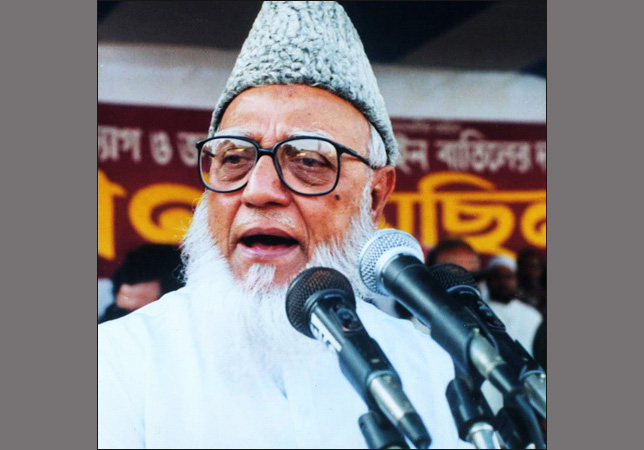
The charges are in response to well documented concerns by Human Rights Watch that the trial of Ghulam Azam (photo), former head of the Islamist group Jamaat-e-Islami Azam’s trial was “deeply flawed” and failed to meet international fair trial standards.
“Silencing voices that highlight the shortcomings of the International Crimes Tribunal impede rather than advance the enormously important task of ensuring that those responsible for committing atrocities during Bangladesh’s war of liberation are brought to justice in a process that complies with international law and standards”, said Alex Conte, Director of the ICJ’s International Law and Protection Programmes.
On 2 September 2013, the International Crimes Tribunal (ICT) in Bangladesh issued a show cause notice asking Human Rights Watch to explain why contempt of court proceedings should not be initiated against it for its allegedly ‘biased’, ‘scandalous’ and ‘inaccurate’ statements about the ICT. Human Rights Watch has to respond within three weeks, or possibly face trial and conviction in absentia.
“Assessing the conduct of administration of justice in judicial proceedings, including where it entails criticism of judicial performance is an important means of ensuring accountability,” said Conte. “Judges and prosecutors should defend the right to freedom of expression, not use their discretionary powers to muzzle criticism”.
Contact:
Alex Conte, Director, International Law & Protection Programmes, t: +41 79 957 2733; email: alex.conte(a)icj.org
Additional information:
The Bangalore Principles on Judicial Conduct clarify that “since judicial independence does not render a judge free from public accountability, and legitimate public criticism of judicial performance is a means of ensuring accountability subject to law, a judge should generally avoid the use of the criminal law and contempt proceedings to restrict such criticism of the courts”.
The Commonwealth (Latimer House) Principles on the Accountability of and the Relationship Between the Three Branches of Government also stress that “criminal law and contempt proceedings should not be used to restrict legitimate criticism of the performance of judicial functions”.
The UN Declaration on Human Rights Defenders underscores that “everyone has the right, individually and in association with others, to promote and to strive for the protection and realization of human rights and fundamental freedoms at the national and international levels”.
The Declaration also highlights that human rights defenders have the right to “freely to publish, impart or disseminate to others views, information and knowledge on all human rights and fundamental freedoms” and to hold opinions and draw public attention to the observance of human rights.

May 29, 2013 | Agendas, Events
On Tuesday 28 May 2013, the ICJ co-sponsored a parallel event with TRIAL and the Missions of Botswana, Costa Rica, Estonia and Switzerland during the Human Rights Council’s 23rd regular session held in Geneva.
The event, held in Room XXV of the Palais des Nations, addressed key issues concerning accountability and human rights. The event was chaired by Professor Paola Gaeta from the Geneva Academy of International Humanitarian Law and Human Rights. Panelists were Tiina Intelmann, President of the Assembly of the States Parties to the ICC Statute; Mothusi Bruce Rabasha Palai, Ambassador of Botswana; Ian Seiderman, Director of the ICJ’s Law and Policy Office; and Gabriella Citroni, Senior Legal Adviser at TRIAL (Swiss association against impunity).
Panelists agreed that accountability is intimately linked to the enjoyment of human rights. It was stated that – under State responsibility – States are, or should be, held responsible for acts involving any violation of international law, including international human rights law and international humanitarian law. Accountability is thus not only about criminal justice, but also about ensuring reparations and guarantees of non-recurrence.
Recommendations made under the Universal Periodic Review (UPR) mechanism were seen as having been partly successful in bridging gaps, although there remains a lack of proper follow-up on the progress of implementation between UPR cycles. Panellists observed that States often fail to refer to standards enunciated by the High Commissioner for Human Rights and by the Special Procedures. Regarding the accountability of non-State actors for conduct involving human rights abuses and violations, the ‘Ruggie Principles’ were referred to as a representing good progress but still failing to be as comprehensive as they should be.
Concerning future steps by Human Rights Council mechanisms, panellists proposed that resolutions, statements and Special Procedures should more directly and frequently refer to accountability. The need for greater political pressure on the International Criminal Court was expressed, with the aim of supporting the domestic capacity of States parties to the Rome Statute. Concerning domestic capacity to strengthen accountability more generally, panellists and participants agreed on the need to improve linkages between the work of persons dealing with development and those working on accountability.
HR Council-Strengthening accountability-event-2013 (event flyer in pdf)
Mar 21, 2013 | News
A resolution adopted today by the UN Human Rights Council highlights the Sri Lankan Government’s ongoing failure to provide accountability for serious violations of human rights and the laws of war, the ICJ said.
“The ICJ welcomes this resolution as it underscores the international community’s continuing concern about the horrific atrocities committed by all sides to the Sri Lankan conflict,” said Alex Conte, Director of ICJ’s International Law and Protection Programmes. “The UN, as well as the Commonwealth and other international organizations interested in helping the Sri Lankan people, should now press and assist the Sri Lankan Government to show tangible implementation of their oft-repeated promises.”
Twenty-five States supported the resolution, following from a similar resolution adopted by the Council on Sri Lanka last year.
The resolution reiterates the need for the Sri Lankan Government to demonstrate tangible steps to ensure accountability for violations of human rights and the laws of war, especially during the final months of the three-decade long conflict in 2009.
In particular, the resolution calls on the Sri Lankan Government to implement the recommendations of its own Lessons Learnt and Reconciliation Commission (LLRC).
The LLRC was widely criticized by Sri Lankan civil society as well as international observers as falling short of international standards of providing accountability.
“Sri Lanka has a long history of promising justice but delivering impunity, and the LLRC is only the most recent example of that. With this resolution, the international community shows it wants to see concrete action,” Conte added. “Not only has the Sri Lankan Government not addressed the violations of the past, but there are strong indications that the rule of law has significantly deteriorated.”
The resolution notes with concern the ongoing reports of human rights violations being committed with impunity in Sri Lanka, including enforced disappearances, extrajudicial killings and torture.
In October 2012, the ICJ released a 150-page report Authority without Accountability: The Crisis of Impunity in Sri Lanka, documenting the systematic erosion of accountability mechanisms in Sri Lanka.
In recent months, Sri Lanka’s Government has stepped up its assaults on the independent functioning of the judiciary. In particular, the country’s Chief Justice was removed from office after she had challenged the legality of Government efforts to consolidate authority. The heavily politicized impeachment process was declared unconstitutional by the Supreme Court of Sri Lanka and was inconsistent with international human rights law and standards.
“In light of this resolution and the situation in Sri Lanka, the Commonwealth should change its plans to hold the 2013 Commonwealth Heads of Government Meeting in Colombo,” said Conte. “Sri Lanka has demonstrated its rejection of the Commonwealth Principles, notably democracy, the independence of the judiciary and human rights. This will no doubt be further confirmed when the High Commissioner for Human Rights presents her oral update to the Human Rights Council in September this year, just two months ahead of the scheduled Heads of Government Meeting.”
The ICJ has urged the Commonwealth Ministerial Action Group (CMAG), which meets next month, to address the human rights situation in Sri Lanka with the objective of removing its right to host the Heads of Government Meeting.
CONTACT:
Sam Zarifi, ICJ Asia-Pacific Regional Director, (Bangkok); t:+66(0) 807819002; email: sam.zarifi(at)icj.org
Sheila Varadan, ICJ Legal Advisor, South Asia Programme (Bangkok); t: +66 857200723; email: sheila.varadan(at)icj.org
NOTES:
- The resolution of the Council was adopted by 25 votes in favor, 13 against and 8 abstentions (with Congo, Ecuador, Indonesia, Kuweit, Maldives, Mauritania, Pakistan, Philippines, Qatar, Thailand, Uganda, United Arab Emirates and Venezuela voting against; and Angola, Botswana, Burkina Faso, Ethiopia, Japan, Kazakhstan, Kenya, Malaysia abstaining)
- The resolution was led by the United States of America and co-sponsored by Austria, Canada, Estonia, Germany, Ireland, Italy, Montenegro, Poland, Romania, Spain, and Switzerland; as well as by the following non-member States of the Council: Belgium, Bulgaria, Croatia, Denmark, Finland, France, Georgia, Greece, Hungary, Iceland, Liechtenstein, Lithuania, Malta, Monaco, Norway, Portugal, Saint Kitss and Nevis, Slovakia, Slovenia, Sweden and the United Kingdom of Great Britain and Northern Ireland.
- In January 2012, Chief Justice Dr Shirani Bandaranayake was removed in an impeachment process that violated international standards of due process and was declared unconstitutional by the Supreme Court. The impeachment was widely condemned internationally. The ICJ issued a letter supported by fifty-six senior jurists from over thirty countries worldwide.
RELATED ARTICLES:
Open letter: Sri Lanka should not host the 2013 Commonwealth Heads of Government Meeting
ICJ calls for International Commission of Inquiry on accountability in Sri Lanka
The International Commission of Jurists welcomes key Human Rights Council resolution on Sri Lanka
Sri Lanka: judges around the world condemn impeachment of Chief Justice Dr Shirani Bandaranayake

Mar 18, 2013 | Advocacy, Events
The ICJ’s Director of the International Law & Protection Programmes today addressed an international conference on strengthening cooperation in preventing terrorism, held in Baku, Azerbaijan.
In a session focussed on measures to address the conditions conducive to the spread of terrorism, Alex Conte emphasised that it is only by avoiding the creation or maintenance of conditions conducive to the spread of terrorism – including human rights violations and lack of the rule of law – that a sustainable international effort can be achieved to combat terrorism.
Identifying numerous negative trends in the national implementation of counter-terrorism obligations, Dr Conte made concrete proposals towards international cooperation aimed at ensuring that national law and practice complies with human rights and the rule of law.
ICJ-BakuConference-Statement-2013 (download full statement in PDF)

Mar 15, 2013 | Advocacy, Non-legal submissions
The ICJ today called on the Government of Sri Lanka to reconsider its rejection of key UPR recommendations on accountability and judicial independence and integrity.
In an Interactive Dialogue to consider the adoption of the outcome document on the Universal Periodic Review of Sri Lanka, the ICJ pointed to the urgent need for the Government to fully implement its legal obligations and commitment to initiate credible and independent actions to ensure justice, equity, accountability and reconciliation. Also pointing to the impeachment of the Chief Justice of Sri Lanka and attacks against the judiciary, the ICJ urged the Government to accept recommendations to strengthen and ensure judicial independence and the integrity of the judiciary.
The statement was made during the Human Rights Council’s 22nd regular session (25 February to 22 March 2013) under Item 6 (Universal Periodic Review), following the review of Sri Lanka in by the Council’s Working Group on the UPR.
SriLanka-HRC22-Item6-UPRSriLanka-NonLegalSubmission-2013 (download full statement in PDF)
SriLanka-UPR-StakeholderSubmission-LegalSubmission-2012 (go to webpage on the ICJ’s submission on the UPR of Sri Lanka)