Mar 26, 2015 | News
The conviction of the Maldives’ former president, Mohamed Nasheed, on terrorism charges after a grossly unfair trial marks a significant deterioration of the independence and impartiality of the country’s judiciary, said the ICJ.
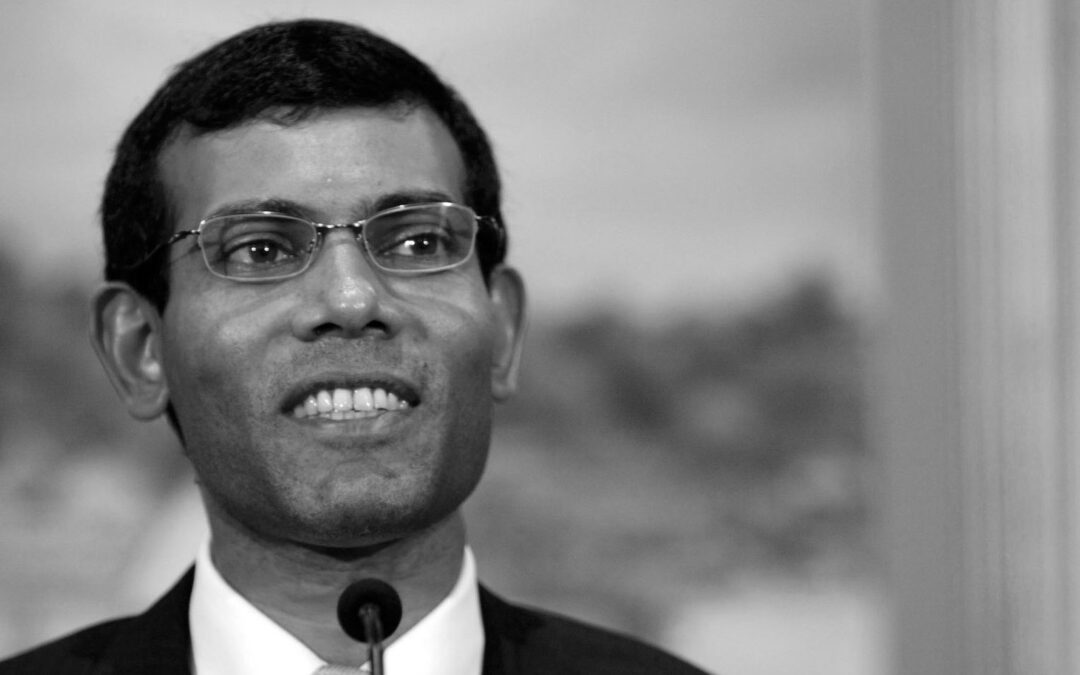
On 13 March, Mr. Nasheed (photo) was sentenced to 13 years in prison for the dismissal and alleged unlawful detention of the Chief Judge of the Criminal Court, Mr. Abdullah Mohamed, in 2012, when Mr. Nasheed was president.
He was convicted of an “act…of kidnapping or abduction of person(s) or of taking hostage(s)” under Section 2(b) of the Prevention of Terrorism Act 1990.
“The Maldivian judiciary’s independence has been compromised for years by serious pressure from the government, and this grossly unfair conviction highlights the numerous problems with the politicization of the judiciary in the country,” said Sam Zarifi, the ICJ’s Regional Director for Asia and the Pacific. “It is crucial for Maldivian authorities to allow Mr. Nasheed to appeal his case effectively, with transparency and monitoring by Maldivian and international observers.”
The case’s pre-trial phase and trial were marked by gross violations of international standards of fair trial, including Article 14 of the International Covenant on Civil and Political Rights, to which the Maldives acceded in 2006.
Two of the judges on the three-judge bench testified as witnesses against Mr. Nasheed in the 2012 investigation; these statements were submitted as evidence in the present trial.
Mr. Nasheed’s defense team was not allowed to be present on his behalf during the first proceeding, nor was he given the opportunity to seek bail.
The defense team was repeatedly denied full access to prosecution evidence and witnesses or to regularly consult with Mr. Nasheed during the course of the trial.
When Mr. Nasheed’s defense team recused itself in protest of the lack of fairness, the court proceeded with the trial without legal representation present for Mr. Nasheed rather than granting him the opportunity to obtain new counsel. The defense was also denied the opportunity to call its own witnesses.
Mr. Nasheed now has the right to appeal the conviction, but his right to appeal has been infringed by the unprecedented amendment of the statutory period for appeal from 90 days to 10 days, via Supreme Court circular six weeks prior to the trial.
In addition, the court has still not released to Mr. Nasheed’s defense team the full court record required to prepare and present an effective appeal within this accelerated timeframe.
The ICJ has previously documented the politicization of the judiciary and the polarized political climate in the Maldives, calling attention to a justice system characterized by vested interests and political allegiances rooted in the country’s authoritarian past (See Maldives: Securing an Independent Judiciary in a Time of Transition (February 2011)).
“Recent events reflect a justice system that still remains deeply politicized along the same lines of entrenched political loyalties that pre-date the transition period,” Zarifi said. “The Maldivian judiciary must allow a proper appeal in this case if it is to establish itself as a separate and equal branch of the government dedicated to supporting the rule of law.”
The ICJ urged Maldivian authorities to ensure Mr. Nasheed’s defense team full access and adequate opportunity to prepare an effective appeal, and to ensure that the appeal proceeding is conducted fairly and transparently, with full access to media and domestic and international observers, in compliance with fair trial and due process standards under both Maldivian and international law.
The Maldives must also take effective measures to ensure that such violations do not reoccur in this or future cases.
Background information can be downloaded here:
Maldives-Background Brief Nasheed Trial-Advocacy-Anylysis brief-2015-ENG (full text in PDF)

Dec 13, 2014 | News
The ICJ condemned decision of the People’s Supreme Court on 12 December 2014 affirming the unfair convictions of human rights defenders Bui Thi Minh Hang, Nguyen Van Minh and Nguyen Thi Thuy Quynh respectively to three, two-and-a half and two years imprisonment.
Nov 27, 2014 | News
Following a visit to the country from 15 to 19 November, the ICJ called on the government of Tajikistan to take meaningful steps to ensure that the institutional independence of the legal profession and the personal integrity of individual lawyers are secured.
The ICJ expressed concern at the continued detention of lawyer Shukhrat Kudratov, on criminal charges. It welcomed the release of another lawyer, Fakhriddin Zokirov, who had been on trial on charges that appeared to constitute an act of retaliation for his work as a defence lawyer. He was released on 3 November as a result of an amnesty.
“While the release of Fakhriddin Zokirov is a positive step, we are concerned that Shukhrat Kudratov remains in detention pending trial on similar criminal charges. We have received credible information that the charges against him are linked to his representation of a client, contrary to international standards on the independence of lawyers”, said Róisín Pillay, Director of the Europe and CIS programme at the ICJ.
The ICJ reiterated its concern at aspects of the reform of the legal profession presently under consideration under the draft law on Advokatura.
Following a mission to Tajikistan in 2013, the ICJ expressed concerns that the independence of the legal profession would be undermined by requirements in the draft law that all lawyers go through a new qualification process, administered by a body in which the Ministry of Justice would play a prominent role.
Amendments recently introduced to the draft law have not altered the inappropriate role which the Ministry of Justice would play in regulating the profession.
Under the draft law, the Deputy Minister of Justice would serve as an ex officio Chair of the Qualification Commission which determines who may be accredited as a lawyer.
This significant role by a member of the executive would jeopardize the independence of the profession.
The ICJ also remains concerned that the draft law would still require requalification of many lawyers, with exemptions only for those with at least 15 years of professional experience as defence lawyers.
Such provisions are contrary to international standards on the independence of the legal profession, including the UN Basic Principles on the Role of Lawyers.
The ICJ recalls Tajikistan’s earlier commitment during the UN Human Rights Committee’s session of 2013 that the Qualification Commission would be placed under the Ministry of Justice only for a short transitional period. A provision to this effect has not yet been introduced in the draft law.
Contact:
Róisín Pillay, Director, ICJ Europe Programme, roisin.pillay(a)icj.org
Temur Shakirov, Legal Adviser, ICJ Europe Programme, temur.shakirov(a)icj.org
Notes:
From 15 to 19 November, an ICJ legal expert, Dr Stefan Strobl, visited Tajikistan and held meetings with a number of international and local civil society organizations and lawyers to discuss recent progress on the reform of the legal profession and the wide ranging challenges it faces.
The visit followed an ICJ mission to Tajikistan in November 2013.
Tajikistan-Independence of legal profession-News-webstory-2014-RUS (full text in PDF)

Sep 10, 2014 | News
The ICJ calls for the immediate and unconditional release of the 23 individuals, most of who are human rights defenders, arrested on 21 June 2014 in the context of a peaceful protest in Heliopolis, Cairo. All charges against them should be dropped.

Aug 12, 2014 | Events
Matt Pollard and Alex Conte, of the ICJ’s International Law and Protection Programmes, will give presentations during the Global Consultation on the Right to Challenge the Lawfulness of Detention, to be held in Geneva on 1-2 September 2014.
The UN Working Group on Arbitrary Detention, in cooperation with the Office of the UN High Commissioner for Human Rights, will convene the Consultation. The aim of the two-day meeting is to seek input on the development by the Working Group of draft basic principles and guidelines on remedies and procedures on the right of anyone deprived of his or her liberty, by arrest or detention, to bring proceedings before court, in order that the court may decide without delay on the lawfulness of his or her detention and order his or her release if the detention is not lawful.
ICJ experts, Matt Pollard and Alex Conte, will be members of two panel discussions during the Global Consultation, respectively on the framework, scope and content of the right to court review of detention and on exercise of that right in situations of armed conflict, state of emergency or for counter-terrorism purposes.
The ICJ has already made two written submissions to the Working Group on Arbitrary Detention on the subject, in November 2013 and April 2014.
Go to the OHCHR webpage on the Global Consultation
See the ICJ’s written submissions to the Working Group on Arbitrary Detention




