Sep 3, 2013 | News
The ICJ today expressed its serious concern at the continued detention of lawyer Zinaida Mukhtorova in a psychiatric facility.
In its statement, the ICJ expressed concern that this detention may amount to an act of harassment or reprisal for Zinaida Mukhtorova’s legitimate exercise of her professional functions. Furthermore, the ICJ is concerned at reports that her detention may have been extended today as a reprisal for her challenging the detention through the courts.

Aug 12, 2013 | News
The ICJ is calling for the immediate release of Adilur Rahman Khan, a prominent Supreme Court lawyer and human rights defender in Bangladesh.
Mr Khan is the Secretary of Odhikar, a Bangladeshi human rights organization that has documented human rights violations allegedly carried out by Bangladeshi security forces.
Plainclothes police officers arrested Mr Khan from his home on 10 August 2013 without an arrest warrant.
“Adilur Rahman Khan is being charged for the lawful exercise of the right to freedom of expression, so Bangladeshi authorities must immediately and unconditionally drop all charges against him and release him,” said Ben Schonveld, ICJ’s South Asia director. “Until the charges are dropped, he must be released on bail.”
Adilur Rahman Khan was charged on 11 August under section 57 of the Information and Communication Technology Act, 2006, for distorting information regarding a police operation on a Hefazat-e Islam rally in May this year.
Odhikar reported that 61 people had been killed in the police crackdown on the rally. The government denied any casualties.
He was not allowed to speak with his family or his lawyers until August 11, when a Magistrate’s Court refused bail and remanded him for a further five days of custodial interrogation.
On August 12, the High Court Division of the Supreme Court stayed the remand order, directing that Mr. Khan be sent back to jail, where he could be interrogated ‘at the gate of the prison.’
“Adilur Rahman Khan’s arrest is illustrative of a deeply worrying government strategy to muzzle and discredit the work of human rights defenders and distract attention from human rights violations,” added Schonveld. “The High Court’s stay of the remand order is a positive development. However, the Bangladesh government must uphold its obligations under domestic and international law to guarantee freedom of expression and allow human rights defenders to carry out their work.”
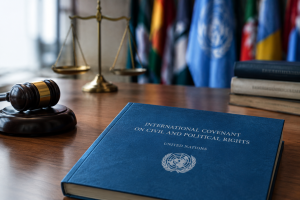
Article 19 of the International Covenant on Civil and Political Rights (ICCPR), to which Bangladesh is a party, guarantees ‘freedom to seek, receive and impart information and ideas of all kinds, regardless of frontiers, either orally, in writing or in print, in the form of art, or through any other media of his choice.’
The UN Basic Principles on the Role of Lawyers provide that lawyers must be allowed to carry out their work ‘without intimidation, hindrance, harassment or improper interference.’
Further, lawyers shall, in particular, have the right to take part in public discussions of matters concerning the law, administration of justice and the promotion and protection of human rights.
In addition, the UN Declaration on Human Rights Defenders clarifies that States must create an enabling environment for human rights defenders and take all necessary measures to protect human rights defenders ‘against any violence, threats, retaliation, de facto or de jure adverse discrimination, pressure or any other arbitrary action as a consequence of his or her legitimate exercise of his or her rights.’
CONTACT:
Ben Schonveld, ICJ South Asia Director (Kathmandu), t: +977 14432651; email: ben.schonveld(a)icj.org
Sam Zarifi, ICJ Asia-Pacific Director, (Bangkok), t: +66 807819002; email: sam.zarifi(a)icj.org

Apr 8, 2013 | News
On 5 April, Vietnam’s Hai Phong court sentenced Doan Van Vuon and three of his male relatives to imprisonment sentences ranging from two to five years, for attempted murder. The ICJ condemns this decision.
Mr. Doan’s wife and sister-in-law received suspended sentences in the form of 18 and 15 months respectively for resisting persons in the performance of their official duties.
Vuon, along with his brothers Doan Van Quy and Doan Van Sinh, as well as Sinh’s son Doan Van Ve, were initially arrested on 5 January 2012 for injuring four policemen and two soldiers with homemade weapons when more than 100 security forces tried to forcibly evict them from their fish farm in a district approximately 90 kilometres from Hanoi.
The four men had remained in detention for more than a year waiting for the commencement of last week’s trial.
Under Article 9(3) of the International Covenant on Civil and Political Rights, which Vietnam is a signatory to, states that “anyone arrested or detained on a criminal charge shall be brought promptly before a judge…and be entitled to trial within a reasonable time or to release”.
“Pre-trial detention should only be used in criminal proceedings as a last resort, and for the shortest possible time period, when required to meet the needs of justice,” said Emerlynne Gil, ICJ’s International Legal Advisor for Southeast Asia in Bangkok. “The prolonged period of detention in this case is detrimental as it could possibly have violated the defendants’ presumption of innocence and due process.”
During the trial, it was concerning to note that all the judges involved in the case were members of the ruling Vietnamese Communist Party and were carrying out their judicial duties under the central government’s directions.
Article 14 of the ICCPR further guarantees that a person is “entitled to a fair and public hearing by a competent, independent and impartial tribunal established by law”.
“Vietnam’s blatant disregard of the right to fair trial violates not only their international law obligations, but also the proper administration of justice in a criminal proceeding,” said Emerlynne Gil.
The ICJ also observed that the court’s judgment failed to incorporate the fact that the defendants had acted in such a manner only as an attempt to defend and protect their land, which was legitimately given to them by the Vietnamese government in 1993.
The right to receive a reasoned judgment is an inherent principle in safeguarding fair trial rights and it is the general rule that court rulings must include the essential findings, evidence and legal reasoning.
“The failure to adhere to the minimum international fair trial standards reveals Vietnam’s serious lack of commitment towards upholding the rule of law and protecting human rights in the country; a violation most certainly not in line with the profile of a country wishing to obtain a seat at the UN Human Rights Council 2014-2016 tenure,” Gil added.
In the event of an appeal, the ICJ calls that the Vietnamese Court of Appeal be consistent with the international basic judicial guarantees and the principles of independence, impartiality and competency.

Mar 5, 2013 | Advocacy, Legal submissions, Non-legal submissions
The ICJ today requested the UN Special Rapporteur on the situation of human rights defenders to call on Zimbabwe, Angola, the Democratic Republic of Congo and Swaziland to take effective measures to prevent and end attacks on and persecution of human rights defenders.
The ICJ delivered its oral statement today during an interactive dialogue with the Special Rapporteur as part of the Human Rights Council’s 22nd regular session (25 February to 22 March 2013).
The ICJ also noted the need for these States to:
- Ensure adherence to international standards on detention and fair trial in cases where human rights defenders have been arrested;
- Conduct prompt and impartial investigations and, where human rights abuses are criminal in character, prosecute all persons responsible; and
- Ensure that affected human rights defenders have access to effective remedies and reparation for such abuses.
Also addressed to the Special Rapporteur on the situation of human rights defenders was a written statement submitted earlier this month concerning legislative restrictions on ‘homosexual propaganda’ that threaten LGBT human rights defenders.
SouthernAfrica-HRC22-IDItem3-SRHRDs-Non-LegalSubmission-2013 (download oral statement in PDF)
For the written statement click here

Oct 25, 2012 | Advocacy, Non-legal submissions
 During a half-day of general discussion held today by the Human Rights Committee, the ICJ supported the establishment by the Committee of a General Comment on the right to security and liberty of the person under article 9 of the International Covenant on Civil and Political Rights (ICCPR).
As an update to its General Comment No 8 of 1982, the Human Rights Committee (the Committee) has commenced a process to develop a new General Comment on article 9 of the ICCPR. Responding to a list of issues prepared by the Committee for potential expansion within the General Comment, the ICJ supported the initiative and called for clarification of certain issues in this work.
The ICJ’s submission and statement also called on the Committee to give express consideration to the following thematic issues within the General Comment:
- The meaning of ‘arbitrary’ deprivation of liberty;
- Application of article 9 in international and non-international armed conflicts, including in the context of administrative detention;
- Control orders and other mechanisms involving restrictions of movement and the extent to which such mechanisms might interfere with liberty rights;
- Detention of asylum-seekers and irregular migrants; and
- The role and accountability of legal entities.
The Committee is scheduled to consider and adopt a first draft of the General Comment during its session in March 2013. The ICJ intends to make substantive submissions on this first draft.
ICJ-HRCttee-GCArticle9-IssuesStatement-non-legal submission (2012) (download in PDF)
ICJ-HRCttee-GCArticle9-IssuesSubmission-non-legal submission (2012) (download in PDF)
HumanRightsCommittee-Issues-Article9 (download in Word)