Jun 29, 2016 | Advocacy, Non-legal submissions
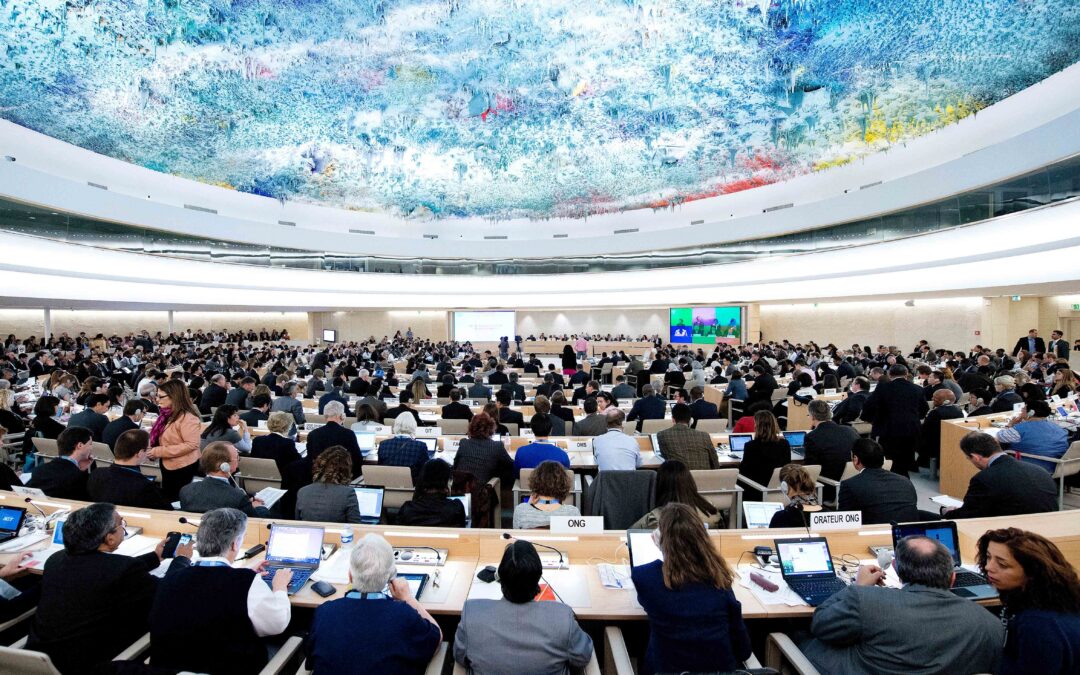
The ICJ, joined by FIDH, Franciscans International, and IMADR, today delivered a statement to the UN Human Rights Council.
The statement was on the situation of Rohingya Muslims in Myanmar, and on the need for active participation by international judges in the judicial mechanism to be adopted in Sri Lanka as part of the process of accountability and reconciliation.
The organizations stated, during general debate on an oral update on Sri Lanka from the High Commissioner for Human Rights, and the Commissioner’s report on the situation of Rohingya in Myanmar, that:
The Government of Myanmar has persecuted the Rohingya, refused to extend basic citizenship rights, and Parliament passed legislation entrenching discrimination such as the Race and Religion Protection laws. This has displaced thousands within Rakhine State and driven the Rohingya to sea and neighbouring countries. The ICJ, FIDH, Franciscans International and IMADR call on Myanmar:
- to repeal the 1982 Citizenship Law or amend it in accordance with the recommendations of the Special Rapporteur, to grant Rohingya full citizenship and accompanying rights;
- to develop a citizenship plan based on non-discrimination;
- to reject the Rakhine State Action Plan in its current form;
- to repeal laws that discriminate against ethnic and religious minorities;
- to diligently prosecute all acts of violence fuelled by discrimination, and hate speech that incites discrimination, hostility or violence; and
- to improve basic living conditions for the Rohingya and Arakanese in Rakhine State by enhancing protection of their economic, social, and cultural rights.
We welcome recent initiatives by the Government of Sri Lanka towards implementing Resolution 30/1, including the establishment of an Office of Missing Persons, and ratification of the Convention for the Protection of All Persons from Enforced Disappearance.
However, many of the commitments in the resolution remain unfulfilled. The other three transitional justice mechanisms envisioned by the resolution – an office of reparation, a truth-seeking commission, and a judicial mechanism – are yet to be established.
We call on Sri Lanka to implement, without delay, all elements of Resolution 30/1, including particularly the establishment of a credible judicial mechanism with full participation of international judges, prosecutors and lawyers. We agree that international participation is “a necessary guarantee for the independence and impartiality of the process in the eyes of the victims” (High Commissioner’s Oral Update, A/HRC/32/CRP.4, paragraph 32).
Rapid progress on this and other key elements of the resolution is essential to the credibility of the overall process of transition in Sri Lanka.
The statement can be downloaded in full, in PDF format, here: HRC32-OralStatement-SriLankaMyanmar-2016
Jun 25, 2016 | Advocacy
The ICJ today published a General Guidance aimed at assisting judges and others in the justice sector to effectively incorporate a gender perspective in their work.
The General Guidance is especially significant as it reaffirms that customs and traditions should not be invoked to justify discrimination against women.
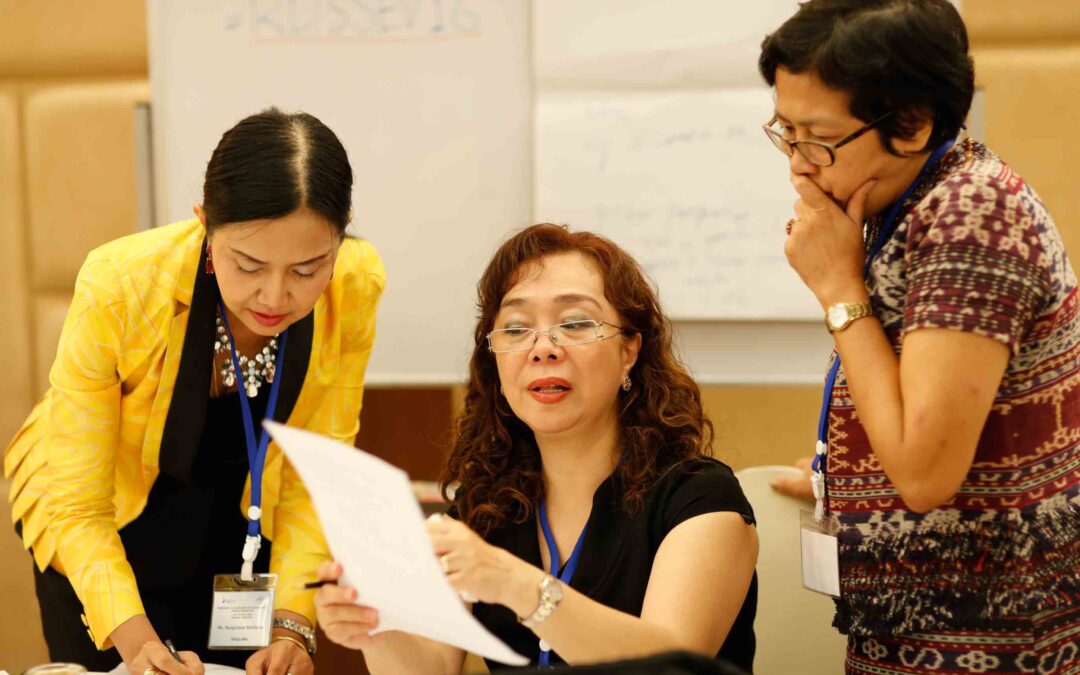
The Bangkok General Guidance for Judges in Applying a Gender Perspective was discussed and adopted by judges from Philippines, Thailand, Timor Leste, and Indonesia, at a gathering in Bangkok from 24 to 25 June 2016, hosted by the ICJ and UN Women.
During the workshop, judges from the four Southeast Asian countries deliberated extensively how best to assist judges in employing a gender perspective in deciding cases before them.
“The Bangkok General Guidance can make a powerful contribution towards achieving gender equality under the law in Southeast Asia,” said Sam Zarifi, Regional Director for Asia and the Pacific at the ICJ. “It is crucial that judges now work to implement this General Guidance in their home countries.”
The idea to initiate the development of th Bangkok General Guidance emerged from the ASEAN Regional Dialogue on Judging with a Gender Perspective, which was held in Jakarta, Indonesia in 2015.
The Supreme Court of the Philippines offered to take the lead on the project during that regional judicial dialogue.
“Women have a right to equal treatment and equal protection and non-discrimination under the law. It is our responsibility as judges to ensure that women receive equal treatment in law and in practice,” said Justice Teresita de Castro of the Supreme Court of the Philippines.
Judges attended several sessions over the course of the two-day workshop, participating in exercises focused on identifying and addressing gender stereotypes.
“Women in the region face many obstacles in accessing justice,” said Roberta Clarke, Regional Director for Asia and the Pacific at UN Women.
“But judges may be either unaware of these issues or unsure how to address these issues through the legal process,” she added.
The Bangkok General Guidance will make judges aware of means to consider evidence without resorting to gender stereotypes and decide cases based on the principle of equality recognized under international human rights standards, including the Convention on the Elimination of All Forms of Discrimination against Women (CEDAW).
Recommendations for institutional policies that should be adopted by courts to help them become more gender sensitive and gender responsive are also set out in the General Guidance.
Contact:
Emerlynne Gil, Senior International Legal Adviser for Southeast Asia, t: +66840923575 ; e: emerlynne.gil@icj.org
Southeast Asia-Bangkok-Guidance-Advocacy-2016-ENG (full PDF, in English)
Southeast Asia-Bangkok-Guidance-Advocacy-2016-BUR (full PDF, in Burmese)
Southeast Asia-Bangkok-Guidance-Advocacy-2016-MON (full PDF, in Mon language)
Southeast Asia-Bangkok-Guidance-Advocacy-2016-SHAN (full PDF, in Shan language)
Jun 9, 2016 | News
The ICJ welcomes the landmark decision issued today by the UN Human Rights Committee in the case of Amanda Mellet v. Ireland under the Optional Protocol to the International Covenant on Civil and Political Rights.
The Committee found that, by forcing Amanda Mellet to choose either to carry her foetus to term, despite its fatal fœtal abnormality, or to travel abroad to seek an abortion, Ireland had subjected her to cruel, inhuman or degrading treatment and discrimination, in violation of its obligations under the Covenant.
The ICJ considers that in light of the Committee’s decision Ireland must provide reparation to Amanda Mellet and reform its laws to prevent future violations.
Otherwise, Ireland will be in breach of its legal obligation to provide Amanda Mellet with an effective remedy – including in the terms set out in the Committee’s decision – for the human rights violations she suffered.
Related readings:
Full text of Human Rights Committee’s decision (download in PDF)

May 25, 2016 | Advocacy, Open letters
More than 230 non-governmental organizations (NGO) world wide have called on members of the UN’s Economic and Social Council to reform the practice of the UN Committee on NGOs, and to ensure apolitical, fair and transparent consideration of NGO applications for access to UN processes.
The response has been sparked by the long-term practice of some States to delay or effectively block certain NGOs from participation at the UN, through perpetual questioning and multiple deferrals of applications for accreditation.
In doing so, the Economic and Social Council (ECOSOC) Committee on NGOs has turned what should be largely an administrative role into the obstruction of NGOs working on issues on which States disagree. Human rights organisations are amongst those facing the most obstacles.
The joint open letter may be downloaded in PDF format here: UN-NGOCommittee-OpenLetter-2016
Feb 3, 2016 | News
Yesterday’s decision of the Indian Supreme Court to refer to a larger bench of the same Court the petition challenging Section 377 of the Indian Penal Code (IPC), offers the opportunity to undo the appalling 2013 judgment of a two-judge bench of the SC in the Suresh Koushal case, says the ICJ.
“This order of the Supreme Court is a crucial opportunity to undo the injustice of the Suresh Koushal decision,” said Sam Zarifi, ICJ’s Asia Director. “It is an important test of the Supreme Court’s commitment to equality and ending discrimination against people on the basis of sexual orientation or gender identity.”
After the December 2013 Suresh Koushal decision – when the Supreme Court upheld the constitutionality of section 377 and reversed the Delhi High Court’s courageous and much celebrated decision – the petitioners filed a review petition, which was dismissed.
The petitioners then filed “curative petitions” in 2014, stating that the Supreme Court’s judgment of December 2013 violated principles of natural justice for several reasons. A “curative petition” allows the Supreme Court to re-assess its previous decisions on limited grounds, even after appeals and reviews have concluded.
Yesterday the Supreme Court referred the curative petition, and the major constitutional questions it raised, to a five-judge bench of the same Court, thus acknowledging doubts about the correctness of its 2013 ruling. A five-judge bench will now be set up to hear this challenge.
“The referral highlights the Supreme Court’s recognition of the need for a judicial response to the ongoing discrimination against people on the basis of sexual orientation and gender identity,” Zarifi said.
“After 16 years within the court process, this issue clearly could not be resolved with the highly problematic Suresh Koushal decision, which ignored the reality of consensual same sex behavior in India and the fact that Section 377 criminalizes people for who they are and leads directly to serious human rights violations.”
By criminalizing consensual same-sex adult sexual conduct, Section 377 is inconsistent with India’s obligations under international human rights law, including in respect of the rights to sexual autonomy, equality, non-discrimination, privacy, dignity, free expression, and life.
Many of these rights are guaranteed in India’s Constitution.
India is also a party to several international instruments, which require that these rights be respected, protected and fulfilled.
The Yogyakarta Principles – which apply international human rights law to issues of sexual orientation and gender identity – clarify that the rights to equality, non-discrimination and privacy require states to “repeal all laws that criminalize consensual sexual activity among persons of the same sex who are over the age of consent.”
The Supreme Court referred to these principles in the 2014 National Legal Services Authority v Union of India (NALSA) case where it also acknowledged that Section 377 was “used as an instrument of harassment and physical abuse against Hijras and transgender persons”.
“Yesterday’s decision offers hope that the Supreme Court intends to reaffirm the principle that people in India cannot be subjected to discrimination, harassment and violence, simply on the basis of their sexual orientation or gender identity,” Zarifi said.
Background
Section 377 makes it an offence to “voluntarily ha[ve] carnal intercourse against the order of nature with any man, woman or animal” and has been used to persecute people for their real or purported engagement in consensual same-sex sexual conduct. The penalty can extend to life imprisonment.
Several reports document how Section 377 has been a tool for discrimination, blackmail, extortion, and violence by state and non-state actors against the LGBTI community.
It has adversely affected HIV/AIDS prevention efforts, and has also reinforced harmful social stereotypes and taboos against sexual minorities.
The petitioners in the original challenge against section 377 have waged this legal battle for over a decade. The constitutional challenge against Section 377 was filed in 2001.
In 2009, in Naz Foundation v. Government of NCT of Delhi and Others, the Delhi High Court held that Section 377 denied “a person’s dignity and criminalises his or her core identity solely on account of his or her sexuality”.
It went on to find that this criminalization of identity denied “a gay person a right to full personhood which is implicit” in the notion of life under Article 21 of the Indian Constitution, and also violated the constitutional right to equality and non-discrimination. The High Court held that Section 377 was unconstitutional insofar as it criminalized consensual same-sex sexual conduct.
However, its judgment was appealed to the Supreme Court.
On appeal, in 2013 the Supreme Court reversed the decision of the Delhi High Court, holding the section to be constitutional.
The Supreme Court also affirmed that legislature would “be free to consider the desirability and propriety of deleting Section 377 IPC from the statute book or amend the same as per the suggestion made by the Attorney General”.