Sep 5, 2018 | Events, News
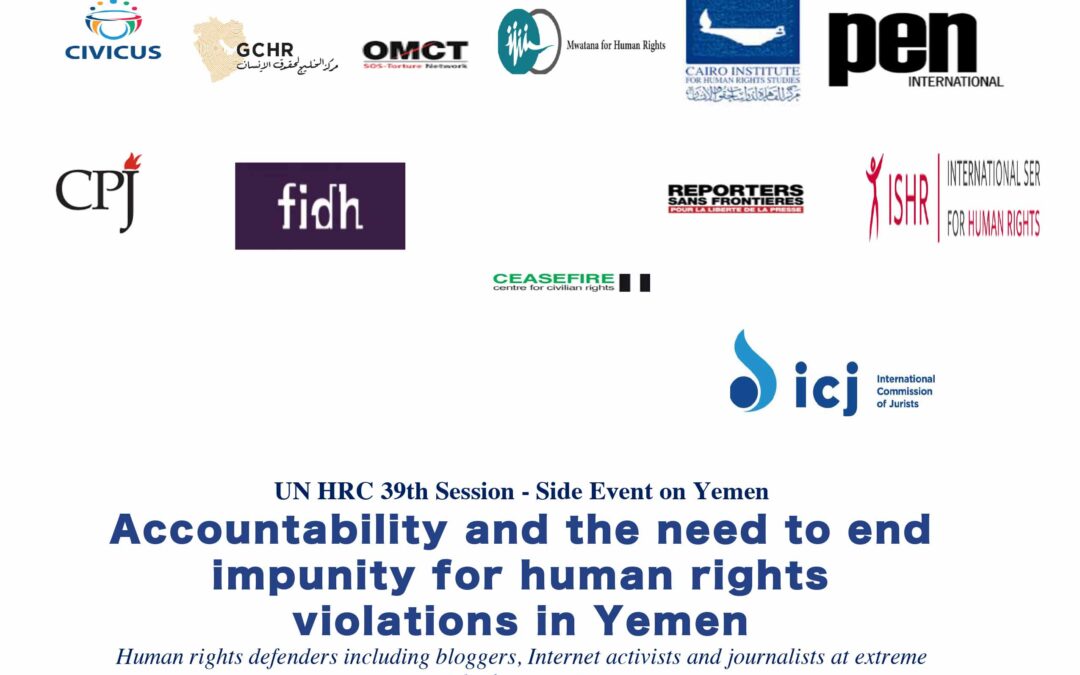
The ICJ will participate in the side event “Accountability and the need to end impunity for human rights violations in Yemen,” organized by the CIVICUS, FIDH, CIHRS in cooperation with Mwatana for Human Rights and the Gulf Centre for Human Rights (GCHR).
This side event at the Human Rights Council will take place on Monday, 10 September 2018 from 12:00 – 13:00 in room XXIV of the Palais des Nations.
The issue of human rights defenders including bloggers, Internet activists, and journalists who are at extreme risk of persecution will be discussed.
Speakers:
- Radhya Al-Mutawakel, Co-founder and Chairperson of Mwatana for Human Rights
- Khalid Ibrahim, Executive Director, Gulf Centre for Human Rights (GCHR)
- Vito Todeschini, Associate Legal Adviser, International Commission of Jurists (ICJ)
- Miriam Puttick, Head of MENA Programmes, Ceasefire for Civilians Rights
Moderator:
Antoine Madelin, International Advocacy Director, International Federation for Human Rights (FIDH)
Yemen-Side event at HRC-News-events-2018-ENG (download the flyer)
Sep 3, 2018 | News
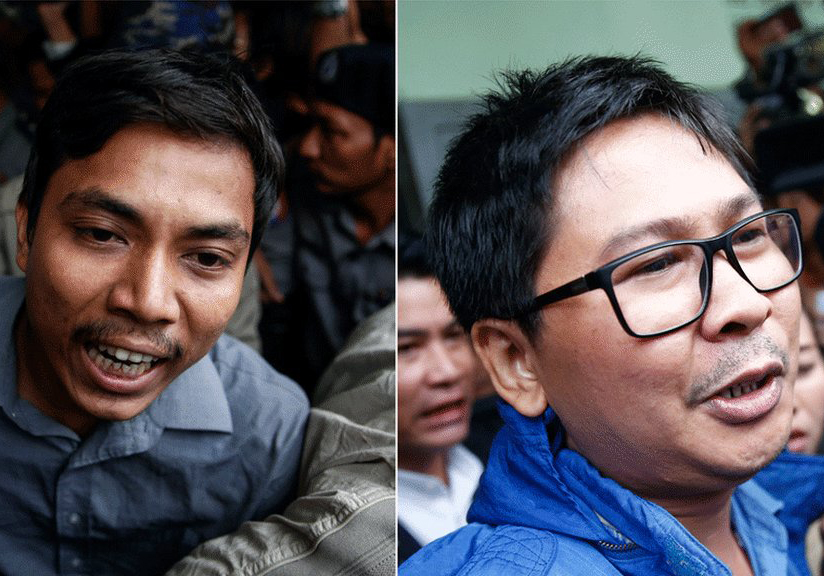
The Yangon District Court’s decision today to sentence Reuters journalists Wa Lone and Kyaw Soe Oo to seven years’ imprisonment for violating the Official Secrets Act deals a massive blow to human rights and the rule of law in Myanmar, said the ICJ.
“The Court’s decision effectively punishes these two courageous journalists for exposing human rights violations, following a grossly unfair trial,” said Frederick Rawski, Asia Pacific Director for the ICJ.
“The decision is a miscarriage of justice that inflicts needless suffering on them and their families, threatens freedom of expression, damages Myanmar’s global standing, and undermines its justice institutions all at once,” he added.
The ICJ has monitored the case since the journalists’ initial detention in December 2017.
As previously noted by the ICJ, the detention and trial has violated numerous basic fair trial guarantees.
The prosecutors had a duty to drop charges and the judge should have dismissed the case given the lack of evidence and the unlawfulness of detention because of fair trail rights violations.
“The case is emblematic of how the justice system ends up reinforcing rather than challenging military impunity,” said Rawski.
“The result undermines government claims that it can deliver accountability for human rights violations on its own, and does nothing to build trust that justice system can act independently and impartially after emerging from decades of military rule,” he added.
Members of security forces generally enjoy impunity for the perpetration of human rights violations, including for crimes under international law.
The ICJ has previously reported that victims and their families, as well as journalists, often face retaliation for publicizing human rights violations by the military.
Wa Lone and Kyaw Soe Oo were arrested in December 2017, and held incommunicado for nearly two weeks, before being charged under the colonial-era Official Secrets Act for allegedly possessing documents related to the operations of security forces in northern Rakhine State, during “clearance operations.”
The two reporters had been reporting on human rights violations in Rakhine State, including the killing of Rohingya by the military in Inn Dinn Village.
In a report issued just last week, the UN Independent International Fact Finding Mission found that security forces had perpetrated crimes under international law during these operations, including crimes against humanity and possibly the crime of genocide.
The detention and prosecution of anyone, including journalists, based solely on the collection and publication of evidence relevant to serious human rights violations, is a violation of international law and standards on freedom of expression, the right to participation in public affairs and on the role of human rights defenders.
Legal options remaining for the journalists include appealing of today’s decision, and requesting a Presidential amnesty.
Jul 31, 2018 | News
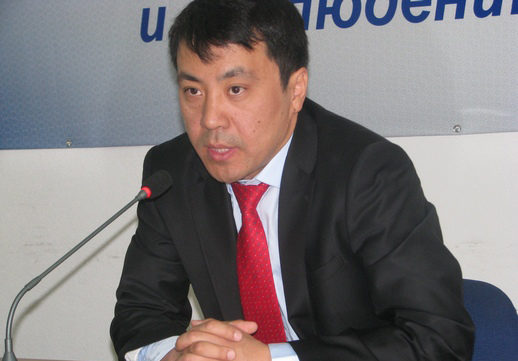
Today, the ICJ called on the government of Kazakhstan to drop all charges of “knowingly disseminating false information” against lawyer Bauyrzhan Azanov related to his representation of a child who is the alleged victim of sexual abuse by older children.
“The prosecution of Bauyrzhan Azanov in relation to statements he made as part of his representation of a child violates the lawyer’s freedom of expression, and prevent him from effectively representing his client,” said Temur Shakirov, Senior Legal Adviser for the ICJ’s Europe and Central Asia Programme.
“Instead of targeting a lawyer, the investigative authorities should use their resources to investigate the allegations of human rights violations in this case and ensure the protection of the rights of this child in accordance with Kazakhstan’s international obligations,” he added.
Bauyrzhan Azanov, a prominent lawyer in Kazakhstan, took up a high-profile case in which he represented a minor, an alleged victim of sexual and physical abuse over a prolonged period.
The case became public in March 2018 through media reports.
Once the case became public several district police officers were fired, and two heads of schools and some other state agents were suspended from office, reportedly in relation to their failure to report and investigate the case.
In his statements in the social media, Azanov alleged the investigation had been obstructed due to corrupt reasons.
In reaction to this, on 21 May 2018, the mother of the minor submitted a complaint against Azanov where she expressed concerns about “social tension”, “forming a negative image of the investigative body” and herself “as a mother”.
Following the mother’s complaint, on 24 July, the General Prosecutor’s Office initiated a criminal investigation against the lawyer for knowing dissemination of false information, which alleged that:
“The information disseminated by lawyer B. Azanov was deliberately distorted and untrue, which created a false idea among the public about the alleged corruption of justice system, investigative bodies, the mother of the child and other persons. This caused psycho-emotional and social tension among the public and created a threat of destabilization of the internal political situation, thereby creating a threat of violation of public order.”
Through the media, Azanov has denied the allegations against him and has stated that he acted in the best interests of his client and sought to ensure accountability for criminal acts.
On 1 June 2018, Nursultan Nazarbayev, President of the Republic of Kazakhstan commented on the case stating that unreasonable prolongation of the investigation is connected with the nepotism in the police and higher investigative authorities.
The Ombudsperson, members of the Kazakhstan Bar Association and human rights activists have made public statements in support of Bauyrzhan Azanov.
In these circumstances, the ICJ is concerned that criminal charges against lawyer Bauyrzhan Azanov for public comments in which he raised concerns about possible violations of human rights of his minor client, may violate the lawyer’s right to freedom of expression.
The right to freedom of expression is protected under international treaties to which Kazakhstan is a party, including by Article 19 of the International Covenant on Civil and Political Rights (ICCPR). As the UN Human Rights Committee stated in its General Comment 34 on the freedom of expression:
“When a State party invokes a legitimate ground for restriction of freedom of expression, it must demonstrate in specific and individualized fashion the precise nature of the threat, and the necessity and proportionality of the specific action taken, in particular by establishing a direct and immediate connection between the expression and the threat.”
According to the UN Basic Principles on the role of lawyers, lawyers have the right to take part in public discussion of matters concerning the law, the administration of justice and the promotion and protection of human rights without suffering professional restrictions by reason of their lawful action or their membership in a lawful organization (Principle 23).
It is of particular concern that the Prosecutor’s Office document uses vague concepts that may amount to arbitrary use of grounds for restriction of freedom of expression of the lawyer.
In particular, it is unclear how prosecutorial authorities measured “psycho-emotional and social tension of the public” or that on what basis the lawyer’s comments may have “created a threat of destabilization of the internal political situation” creating a threat to the public order.
These broadly and atypically worded justifications for prosecution are likely to lead to arbitrary interference with freedom of expression.
Prosecution of the lawyer for his attempts to raise human rights-related issues of his minor client, unsupported by any evidence or explanation what they may refer to, is also likely to have a chilling effect on those who defend human rights of victims of abuse.
The ICJ recalls that according to the UN Basic Principles on the Role of Lawyers, Governments must ensure that lawyers are able to perform all of their professional functions without intimidation, hindrance, harassment or improper interference (Principle 16).
Kazakhstan-Lawyer Azanov-News-web story-2018-ENG (full story, in PDF)
Kazakhstan-Lawyer-Azanov-News-Web-story-2018-RUS (full story in Russian, PDF)
Jul 26, 2018 | News, Op-eds
An opinion piece by Kingsley Abbott, ICJ Senior Legal Adviser in Bangkok, Thailand.
Over recent decades, international observers have tended to view the human rights and political situation in Cambodia as a series of predictable cycles that does not warrant too much alarm.
The conventional wisdom has been that Prime Minister Hun Sen and his government routinely tightens their grip on the political opposition and civil society in advance of elections before relaxing it again after victory has been secured.
But that analysis is no longer valid.
The reason is simple: During the course of ensuring it will win the national election scheduled for this Sunday (29 July), Hun Sen’s ruling Cambodian People’s Party (CPP) has, since the last election, systematically altered the country’s constitutional and legal framework – and these changes will remain in place after the election has passed.
Through the passage of a slew of new laws and legal amendments inconsistent with Cambodia’s obligations under international law, and the frequent implementation of the law to violate human rights, the legal system has been weaponized to overwhelm and defeat the real and perceived opponents of the CPP, including the political opposition, the media, civil society, human rights defenders and ordinary citizens.
This misuse of the law is a significant development in the history of modern Cambodia and represents a determined move away from the vision enshrined in the historic 1991 Paris Peace Agreements that ended years of conflict and sought to establish a peaceful and democratic Cambodia founded on respect for human rights and the rule of law.
And it risks cementing the human rights and rule of law crisis that now exists within Cambodia for years to come.
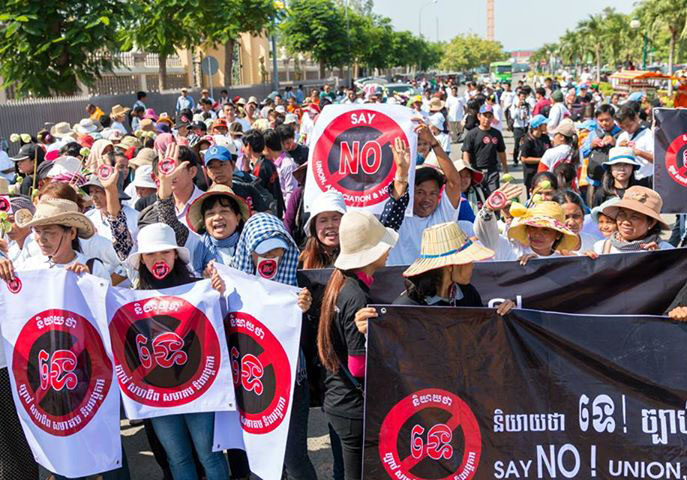
To facilitate the closure of civil society space, and contrary to international law and standards, in 2015 the Law on Associations and Non-Governmental Organizations (LANGO) was passed, which requires the mandatory registration of all NGOs and Associations, provides the government with arbitrary powers to deny or revoke registration, and places a vaguely worded duty on NGOs and associations to “maintain their neutrality towards political parties”.
The biggest blow to the political opposition has been the amendment last year of the Law on Political Parties (1997), amended twice within four months, which empowers the Supreme Court to dissolve parties, and four election laws, which permits the redistribution of a dissolved party’s seats in the country’s senate, national assembly, and commune and district councils.
Last November, the Supreme Court, presided over by a high-ranking member of the CPP, used the amended Law on Political Parties to dissolve the main opposition party, the Cambodia National Rescue Party (CNRP), which had received just under 44% of the vote – or about 3 million votes – in communal elections held in June 2017.
After the CNRP’s dissolution, the amended election laws were then used to redistribute CNRP seats at every level of government, from the commune to the senate, to the CPP and minor parties.
To silence the media, the country’s media and taxation laws have been invoked – local radio stations have been ordered to stop broadcasting Radio Free Asia and Voice of America “in order to uphold the law on media” and the independent Cambodia Daily was forced to close after being presented with a disputed US $6.3 million tax bill which the Daily claimed was “politically motivated” and not accompanied by a proper audit or good faith negotiations.
To curb the exercise of freedom of expression, the Constitution has received vaguely worded amendments placing an obligation on Cambodian citizens to “primarily uphold the national interest” while prohibiting them from “conducting any activities which either directly or indirectly affect the interests of the Kingdom of Cambodia and of Khmer Citizens”.
Meanwhile individual journalists, members of the political opposition including the CNRP’s leader, Kem Sokha, human rights defenders and an Australian documentary filmmaker have been charged with any number of a kaleidoscope of crimes ranging from intentional violence and criminal defamation to treason and espionage.
And Cambodia lacks an independent and impartial judiciary.
In 2014, three “judicial reform laws” were passed which institutionalized the prosecution and judiciary’s lack of independence from the executive.
At the same time, the government perversely uses the doctrine of the “rule of law” to justify its actions.
Just hours after the Supreme Court dissolved the CNRP, Hun Sen announced that the decision was made “in accordance with the rule of law.”
When members of the diplomatic community and senior UN officials meet government officials to express concern at the increasing misuse of the law they receive an absurdist legal lecture on the “importance of the rule of law”.
What is happening in Cambodia is the opposite of that.
The International Commission of Jurists, UN authorities and others have been defining the rule of law since the Universal Declaration of Human Rights was pronounced in 1948.
All agree that that the rule of law entails passing and implementing laws consistent with a country’s international human rights obligations.
It is time for the international community to recognize that a frank and fresh analysis of the situation in Cambodia is urgently required which acknowledges the way the country’s underlying legal and constitutional framework has been deliberately altered, and the way in which this will impact the country adversely long past this month’s election.
This acknowledgment must be accompanied by a coherent and, where possible, joint, plan of action that clearly sets out, with a timeline, what is required to bring Cambodia back on track with the agreed terms of the Paris Peace Agreements – including necessary legal and justice sector reforms – and the political and economic consequences for not doing so.
As long as Hun Sen’s Government deploys increasingly sophisticated justifications for its repressive actions, a more refined, multilayered and vigorous response from the international community is required – grounded on a proper application of the rule of law and Cambodia’s international human rights obligations.

Jul 18, 2018 | News, Publications, Reports
The ICJ welcomed today the lapse of Turkey’s nearly two-year state of emergency, which is expected to be effective as of midnight, but said that the authorities needed now to take a range of measures to repair the rupture to the rule of law in the country.
The ICJ’s comments came as it released its report Justice Suspended – Access to Justice and State of Emergency in Turkey, outlining how measures undertaken pursuant to a state of emergency, including the mass dismissal of judges and arbitrary arrests and prosecutions of lawyers and human rights defenders had eroded the justice institutions and mechanisms in the country.
The report recommends a number of measures including the repeal of measures enacted under the state of emergency, the restoral of the independence of the judiciary and the reform of the country’s anti-terrorism legislation.
“With the end of the state of emergency we call for the immediate withdrawal of the notifications of derogations to the European Convention on Human Rights and the International Covenant on Civil and Political Rights,” said Massimo Frigo, ICJ Senior Legal Adviser for the Europe and Central Asia Programme.
“We remain concerned that many of the emergency measures have been given permanent effect in Turkish law and will have pernicious and lasting consequences for the enjoyment of human rights and for the rule of law in Turkey,” he added.
These measures include the dismissals of hundred of thousands of people from their job, including judges and prosecutors.
Constitutional amendments, introduced during the state of emergency, permanently enshrine executive and legislative control of the governing institutions of the judiciary, contrary to international standards on judicial independence, the ICJ says.
Many of those charged with vaguely-defined offences under the state of emergency face trial before courts that are not independent and cannot guarantee the right to a fair trial, the Geneva-based organization adds.
Crucially, most of the people affected by emergency measures, including summary dismissals, have not yet had the opportunity to obtain a remedy before an effective and independent court or tribunal.
The ICJ report illustrates how the mechanisms which should address and remedy human rights violations in Turkey lack effectiveness and independence and that these deficiencies extend both to the courts and the state of emergency complaints commission.
It further finds that the ordinary functions of lawyers and activities civil society, key actors in ensuring access to justice, have been considerably curtailed.
“The Turkish Government says that they want their actions to respect the rule of law. Effective and independent remedies and reparations for human rights violations must be available to all if this principle is to have any reality in practice,” said Massimo Frigo.
Contact
Massimo Frigo, ICJ Senior Legal Adviser for the Europe and Central Asia Programme, t: +41 22 979 3805, e: massimo.frigo@icj.org
Download
Full ICJ report in PDF in English: Turkey-Access to justice-Publications-Reports-2018-ENG
Full ICJ report in PDF in Turkish: Turkey-Access to justice-Publications-Reports-2018-TUR