Sep 18, 2017 | Events
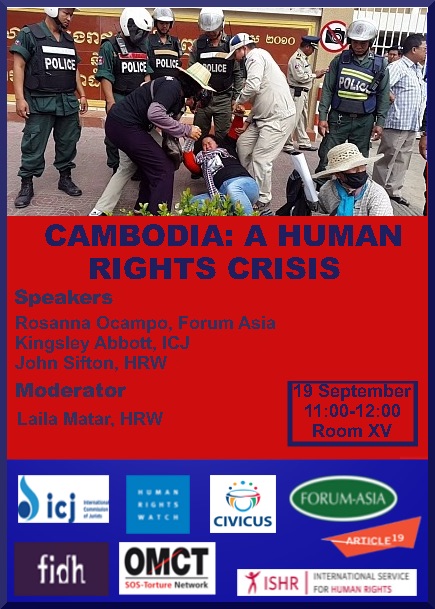
On 19 September, the ICJ and other leading international NGOs are convening a panel to discuss the crisis for human rights and rule of law in Cambodia, at a side event to the UN Human Rights Council session taking place in Geneva.
The side event comes as States consider a new draft resolution on Cambodia for adoption by the Human Rights Council. Before the session, the ICJ joined other organizations in calling for strengthening of the resolution and its measures for monitoring, reporting on and discussing the situation for human rights in the country.
Moderator:
- Laila Matar, Senior UN Advocate, Human Rights Watch
Speakers:
- Rosanna Ocampo, Forum Asia
- Kingsley Abbott, International Commission of Jurists
- John Sifton, Human Rights Watch
The event takes place Tuesday, 19 September 2017, 11:00 – 12:00, in the Palais des Nations, Room XV.
ICJ is organizing the event together with Human Rights Watch, Forum-Asia, Civicus, Article 19, FIDH, OMCT, and ISHR.
For more information, contact un(a)icj.org

Jun 29, 2017 | Advocacy, News, Non-legal submissions
The ICJ, together with other 60 national and international human rights organizations urged today the Myanmar authorities, and in particular the Ministry of Transport and Communication and the Parliament, to ensure the repeal of the offence of criminal defamation.
Myanmar-JointStatement-CriminalDefamation-2017-ENG (joint statement in English)
Myanmar-JointStatement-CriminalDefamation-2017-BUR (joint statement in Burmese)
Jun 20, 2017 | News
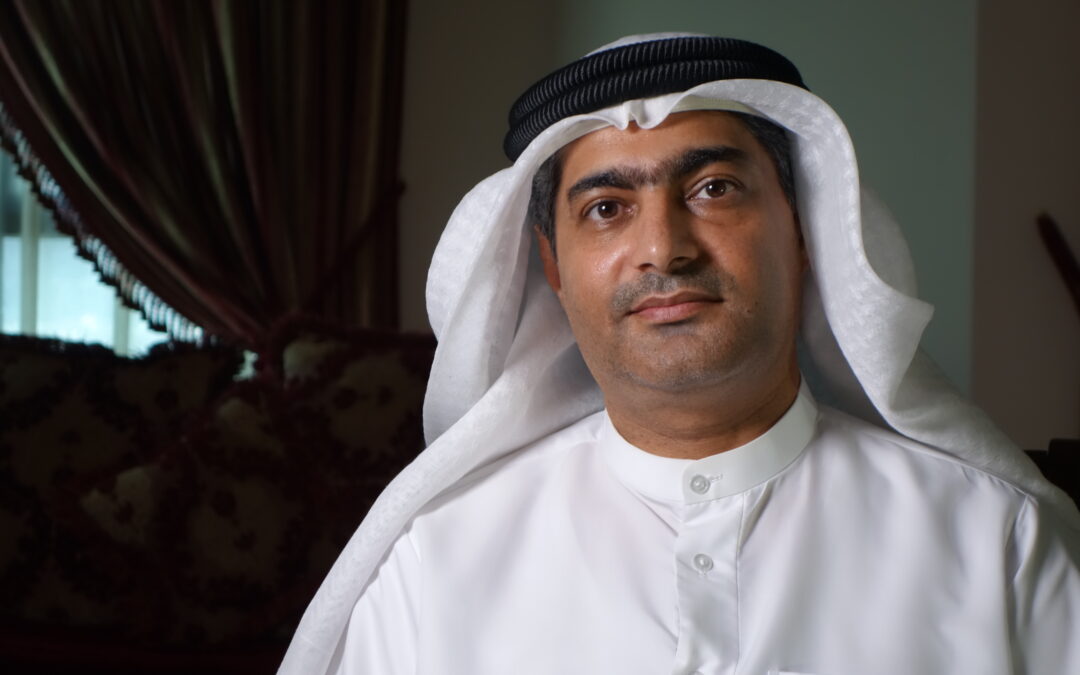
The Martin Ennals Foundation and the ten human rights organizations that make up the jury of the Martin Ennals Award for Human Rights Defenders (MEA), including the ICJ, today renewed their appeal to the UAE government to release immediately and unconditionally Ahmed Mansoor.
Ahmed Mansoor is the last remaining human rights defender in the UAE who had previously been able to criticize the authorities publicly, they say.
Ahmed Mansoor received the Martin Ennals Award for Human Rights Defenders in 2015.
Three months ago today, in the pre-dawn hours of 20 March about a dozen security officers arrested Ahmed Mansoor at his home in Ajman, about 150 kilometres northeast of Abu Dhabi, the capital of the UAE.
“We urge the UAE government to end the incomprehensible three-month imprisonment of Ahmed Mansoor. This is really about the UAE failing to respect basic principles of justice,” said Dick Oosting, Chairperson of the MEA Board.
“The purported case against Ahmed Mansoor beggars belief. States have the duty to bring to justice those whom they suspect of having committed criminal offenses,” he added.
“Yet what is clear is that the UAE authorities have arbitrarily deprived him of liberty and taken him away from his family for peacefully exercising his human right to freedom of expression. The three-month lapse and total lack of transparency indicates, likewise, that the authorities merely wanted to silence him,” he further said.
On 20 March, the UAE authorities stated that Ahmed Mansoor was accused of using social media websites, including to “publish false and misleading information that harm national unity and social harmony and damage the country’s reputation,” under the UAE’s repressive 2012 Cybercrime Law, which authorities have used to imprison numerous human rights activists and which provides for long prison sentences and severe financial penalties.
On 28 March, a group of United Nations human rights experts called on the UAE government to release him immediately, describing his arrest as “a direct attack on the legitimate work of human rights defenders in the UAE.” They expressed their fear that his arrest “may constitute an act of reprisal for his engagement with UN human rights mechanisms, for the views he expressed on social media, including Twitter, as well as for being an active member of organizations such as the Gulf Centre for Human Rights, and an active supporter of others, including Human Rights Watch.”
The next day, the UAE authorities responded directly to the statement, disputing the allegation that Ahmed Mansoor’s detention was arbitrary, and stating that he “has the freedom to hire a lawyer and that his family has full access to the place of confinement and is allowed to visit him.”
The government has detained Ahmed Mansoor in Abu Dhabi.
It is too far from his home for regular visits from his family, who have only been able to see him once in the last three months.
The authorities appear determined to isolate Ahmed Mansoor from his own family.
Despite government assertions that he is able to do so, it appears that he has not been able to appoint an independent lawyer of his own choosing.
This is a necessary component of the right to a fair trial.
The right to see a lawyer is a basic right of anyone detained as outlined in article 16 of the Arab Charter on Human Rights, which the UAE has ratified.
The ten human rights organizations that make up the jury of the Martin Ennals Award for Human Rights Defenders reiterate their call to the UAE authorities to release Ahmed Mansoor immediately and unconditionally, since the charges against him relate solely to his human rights work and his right to freedom of expression.
In the meantime, he should be granted immediate and regular access to his family and a lawyer of his choosing. The UAE must end their harassment of human rights defenders and critics of the authorities.
Signatories
Organizations forming the jury of the Martin Ennals Award:
Agency for Diakonia and Development, Germany
Amnesty International
FIDH
Front Line Defenders
Human Rights First
Human Rights Watch
International Commission of Jurists
International Service for Human Rights
HURIDOCS
World Organisation Against Torture (OMCT)
Jun 13, 2017 | News
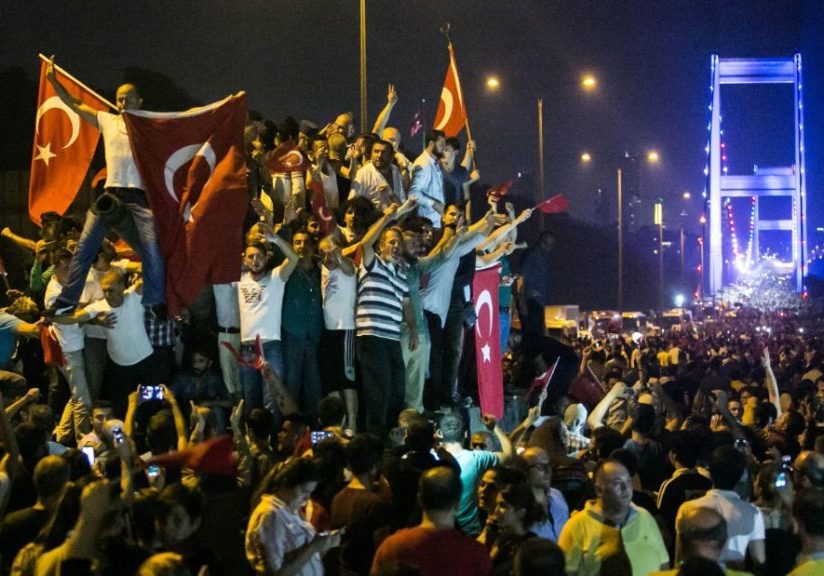
The ICJ welcomed today the Special Rapporteur’s report on Turkey and his preliminary findings on his visit to the country last November.
The ICJ welcomes and concurs with the finding that the “situation of the judiciary is undermining freedom of opinion and expression”.
Mass dismissals of judges have had a devastating effect on the judiciary’s independence, already weakened by the current state of emergency. Furthermore, we are concerned at the claim by the President that the state of emergency will remain in place until Turkey reaches “peace and prosperity”. Whatever other questions there may be about their validity, maintaining emergency derogations to human rights law instruments for such an open-ended period would clearly not be in line with international law.
The ICJ is also concerned at the constitutional amendments approved on the 16th of April by a referendum. Among other things, the amendments have given powers to the President and the Parliament to appoint all the members of the High Council of Judges and Prosecutors, the body tasked with protecting the independence of these professions.
The judiciary has had in the past an important role in implementing legislation that has severely limited the freedom of journalists to carry out their job.
The independence of the judiciary has now been eroded to its core in Turkey. Without it, there is no effective remedy in the country to protect freedom of opinion and expression.
Further reading: ICJ’s briefing paper Turkey: the Judicial System in Peril
May 31, 2017 | News
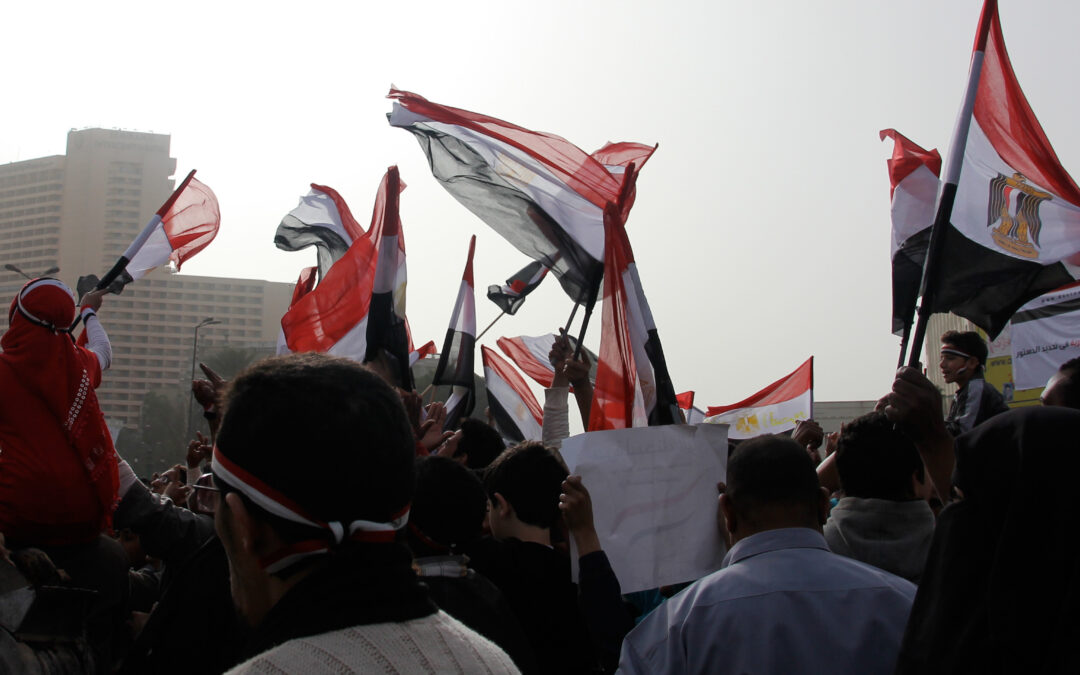
The ICJ today called on the Egyptian authorities to act immediately to repeal the law on civic associations.
The law was adopted by Egypt’s Parliament on 15 November 2016 and signed into law by President El-Sisi on 29 May 2017.
Until the law is repealed, the authorities should desist from enforcing it, the ICJ says.
The law effectively prohibits most Egyptian human rights non-governmental organizations (NGOs) from registering and working in Egypt, stipulating that civic associations’ work shall take place in the fields of development and social welfare consistent with “the State’s plans and its developmental needs and priorities.”
Egyptian and international NGOs are also forbidden to advocate against any law or its implementation, as well as to carry out “political activities” or any that “harm national security, public order, public morals or public health.”
They are prohibited from conducting public surveys, research or reports without permission and approval of the results of such work must be given by the authorities prior to publication (articles 14, 87).
The law also provides for an entity to be formed by presidential decree from representatives of three security bodies, which will decide on all matters related to NGO funding, the registration and issues relating to the work of international NGOs, and cooperation between Egyptian associations and any foreign body.
“The law on civic associations, if implemented in its present form, would be tantamount to an official death certificate of independent civil society in Egypt,” said Said Benarbia, ICJ Middle East and North Africa Director.
“By signing it into law, President El-Sisi is silencing the very organizations that could act as a check on the abusive and arbitrary exercise of his power,” he added.
The adoption of this repressive law is just the latest measure in a sustained, relentless campaign by Egypt’s military and executive authorities aimed at dismantling Egyptian civil society through highly politicized judicial proceedings and arbitrary travel bans against NGOs and human rights defenders.
For instance, the foreign funding case taken against NGOs (no. 173/2011) saw leading Egyptian human rights organizations, such as the Cairo Institute for Human Rights Studies (CIHRS), the Arabic Network for Human Rights Information (ANHRI) and the Hicham Mubrak Law Center (HMLC), subject to arbitrary investigations.
The grounds included “receiving funds to harm national interests and destroy the basic foundations of the state (the army, police, and judiciary),” “establishing an entity operating as a civic association without official registration,” and “income tax evasion.”
Four of these organizations and six NGO directors/board members have been subjected to asset freezes.
In the last two months, many NGO staff and directors have been summoned for interrogation by investigative judges, including ICJ partners Mustapha El-Hassan, Director of HMLC, Gamel Eid, Founder and Director of ANHRI, and Mohamed Zaree, CIHRS’ Programme Director and short-listed candidate for the Martin Ennals Award 2017.
The ICJ has previously documented how the Egyptian authorities have used the justice system as a repressive tool in their efforts to silence many of those suspected of opposing them.
“Egyptian authorities must comply with their obligations under international law and put an immediate end to their campaign to silence human rights defenders and NGOs. A first step in that direction would be the immediate repeal of the law on civic associations,” Benarbia said.
Contact
Said Benarbia, Director of the ICJ Middle East and North Africa Programme, t: +41 22 979 38 17: said.benarbia(a)icj.org
Egypt-NGO Law-News-Press release-ARA (Press release in Arabic, PDF)