Nov 14, 2013 | News
The International Bar Association’s Human Rights Institute (IBAHRI) and the ICJ urge the Commonwealth Heads of States meeting in Colombo this week to make Sri Lanka accountable to Commonwealth values.
The IBAHRI and the ICJ recall that the Commonwealth Charter, passed in March 2012, sets out 16 core values, which include safeguarding the independence of the judiciary, protecting the rule of law, respecting the separation of powers and promoting democratic rule.
But the two organizations point out numerous examples where these values have not been respected by the Government of Sri Lanka.
The IBAHRI and the ICJ were holding a press conference in Bangkok Thailand today after a high-level IBAHRI delegation was blocked from entering Sri Lanka late last week to attend a conference on the rule of law and independence of the legal profession hosted by the Bar Association of Sri Lanka.
Giving a statement remotely, Gabriela Knaul, UN Special Rapporteur on the Independence of Judges and Lawyers, expressed “serious concerns about acts of reprisals against judges, prosecutors, lawyers and other actors of the judicial system who cooperate, or seek to cooperate, with UN and regional human rights mechanisms.”
“Reprisals against judicial actors and legal professionals are a kind of attack to their institutional and functional independence,” she added.
Earlier this year, the IBAHRI conducted a remote fact-finding mission on the politically motivated impeachment of Chief Justice Banadranayake in January 2013, after being denied entry into Sri Lanka.
The IBAHRI Mission concluded that the Chief Justice’s removal was unlawful, undermined public confidence in the rule of law and threatened to eviscerate the country’s judiciary as an independent guarantor of constitutional rights.
In an open letter signed by 56 eminent jurists and senior judges from around the world, the ICJ also expressed its grave concern over the disregard for international standards on the independence of the judiciary and the removal of judges.
“This weakening of rule of law and independence of the judiciary is accompanied by an equally deteriorating human rights situation,” said Sheila Varadan, ICJ Legal Adviser for South Asia.
The United Nations High Commissioner of Human Rights, Navi Pillay, in her recent visit to Sri Lanka expressed concern over the curtailment or denial of personal freedoms and human rights, the persistent impunity and the failure of rule of law.
“The state of affairs in Sri Lanka sits uneasily with the aspirations set out in the Commonwealth Charter,” said Human Rights Barrister and IBAHRI Sri Lanka Mission Rapporteur, Sadakat Kadri. “The Government of Sri Lanka has spent years undermining the values and principles of the Commonwealth.”
“If the Commonwealth is to remain a relevant and effective international organization, it is paramount that those heads of State who have chosen to attend this week’s summit take measures to make Sri Lanka accountable to the core values and principles of the Commonwealth,” said IBAHRI Senior Programme Lawyer Alex Wilks.
Contact:
Sheila Varadan, ICJ Legal Advisor, South Asia Programme (Bangkok), t: +66857200723; email: sheila.varadan(a)icj.org
Notes:
- The IBAHRI delegation blocked from entering Sri Lanka included UN Special Rapporteur on the Independence of Judges and Lawyers, Ms Gabriela Knaul, former UN Special Rapporteur on the Independence of Judges and Lawyers and ICJ Commissioner Dato’ Param Cumaraswamy, and IBAHRI senior programme lawyer Alex Wilks, had intended to travel to Colombo to attend a conference on the rule of law and independence of the legal profession hosted by the Bar Association of Sri Lanka. IBAHRI Mission Rapporteur Sadakat Kadri was also unable to enter Sri Lanka as he was denied a visa.
- The Bar Association of Sri Lanka with the International Bar Association’s Human Rights Institute had planned a conference for 13 November 2013 on ‘Making Commonwealth values a reality: the rule of law and independence of the legal profession’. The 13 November 2013 conference was cancelled when the Government of Sri Lanka revoked visas for the UN Special Rapporteur and the IBAHRI delegation on 7 November 2013.
- In March 2013, a delegation of the IBAHRI undertook a remote fact-finding mission to investigate the impeachment proceedings of Chief Justice Bandaranayake, the independence of the legal profession and rule of law in Sri Lanka. The mission was conducted remotely following the cancellation of visas by the Government of Sri Lanka for the IBAHRI delegation. A report was released in April 2013 A Crisis of Legitimacy: The Impeachment of Chief Justice Bandaranayake and the Erosion of the Rule of Law in Sri Lanka.
- The ICJ released a report, Authority without Accountability: The crisis of impunity in Sri Lanka in November 2012 documenting the systemic erosion of rule of law and accountability mechanisms in Sri Lanka. The ICJ report described how decades of Emergency rule and legal immunities granted to the President and other government officials weakened the checks and balances in the Sri Lankan government, while political interference has increasingly led to attacks on the independence of the judiciary and rule of law.

Nov 14, 2013 | Events, News
The International Bar Association Human Rights Institute (IBAHRI) and the ICJ urge Commonwealth Heads of States meeting in Colombo this week to make Sri Lanka accountable to Commonwealth values.
The IBAHRI and the ICJ are holding a press conference in Bangkok, Thailand, this morning after a high-level IBAHRI delegation was blocked from entering Sri Lanka late last week.
You can watch the event here: http://www.ustream.tv/recorded/40754120
Further reading:
Sri Lanka-Muttur killings-ICJ-ACF Q&A-briefing paper-2013 (full text in pdf)
ICJ open letter signed by 56 eminent jurists and senior judges from around the world
ICJ report Authority without Accountability: The crisis of impunity in Sri Lanka
Nov 1, 2013 | News
Jueces europeos y centroamericanos expresaron en Tegucigalpa su preocupación por la falta de independencia del sistema judicial en países como Honduras, Guatemala y El Salvador.
Instaron a los Estados a tomar medidas para garantizar la autonomía de esa rama del poder público.
El 31 de octubre y 1 de noviembre se llevó a cabo en la ciudad de Tegucigalpa (Honduras) el foro denominado “Encuentro de Juristas Europeos y Centroamericanos: experiencias sobre la defensa de la independencia judicial”.
Durante el mismo, se tuvo la oportunidad de intercambiar experiencias en torno a las amenazas que hoy día persisten en contra de la independencia judicial y las medidas que los estados de Centroamérica deben tomar para fortalecer los diferentes sistemas de justicia en la región.
El foro reconoce el papel fundamental que tienen todos los jueces y juezas en la construcción y consolidación de la Democracia y el Estado de Derecho en Centroamérica; las y los participantes expresan su preocupación porque aún existen serias amenazas a la independencia judicial, entendiéndose dicha independencia como una garantía para los ciudadanos y ciudadanas.
En tal sentido, los estados centroamericanos deben respetar plenamente la independencia del Poder Judicial.
Honduras-Foro Jueces Independencia en CA-news-web story-2013-spa (full text in pdf)
Oct 24, 2013 | News
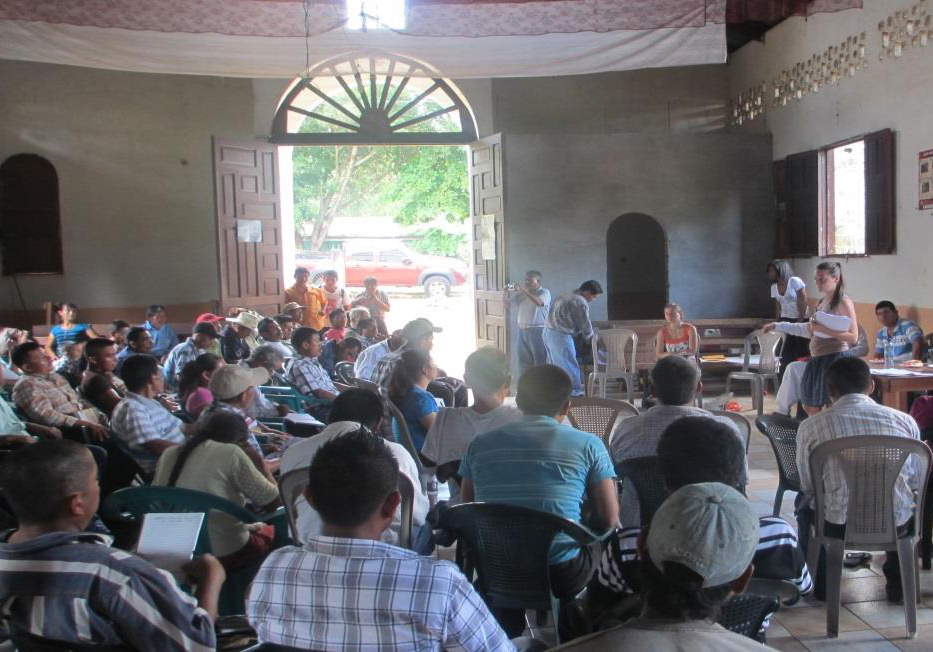
Los días 22, 23 y 24 de octubre se reunieron en el Departamento de Petén diferentes comunidades, dirigentes comunitarios, defensores de derechos humanos y organizaciones sociales.
El objetivo de la reunion fue evaluar la situación de las comunidades que viven en los municipios de San Andrés y La Libertad, de dicho departamento.
Entre otras organizaciones y dirigentes del departamento de Petén, estuvieron presentes las organizaciones Unión Verapacense de Organizaciones Campesinas (UVOC) y el Comité de Desarrollo Campesino (CODECA), ambas integrantes de la Coordinadora Nacional de Organizaciones Campesinas (CNOC); dirigentes del Frente de Resistencia en Defensa de los Recursos Naturales y Derechos de los Pueblos (FRENA) del Departamento de San Marcos y dirigentes de la Sociedad Civil de Santa Cruz Barillas del Departamento de Huehuetenango; representantes del Bufete de Derechos Humanos (BDH), representantes de El Observador y de la Oficina de la Comisión Internacional de Juristas (CIJ) para Centroamérica.
Después de realizar varios talleres, reuniones, análisis y reflexión sobre la situación de derechos humanos en dichos municipios, las organizaciones mencionadas pudieron constatar que continúa la política de persecución, represión y hostigamiento en contra de las comunidades y de sus dirigentes y pobladores, por el hecho de que sus comunidades quedaron en áreas declaradas “protegidas” en la década de los años noventa.
Muchos dirigentes están sufriendo amenazas por parte de las autoridades estatales, mientras el Ejército de Guatemala mantiene diferentes “retenes” que sirven para amedrentar a las poblaciones y a sus dirigentes y para evitar que trasladen alimentos y medicinas a sus comunidades.
El Concejo Nacional de Áreas Protegidas (CONAP) pretende obligar a las comunidades que viven en zonas protegidas a firmar “Acuerdos de Cooperación”, que resultan lesivos a sus intereses y que no otorgan seguridad jurídica sobre la propiedad y posesión de sus tierras. Al resistirse a firmar dichos acuerdos, representantes de CONAP amenazan a las comunidades y a sus dirigentes con implementar desalojos forzosos en su contra y en contra de sus comunidades.
Esta actitud contrasta con la política gubernamental hacia la compañía petrolera PERENCO, a la cual durante la gestión del ex Presidente Álvaro Colom, se le prorrogó el contrato petrolero por 15 años más a partir del año 2010, aún en contra de preceptos constitucionales e internacionales. Además, recientemente el Gobierno concesionó seis licencias más de exploración petrolera, algunas en áreas protegidas, a favor de diferentes empresas privadas en los Departamentos de Petén, Quiché, Huehuetenango e Izabal.
El Departamento de Petén es uno de los más afectados por las políticas de desalojos forzosos del Estado de Guatemala.
Guatemala-NOTA INFORMATIVA PETEN-web story-2013-spa (full text in Spanish, pdf)

Aug 29, 2013 | News
También la CIJ solicita audiencia temática a la comisión interamericana de derechos humanos.
La CIJ condenó los ataques que se han venido dando en contra de defensores de derechos humanos en Guatemala.
Por tal razón, conjuntamente con organizaciones sociales y campesinas como el Comité de Unidad Campesina (CUC), Asociación para la Promoción y el Desarrollo de la Comunidad (CEIBA), WAQIB´KEJ y otras organizaciones sociales de Guatemala, solicitaron a la Comisión Interamericana de Derechos Humanos una audiencia temática sobre el fenómeno de la criminalización de la protesta social el pasado viernes.
El objeto de la misma es, además de proporcionar información sobre el fenómeno de la criminalización de la protesta social, identificar patrones de represión en contra de líderes sociales en Guatemala.
Según la CIJ, este fenómeno es un claro retroceso del proceso democrático de Guatemala.
En efecto, se han identificado patrones de represión estatal, utilizando el derecho penal para reprimir las libertades de pensamiento, expresión y reunión de sus actores.
En este contexto, la CIJ nota con preocupación varios patrones de ataque en contra de defensores y defensoras de Derechos Humanos de Guatemala, que preocupan profundamente y que se expresan en detenciones ilegales, campañas de difamación y acusaciones falsas, ataques directos que han quitado la vida a cuatro periodistas en los últimos meses y falta de investigación pronta y eficiente, que identifique quien está detrás de estos hechos y si hay presencia de estructuras criminales organizadas que cometen estos crímenes para evitar la defensa de los derechos de los Pueblos Indígenas y de sus territorios.
Ramón Cadena, Director de la CIJ para Centroamérica expresó: “Pedimos a las autoridades del Sistema de Justicia que investiguen estos ataques. La impunidad de estos hechos sigue siendo alarmante. Por esta razón, la Organización de las Naciones Unidas debería nombrar cuanto antes al futuro representante de la Comisión Internacional contra la Impunidad (CICIG), quien debería ser un Fiscal con experiencia para continuar la lucha en contra de cuerpos ilegales y aparatos clandestinos de seguridad.”