Mar 7, 2014 | News, Publications, Reports
A new ICJ report criticizes the Thai Government’s failure to take the steps necessary to establish the fate and whereabouts of missing lawyer Somchai Neelapaijit, saying it illustrates the challenges of achieving justice in cases of serious human violations in Thailand.
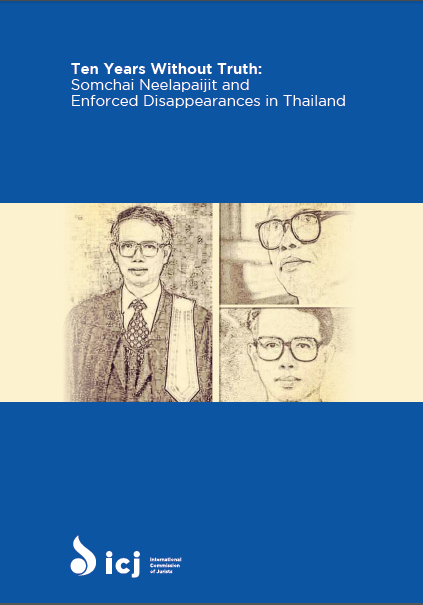
In the report, Ten Years Without Truth: Somchai Neelapaijit and Enforced Disappearances in Thailand, the ICJ documents the tortuous legal history of the case.
It highlights several key problems, such as poor use of forensic evidence, failure to follow and develop leads, unduly restrictive interpretation of national and international law, and above all, a lack of political will to resolve a case that remains emblematic of the culture of impunity in Thailand.
“Over the past 10 years, this case has taken many unexpected turns, including the disappearance of a prime suspect, admissions of Somchai’s death from officials while the courts have rejected such a finding, and most recently, a statement from the Department of Special Investigations that it had lost, and then found, the case files,” said Sam Zarifi, ICJ’s Regional Director for Asia and the Pacific.
“The Royal Thai Government has not exhausted all potential areas of inquiry and it must continue this investigation. There is no statute of limitations on an enforced disappearance and Somchai’s case is not forgotten in Thailand or around the world.”
Somchai, a lawyer and human rights defender, was stopped at a Bangkok roadside on March 12, 2004 and pulled from his car by a group of men. He has not been seen since.
At the time, Somchai was defending clients from Thailand’s restive southern provinces who were accused of attacking a military base as part of the ongoing insurgency in the region. Somchai had alleged police tortured the Muslim suspects.
Ten years later, Somchai’s wife, Angkhana Neelapaijit, and her family are no closer to knowing the truth about what happened to him.
“Somchai’s enforced disappearance, and the failure of the Royal Thai government to provide accountability or even basic information about his fate are emblematic of the challenges of achieving justice in cases of serious human rights violations in Thailand,” said Zarifi. “Enforced disappearance is not only a serious human rights violation but also a crime under international law.”
Thailand signed, but has not yet ratified, the Convention Against Enforced Disappearance in January 2012. Pending the ratification, Thailand must desist from any acts that would defeat the objective and purpose of the convention, which places an obligation on State Parties to make enforced disappearance a criminal offence and treat family members of a ‘disappeared’ person as victims in their own right.
The ICJ has followed Somchai’s case closely and worked with Angkhana Neelapaijit since 2004.
“The Royal Thai government’s failure to shed any more light on the enforced disappearance of Somchai Neelapaijit, despite providing compensation for his family and finding him to be ‘disappeared’, contradicts multiple past declarations of its commitment to seeking justice, or at least truth, including by several former Prime Ministers, Attorneys General, and officials,” the report says.
“It also contradicts official commitments before the United Nations Human Rights Council in March 2008.”
The ICJ’s report calls on the Royal Thai government to prioritize and advance the investigation into Somchai’s disappearance in a manner that conforms to its international obligations. It also recommends that Thailand:
–Ratify the Convention Against Enforced Disappearance;
–Enact legislation that makes enforced disappearance a specific crime in Thai domestic law, together with penalties that recognize its extreme seriousness;
–Amend existing Thai law to conform to the Convention Against Enforced Disappearance, as well as the State’s obligations, including with respect to effective remedy and reparation, under the ICCPR and CAT;
–Provide Angkhana Neelapaijit and her family with effective remedy and full reparation, in particular knowledge and clarification of the facts leading to the enforced disappearance and the progress and results of the Department of Special Investigations, and;
–Address the recommendations the ICJ made to the DSI in its letter of February 4, 2014 with respect to its investigation.
CONTACT
Sam Zarifi, ICJ Asia-Pacific Regional Director, (Bangkok), t:+66 807819002, e-mail: sam.zarifi(a)icj.org
Craig Knowles, ICJ Media & Communications, (Bangkok), t:+66 819077653, e-mail: craig.knowles(a)icj.org
Download the full report in PDF:
Ten Years Without Truth- Somchai Neelapaijit and Enforced Disappearances in Thailand – report – 2014
Thailand-Ten Years Without Truth-Publications-Reports-2014-THAI
Mar 5, 2014 | Advocacy
The ICJ has submitted a written statement to the Human Rights Council, on lack of progress in Nepal to end impunity.
The written statement, published by the United Nations today, notes that in 2012 the Government of Nepal adopted a plan to implement the recommendations made during its 2011 Universal Periodic Review (UPR) by the Human Rights Council.
However, Nepal has failed to take necessary measures to implement recommendations on ending impunity.
Key concerns include:
- the failure to implement recommendations for strengthening the National Human Rights Commission (NHRC),
- failure to draft constitutional provisions consistent with international legal principles on the protection of human rights, rule of law and the right to effective remedy,
- failure to establishment of credible transitional justice measures,
- failure to take the necessary practical steps in relation to individual cases, towards ending impunity
Nepal-WrittenStatement-HRC25-Advocacy-2014 (download PDF)

Feb 21, 2014 | Advocacy, News, Non-legal submissions
The ICJ and other human rights organizations issued a public statement calling on Spanish lawmakers not to pass draft legislation that, if approved, would seriously limit Spanish courts’ ability to investigate and prosecute serious crimes under international law.
The draft legislation, tabled in Parliament by the Popular Party (PP), provides that, for cases involving allegations of genocide, crimes against humanity and war crimes not occurring on Spanish territory to be investigated and prosecuted in Spain, the suspect must either be a Spanish national or a foreigner habitually resident in Spain or a foreigner who is in Spain, whose extradition has been denied by Spanish authorities.
For case of torture and enforced disappearance, the proposed legislation requires that the suspect be a Spanish national or, alternatively, that the victim be a Spanish national at the time when the crime was committed and that the suspect be present in Spain when jurisdiction is assumed.
Where these conditions are not met, the proposal would allow Spanish courts to hear cases for those crimes for which prosecution is required by international treaties where the suspect is a foreigner on Spanish soil, so long as Spain has received and denied an extradition request.
The ICJ and other organizations stressed in their statement that if enacted, this legislation would close the doors of Spanish courts to certain victims of gross human rights violations who are unlikely otherwise to be able to obtain justice, particularly within their own jurisdictions.
Spain-Universaljurisdiction-NGOsJointStatement-2014-eng (download the joint statement in English)
Spain-Universaljurisdiction-NGOsJointStatement-2014-SPA (download the joint statement in Spanish)

Feb 17, 2014 | News
The ICJ today expressed concern at a ruling of the Italian Constitutional Court which denies full accountability of Italian officials in the case of the 2003 unlawful rendition, enforced disappearance and torture of Osama Mustafa Hassan Nasr, also known as Abu Omar.
In a ruling making no mention of the international human rights law obligations of Italy, the Court agreed with the contention of the Italian Government that it may protect from disclosure and use in court what it considers to be “secrets of state” even if to do so would prevent the revelation of the truth about serious crimes and human rights violations and the holding of those responsible to account.
The Court ruled that, under the Italian Constitution and the law on secrets of state, it is the sole prerogative of the President of the Council of Ministers, exercising “a wide discretionary power”, to establish the width of application of the secret of state doctrine.
The Court affirmed that such decisions cannot be questioned by ordinary courts.
A number of Italian and United States intelligence agents, including the former Director of the Italian Military Secret Service, Nicolò Pollari, had been found guilty of criminal offences in connection with the rendition.
The Constitutional Court’s ruling is likely to effectively annul the convictions of the top Italian secret agents involved in the rendition.
“This ruling constitutes a serious blow to the fight against impunity for some of the most serious crimes under international law”, said Massimo Frigo, Legal Adviser for the Europe Programme. “It disregards fundamental pillars of international human rights law, including the right to truth and the duty to investigate, prosecute and ensure accountability for gross violations of human rights”.
“The doctrine of “secret of state” must never be used as a means to cover up responsibility for crimes under international law or gross violations of human rights,” Frigo added. “The United States, which is primarily responsible, deplorably has abdicated its responsibility to meaningfully investigate and hold officials to account for gross human rights violations in its rendition and secret detention programme. Italy, by contrast, had been the only country in which the courts had imposed convictions for the US-led renditions. After this judgment, there is a real risk that the Italian complicity in this crime will never be fully ascertained and accounted for.”
The ICJ is concerned at reports that time limits for the conclusion of criminal proceedings in this case could expire in two months, despite the fact that, under international standards, limitation periods should not be imposed in respect of serious of crimes such as torture and enforced disappearance.
The expiry may foreclose any further investigation or criminal trial on Italian involvement in this rendition, which should occur irrespective the obstacles caused by the secret of state doctrine.
The ICJ is particularly concerned that successive Italian governments since 2007 have either proposed or refused to withdraw government applications before the Constitutional Court affirming that the executive prerogative on secret of state takes precedence over the fight against impunity.
The ICJ considers that the law and practice regarding the “secret of state” must be reformed to be into compliance with Italy’s duty to investigate crimes under international law and gross human rights violations.
While States may protected a limited amount of information when strictly necessary for legitimate national security purposes, they may not do so with respect to information concerning gross violations of human rights.
Background
Hassan Mustafa Osama Nasr, also known as Abu Omar, was been kidnapped in 2003 in the streets of Milan by CIA operatives and subject to rendition to Egypt where he had been subject to enforced disappearance, arbitrary detention and torture.
The case of Abu Omar was one of at least 136 known cases in the rendition and secret detention carried out since 2001 by the United States, with the participation of some 54 other States, which typically involved multiple human rights violations, including torture and ill-treatment, enforced disappearance, and arbitrary detention.
The Constitutional Court judgment effectively reversed the ruling of the Court of Cassation that ordered the reopening of the trial against the former Director of the Italian Military Secret Service, Nicolò Pollari, his deputy, Marci Mancini, and other Italian military secret services operatives for their alleged complicity in the operation.
The Court of Cassation had held that the doctrine of “secret of state”, which barred their conviction, would not apply to them, because the Italian secret services have no authority to conduct such illegal operations and they had therefore effectively acted in private capacity.
Following that judgment, the Court of Appeal convicted, among others, for complicity in the kidnapping Nicolò Pollari to ten years of imprisonment and Marco Mancini to nine years.
The Court of Cassation upheld in absentia the convictions and sentences of 23 US agents involved for the offence of kidnapping.
On 5 April 2013, the President of the Italian Republic, Giorgio Napolitano, granted a pardon for US Colonel Joseph L. Romano III, who had been convicted by Italian courts of the offence of complicity with the US in kidnapping for his role in the rendition of the Milan cleric Abu Omar in 2003.
Contact:
Massimo Frigo, Legal Adviser, ICJ Europe Programme, massimo.frigo(a)icj.org

Nov 14, 2013 | News
The International Bar Association’s Human Rights Institute (IBAHRI) and the ICJ urge the Commonwealth Heads of States meeting in Colombo this week to make Sri Lanka accountable to Commonwealth values.
The IBAHRI and the ICJ recall that the Commonwealth Charter, passed in March 2012, sets out 16 core values, which include safeguarding the independence of the judiciary, protecting the rule of law, respecting the separation of powers and promoting democratic rule.
But the two organizations point out numerous examples where these values have not been respected by the Government of Sri Lanka.
The IBAHRI and the ICJ were holding a press conference in Bangkok Thailand today after a high-level IBAHRI delegation was blocked from entering Sri Lanka late last week to attend a conference on the rule of law and independence of the legal profession hosted by the Bar Association of Sri Lanka.
Giving a statement remotely, Gabriela Knaul, UN Special Rapporteur on the Independence of Judges and Lawyers, expressed “serious concerns about acts of reprisals against judges, prosecutors, lawyers and other actors of the judicial system who cooperate, or seek to cooperate, with UN and regional human rights mechanisms.”
“Reprisals against judicial actors and legal professionals are a kind of attack to their institutional and functional independence,” she added.
Earlier this year, the IBAHRI conducted a remote fact-finding mission on the politically motivated impeachment of Chief Justice Banadranayake in January 2013, after being denied entry into Sri Lanka.
The IBAHRI Mission concluded that the Chief Justice’s removal was unlawful, undermined public confidence in the rule of law and threatened to eviscerate the country’s judiciary as an independent guarantor of constitutional rights.
In an open letter signed by 56 eminent jurists and senior judges from around the world, the ICJ also expressed its grave concern over the disregard for international standards on the independence of the judiciary and the removal of judges.
“This weakening of rule of law and independence of the judiciary is accompanied by an equally deteriorating human rights situation,” said Sheila Varadan, ICJ Legal Adviser for South Asia.
The United Nations High Commissioner of Human Rights, Navi Pillay, in her recent visit to Sri Lanka expressed concern over the curtailment or denial of personal freedoms and human rights, the persistent impunity and the failure of rule of law.
“The state of affairs in Sri Lanka sits uneasily with the aspirations set out in the Commonwealth Charter,” said Human Rights Barrister and IBAHRI Sri Lanka Mission Rapporteur, Sadakat Kadri. “The Government of Sri Lanka has spent years undermining the values and principles of the Commonwealth.”
“If the Commonwealth is to remain a relevant and effective international organization, it is paramount that those heads of State who have chosen to attend this week’s summit take measures to make Sri Lanka accountable to the core values and principles of the Commonwealth,” said IBAHRI Senior Programme Lawyer Alex Wilks.
Contact:
Sheila Varadan, ICJ Legal Advisor, South Asia Programme (Bangkok), t: +66857200723; email: sheila.varadan(a)icj.org
Notes:
- The IBAHRI delegation blocked from entering Sri Lanka included UN Special Rapporteur on the Independence of Judges and Lawyers, Ms Gabriela Knaul, former UN Special Rapporteur on the Independence of Judges and Lawyers and ICJ Commissioner Dato’ Param Cumaraswamy, and IBAHRI senior programme lawyer Alex Wilks, had intended to travel to Colombo to attend a conference on the rule of law and independence of the legal profession hosted by the Bar Association of Sri Lanka. IBAHRI Mission Rapporteur Sadakat Kadri was also unable to enter Sri Lanka as he was denied a visa.
- The Bar Association of Sri Lanka with the International Bar Association’s Human Rights Institute had planned a conference for 13 November 2013 on ‘Making Commonwealth values a reality: the rule of law and independence of the legal profession’. The 13 November 2013 conference was cancelled when the Government of Sri Lanka revoked visas for the UN Special Rapporteur and the IBAHRI delegation on 7 November 2013.
- In March 2013, a delegation of the IBAHRI undertook a remote fact-finding mission to investigate the impeachment proceedings of Chief Justice Bandaranayake, the independence of the legal profession and rule of law in Sri Lanka. The mission was conducted remotely following the cancellation of visas by the Government of Sri Lanka for the IBAHRI delegation. A report was released in April 2013 A Crisis of Legitimacy: The Impeachment of Chief Justice Bandaranayake and the Erosion of the Rule of Law in Sri Lanka.
- The ICJ released a report, Authority without Accountability: The crisis of impunity in Sri Lanka in November 2012 documenting the systemic erosion of rule of law and accountability mechanisms in Sri Lanka. The ICJ report described how decades of Emergency rule and legal immunities granted to the President and other government officials weakened the checks and balances in the Sri Lankan government, while political interference has increasingly led to attacks on the independence of the judiciary and rule of law.