
Apr 14, 2015 | News
The ICJ is deeply concerned over the decision of the High Judicial Council and the President of the Cairo Court of Appeal to investigate two judges with a view to referring them to the disciplinary Council.
Media reports have indicated that Assem Abdel Jabar, deputy president of the Cassation Court, and Hicham Raouf, a judge in Cairo’s Appeal Court, are being investigated over their individual participation, together with other leading lawyers and legal experts, in a workshop organized by an Egyptian organization, United Group, to discuss and propose new legislation on the prevention of torture.
According to information available to the ICJ, the two judges have so far not been formally notified of any charges against them and have received no information about the allegations on which they are based.
The actions against these judges continue a pattern of intimidation and attempted silencing of judges who are seen by authorities as not aligning themselves with government objectives.
The apparent investigation is only the latest in a string of cases where judges have been subject to arbitrary disciplinary proceedings for legitimately exercising their rights to freedom of expression and assembly.
On 14 March 2015, the Disciplinary Council forced 31 judges into retirement for signing a statement, on 24 July 2013, which criticized the “attack on the constitutional legitimacy and the ouster of the legitimate president that was elected”.
The disciplinary proceedings against these judges were marred with violations of due process rights.
The judges were not adequately informed of the date and location of the hearings, defence witnesses were not called and requests by the judges that the hearings be public were disregarded.
On 4 April 2015, a disciplinary hearing took place against Zakaria Abdelaziz, former president of Egypt’s Judges Club and one of the leading advocates for judicial independence in Egypt.
The charges alleged “involvement in politics” and “breaking into the State Security Building during a demonstration on 5 March 2011”.
According to information available to the ICJ, the case files were not made available to Zakaria Abdeaziz until the first hearing despite repeated requests to obtain them.
Under international human rights law and standards, judges are guaranteed the right to freedom of belief, association, assembly and expression, including by commenting on matters of public concern and matters pertaining to the rule of law and human rights situation in a country.
“Instead of subjecting judges to arbitrary proceedings for lawfully exercising their rights, the Egyptian authorities should stop its sustained campaign to muzzle judges who are seen as not friendly to the authorities,“ said Said Benarbia, Director of the ICJ MENA programme. “The Egyptian authorities must reinstate all judges who were removed from office solely for exercising their rights to freedom of expression and assembly and drop all charges against those currently subject to disciplinary proceedings for charges stemming from the exercise of these rights.”
Contact:
Alice Goodenough, Legal Adviser of the ICJ Middle East and North Africa Programme, t: +44 7815 570 834, e-mail: alice.goodenough(a)icj.org
Nader Diab, Associate Legal Adviser of the ICJ Middle East and North Africa Programme, t: +41 229 793 804, e-mail: nader.diab(a)icj.org
Egypt-Judges harassed-News-web story-2015-ARA (full text in PDF)
Jan 8, 2015 | News
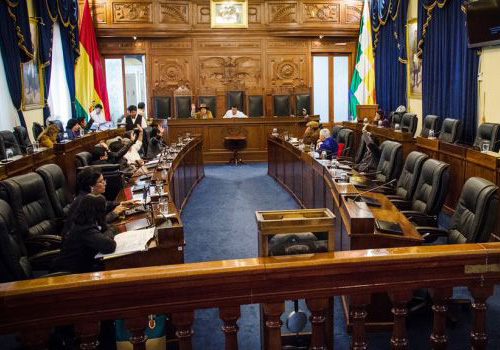
Reacting to the Bolivian Senate’s “judgment” removing Constitutional Court judge Soraida Rosario Chanez Chire from office, the ICJ condemned the proceedings as fundamentally flawed and in violation of international standards for the independence of judges.
Dec 1, 2014 | News
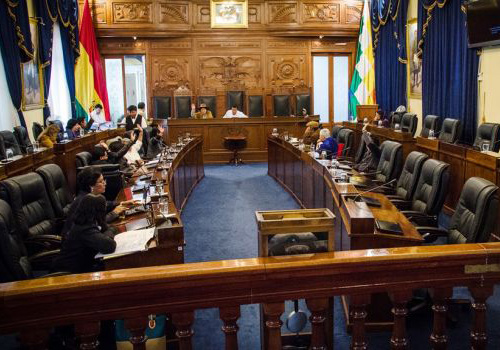
The ICJ expresses deep concern that the Legislative Assembly of Bolivia continues to threaten three Constitutional Court judges with removal, and possibly criminal punishment, based solely on legislators’ disagreement with a legal opinion and ruling issued by the judges.
A “trial” of the three judges conducted by the Senate is scheduled to begin on 4 December 2014.
The ICJ has previously condemned the proceedings as fundamentally flawed and in violation of international standards for the independence of judges.
The legislature and government now appear to accept some of the ICJ’s criticisms.
Last-minute legislative amendments would apparently specify that the legislative assembly process is disciplinary in character and that the only sanction the assembly can directly impose is permanently to remove judges from office; if a disciplinary violation is found, the case would be referred onward for criminal prosecution before the ordinary courts. (Legislators were previously reported to be seeking for the Senate itself to impose a sentence of 10 years’ imprisonment.)
The ICJ reaffirms, however, that the case against these three judges remains inherently flawed because the allegations on which the proceedings are based cannot be a valid basis for any removal from office or criminal punishment.
“It is fundamental to the independence of the judiciary, and the rule of law, that judges must be able to decide cases without fear of punishment for their legal opinions and rulings, including those that the government or legislature may not like,” said Matt Pollard, Head of the Centre for Independence of Judges and Lawyers at the ICJ.
“The procedural amendments under consideration could be an improvement for other kinds of cases in the future,” said Pollard. “However, the stated reason for pursuing these three judges – disagreement with the content of their legal opinion and ruling – cannot form a valid basis for their removal from office or criminal punishment under any procedure.”
“The case against these three judges cannot be cured by legislative ‘quick fixes’ and must simply be dropped immediately,” Pollard added.
The ICJ is also concerned that the legislature has said it will press ahead immediately with the “trial” on 4 December, a few days from now, while fundamental changes to the procedure are still underway.
Further, the media has reported that Chamber of Deputies President Marcelo Elío has stated that the judges could avoid trial by “voluntarily” resigning before 4 December.
It would be unacceptable to use the threat of unjust or unclear procedures to pressure a judge to resign.
The ICJ welcomes the decision by the legislature to review and potentially reform judicial accountability procedures in Bolivia.
At the same time, reform of procedures that are of such fundamental importance to the rule of law and democracy should be based on a process of broader consultation with all concerned stakeholders, and more considered, comprehensive and detailed assessment and analysis in relation to international standards.
For instance, under the new amendments, it would appear that the Senate (photo) has no option in any case to impose a disciplinary penalty less than permanent removal from office, even if this would be disproportionate.
Placing all responsibility for disciplinary proceedings with an independent Judicial Council should also be considered.
In October, the ICJ sent an open letter and analysis brief to members of the Legislative Assembly, explaining why the proceedings violate international law and standards, urging that proceedings against the three judges immediately be ended, and recommending a process of longer-term reform of judicial accountability processes in Bolivia.
Contact:
English: Matt Pollard, Head of the Centre for Independence of Judges and Lawyers at the ICJ, t: +41 79 246 54 75; e: matt.pollard(a)icj.org
Spanish: Carlos Ayala, ICJ Commissioner, t: +58 212 952 8448; e: carlos.ayala(a)icj.org
Bolivia-Procedimento magistrados-News-Press Release-2014-SPA (full text in PDF)
(Update: the proceedings were suspended on 4 December, and are to continue on 9 December)
Nov 7, 2014 | Multimedia items, News, Video clips
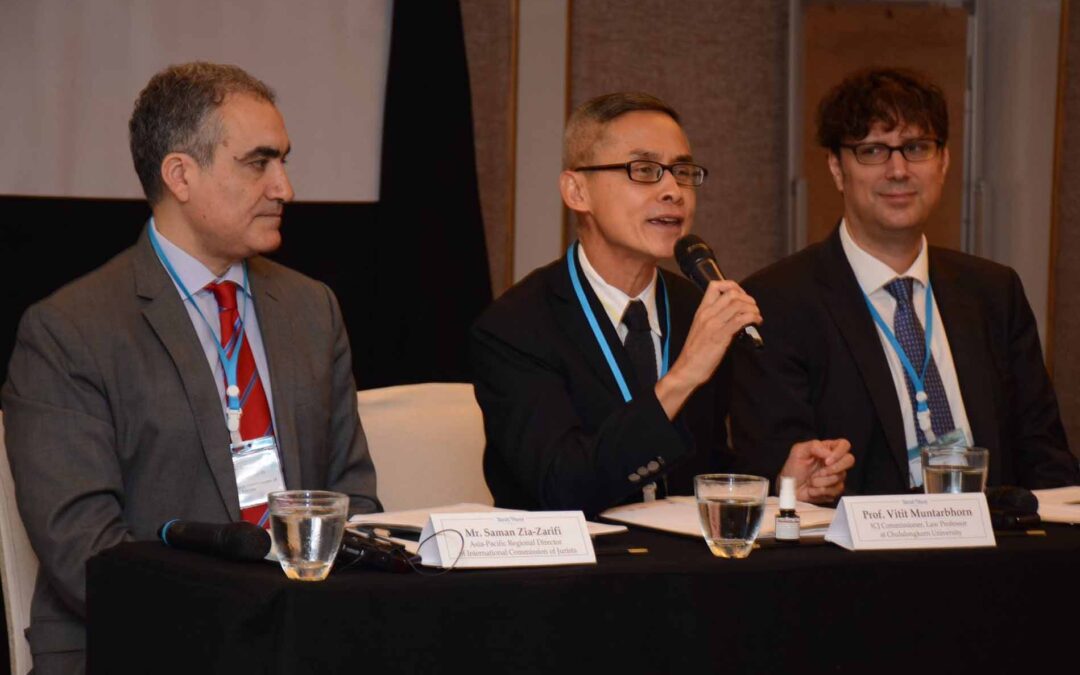
For the fist time, about 40 judges and representatives from judicial training institutions across Southeast Asia gathered to discuss recent developments in international human rights law on the right to life, with a focus on extrajudicial executions, deaths in custody and enforced disappearances.
Oct 16, 2014 | Advocacy, Analysis briefs, News, Open letters
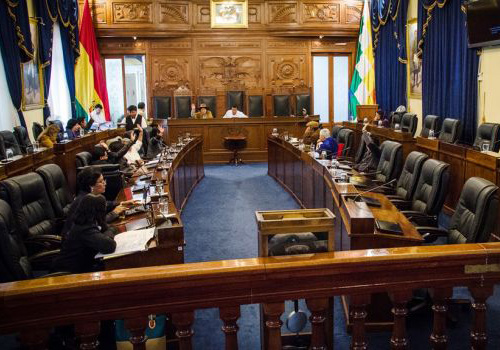
The ICJ condemns the imminent “trial” of Constitutional Court judges by Bolivia’s Senate, in proceedings that could see the judges sent to prison over politicians’ disagreement with a legal ruling.
The proceedings “violate the independence of the judiciary and the right to fair trial,” the Geneva-based organization wrote today in an open letter to all Senators and Deputies of the legislative assembly.
The charges in the trial, scheduled to begin on 21 October, are based entirely on a precautionary ruling by the judges that parts of a new law regulating notaries should not be implemented until the Court has an opportunity to hear a constitutional challenge to the law.
“The spectacle of dozens of politicians pretending to act as an independent and impartial criminal court, threatening to throw constitutional court judges in jail over a difference of opinion as to interpretation of the law, is incompatible with respect for human rights, the separation of powers, and the rule of law,” said Matt Pollard, Head of the Centre for Independence of Judges and Lawyers at the ICJ.
Constitutional Court Judges Soraida Rosario Chanez Chire and Ligia Mónica Velásquez Castaños are to be tried on 21 October, while proceedings against Judge Gualberto Cusi Mamani have reportedly been temporarily suspended for reasons of health. The judges were suspended from duty on 28 July.
An analysis brief published by the ICJ and sent to the legislative members concludes that the proceedings violate Bolivia’s international legal obligations under the American Convention on Human Rights and the International Covenant on Civil and Political Rights.
The brief also cites judgments of the Inter-American Court of Human Rights that found violations of the American Convention as a result of defective parliamentary proceedings for removal of judges in other countries. The proceedings in Bolivia are poised to be even more egregious than the proceedings at issue in the earlier judgments, given the possibility for the Bolivian Senate (photo) to impose a criminal conviction and imprisonment.
“The ICJ urges the Senators and Deputies immediately to cancel the proceedings, to end the judges’ suspension from duty, to refrain from any other form of interference with judicial independence, and to reform judicial discipline and removal procedures to bring them into line with international standards,” said Pollard.
(update as of 21 October: the proceedings were postponed to 4 November after one of the judges collapsed on arrival at the Legislative Assembly and was taken to hospital).
Contacts:
English: Matt Pollard, Head of the Centre for Independence of Judges and Lawyers at the ICJ, t: +41 79 246 54 75; e: matt.pollard(a)icj.org
Spanish: Carlos Ayala, ICJ Commissioner, t: +58 212 952 8448; e: carlos.ayala(a)icj.org
BOLIVIA-Unfair trial of judges-News-Press release-2014-SPA (full text in PDF)
BOLIVIA-unfair trial of judges-Advocacy-Open letter-2014-ENG (full text in PDF)
BOLIVIA-unfair trial of judges-Advocacy-Open letter-2014-SPA (full text in PDF)
BOLIVIA-unfair trial of judges-Advocay-Analysis brief-2014-ENG (full text in PDF)
BOLIVIA-unfair trial of judges-Advocacy-Analysis brief-2014-SPA (full text in PDF)