Jun 16, 2015 | News
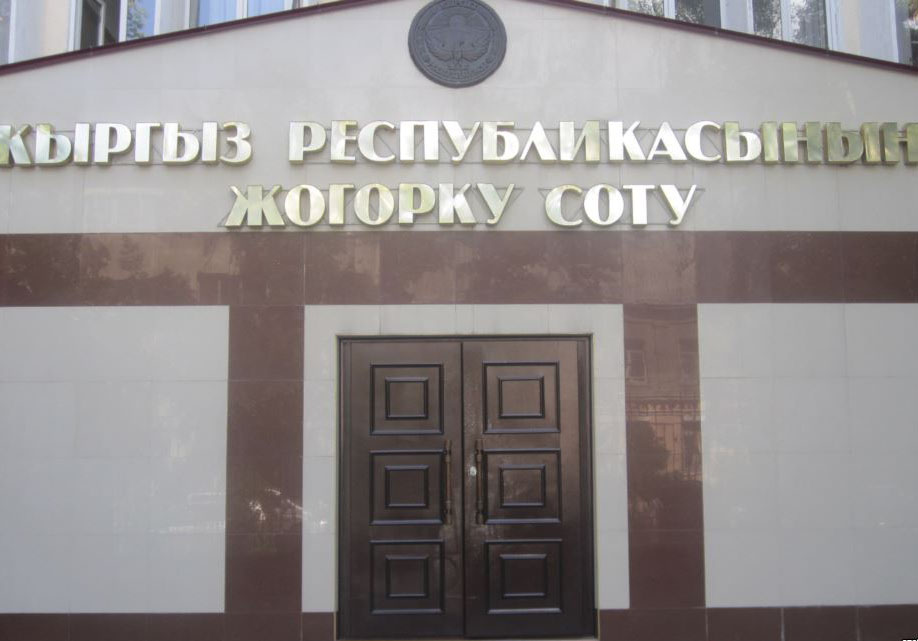
On 17 June, the ICJ will observe proceedings before the Supreme Court of the Kyrgyz Republic concerning searches of the workplace and homes of lawyers Valerian Vakhitov and Khusanbay Salieyv by law enforcement agents.
The case concerns confidentiality of lawyer-client communications and seizure of lawyers’ files, in light of the prohibition of arbitrary interference with privacy, correspondence, and home.
The Supreme Court of the Kyrgyz Republic is to consider the challenge of the Prosecutor’s Office to the decision of the Regional Osh Court of 30 April 2015.
The prosecutor also seeks disciplinary measures against the judges of the Regional Court who decided in favour of the protection of the professional guarantees of lawyers, ruling that the searches and seizures of documents were illegal.
The ICJ trial observation mission includes Olga Zimareva, a lawyer practicing in the Russian Federation and Almaz Osmanova, a lawyer in the Kyrgyz Republic and chair of the Central Asian League of Lawyers.
Following the conclusion of the case, the ICJ will publish its analysis of the proceedings and the judgment of the Supreme Court of the Kyrgyz Republic in light of international human rights law and international standards on the independence of the judiciary and the role of lawyers.
Contact:
Róisín Pillay, Director, Europe Programme, roisin.pillay(a)icj.org
Temur Shakirov, Legal Adviser, Europe Programme, temur.shakirov(a)icj.org
Kyrgyzstan-Trial observation-News-Web story-2015-RUS (full text in PDF, Russian)
Jun 5, 2015 | News
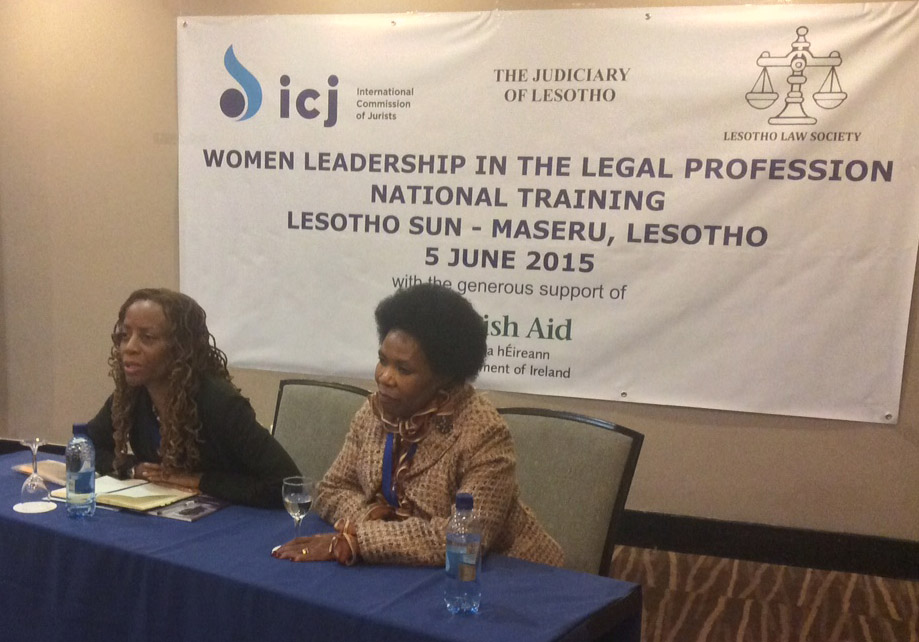
Today, the ICJ convened its training on “Women lawyers making a difference through the Legal Profession” in Maseru. Thirty-five women participated in the event.
In many jurisdictions, men invariably dominate the legal profession and there is a necessity to interrogate the reasons for this.
The advancement of women has not been significant despite the fact that there is equality in numbers in enrolment in law schools.
There have been cited challenges and obstacles that have been raised by women lawyers for this lack of advancement, and these needed to be fully explored in order to adopt concrete recommendations to inform an adequate and effective response to the apparent inequalities.
In order to address this issue within the legal profession in Lesotho, the ICJ collaborated with the Judicial Service Commission and the Lesotho Law Society.
The training brought together 35 women including Chief Justice Majara, Judges, Magistrates, Lawyers and Human Rights Activists from Non-Governmental Organisations.
The main objective of the training was to provide a platform for the participants to engage in robust discussions on the systemic obstacles that affect the ascendancy of women to leadership positions and provide them with an opportunity to introspect and come up with plausible innovative solutions and identify opportunities for change.
Further, the training would address the gender gap in the legal profession and also interrogate possible capacity building initiatives for the participants, which will enable them to effectively advance women’s rights through various advocacy techniques.
In addition, the training also sought to provide an opportunity for the Judicial Service Commission and the Lesotho Law Society for dialogue on improving the situation of women in the legal profession, as well as contributing to the promotion and protection of women’s rights and access to justice.

May 18, 2015 | News
From 18 to 22 May, the ICJ will carry out a mission to the Russian Federation to examine questions related to the independence and integrity of the legal profession, access to an independent lawyer and the right to an effective defence.
The mission will address the role of Bar Associations in protecting the independence of lawyers, as well as obstacles faced by individual lawyers in protecting the rights of their clients.
The ICJ mission, led by Wilder Tyler, the ICJ Secretary General, will hold meetings with leading Russian experts in the field.
The mission will also meet with the representatives of the Federal Chamber of Lawyers, government officials, and independent lawyers and will take part in two round table discussion with legal scholars and practicing lawyers.
A comprehensive report analyzing the main findings will follow the mission and will present recommendations for reform of law and practice in light of international law and standards on the role of lawyers.
Contact:
Róisín Pillay, Director, Europe Programme, roisin.pillay(a)icj.org
Temur Shakirov, Legal Adviser, Europe Programme, temur.shakirov(a)icj.org

Apr 24, 2015 | News
The ICJ today called on the Egyptian authorities to ensure a prompt, impartial and effective investigation into the deaths of two lawyers, Imam Afifi and Karim Hamdi, who recently died while in police custody in Mataria police station.
The ICJ is deeply concerned that the deaths of Imam Afifi and Karim Hamdi while in police custody are part of a widespread and sustained campaign targeting hundreds of lawyers since 2013, including those defending political opponents of the regime and human rights activists, as well as lawyers exercising their rights to freedom of assembly and expression.
“The Egyptian authorities must effectively investigate and prosecute all those responsible for the alleged torture and death of Imam Afifi and Karim Hamdi while in police custody and must hold accountable any person responsible for wrongful conduct ,” said Said Benarbia, Director of the ICJ MENA Programme.
“The authorities must bring an end to their ongoing campaign of harassing and persecuting lawyers, including arbitrary arrests and prosecutions, for simply discharging their professional duties or for speaking out against human rights violations,” he added.
Under international standards, lawyers should be able to carry out their professional duties free from hindrance, intimidation, harassment or interference, says the ICJ.
They should not be identified with their clients or their clients’ causes or subject to arbitrary arrest and prosecutions as a result of the discharge of their functions.
Background:
On 10 April, Imam Afifi, a 63-year old lawyer, was assaulted and arrested in the Mataria neighborhood where a demonstration was taking place against the government.
He was detained in Mataria police station where he was allegedly subjected to torture, including a severe beating to his head.
On 11 April, he was transferred from the police station to Mataria hospital.
A medical report from the same day, to which the ICJ had access, indicates that Imam Afifi was admitted to the hospital with a massive trauma to the head. He died in hospital on 22 April.
On 22 February, another lawyer, Karim Hamdi, was arrested and questioned on suspicion of belonging to the Muslim Brotherhood, membership of which has been outlawed, and participating in an unauthorized demonstration against the government.
While in police custody in Mataria police station, he was reportedly severely beaten on his neck, chest and abdomen. He died two days later after being transferred to hospital.
Following a complaint by the Bar Association to the prosecutor’s office, two members of the National Security Agency were charged with torturing and murdering Karim Hamdi.
Additional information:
According to information available to the ICJ, attacks against lawyers since 2013 include the following:
On 23 April 2015, six lawyers were summoned for interrogation in relation to their participation in a demonstration on 9 March to protest against the death of Mr Karim Hamdi.
The lawyers also challenged the prosecutor’s decision to prohibit anyone from reporting on the investigation into Mr Hamdi’s case.
On 23 March 2015, human rights lawyer, Azza Soliman, was charged with breaching public order and security under the 2013 Demonstration Law after voluntarily providing testimony against police involved in the killing of Social People’s Alliance party activist, Shaimaa El Sabbagh, on 24 January 2015.
The Qasr El Nile Prosecution Office in Cairo subsequently changed her status from witness to defendant.
On 9 February 2015, a human rights lawyer, Ms Mahienour El Massry, was sentenced to two years imprisonment after she attended the El-Ramel police station in Alexandria, in March 2013, in order to defend demonstrators.
The charges against her included “insulting government employees in the performance of their duties”, “insulting representatives of the authorities” and “attempting to break into a police station”.
Three lawyers, Basma Zahran, Mahmoud Bilal and Oussama Al Mahdi, were referred for investigation, on 3 September 2014, for “disrupting and causing trouble” during trial proceedings for insisting that their client, the human rights activist Ahmed Douma, seated in a sound-proof glass cage, should be heard.
On 5 July 2013, Abdel Men’em Abdel Maqsoud was arrested while attempting to attend the interrogation of his clients, deputy Secretary General of the Muslim Brotherhood, Rachad Bayoumi, and Mohamed Saad Al Katanah.
He was detained before being released on bail on 2 September 2014.
Contact:
Alice Goodenough, Legal Adviser of the ICJ Middle East and North Africa Programme, t: 44 7815 570 834, e: alice.goodenough(a)icj.org
Nader Diab, Associate Legal Adviser of the ICJ Middle East and North Africa Programme, t: 41 229 793 804, e: nader.diab(a)icj.org
Egypt-Deaths of lawyers-News-Press release-2015-ARA (full text of Arabic version in PDF)