Sep 14, 2018 | News
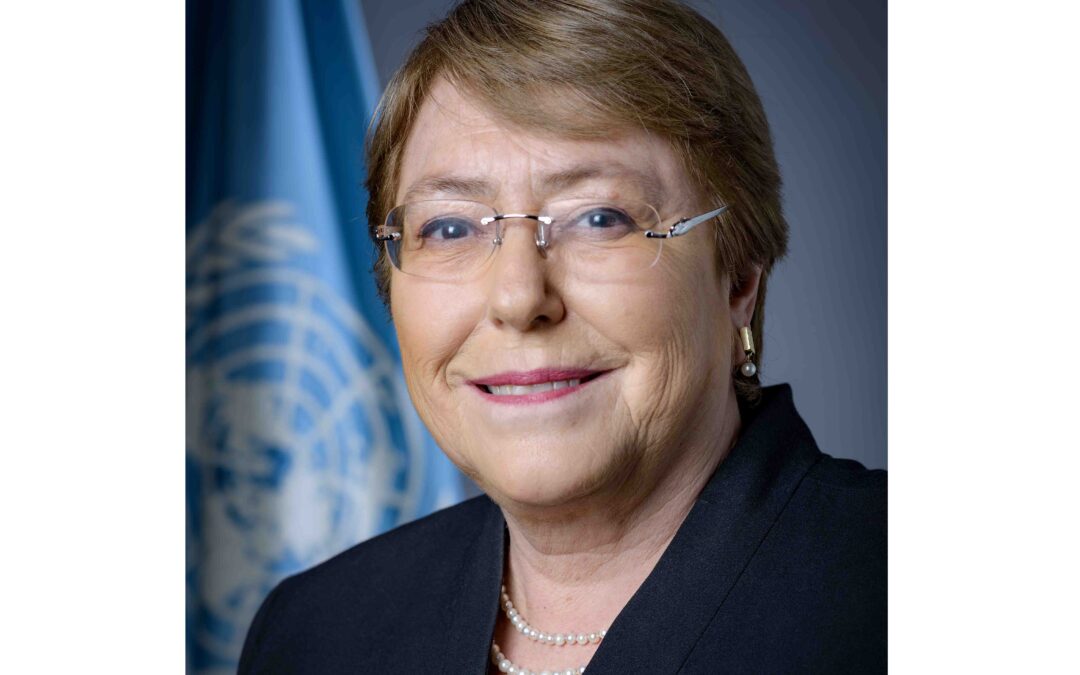
On 14 September 2018, the ICJ joined 67 other international and Guatemalan civil society organizations in a letter to the High Commissioner for Human Rights, Michelle Bachelet, to express grave concern about recent developments to curtail anti-impunity efforts in the country.
These include President Jimmy Morales’ decision on 31 August 2018 not to extend the mandate of the International Commission against Impunity in Guatemala (CICIG); the Guatemalan authorities’ subsequent decision on 4 September 2018 to prohibit the re-entry into the country of the CICIG’s Commissioner Iván Velásquez; and judicial reforms adopted by Congress on 6 September 2018 that threaten to undermine the independence of the judiciary and the function of the Constitutional Court judges and the office of the Human Rights Ombudsman.
The signatories welcomed the High Commissioner’s critical reference of these developments in her opening remarks to the 39th session of the Human Rights Council.
They asked that the High Commissioner give continued support in the fight against corruption and impunity in Guatemala and called on her to press the Guatemalan authorities to adopt necessary measures to facilitate compliance with the mandate of the CICIG under the terms of the Agreement signed between Guatemala and the United Nations.
The letter is available here (in Spanish): Guatemala-Letter to Michelle Bachelet-News-2018-SPA
Sep 11, 2018 | Advocacy, Non-legal submissions
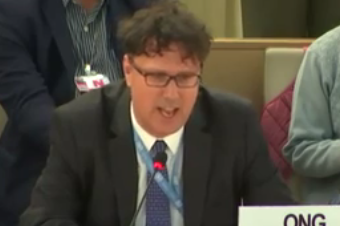
The ICJ today addressed the new UN High Commissioner for Human Rights, Michelle Bachelet, highlighting the role of her office in countering global threats to the rule of law and human rights.
The statement was made at the UN Human Rights Council, during general debate on the High Commissioner’s oral update. It read as follows:
“Madam High Commissioner,
The International Commission of Jurists (ICJ) warmly welcomes you to your new mandate – a mandate that the ICJ has, since 1964, fought to create and support.
A multitude of issues and situations urgently call for your attention. However, a dark cloud looms over them all, and casts its shadow across the globe, including in this chamber. From different directions, various political actors driven by authoritarian ideologies and impulses, thirst for power and fraudulent populisms, grow in strength and are joining forces to mount a concerted attack on the rule of law.
They openly scorn the stated aims of the UN Charter, including “faith in fundamental human rights” and the maintenance of “justice and respect for … international law.” They seek to undermine, defame, and destroy global, regional and national institutions built over decades as bulwarks to protect human rights and human dignity. They thrive on silence or passivity by global leaders and populations, as they assault independent judiciaries, media, and civil society.
Madam High Commissioner, you can make a unique impact by speaking forcefully and publicly in defense of human rights and the rule of law, in defense of victims, and against governments and individuals who demonstrate their hostility or indifference to these aims. The ICJ stands ready to support you and your office in the challenges that lie ahead.
Thank you.”
Sep 10, 2018 | Events, News
The legal profession plays a crucial role in ensuring access to justice for all, transparency and accountability of the state, Rule of law and the respect for human rights.
Yet, instead of being perceived as a vital player to the justice sector, today lawyers are often targeted by the governments in many OSCE countries for seeking truth and justice. As a result, lawyers often face high risks of persecution, harassment as well as severe sanctions for doing their job.
This side-event aims to specifically discuss the situation of lawyers in Belarus, Russia, Azerbaijan, Tajikistan and Kazakhstan. The discussion will extend to consider the latest developments related to the rights of lawyers and their independence in the respective countries, and what impact this has on the overall rule of law and human rights situation.
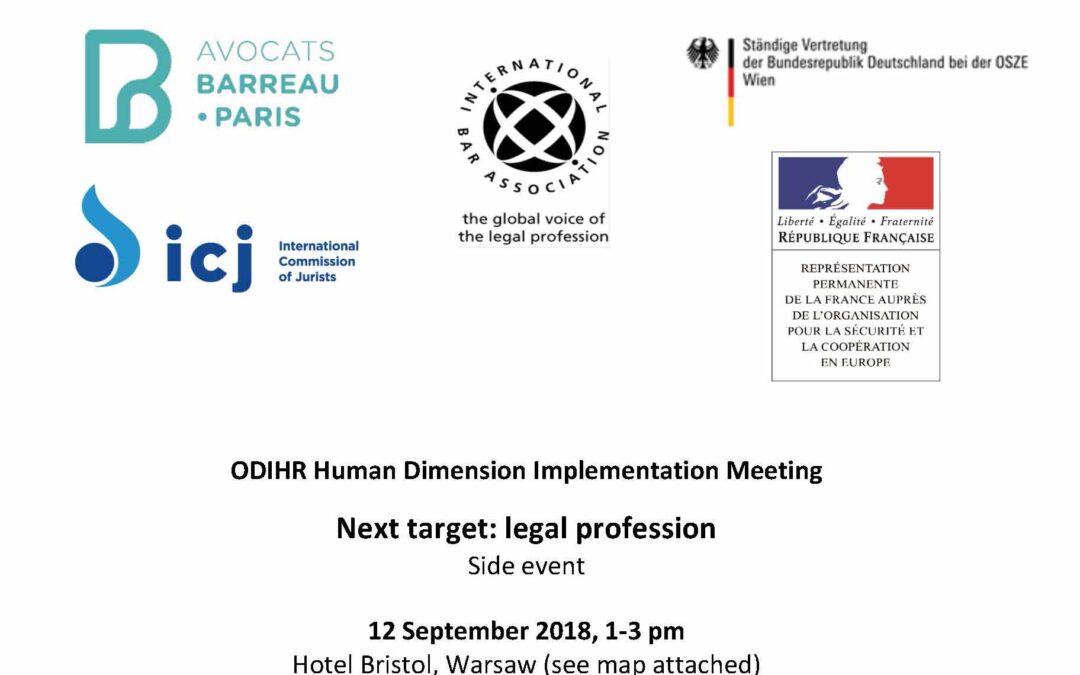
This side event will take place on 12 September 2018, from 13.00 -15.00 at Hotel Bristol, Warsaw
Moderator: Jurate Guzeviciute, Programme Lawyer, International Bar Association’s Human Rights Institute
Presentations and Discussions:
Independence of the legal profession and harassment of lawyers in Eastern Europe and Central Asia:
- Tajikistan: Dilrabo Samadova, lawyer, Tajikistan
- Azerbaijan: Nijat Mammadbayli, lawyer, Azerbaijan
- Kazakhstan: Snezhanna Kim, lawyer, Kazakhstan
- Russia: Róisín Pillay, Director of the Europe Regional Programme, International Commission of Jurists
- Belarus: Anne Souléliac, Head of the Human Rights section, Paris Bar Association
Organizers: Permanent Mission of the Federal Republic of Germany to the OSCE, Permanent Representation of France to the OSCE, International Bar Association’s Human Rights Institute, Paris Bar Association, International Commission of Jurists.
Poland-HDIM_Side event-News-event-2018-ENG (flyer of the event in PDF)

Sep 4, 2018 | News
The ICJ today condemned the public caning of two women, a punishment imposed upon them by the Terengganu High Court after conviction on charges of ‘attempting to have sexual intercourse’.
The ICJ called on the Government of Malaysia to immediately abolish the practice of caning as it constitutes a form of cruel, inhuman or degrading punishment prohibited under international human rights law and standards.
Furthermore, it also called on the Government to ensure that its laws, policies and practices at the local, state, and federal levels are in full compliance with its international legal obligations, including under the Convention on the Elimination of all forms of Discrimination against Women (CEDAW).
On 3 September 2018, two women, aged 23 and 33, were publicly caned in front of a hundred people in Terengganu, a coastal state of Malaysia, located northeast of Kuala Lumpur.
The two women were convicted under Section 30 of the Syariah Criminal Offences (Terengganu) Enactment 2001, for the crime of ‘Musahaqah’ (sexual relations between female persons).
“This punishment is a clear violation of Malaysia’s obligations to prevent, prohibit and prosecute all forms of torture and other cruel, inhuman or degrading treatment or punishment. The Government of Malaysia should immediately abolish the practice of corporal punishment, which has been condemned by international authorities such as the UN Human Rights Council’s Special Rapporteur on torture,” said Emerlynne Gil, ICJ’s Senior International Legal Adviser.
“It is equally deplorable that Malaysia continues to criminalize consensual same sex relations. The criminalization of private consensual sexual activities – whatever the sex, gender identity and sexual proclivities of those involved, and whatever the actual sexual practices – violates international human rights law. It also undermines women’s enjoyment of their rights to privacy, personal integrity, and equality,” she added.
The Human Rights Committee has said that criminalizing private sexual acts between consenting adults constitutes an arbitrary interference with privacy and cannot be justified.
It has also observed in a number of Concluding Observations that the criminalization of private consensual sexual activities between adults of the same sex violates the prohibition of discrimination, and the right of equality before the law.
The ICJ also notes that early this year, the CEDAW Committee recommended to Malaysia to “take effective measures to ensure that civil law and Syariah law are in full compliance with the provisions of the Convention at local, state, and federal levels” so as to guarantee the rights of all women throughout the country.
The ICJ calls on the Government of Malaysia to abide by its obligations under international law and follow through with its commitment to human rights, non-discrimination and equality by abolishing the sentence of caning and the criminalization of consensual same sex relations in the country.
Contact
Emerlynne Gil, ICJ Senior International Legal Adviser, t: +66 840923575, e: emerlynne.gil(a)icj.org
Background
On 8 April 2018, religious state authorities arrested the two women who were in a car and accused them of preparing to ‘commit sexual acts’, which is an offense in the State of Terengganu, under the Syariah Criminal Offences (Terengganu) Enactment 2001. The women pleaded guilty to the offence without being represented by a lawyer and did not appeal their case.
On 12 August 2018, the two women pleaded guilty and were sentenced by the Terengganu Shariah to a fine of RM3,300 ($800 USD) and six strokes of caning for attempting to have sexual intercourse.
This is the first case of caning of women for ‘Musahaqah’ (sexual relations between female persons) crime and its attempt in Malaysia and it marks a steady decline in Malaysia’s commitment to protect the rights of its sexual minorities and the members of the LGBTIQA community.
In Malaysia’s Criminal Procedure Code, under Federal law, it states that
“No sentence of whipping shall be executed by installments, and none of the following persons shall be punishable with whipping: (a) females;”
Malaysia’s Federal Constitution provides that Islamic law falls under the matters of State law, with the exception of the Federal States.
It is concerning that the Syariah legal system in Malaysia continues to carry out caning in a manner that is discriminatory against women, and women sexual minorities, as seen in the 2010 case, where three women were found guilty of ‘illicit sex’ by the Kuala Lumpur Syariah Court, as well as the continuing use of Syariah legal enactments to harass, intimidate and prosecute the transgender community in Malaysia.
Sep 2, 2018 | News
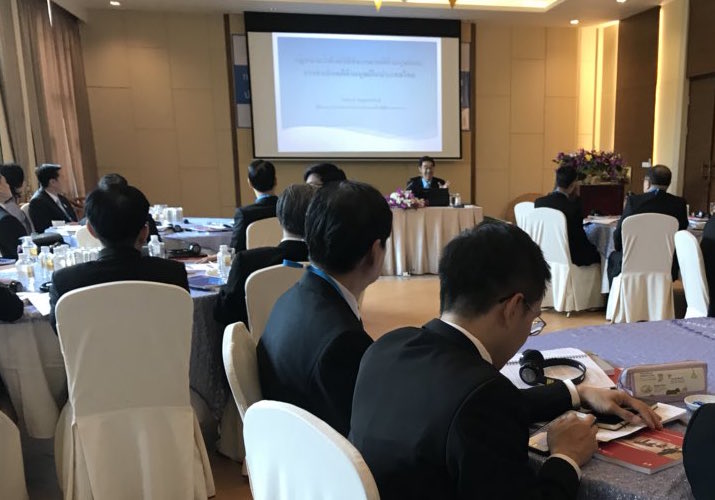
On 1 and 2 September, the ICJ held a “Workshop on the Independence of the Judiciary in the Context of the Inquisitorial Judicial System in Thailand” for members of the Thai judiciary in the north of the country.
Some 31 judges from 21 courts and the Administrative Office of the Court of Justice, Region V, attended the workshop, which was held in Chiang Mai.
The objective of the workshop was to discuss the role of judges and exercise of judicial power within the inquisitorial system, particularly in the context of adjudicating cases of human trafficking.
In an effort to combat human trafficking in Thailand, the Procedures for Human Trafficking Cases Act B.E. 2559 (2016) established inquisitorial system procedures for adjudication of cases of human trafficking.
With an increasing number of cases of human trafficking in Northern Thailand, judges in Northern Thailand are increasingly required to utilize inquisitorial processes in human trafficking cases.
Courts in Thailand generally adjudicate cases based on the adversarial judicial system.
In this context, the ICJ held the workshop in collaboration with the Administrative Office of the Court of Justice, Region V, in the North of Thailand, to share information and expand collaboration between Thai and international judges about inquisitorial processes.
Justice Aree Thecharuwichit, Chief Justice of the Office of the Chief Justice, Region V, Frederick Rawski, Regional Director of ICJ Asia and the Pacific, and Justice Radmila Dragicevic-Dicic, Vice-President of the ICJ, ICJ Commissioner, Acting President of the Belgrade Court of Appeals and Judge of the Supreme Court of Serbia delivered opening statements at the Workshop.
Justice Sittipong Tanyaponprach, Chief Judge of the Office of the Chief Justice, Region I, spoke about existing procedures in Thailand’s justice system to deal with human trafficking cases under the Procedures for Human Trafficking Cases Act 2016.
Justice Marcel Lemonde, Honorary President of Chamber in France’s Court of Appeal and an International Consultant in Judicial Matters, delivered an introduction to the inquisitorial system based on the French judicial system and spoke about existing challenges in inquisitorial processes.
Justice Radmila Dragicevic-Dicic, of the Supreme Court of Serbia and ICJ Vice-President spoke about judicial practice in cases involving human trafficking and shared her experience in adjudicating human trafficking cases in Serbia.
ICJ’s Senior Legal Adviser Kingsley Abbott moderated the workshop and provided an introduction to the ICJ’s resource materials on the independence of the judiciary and judicial accountability, including the ICJ’s Practitioners’ Guide No. 13 on Judicial Accountability.
The ICJ ended the Workshop with a statement reiterating its commitment towards working with Thailand’s judiciary to strengthen the rule of law and administration of justice in Thailand.
This Workshop is the second workshop held by the ICJ for Thailand’s judiciary in the North of Thailand.