Jul 27, 2018 | News
On 26 July 2018, the ICJ Secretary General, Sam Zarifi, met Myanmar’s Union Attorney General, U Tun Tun Oo.
The ICJ Legal Adviser Sean Bain and senior staff from the Union Attorney General’s Office (UAGO) joined the meeting in Nay Pyi Taw.
Rule of law developments in Myanmar were discussed, including progress integrating international standards into the work of the UAGO, such as the new “Code of Ethics for Law Officers”.
The participation of UAGO staff in the ICJ’s recent workshops on the Minnesota Protocol on the Investigation of Potentially Unlawful Deaths was another topic discussed.
Noting the UAGO’s stated reform commitments, Sam Zarifi renewed the ICJ’s call on Myanmar’s prosecution authorities to drop the charges against Wa Lone and Kyaw Soe Oo, two Reuters journalists, which do not appear to have a valid legal rationale.
Efforts to effectively prosecute the assassination of lawyer U Ko Ni were also discussed.
Sean Bain noted the UAGO’s efforts to draft an umbrella land law according to the government’s National Land Use Policy, and highlighted the importance of public participation and consultation in this process, to ensure compliance with Myanmar’s obligations under the International Covenant on Economic, Social and Cultural Rights.
The Attorney General thanked the ICJ for the organization’s ongoing honest advice and support for human rights.
The ICJ has worked with the UAGO since 2014 to provide assistance on prosecutorial independence and human rights in the context of Myanmar’s broader democratic reforms.
Jul 24, 2018 | Events, News
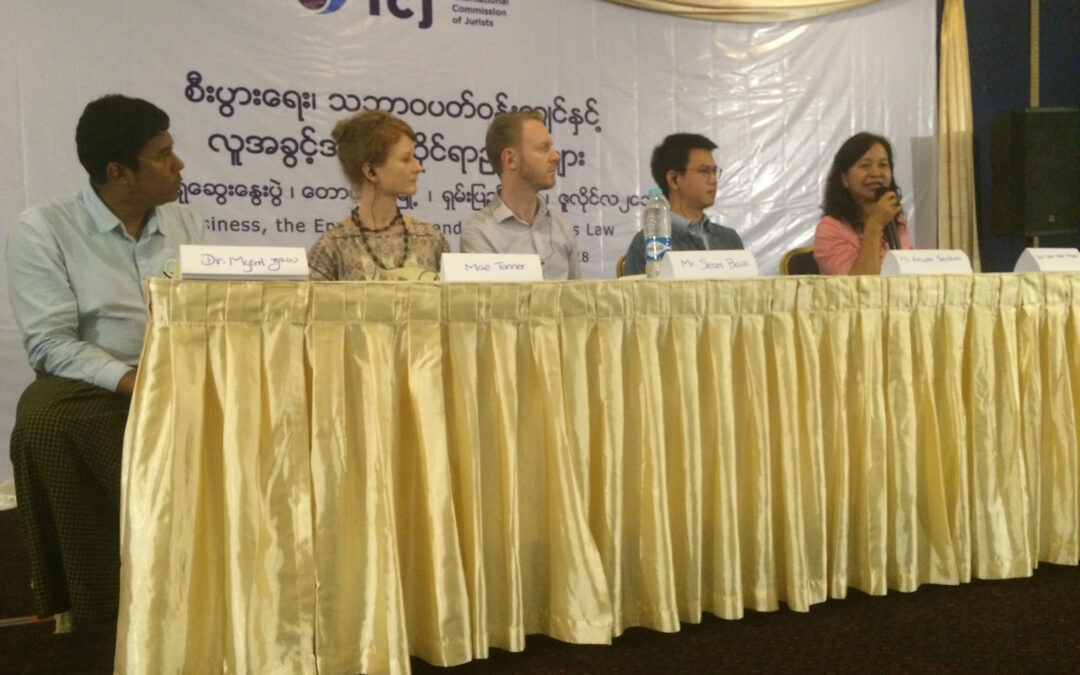
On 22 and 23 July the ICJ convened a workshop on Business, the Environment and Human Rights Law in Taunggyi, the capital of Myanmar’s Shan State.
This followed meetings between the ICJ’s legal advisers and the Shan State High Court and also with the State Advocate General on 13 July, to discuss rule of law developments.
The workshop aimed to identify ways to address the impacts of business activities on human rights and the environment, through legal advocacy including strategic litigation, and to provide a forum for cooperation and experience sharing among participants.
More than 50 lawyers, parliamentarians, human rights defenders and civil society representatives attended from Shan, Kayah and Mon states – provinces that together border Thailand, Laos and China.
An overview of the investment context was provided by Dr Myint Zaw of Paung Ku Myanmar, who also shared lessons from environmental activism in Myanmar.
As well as highlighting weaknesses in domestic law and policy, he presented concerns around lack of transparency and information sharing between the legislature and executive branches of government.
Australian lawyer and ICJ consultant Mae Tanner gave an overview of international human rights law and standards relevant to business activities and environmental protection, particularly emphasizing the obligations assumed by Myanmar in ratifying the International Covenant on Economic, Social and Cultural Rights.
She offered insights as to how UN mechanisms can be used by civil society to advance their advocacy on business and human rights in Myanmar.
Senior Advocate U Myint Thwin drew on his extensive litigation experience to share perspectives on the complex and confusing array of land laws in Myanmar and emphasized the importance of legal knowledge and training to combat corruption and achieve accountability.
The ICJ’s legal adviser Mr Sean Bain outlined the domestic laws relevant to investment and environmental protection in Myanmar and highlighted some key provisions that offer protection against human rights violations and abuses.
He noted the government’s stated aim of promoting the rule of law in Myanmar and emphasized the importance of demanding accountability, transparency and justice in this context.
Amarin Saichan, lawyer with Thai NGO EnLAW, shared experiences of pursuing strategic litigation to address unlawful and harmful business activities in Thailand, stressing the need for creativity in using the law to seek justice and accountability.
He also raised concerns around the use by government of strategic litigation against public participation in Thailand and explained how Thai lawyers are using the courts to guarantee the right protest against harmful development projects.
Participants had the opportunity to discuss how the strategies they shared could be used in the context of issues faced by their communities.
These included human rights and environmental concerns raised by energy and extractive projects, restrictions on shifting agriculture, and violations of the right to freedom of expression and assembly faced by communities who oppose state-backed developments.
They considered advocacy strategies for four case studies selected by participants from across Shan, Kayah and Mon states.
Throughout the workshop speakers and participants highlighted the importance of cooperation between civil society and lawyers, and the need to use Myanmar’s legal system more proactively as part of their broader advocacy strategies.
This workshop is part of the ICJ’s ongoing support to lawyers and civil society in Myanmar.
Jul 22, 2018 | News
The Supreme Court’s election of a person who is not suitable for the position of substitute judge on the Constitutional Court is deeply concerning for the sound administration of justice and the effective application of the rule of law, the ICJ said today.
Ramon Cadena, the Director of the Central American office of the ICJ added: “with this election, the SCJ has contributed to deepening the crisis in the judicial system and it will affect the little credibility that the Guatemalan people still retain in the justice system.”
The position of substitute judge on the Constitutional Court (CC) had become vacant when the former substitute judge was appointed Attorney General by the President, Jimmy Morales.
The eight judges of the SCJ who voted in favour of the substitute judge of the CC did not comply with international norms and standards on the administration of justice.
The Basic Principles on the Independence of the Judiciary state that “Persons selected for judicial office shall be individuals of integrity and ability with appropriate training or qualifications in law.”
The ICJ has been able to verify that the SCJ judges elected a person who:
- in 2010 was dismissed as Attorney General by the CC shortly after assuming office because the person was deemed not suitable;
- openly opposes the International Commission against Corruption and Impunity (ICCIG) despite the good work that the Commission undertakes to address corruption and impunity;
- in 2010, after assuming the office of Attorney General was accused of intervening in cases concerning corruption and impunity and impairing evidence in these cases.
The ICJ recalls that the CC stated that the acts carried out by Congress on 11 September 2017 were susceptible of causing “irreparable harm to the justice system”.
The ICJ considers that the election by the SCJ of the substitute judge to the CC should also be considered an act of irreparable harm to the justice system.
The ICJ therefore urges the CC to once again protect the rule of law in Guatemala.
Jul 11, 2018 | News
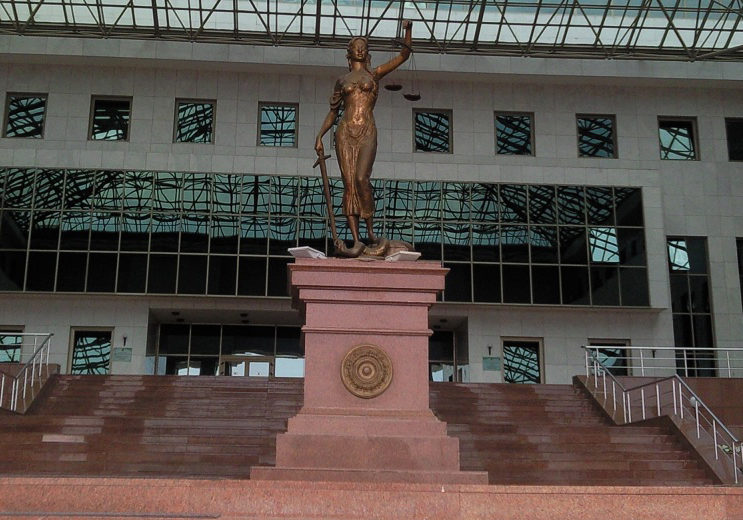
Today, the ICJ expressed concern at the adoption of a new law on lawyers in Kazakhstan.
The Law ‘On the Professional Activities of Advocates and Legal Assistance’, signed into law on 10 July 2018, contradicts international law and standards on the independence of the legal profession, by enabling the executive to influence or to have control over who is allowed to practice law and substantial influence on disciplinary proceedings against lawyers.
The law will have negative repercussions for protection of human rights and the rule of law in the Republic of Kazakhstan.
“Some of the key provisions of the adopted law undermine the independence of the legal profession, a cornerstone of the rule of law,” Temur Shakirov, ICJ Europe Program Senior Legal Adviser said today.
“Not only does the law weaken the legal profession, it sends an unfortunate message to the public that, as a result, their human rights, including their right to a fair trial, may be harder to uphold within the legal system,” he added.
More specifically, the ICJ is concerned that, under the new law, the role of the independent Bar Association in the composition of the disciplinary commissions is reduced.
Besides lawyers, the Disciplinary Commission will now include ‘representatives of the public’ designated by the Ministry of Justice. While the law does not specify how these members of the Disciplinary Commission would be selected, the selection is to be made by the Ministry of Justice.
The same procedure is not excluded to select members who are retired judges, which the Law requires also be part of disciplinary commissions.
While many of the specific procedures are unclear, it is apparent that these provisions would give the Ministry extensive influence over the Disciplinary Commission, especially as the law does not explicitly require these members perform their duties independently from the instructions of the Ministry of Justice.
The influence of the executive over the disciplinary proceedings of the Bar Association is contrary to the principles of independence of lawyers.
The UN Basic Principles on the Role of Lawyers provide that disciplinary proceedings against lawyers are to be brought before an impartial disciplinary committee established by the legal profession, before an independent statutory authority, or before a court, and shall be subject to an independent judicial review.
Furthermore, the law continues to give the Ministry of Justice control over admission to the practice of law.
It stipulates that prospective lawyers who have completed their professional training are to be assessed by the Commission for admission to practice established by territorial bodies of the Ministry of Justice.
The commissions consist of seven members, of which only three are members of the Bar Association. The composition of the commissions and the principles of their work are to be approved by the orders of the Minister of Justice of the Republic of Kazakhstan.
The Law therefore preserves the previous procedure on admission to the profession criticized by the ICJ earlier, according to which the attestation of applicants for obtaining the membership to the Bar Association and issuing a license were within the exclusive competence of the Ministry of Justice of the Republic of Kazakhstan.
At the same time, many defense rights listed in the Law are curtailed or compromised by the wording that would allow for enactment of restrictions by secondary legislation, including that the adopted Law would not allow lawyers to freely and without interference collect evidence in defense of their clients or that lawyer’s inquiries can be subject to limitation where they seek to obtain “restricted information”.
The ICJ notes that according to the UN Basic Principles on the Role of Lawyers, States must ensure lawyers have access to appropriate information, files and documents in their possession or control in sufficient time to enable lawyers to provide effective legal assistance to their clients. Such access should be provided at the earliest appropriate time (Principle 21).
Read the full text in English here
Read the full text in Russian here

Jun 22, 2018 | News
Conclusions of the Conference on Judicial Independence, Guatemala City, 18-19 June 2018
The ICJ is deeply concerned about the increase in the abuse of disciplinary measures against independent and impartial judges and about crimes committed against human rights defenders. These attacks are putting the rule of law at risk in Guatemala.
The ICJ therefore urges the Inter-American Commission on Human Rights, the Subcommittee on Human Rights of the European Parliament and the UN Special Rapporteur on the Independence of Judges and Lawyers to carry out visits to the country so as to verify the situation.
Judges facing malicious disciplinary proceedings
From 18-19 June 2018, the ICJ hosted a conference on the independence of judges with participants from different Central American judges’ associations.
The conference was able to verify that impartial and honourable judges face on-going disciplinary actions that seek to have then recused from trials or have them removed from office on account of their judicial decisions.
Judges are facing the malicious use of the judicial disciplinary system by groups or persons who disapprove of judicial rulings in high-impact cases.
The meeting was an opportunity for different justice sector institutions and judges, victims of attacks, to analyse fundamental concepts and international standards on the judiciary.
The conference concluded, the judicial career system must guarantee that a higher judicial authority can only sanction judges for legally established reasons as set down by international standards.
There was a full agenda of discussions with the participation of the Association of Guatemala Judges for Integrity (AGJI), the President of the Supreme Electoral Tribunal, the Supervisor General of Courts, judges from the Penal Chamber of the Supreme Court, the Commissioner of the International Commission against Impunity in Guatemala (CICIG) and the plenary of the Council of the Judicial Career.
The conference examined attacks against judges and their impact, case by case, in the light of international standards. The conference concluded that judges including Ericka Aifán, Yassmín Barrios, Miguel Ángel Gálvez, Carlos Ruano and Pablo Xitumul are facing disciplinary measures because they have acted independently and impartially.
The spurious complaints presented against them before the judicial disciplinary system or other State institutions should be excluded “in limine”.
Read the full Article in English (PDF): Guatemala-Conference-of-Judges-News-Web-stories-June-2018-ENG