Feb 27, 2020 | Events, News
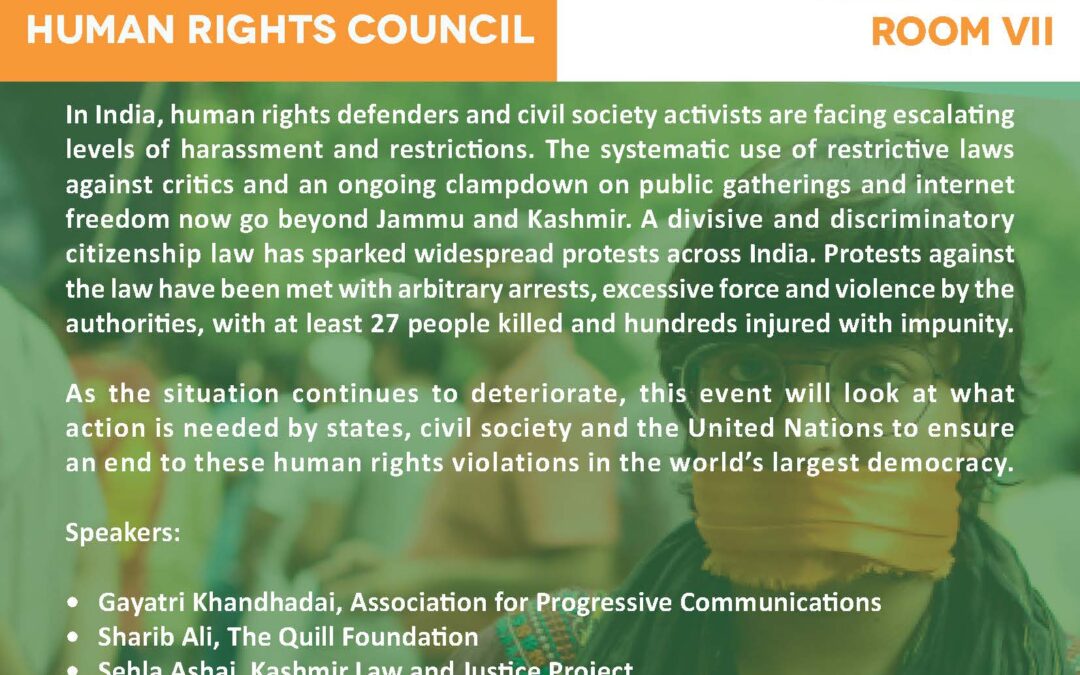
On 2 March, the ICJ and other NGOs will present discussion of the situation for human rights in India at a side event to the UN Human Rights Council in Geneva.
The event takes place Monday 2 March 2020, 14:00 – 15:00, in Room VII, Palais des Nations, Geneva.
In India, human rights defenders and civil society activists are facing escalating levels of harassment and restrictions. The systematic use of restrictive laws against critics and an ongoing clampdown on public gatherings and internet freedom now go beyond Jammu and Kashmir. A divisive and discriminatory citizenship law has sparked widespread protests across India. Protests against the law have been met with arbitrary arrests, excessive force and violence by the authorities, with at least 27 people killed and hundreds injured with impunity.
As the situation continues to deteriorate, this event will look at what action is needed by states, civil society and the United Nations to ensure an end to these human rights violations in the world’s largest democracy.
A flyer for the event can be downloaded here in PDF format: UN-Event-India-2019
Feb 27, 2020 | Events, News
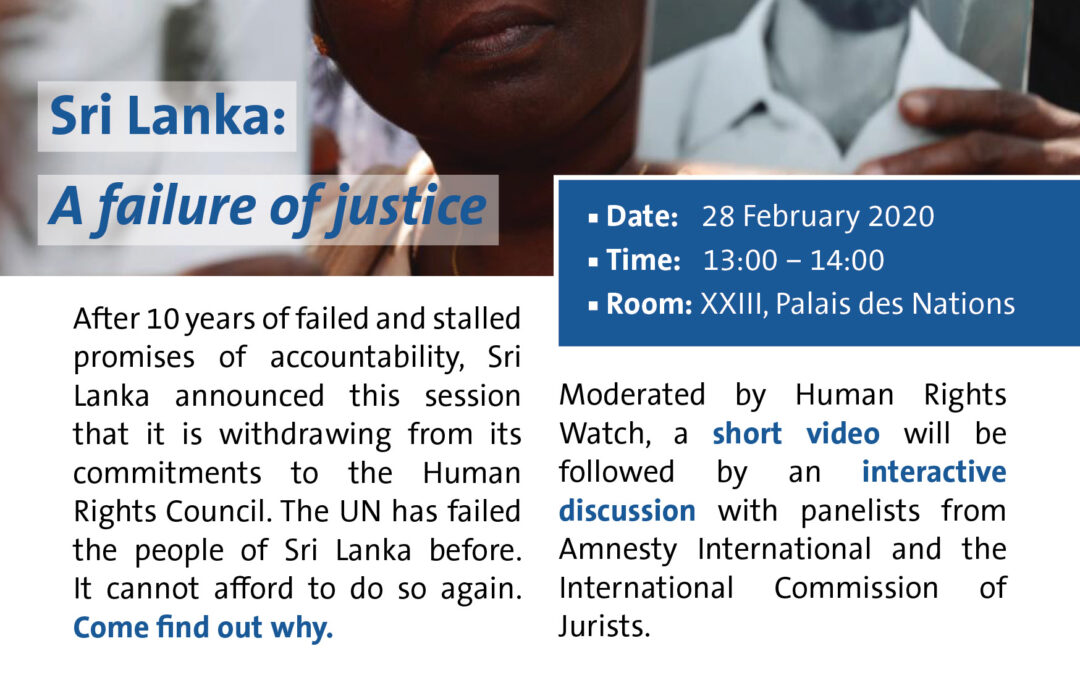
An event at the UN Human Rights Council on 28 February will highlight the continuing failure of Sri Lanka to secure justice for crimes under international law, and discuss ways forward for international efforts to fill the gap.
The event will take place 28 February 2020, 13:00 – 14:00, in Room XXIII of the Palais des Nations in Geneva.
It will be moderated by Human Rights Watch, with a short video will be followed by an interactive discussion with panelists from Amnesty International and the International Commission of Jurists.
A flyer for the event can be downloaded in PDF format here: HRC43 – Sri Lanka
Feb 27, 2020 | Advocacy, Non-legal submissions
The ICJ today urged law reforms to address discrimination against minorities in Myanmar, during an interactive dialogue with the UN High Commissioner on Human Rights on her report on Rohingya and other minorities in Myanmar, at the Human Rights Council in Geneva.
The statement read as follows:
“The ICJ welcomes the report of the High Commissioner,[1] delivered against the background of continuing ethnic armed conflict in Myanmar.
With over 50 years’ experience monitoring and documenting Myanmar’s human rights situation, the ICJ concurs with the High Commissioner’s conclusions and recommendations.
While the root causes of violations and abuses against the Rohingya and other persecuted minorities in Myanmar may be complex, as the Fact-Finding Mission already reported to the Council in September 2018, the steps required to address them are by now “well known”.[2]
One essential step is comprehensive legal and justice sector reform within the country.
In a briefing paper last year, the ICJ recommended three immediately achievable, concrete areas of law reform available to the Government: 1) legislative reform, including most urgently of the 1982 Citizenship Law; 2) Constitutional reform, to protect the right of citizens to full political participation; and 3) interim measures to address discrimination on the basis of race or ethnicity.
At the same time, it is imperative the international community continues to support the various international accountability efforts underway, including the work of the International Criminal Court and Independent Investigative Mechanism for Myanmar.
The ICJ would like to ask: what role do you see for States and civil society in relation to monitoring and implementation of your recommendations, particularly with respect to law and justice sector reform?”
[1] UN Doc A/HRC/43/18
[2] UN Doc A/HRC/39/64 (12 September 2018), para 102.
Feb 25, 2020 | Advocacy, Non-legal submissions
The ICJ today spoke at the UN Human Rights Council in Geneva, highlighting issues of access to justice for women in the context of religious and customary law.
The statement, delivered during a High Level Panel discussion commemorating the twenty-fifth anniversary of the Beijing Declaration and Platform for Action adopted at the Fourth World Conference on Women, read as follows:
“The International Commission of Jurists (ICJ) welcomes this opportunity to celebrate the progress made in the implementation of the Beijing Declaration and Platform for Action 25 years after its adoption and to address the remaining challenges to gender equality and women’s empowerment.
We have indeed seen an expansion in many countries of women’s legal entitlements and protection of their rights. However, there is also a growing trend to push these advances back and violate women’s human rights, invoking as justification religion, tradition, culture, and custom. This came out clearly when ICJ, UN Women and the OHCHR hosted a consultation for the UN Special Rapporteur on freedom of religion or belief last year, where women human rights defenders from all over Asia raised concerns about the resurgence of intersecting forms of discrimination by religion and culture based on patriarchal attitudes. They specifically narrated how women and girls were denied their sexual and reproductive rights.
Recalling the vision of the Beijing Declaration and Platform for Action, we reiterate the obligation of States not to invoke, “any custom, tradition or religious consideration”, to avoid their obligations to combat gender-based violence and discrimination against women. The Human Rights Committee also provides that “State parties should ensure that traditional, historical, religious or cultural attitudes are not used to justify violations of women’s right to equality before the law and to equal enjoyment of [ICCPR] rights[1].”
We therefore urge the Council to foster an open and inclusive discourse with Member States on the regressive interpretations of religious and customary laws that discriminate against women, and to acknowledge the voices and the diversity of women in that process. We urge States to ensure the full implementation of the human rights of women as an inalienable part of all fundamental freedoms.”
[1] Para 5, CCPR/C/21/Rev.1/Add.10
Feb 17, 2020 | Advocacy, Non-legal submissions
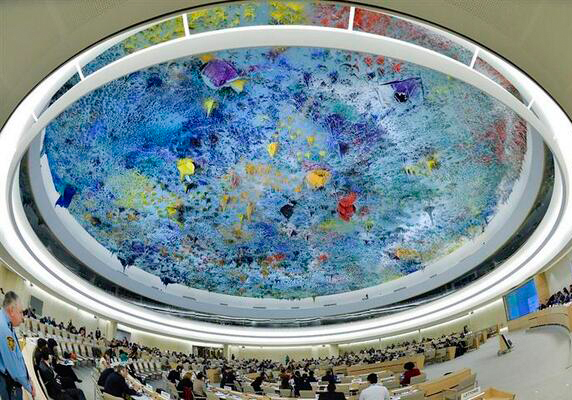
The ICJ has urged expert members of the UN Human Rights Council Advisory Committee to focus on the most direct and acute human rights issues, including a human-rights based approach to victims of terrorism, as the Committee prepares a report on “effects of terrorism on all human rights”.
In an oral statement to the Advisory Committee’s ongoing 24th session in Geneva, the ICJ expressed grave concern about the content of the latest draft of the report, and the potential negative consequences for human rights protection of the report in its current form, and urged the Advisory Committee:
- To substantially revise and refocus the report to include a clear recommendation to the Council that the exclusive focus of the Council’s work should remain on the most acute issues from a human rights perspective: violations in countering terrorism and a human-rights based approach to victims of terrorism, along the lines already established by successive holders of the Special Rapporteur mandate.
- To recommend against the Council entering into more diffuse macroeconomic issues such as diverting foreign direct investment, reducing capital inflows, destroying infrastructure, limiting foreign trade, disturbing financial markets, and negatively affecting certain economic sectors and impeding economic growth.
- To avoid making recommendations that simply repeat already-existing obligations or commitments to counter terrorism under various UN or other instruments.
- To affirm that the existing and longstanding normative and institutional framework on counter-terrorism and human rights is already sufficient to address relevant impacts of terrorism from a human rights perspective.
Prior to the session, the ICJ together with other NGOs had filed a written statement alerting the Advisory Committee to the highly sensitive context into which its report would be delivered at the Council, and urging the Committee to guard against its work being instrumentalized by Egypt and other States who seek to distort, distract and divert the limited resources and attention of the Council and its Special Rapporteur, away from the longstanding focus, achieved by years of Mexican leadership with consensus support of the Council, on human rights in countering terrorism, and the human rights of victims of terrorism.
The Advisory Committee’s report was requested by a 2017 resolution led by Egypt, which was not a matter of consensus, and is being drafted by a former Ambassador of Egypt who is now a member of the Committee.
Earlier at the session, several States including the EU, Switzerland, and Mexico had expressed concern or otherwise questioned particular aspects of the current draft of the report, and urged the Committee to substantially review and revise the draft. Egypt, China, Russia and several other States expressed satisfaction with the draft and urged the Committee to quickly finalize the report and send it to the Council.
The Advisory Committee report is due to be presented to and considered at the September 2020 session of the Human Rights Council, although some Committee members expressed the wish to finalize the report at the current Committee session.