Mar 6, 2020 | Advocacy, Non-legal submissions
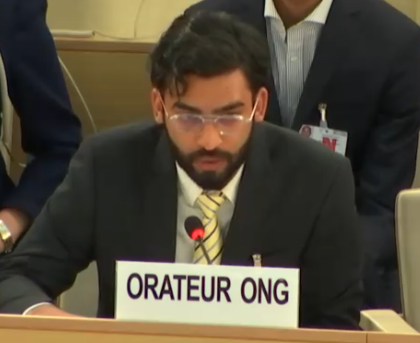
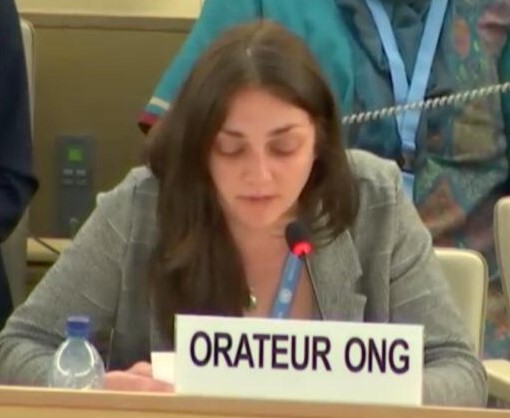
The ICJ, speaking in a general debate at the UN Human Rights Council in Geneva, urged all States to work together towards adoption of a treaty on business and human rights, and highlighted threats to the independence of the judiciary in Europe.
The statement, delivered in the general thematic debate at the Council, read as follows:
“The International Commission of Jurists (ICJ) welcomes the report of the 5th session of the Intergovernmental Working Group (A/HRC/43/55) in charge of the elaboration of a treaty on business and human rights and notes the consensual nature of its conclusions and recommendations. Abuses of human rights and environmental degradation caused with the involvement of business enterprises have so far been met with very limited action by businesses and States.
The ICJ considers that the revised draft treaty is a serious and advanced proposal that is suitable for negotiations and thanks the Chair-Rapporteur for its efforts and leadership in this process.
The ICJ urges States that are not yet actively involved in the negotiations to join the growing number of States that are active for a final push.
The ICJ also draws the attention of the Council to serious threats to independence of judges and lawyers in European countries.
In Poland, judges are being disciplined merely for applying EU law, under legislation curtailing their freedom of expression and independence.
In Turkey, independence of lawyers and judges continues to be seriously compromised, as demonstrated by the disciplinary proceedings against the Gezi trial judges launched after critical comments by the President of Turkey.
The ICJ urges the Council to give attention to these developments of extreme concern.”
Mar 6, 2020 | Advocacy, Non-legal submissions
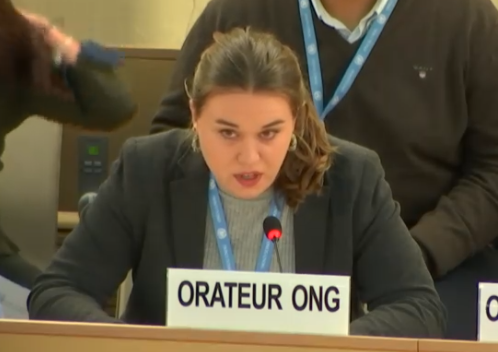
Speaking at the UN Human Rights Council, the ICJ today urged States to decriminalize consensual sexual relations, including between people of the same sex.
The statement, delivered during an interactive dialogue with the UN Special Rapporteur on the Right to Privacy, read as follows:
“The ICJ welcomes the report of the Special Rapporteur on privacy, particularly the recommendation to repeal laws criminalizing consensual sexual activity, cluding between people of the same sex.
The ICJ agrees that criminalization of consensual same-sex relations violates international law and standards, including the rights to privacy, non-discrimination and equal protection.
The ICJ advocates for the abolition of laws that criminalize consensual sexual relations – including between people of the same sex – that still exist in many countries around the world.
In Indonesia, for example, a draft Penal Code currently includes a provision that would criminalize “extramarital” sexual acts between consenting persons, including persons of the same sex. We note that the draft provision may superficially appear to be gender neutral because it would penalize both men and women, but studies have shown that, in practice, criminalization of “adultery” and extramarital sexual relations typically results in disparate, discriminatory impacts against women and girls. Malaysia and other States that are former British colonies in Asia, likewise, have similar provisions in their criminal laws penalizing consensual sexual relations.
Like the Special Rapporteur, the ICJ in urges States to repeal laws that criminalize consensual sexual activity – including between people of the same sex.”
Mar 5, 2020 | Advocacy, Non-legal submissions
The ICJ today expressed concern at violations of human rights perpetrated in the name of countering violent extremism, and at attempts by some States at the Human Rights Council to dilute its focus on human rights while countering terrorism and the human rights of victims of terrorism.
The statement, delivered during an interactive dialogue with the UN Special Rapporteur on the promotion and protection of human rights and fundamental freedoms while countering terrorism, read as follows:
“The International Commission of Jurists (ICJ) welcomes your report on “Human rights impact of policies and practices aimed at preventing and countering violent extremism” (A/HRC/43/46).
The ICJ shares concern at the growing range of measures that restrict human rights, adopted in the name of the opaque and contested concepts of countering or preventing violent extremism. At the Council, certain States push for agreed language on suppression of terrorism to be cut-and-pasted to apply to “violent extremism”, and then eventually to all “extremism” whether violent or not, without definitions. As your report documents, at the national level this translates into overbroad, unjustified, arbitrary, and discriminatory measures, with particular impacts on civil society, especially human rights defenders, and from a gender perspective.
We also share the view expressed at para 51 of your report, that the current draft report of the Human Rights Council Advisory Committee on “the negative effects of terrorism on the enjoyment of human rights”, remains fundamentally flawed. Any discussion of “effects of terrorism” at the Council should exclusively focus on a human-rights based approach to victims of terrorism, consolidating work already undertaken by successive Special Rapporteurs and other UN and regional entities, as collected in a compilation published recently by the ICJ.[1] The Council must not allow its attention and limited resources to be diverted away from the human rights of victims of terrorism and protecting human rights while countering terrorism, to more diffuse questions of a macro-economic or budgetary character or duplicating work of other bodies.”
[1] See https://www.icj.org/victimsofterrorism2019/ and https://www.icj.org/icj-highlights-rights-of-victims-of-terrorism-to-un-delegations/
Feb 28, 2020 | Advocacy, Non-legal submissions
At the UN Human Rights Council, the ICJ today urged renewed international action to ensure justice and accountability for crimes under international law in Sri Lanka.
The statement, delivered during a discussion of updates and reports from the High Commissioner for Human Rights, read as follows:
“The ICJ deeply regrets the Sri Lankan Government’s withdrawal of support for the process under resolutions 30/1 and 40/1. ICJ supports the joint statement read by IMADR.
The Sri Lankan legal system and judicial institutions have for decades demonstrated a chronic inability to address systemic and entrenched impunity for crimes under international law perpetrated by the military and security forces.[1] The new President’s promises to protect the military from accountability, and senior command appointments of individuals credibly accused of crimes under international law, only deepen the concern.
As the High Commissioner notes,[2] the failure to deal comprehensively with impunity and to reform institutions may lead to more human rights violations.
The Tamil population have consistently and rightly rejected any reconciliation process that ignores justice and accountability, and it is obvious that no justice or accountability process that is left to domestic Sri Lankan institutions alone can be credible. The compromise national-international “hybrid” judicial accountability mechanism foreseen by resolution 30/1 already fell far short of what the situation actually warrants.
If the Government seeks now to abandon even that compromise, purely international processes, whether before the ICC or through creation of another international accountability mechanism by the Council, and the exercise of universal jurisdiction by other States, are the only remaining options for securing the justice required by international law and indispensable to any credible reconciliation process for Sri Lanka.”
[1] International Commission of Jurists, Authority without Accountability: The Crisis of Impunity in Sri Lanka, 2012, https://www.icj.org/sri-lanka-new-icj-report-documents-crisis-of-impunity/; Human Rights Council must respond to ongoing failure of Sri Lankan justice system to ensure accountability for human rights violations, 2014, https://www.icj.org/human-rights-council-must-respond-to-ongoing-failure-of-sri-lankan-justice-system-to-ensure-accountability-for-human-rights-violations/; Sri Lanka: the need for an international inquiry, 2014, https://www.icj.org/sri-lanka-the-need-for-an-international-inquiry/; Sri Lanka: Joint Open Letter to the Ambassadors of UN Human Rights Council Member States, 2015, https://www.icj.org/wp-content/uploads/2015/07/SriLanka-JointOpenLetter-Accountability-Advocacy-2015.pdf; Sri Lanka’s victims demand and deserve credible justice, 2016, https://www.icj.org/sri-lankas-victims-demand-and-deserve-credible-justice/.
[2] UN Doc A/HRC/43/19, para 36.
Feb 27, 2020 | Events, News
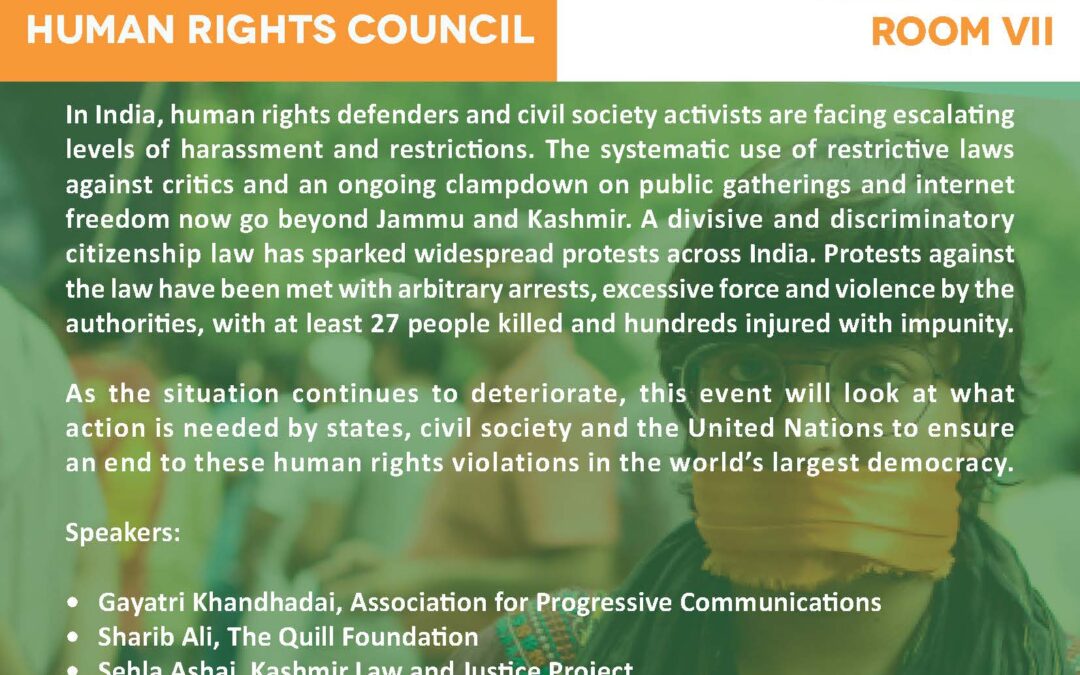
On 2 March, the ICJ and other NGOs will present discussion of the situation for human rights in India at a side event to the UN Human Rights Council in Geneva.
The event takes place Monday 2 March 2020, 14:00 – 15:00, in Room VII, Palais des Nations, Geneva.
In India, human rights defenders and civil society activists are facing escalating levels of harassment and restrictions. The systematic use of restrictive laws against critics and an ongoing clampdown on public gatherings and internet freedom now go beyond Jammu and Kashmir. A divisive and discriminatory citizenship law has sparked widespread protests across India. Protests against the law have been met with arbitrary arrests, excessive force and violence by the authorities, with at least 27 people killed and hundreds injured with impunity.
As the situation continues to deteriorate, this event will look at what action is needed by states, civil society and the United Nations to ensure an end to these human rights violations in the world’s largest democracy.
A flyer for the event can be downloaded here in PDF format: UN-Event-India-2019