Mar 1, 2018 | Advocacy, Non-legal submissions
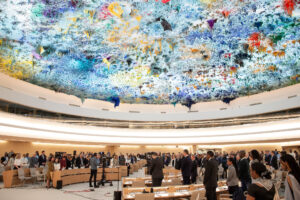
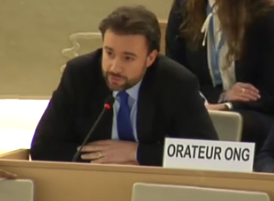
The ICJ today delivered an oral statement to the UN Human Rights Council, on attacks on lawyers and the legal profession in Turkey, Azerbaijan, Kazakhstan and China.
The statement, which was made during an interactive dialogue with the UN Special Rapporteur on human rights defenders and the UN Special Rapporteur on Torture, read as follows:
Our organizations welcome that the main report (A/HRC/37/51, para 13) and communications report (A/HRC/37/51/Add.1, e.g. paras 278-297, 431, 508-510) of the Special Rapporteur on Human Rights Defenders recognizes the role of lawyers as human rights defenders. In this regard, we would highlight the global problem of continued attacks on lawyers and threats to the independence of their profession, including for example as is well known in China (A/HRC/37/51/Add.1, paras 278-297), but also in Azerbaijan, Kazakhstan and Turkey.
In Azerbaijan, lawyers face criminal prosecution, suspension or disbarment for statements clearly constituting protected freedom of expression. The lack of independence of the Bar Association is a serious concern, even more so now that new legislation prohibits lawyers from representing clients before courts unless they become a member.
In Kazakhstan, a proposed new law threatens the independence of lawyers by providing for representatives of the executive to be included on disciplinary bodies of the legal profession, contrary to international standards.
Finally, the situation of lawyers in Turkey under the current state of emergency is of particular concern. In particular, echoing the recent statement of five UN special procedures mandate holders for his release, we expresses concern at the current detention of Taner Kılıç, lawyer and president of Amnesty International Turkey.
These arrests, trial and disbarments as well problematic legislative changes have a chilling effect on the work of lawyers. They undermine access to effective and independent legal assistance to protect human rights, in contravention of the rights of both the lawyers and their clients, including as mentioned in the report of the visit to Turkey by the Special Rapporteur on Torture (A/HRC/37/50/Add.1, paras 24, 26, 41, 63-66, 71, 101(d)(e)(h), 106(c)).
Our organizations urge the Council to address these worrying developments threatening the rule of law.
The following organizations joined the statement, in addition to the ICJ:
- International Bar Association’s Human Rights Institute (IBAHRI)
- Union Internationale des Avocats (UIA)
- Lawyers for Lawyers (L4L)
- the Law Society of England and Wales
- Lawyer’s Rights Watch Canada (LRWC), and
- the Bar Human Rights Committee of England and Wales (BHRC).
The statement can be downloaded in PDF format here: UN-HRC37-JointOralStatement-LawyersHRDsTorture-2018
Feb 27, 2018 | Advocacy, News, Non-legal submissions
The head of the ICJ’s Centre for the Independence of Judges and Lawyers, Matt Pollard, highlighted the role of judges, lawyers and prosecutors in preventing human rights abuses, at a UN expert workshop in Geneva.The Office of the UN High Commissioner for Human Rights (OHCHR) organised the expert workshop, 21 to 22 February 2018, to discuss the role and contribution of civil society organizations, academia, national human rights institutions and other relevant stakeholders in the prevention of human rights abuses, drawing on the conclusions and recommendations of OHCHR’s study on the prevention of human rights violations.
The workshop, mandated by the Human Rights Council resolution 33/6, covered topics such as: a framework approach to prevention; human rights education; abuses by private actors, national and regional practices, planning and monitoring tools; human rights impact assessments; and the role of UN institutions.
The presentation on the role of judges and lawyers can be downloaded in PDF format here: UN-ExpertMeeting-JudgesLawyersPrevention-2018
More information about the expert workshop is available by clicking here.
Feb 27, 2018 | Events, News
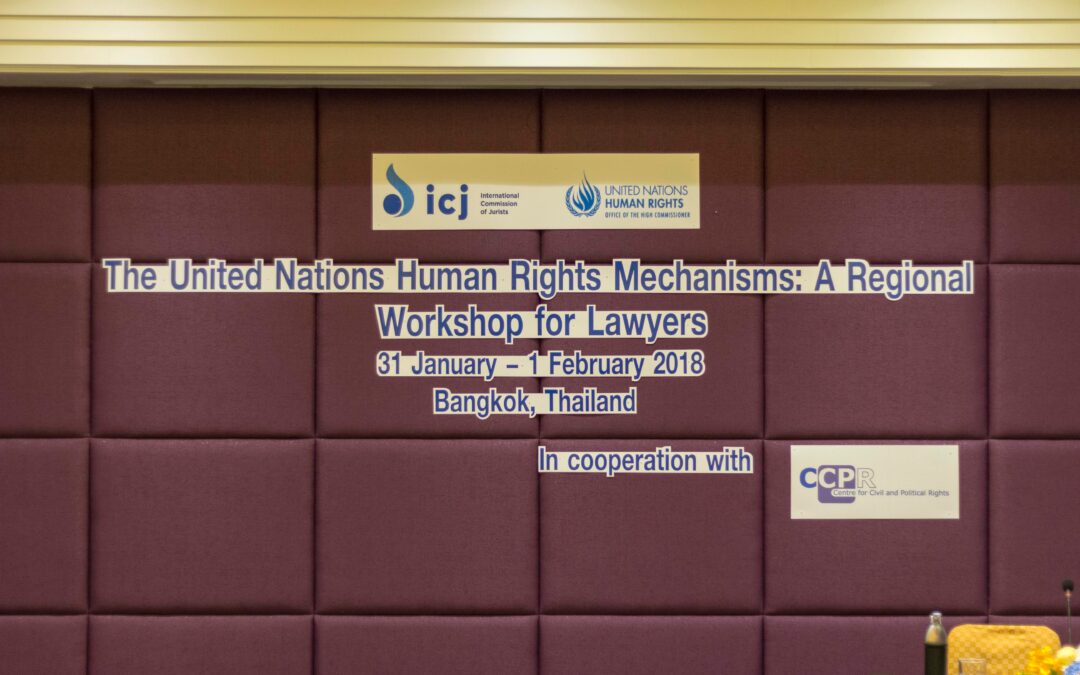
The ICJ, in collaboration with the UN High Commissioner for Human Rights Regional Office for South-East Asia (OHCHR), and the Centre for Civil and Political Rights, organised a workshop for lawyers from southeast Asia, on engaging with UN human rights mechanisms.
The two-day workshop provided some thirty lawyers from Thailand, Cambodia, Vietnam, and Lao PDR with knowledge, practical skills and expert advice about UN human rights mechanisms, with the participants themselves sharing their own experiences and expertise.
In addition to explaining what the UN mechanisms are and how they work, the workshop discussed how lawyers can use the outputs of UN human rights mechanisms in their professional activities, as well as how to communicate with and participate in UN human rights mechanisms in order to ensure good cooperation and to best serve the interests of their clients.
Sessions were introduced by presentations by the ICJ’s Main Representative to the United Nations in Geneva and OHCHR officials, followed by discussions and practical exercises in which all participants were encouraged to contribute questions and their own observations.
A special discussion of effective engagement of lawyers with Treaty Bodies was led by Professor Yuval Shany, a member of the Human Rights Committee established to interpret and apply the International Covenant on Civil and Political Rights (ICCPR).
The workshop also aimed to encourage the building of relationships and networks between the lawyers from across the region.
The workshop forms part of a broader project of awareness-raising and capacity-building for lawyers from the region, about UN mechanisms.
A similar workshop was held in January 2017 for lawyers from Myanmar.
The project has also published (unofficial) translations of key UN publications into relevant languages, and is hosting lawyers in a mentorship programme in Geneva.
More details are available by contacting UN Representative Matt Pollard (matt.pollard(a)icj.org) or by clicking here: https://www.icj.org/accesstojusticeunmechanisms/

Feb 26, 2018 | Events
On 28 February 2018, the ICJ is holding a workshop on combatting sexual and gender-based violence (SGBV) in Swaziland, in cooperation with Women and Law in Southern African – Swaziland (WLSA Swaziland) and the Swaziland Action Group Against Abuse (SWAGAA).
The workshop, held as part of the ICJ’s Global Redress and Accountability Initiative, will consider the prevalence of SGBV in Swaziland, and contributing factors, and will focus on the extent to which perpetrators of such violence are, and can be, held accountable in law and in practice and the means by which victims of SGBV may better access effective remedies and reparation.
Participants will also discuss opportunities for engagement with UN mechanisms on addressing SGBV in the Kingdom of Swaziland.
The workshop is set against the backdrop of urgent recommendations adopted by the UN Human Rights Committee in 2017 on the combatting of violence against women, in respect of which Swaziland must report to the Committee by July 2018.
It comes ahead of Swaziland’s anticipated report, also due in July 2018, to the UN Committee on the Elimination of All Forms of Discrimination Against Women which in 2014 also adopted several recommendations on the combatting of violence against women.
The workshop also comes as national debates continue on the enactment of the Sexual Offences and Domestic Violence Bill, which Swaziland had committed to enact without delay at its 2016 Universal Periodic Review.
Workshop Agenda
Feb 14, 2018 | Advocacy, Non-legal submissions
The ICJ has set out key principles and sources on judicial councils and other national mechanisms for selecting, appointing, promoting, transferring, suspending or removing judges, in a submission to the UN Special Rapporteur on the independence of judges and lawyers.The submission was made in response to a call by the Special Rapporteur for input to a report he will present at the June 2018 session of the Human Rights Council.
The ICJ submission highlights that judicial councils are a proven means of safeguarding judicial independence and ensuring judicial accountability. It recommends that, even in countries where judicial independence and accountability have traditionally been secured by other means, consideration should be given to the establishment of a judicial council.
The submission stresses that judicial councils must be fully independent of the executive and legislative branches of government, and notes several key safeguards to help secure such independence.
The ICJ recommends that such judicial councils should in principle be responsible for all decisions relating to the selection, appointment, promotion, transfer, discipline, suspension and removal of judges.
The submission also highlights the need for diversity of membership of such councils to ensure its representativeness of the society the judiciary is to serve, that it reflects a cross-section of the judiciary as a whole, and that it has the experience and expertise needed to be effective.
The full submission can be downloaded in PDF format here: Global-UN-SRIJL-JudicialCouncils-2018
Most of the sources cited in the submission are available here.
Related and more detailed guidance is available in the ICJ’s 2016 Practitioners’ Guide no. 13 on Judicial Accountability, as well as the 2007 Practitioners’ Guide no. 1 on Independence and Accountability of Judges, Lawyers and Prosecutors.
More information about the Special Rapporteur is available here.
For more information about the ICJ and judicial councils and similar mechanisms, contact Matt Pollard (matt.pollard(at)icj.org)