Apr 7, 2021 | News
Victims of gross human rights violations must be provided with effective reparations and guarantees of non-recurrence by Tunisia’s Specialized Criminal Chambers (SCC), judges and prosecutors asserted during a workshop held by the ICJ and the Association of Tunisian Magistrates (AMT) on 3 and 4 April.
The workshop highlighted the need for the SCC to adopt restitution, compensation, rehabilitation and satisfaction measures to achieve to the fullest extent possible reparation for material and moral damage suffered by victims of gross human rights violations in Tunisia.
Participants further emphasized that SCC decisions should include recommendations on guarantees of non-recurrence, including on legal and institutional reforms.
The workshop was attended by more than 25 Tunisian judges and prosecutors attached to the 13 Specialized Criminal Chambers. Discussions involved also international experts and ICJ representatives.
“It is important that the SCC, consistent with international standards, adopt a comprehensive notion of victims and persons entitled to reparation,” said Philippe Texier, ICJ Commissioner.
“In this respect, reparative measures should focus not only on direct victims, but also indirect victims, including the immediate family or dependants of the direct victim and persons who have suffered harm in intervening to assist victims,” he added.
Federico Andreu-Guzmán, international expert, noted the non-derogable nature of the right to reparation under international law and that SCC should seek to ensure that all their decisions comply with this right.
“SCC decisions should include wide-reaching recommendations in order to guarantee that the violations will not be repeated,” said Said Benarbia, Director of ICJ’s Middle East and North Africa Programme.
The workshop also offered the opportunity to participants to discuss a set of recommendations targeting the High Judicial Council and its role in supporting the SCC.
The recommendations, which were developed by a group of SCC judges and prosecutors following the ICJ’s roundtable of 13-14 March, aim to find joint approaches to address ongoing procedural obstacles before the SCC and will be subject of future meetings and roundtable discussions organized by the ICJ and the AMT.
Contact
Valentina Cadelo, Legal Adviser, ICJ Middle East and North Africa Programme, e: valentina.cadelo(a)icj.org
Asser Khattab, Research and Communications’ Officer, ICJ Middle East and North Africa Programme, e: asser.khattab(a)icj.org

Sep 8, 2020 | Feature articles, News
Judges from six Latin American countries revealed that there were serious obstacles, but also possibilities for justice, facing regional judiciaries as they try to protect the human rights of those who have been adversely affected by the activity of business entities.
The judges gathered as part of the Regional Judicial Dialogue on Business and Human Rights organized by the ICJ of Jurists on September 7.
The Dialogue, moderated by ICJ Commissioner Professor Monica Pinto, brought together 17 judges from Central and South America to consider the role of judges in guaranteeing the right of access to justice and remedy and reparation. The judges also considered the need to guarantee the independence of the judiciary and the security of individual judges, lawyers, and human rights defenders in the context of business activities in the region.
The session featured presentations from a member of the UN Working Group on Business and Human Rights and the Office of the UN High Commissioner for Human Rights. The Dialogue took place in the context of the 5th Regional Forum on Business and Human Rights for Latin America and the Caribbean.
Discussing access to justice and remedy and reparation, the judges shared experiences and jurisprudence in cases related to serious crimes, including against humanity committed during the Argentine military regime, as well as cases of serious corruption and embezzlement in Guatemala.
In Argentina, in a case concerning the 1976 kidnapping and torture of 24 workers employed by the local Ford Motor company at their factory in Buenos Aires during the 1976-83 military dictatorship, a Federal Trial Tribunal sentenced three persons, a former military officer and two former Ford executives to prison of between 10 and 12 years, for their complicit involvement in the crimes.
Former Ford executives were accused of providing detailed information and logistical support to security agents that led to the abduction and torture of the victims, and also allowed a detention centre to be set up inside the premises of that factory.
The three judges of the Tribunal in this case attended the meeting to share the lessons learned and the significance of the criminal proceedings in the context of efforts to bring justice and reparations for the crimes of the past.
The process and the final sentence is a landmark in the fight against impunity in Argentina and an important message to all so that these crimes are not committed again. The case clarified the ways in which private individuals (the former company executives) participated in the commission of the crimes by State agents (military and security agents), elaborating upon modalities of attribution of the acts to the accessory perpetrators.
It is also an innovation in the ways it gathered and assessed the probatory value of the available evidence of crimes committed more than 30 years ago so that the crimes could still be attributed to the perpetrators.
The reparation ordered by the Tribunal in this case was “symbolic and historical”, consisting on an acknowledgment of the facts by the State and the private actors. The victims may demand now other forms of reparation from the State, but not from individuals.
The company as such was not part of the criminal proceedings nor was it sanctioned in the final sentence, since Argentinian law does not accept the criminal responsibility of legal entities such as corporations.
A participant judge from Guatemala shared a case concerning economic crimes of corruption, fraud, illicit association and assets laundering in a provincial town in Guatemala. Here, the experience and outcomes were somewhat different.
The case involved the town major and several of his relatives as well as some 20 companies out of which nearly 20 individuals and seven companies received penalties in the final sentence.
The case is of special significance in Guatemala as one of the few, large scale, corruption cases that has reached its final stage with convictions. In the investigation and collection of evidence considered during the trial, participated several public offices and the then International Commission Against Impunity in Guatemala (CICIG), which is no longer in operation.
Thanks to recent laws on corruption and money laundering, it is possible to impose sanctions on the company, as a legal entity. In the instant case, those sanctions consisted of monetary fines but not suspension or dissolution of the legal entity to allow other administrative proceedings against the same companies to continue.
In accordance with national laws and international standards, the judges ordered full reparation, including for damages, measures of satisfaction such as public statements of apologies and publications to be made by the convicted.
Citing a graphic statement contained in the final sentence, the judge Pablo Xitumul who presided the Tribunal said “corruption and impunity are even more lethal than a cancer or a pandemic, and should be combated without delay or excuses!”
Read the full story here: Americas-Judges and BHR-News-Feature article-2020-ENG
Oct 1, 2019 | News
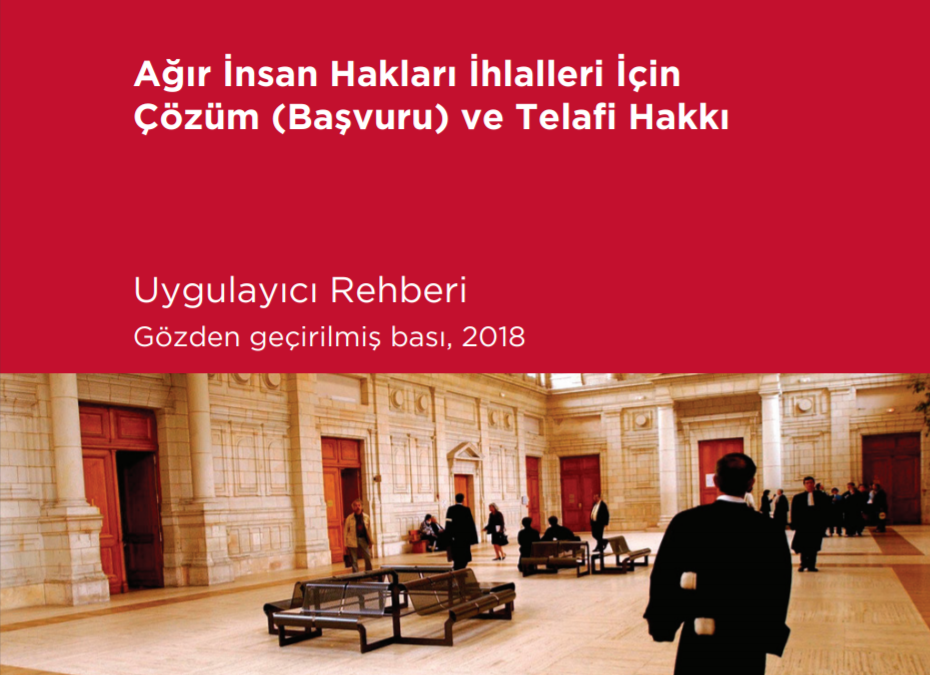
Today, the ICJ published a Turkish translation of Practitioners’ Guide N°2 on the Right to a Remedy and Reparation for Gross Human Rights Violations.
The translation has been funded by the European Instrument for Democracy and Human Rights (EIDHR).
Under its Global Redress and Accountability Initiative, the ICJ had launched its 2018 update to Practitioners’ Guide No 2, outlining the international legal principles governing the right to a remedy and reparation for victims of gross human rights violations and abuses by compiling international jurisprudence on the issues of reparations.
The Guide is aimed at practitioners who may find it useful to have international sources at hand for their legal, advocacy, social or other work.
Amongst revisions to the Guide, the 2018 update includes new sections on terminology and on non-discrimination;updated sections on the notions of ‘collective victims’, ‘collective rights’, the rights of ‘groups of individuals’; additional references to the work of the Committeeon the Elimination of Discrimination against Women and the Committee on the Rights of the Child; an updated section on remedies for unlawful detention, including references to the 2015 UN Basic Principles and Guidelines on Habeas Corpus; and updates on gender-based violence and on violations occurring in the context of business activities.
The Guide first recalls the States’ general duty to respect, protect, ensure and promote human rights, particularly the general duty of the State and the general consequences flowing from gross human rights violations (Chapter 1).
It then defines who is entitled to reparation: victims are, of course, the first beneficiaries of reparations, but other persons also have a right to reparation under certain circumstances (Chapter 2).
The Guide goes on to address the right to an effective remedy, the right to a prompt, thorough, independent and impartial investigation and the right to truth (Chapters 3-4).
It then addresses the consequences of gross human rights violations, i.e. the duty of the State to cease the violation if it is ongoing and to guarantee that no further violations will be committed (Chapter 6). It continues by describing the different aspects of the right to reparation, i.e. the right to restitution, compensation, rehabilitation and satisfaction (Chapter 7).
While the duty to prosecute and punish perpetrators of human rights violations is not necessarily part of the reparation as such, it is so closely linked to the victim’s right to redress and justice that it must be addressed in this Guide (Chapter 8).
Frequent factors of impunity, such as trials in military tribunals, amnesties or comparable measures and statutes of limitations for crimes under international law are also discussed (Chapter 9).
The guide in Turkish is available here.
This document has been produced with the financial assistance of the European Union. The contents of this document are the sole responsibility of the ICJ and can under no circumstances be regarded as reflecting the position of the European Union.

Jul 29, 2019 | News
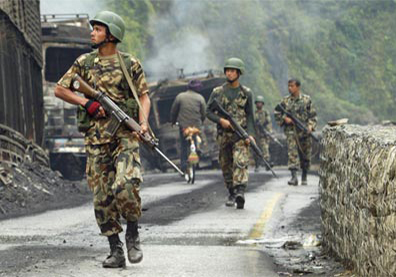
The Government of Nepal has failed to fulfill its commitment to provide justice for the victims of the country’s decade-long armed conflict, the ICJ, Amnesty International, Human Rights Watch, and TRIAL International said today.
The organizations echoed statements by victims and human rights groups about the Nepal government’s inaction on addressing conflict-era human rights violations, and a lack of transparency in the appointment of commissioners to the Truth and Reconciliation Commission and to the Commission on the Investigation of Enforced Disappearances.
“The lack of progress in holding perpetrators accountable for the suffering inflicted upon victims, their families and Nepali society as a whole, is appalling,” said ICJ Asia-Pacific Director Frederick Rawski.
“Nearly 13 years after the signing of the Comprehensive Peace Agreement, political leaders inside and outside of government are still playing games by politicizing the process. It is about time that they showed some courage, and took action to ensure access to justice, instead of continually looking after their own short-term self-interests,” he added.
“We have seen no evidence so far that the authorities of Nepal are serious about fulfilling their obligation to investigate conflict-era violations and bring all those suspected of criminal responsibility to justice in fair trials before ordinary civilian courts,” said Raju Chapagai, South Asia researcher at Amnesty International. “If the commitment to human rights obligations was as unflinching as claimed by Prime Minister KP Sharma Oli, the government would have acted diligently to deliver on its transitional justice responsibilities.”
After being elected in 2018, Prime Minister Khadga Prasad Oli renewed promises that the legal framework governing the transitional justice process would be brought into conformity with Nepal’s international human rights law obligations, as the Supreme Court had repeatedly directed. However, the government never amended the law, and instead pushed forward – without adequate consultation – with the establishment of a committee to recommend appointments to the transitional justice bodies.
“The failure of the government to deliver on its commitment to ensure truth, justice and reparations for the victims of conflict-era abuses shows a dismaying disregard for the protection of human rights,” said Meenakshi Ganguly, South Asia Director at Human Rights Watch.
The organizations called on the government to: 1) suspend the current process, and initiate a consultative and transparent process for the nomination and appointment of commissioners; 2) follow through on commitments to amend the 2014 transitional justice law to ensure that the legal framework is consistent with international human rights standards and Supreme Court rulings; and 3) adopt and publicize a plan for taking the transitional justice process forward.
“The legitimacy of Nepal’s transitional justice process lies both on a transparent and consultative appointment process for commissioners, and a strong legal foundation to allow the commissions to fulfil their mandate,” said Helena Rodríguez-Bronchú, Head of TRIAL International’s Nepal program. “Societal consensus is crucial for both factors.”
Amnesty International, ICJ and TRIAL International had previously submitted their analysis of the draft transitional justice legislation circulated in 2018 and had made recommendations on ensuring compliance with international human rights law. Human Rights Watch had also alerted for reform of the transitional justice law before appointing the commissioners. In April 2019, United Nations experts also wrote a joint letter to the foreign minister reminding the government of its commitment to amend the law and calling for a transparent process for appointing new commissioners after the terms of the previous commissioners expired.
Contact
Frederick Rawski, ICJ Asia-Pacific Director, t: +66 644781121 ; e: frederick.rawski(a)icj.org,
Nepal-trans just-News-Press releases-2019-NEP (story in Nepali, PDF)
May 25, 2018 | News
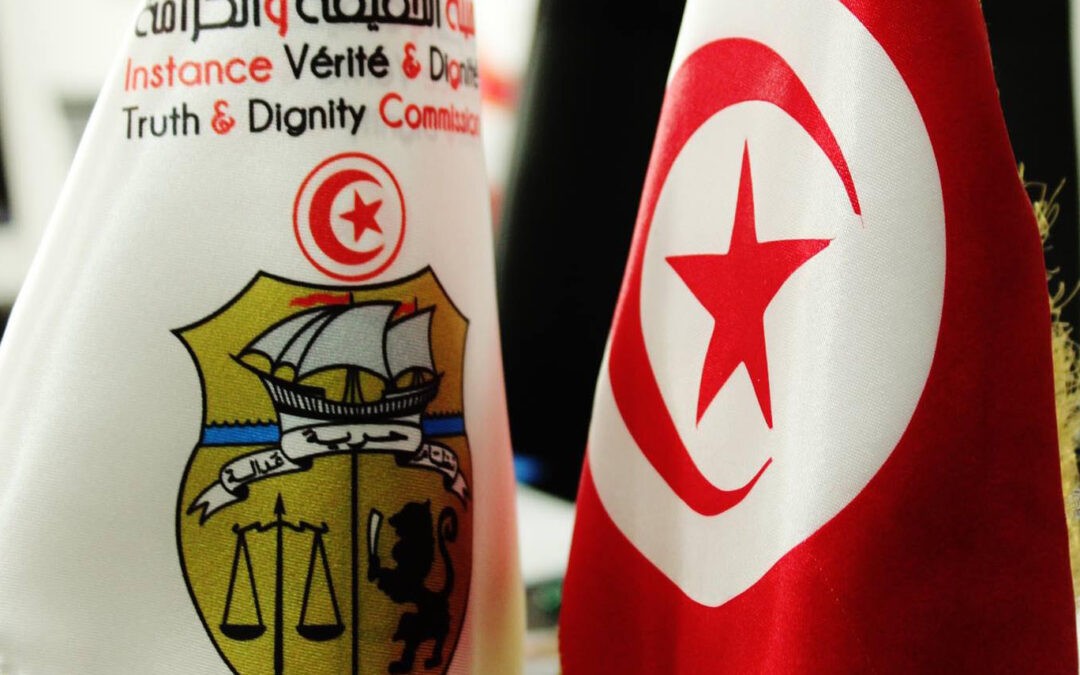
The ICJ today called on the Tunisian Parliament to reverse its decision of 26 March 2018 and allow the Truth and Dignity Commission (IVD) to carry out its mandate for at least another year.
The IVD should be in the position to finalize its investigations of past serious human rights violations in the country and, when appropriate, refer cases to the Specialized Criminal Chambers (SCC), the ICJ added.
Since its decision, the Parliament has not considered or adopted any measures to address the legal and practical consequences, including how incomplete investigations by the IVD will be handled, how other investigations will be transferred to the SCC and by whom, how evidence will be preserved and protected, how the documents and the material gathered by the IVD will properly be archived, and what would happen if the IVD were unable to complete the drafting of the final report.
The initial four-year term of the IVD ends on 31 May 2018.
“It’s absolutely irresponsible for the Tunisian Parliament to thwart the whole transitional justice process and curtail the work of the IVD without providing any path forward,” said Said Benarbia, ICJ MENA Director.
“As one of the three branches of government, the Parliament must abide by Tunisia’s obligations under international law to establish the truth about past human rights violations, bring the perpetrators to account, and provide victims with effective remedies and reparation,” he added.
The March decision runs counter to all these obligations.
It denies the rights of victims, and broader society, to know the truth, including about the circumstances and reasons that led to decades of serious human rights violations in the country.
The IVD has not been able to finalize its investigations or produce its final report.
It also shields those responsible from criminal accountability. Only eight cases have so far been referred by the IVD to the SCC.
The fate of cases that have been investigated but are not referred before 31 May 2018 remains unclear. The IVD reportedly received some 62’712 complaints.
“The Parliament is abdicating its responsibility to respect and protect victims’ rights,” Benarbia said.
“Instead of playing cynical political games that can only foster impunity, the Parliament should reverse its decision and remove all the obstacles that might impede the IVD’s work in ensuring accountability for past abuses, ” he added.
Contact
Said Benarbia, Director of the ICJ Middle East and North Africa Programme, t: +41798783546, e: said.benarbia(a)icj.org
Background
Under the 2013 law on transitional justice, the IVD initially had a four-year term, with the possibility of renewal for a single additional year, on the basis of a reasoned decision by the IVD.
The 2013 law provided that the IVD’s decision on renewal should be submitted to the Parliament.
The law is however silent as to whether the submission of the IVD decision was simply a matter of notification, or required approval of Parliament to be effective.
In any event, 68 members of the Parliament voted on 26 March against extending the term of the IVD for another year.
Under its bylaws, for decisions of Parliament to be valid they must be adopted by at least 72 of its members.
The apparent lack of quorum for the Parliament’s 26 March decision has only introduced more uncertainty and confusion, further complicating the position for the IVD and others, including most notably the victims themselves.
On 24 May 2018, the IVD and the Minister in charge of relations with constitutional bodies, civil society and human rights issued a joint statement reiterating Tunisia’s commitments to the transitional justice process as provided by the Constitution.
In the statement, the IVD was requested to transfer all cases concerning serious human rights violations to the SCC, to establish criteria on the basis of which reparation for victims will be provided, to establish compensation criteria for the Victims Fund, and to send the final report to the President of the Republic, the President of the Parliament and the President of the Government.
Tunisia-IVD Parliament-News-2018-ARA (full story in Arabic, PDF)