Nov 28, 2019 | Cases, News
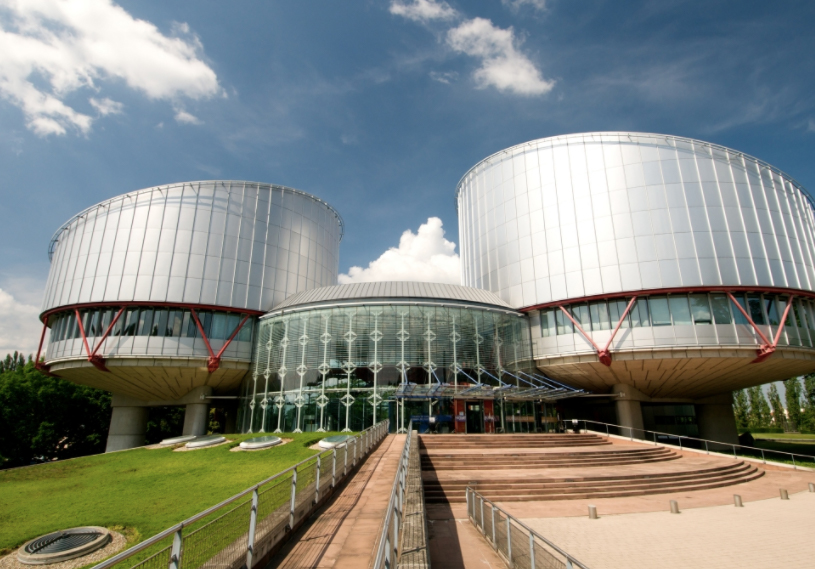
The ICJ and Amnesty International have submitted a joint third party intervention before the European Court of Human Rights in the case of Judge Jan Grzęda.
Judge Grzęda’s mandate as a member of the Polish National Council of the Judiciary (NCJ) was prematurely terminated by legislation that entered into force in 2018. Under this law, the mandates of the judicial members of the NCJ appointed under previous legislation were automatically brought to an end once new members were appointed.
Judge Grzęda applied to the European Court of Human Rights alleging that he had been denied access to a tribunal to challenge the termination of his mandate and had been denied an effective remedy for the violations of his rights.
In their third party intervention, the ICJ and Amnesty International analyze international standards on judicial independence and self-governance, including as regards the role national councils for the judiciary, and the consequences of these standards for the right of access to court under Article 6.1 ECHR. The intervention also analyses the role of the NCJ in safeguarding judicial independence in Poland, and recent legislative and policy developments that have seriously undermined the independence of the Polish judiciary.
Read the full intervention text here.

Nov 28, 2019 | Events, News
Today, the ICJ, together with the Constitutional Chamber of the Supreme Court of Kyrgyzstan, OHCHR and UNODC are holding a meeting of judges from Central Asia to discuss international law and standards in the field of extradition, expulsion, the rule of law and human rights.
The workshop aims to facilitate exchange of experiences regarding the law and practice of extradition and expulsion in European and Central Asian countries. Presentations at the workshop will analyse international law and standards on effective criminal justice co-operation and the protection of human rights in extradition and expulsion, and their application in practice.
The workshop will present cases from national courts as well as from international mechanisms such as the European Court of Human Rights, the UN Committee against Torture and the UN Human Rights Committee.
The workshop is taking place in Bishkek (Kyrgyzstan) and is hosted by the Constitutional Chamber of the Supreme Court of Kyrgyzstan.
Judges from Kazakhstan and Uzbekistan are participating in the event that includes international experts from UNODC, ICJ, and Italian Judge Elena Masetti Zannini.
See the agenda of the day in English and in Russian.
Nov 27, 2019 | News
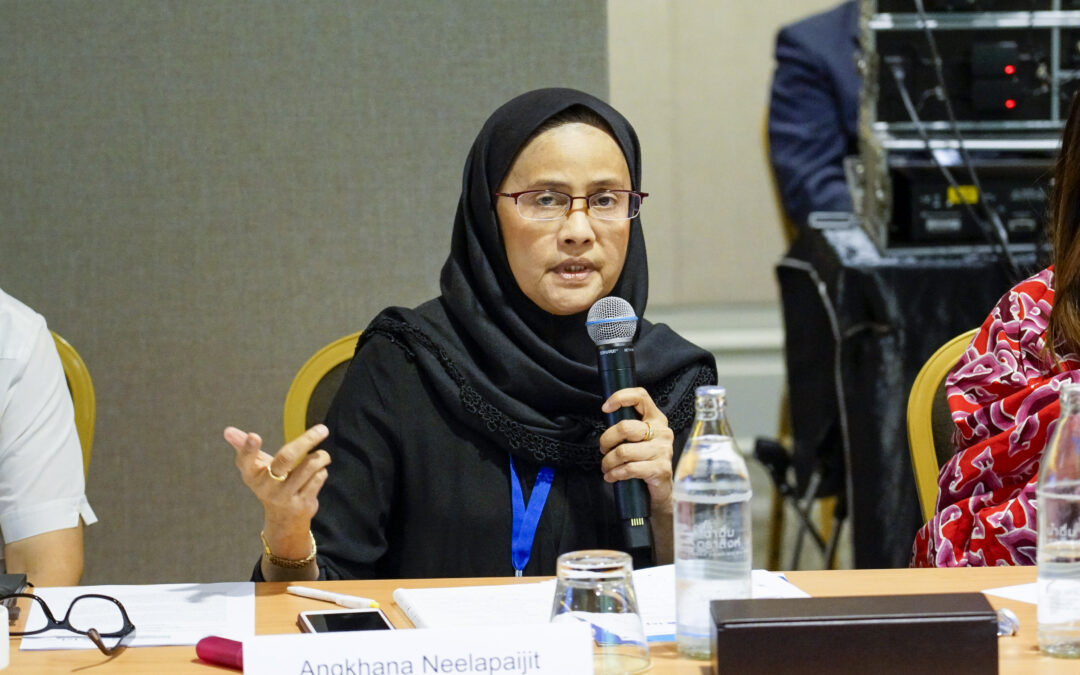
Today, the ICJ condemned Thammakaset Co., Ltd’s use of the criminal defamation provisions of the Thai Criminal Code to harass former National Human Rights Commissioner Angkhana Neelapaijit.
“This action by Thammakaset is a textbook case of how defamation laws are used in Thailand to silence human rights defenders. It is clearly without any legitimate basis, and intended to harass and intimidate Khun Angkhana, who is a leading champion of human rights in Thailand and the region,” said Frederick Rawski, ICJ Asia Pacific Regional Director. “We hope that the Courts will dismiss this frivolous case at first opportunity.”
On 25 October 2019, Thammakaset Co. Ltd., a poultry farm in Lopburi Province, filed a criminal defamation suit under sections 326 and 328 of the Criminal Code against Angkhana Neelapaijit for two posts she shared that contained links to press statements of 16 organizations, including the ICJ, and Fortify Rights.
The statements cited in the warrant as the basis for the action were a post on 3 December 2018 in which Angkhana Neelapaijit re-tweeted an ICJ link to a joint statement co-signed by 16 organizations, including the ICJ. The statement contained a link to a short film in which former employees spoke out about alleged labor abuses; and a post on 28 June 2019 which included a link to a Fortify Rights’ news release containing the same link. The film refers to a previous defamation complaint brought by Thammakaset against 14 of its former workers, and called upon the authorities to drop criminal defamation charges against them and decriminalize defamation in Thailand. Thammakaset claimed that the film was defamatory.
Criminal defamation, under sections 326 of the Criminal Code, carries a maximum sentence of one year of imprisonment, a fine of up to 20,000 Baht (approx. USD 640) or both. Section 328 criminalizes defamation “by means of publication” with up to two years’ imprisonment and a fine of up to 200,000 Baht (approx. USD 6,400).
Thailand is party to the International Covenant on Civil and Political Rights (ICCPR), which guarantees the right to freedom of expression. The UN Human Rights Committee, the supervisory body that provides the authoritative interpretation of the ICCPR, has called on States that criminalize defamation to abolish criminal defamation laws and reserve defamation for civil liability.
“The criminal defamation provisions in the Criminal Code have been repeatedly invoked for nefarious ends, such to target persons seeking to bring public attention to human rights violations, including by business enterprises. They need to be removed from the Criminal Code as a matter of urgency,” said Rawski. “The imposition of criminal penalties for speech, even allegedly defamatory speech, is disproportionate and risks having a ‘chilling effect’ on the exercise of freedom of expression.”
Further reading
Thailand: Drop defamation complaints against human rights defenders Nan Win and Sutharee Wannasiri
Thailand: ICJ and LRWC submit amicus in criminal defamation proceedings against human rights defenders Nan Win and Sutharee Wannasiri
Contact
Frederick Rawski, ICJ Asia-Pacific Director, t: +66 64 478 1121; e: frederick.rawski(a)icj.org
***
Download the press-release with additional information in English and Thai. (PDF)

Nov 26, 2019 | News
Three exceptional women – Huda Al-Sarari, Norma Ledezma and Sizani Ngubane – are the finalists for the 2020 Martin Ennals Award, a demonstration of the leading position now occupied by women in the defence of human rights. The ICJ is member of the MEA Jury.
In Yemen, Huda Al-Sarari has exposed and challenged the existence of secret prisons and many cases of torture.
In Mexico, Norma Ledezma is fighting against femicides and disappearances.
In South Africa, Sizani Ngubane is fighting for access for women to education and to land.
Three women nominated: a first
Each year, the Martin Ennals Award rewards human rights defenders from around the world who distinguish themselves by their strong commitment to promoting human rights – often at the risk of their own lives.
In 2020, for the first time the Jury nominated three women who defend the fundamental rights of their communities in sensitive contexts.
“The Martin Ennals Foundation is proud to recognize the courageous work of three women. For the 2020 edition, our Jury’s choice reflects the ever-greater global impetus of individuals – whatever their gender – who are committed to respect for human rights and women’s rights in particular,” said Isabel de Sola, Director of the Martin Ennals Foundation.
“The finalists for the 2020 Martin Ennals Award work on different continents, but all three have in common their resilience, determination, a tremendous rigour and, finally, the positive and concrete impact of their work,” added Hans Thoolen, Chairman of the Jury.
In Yemen, where the conflict has been ongoing since 2005, Huda Al-Sarari, a Yemeni lawyer, unveiled the existence of several secret detention centres where the worst violations of human rights were committed: torture, disappearances or even extrajudicial executions.
In South Africa, women face discrimination, the worst expression of which is widespread gender violence. In rural communities, they frequently have their land expropriated and are deprived of access to education and justice. Sizani Ngubane founded an organization of more than 50,000 women from rural areas in her country and has fought successfully for over 40 years for the recognition of their rights.
In Mexico, the civil population is paying a high price for the weakness of the rule of law which is underpins widespread violence and impunity. Women are the primary victims, with more than 3,500 femicides committed each year. Norma Ledezma, who is the mother of one of the victims, puts all her energy into supporting families seeking access to justice in the state of Chihuahua.
The finalists were selected by a jury made up of representatives of ten of the world’s leading human rights organizations: the ICJ, Amnesty International, Human Rights Watch, Human Rights First, International Federation for Human Rights, World Organisation Against Torture, Front Line Defenders, EWDE Germany, International Service for Human Rights and HURIDOCS.
The 2020 Martin Ennals Award will be given to one of the three finalists on 19 February 2020 at a livestreamed public ceremony. The event is hosted by the City of Geneva which, as part of its commitment to human rights, is a longstanding supporter of the Award.
Contact
Olivier van Bogaert, Director Media & Communications, ICJ representative in the MEA Jury, t: +41 22 979 38 08 ; e: olivier.vanbogaert(a)icj.org
Chloé Bitton, Communications Manager, Martin Ennals Foundation, t +41 22 809 49 25 e: cbitton(a)martinennalsaward.org
Universal-MEA2020bios-News-2019-ENG (full bios of finalists, in PDF)
Universal-MEA2020bios-News-2019-ARA (full story and bios of finalists in Arabic, PDF)
Nov 25, 2019 | News
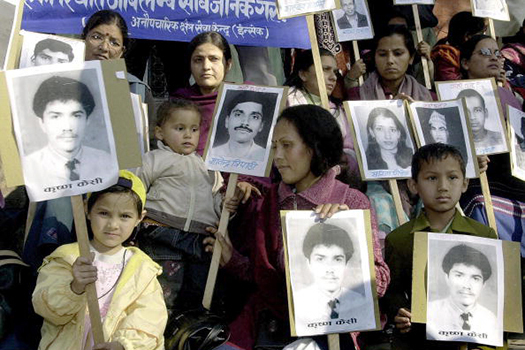
Nepal has made no real progress on questions of justice, truth and reparations for victims of gross human rights violations and abuses during its 10-year conflict, the ICJ, Amnesty International, Human Rights Watch (HRW) and TRIAL International said today.
The Comprehensive Peace Agreement to end the war was signed on November 21, 2006.
While two commissions have been set up to address conflict-era atrocities, they have not been effective and impunity and denial of access to justice to victims remain prevalent. The four human rights organizations are particularly concerned about the recent moves that suggest that the government will go forward with the appointing of commissioners without making necessary reforms to the legal framework.
“Last week marked the 13th anniversary of the Comprehensive Peace Agreement that ended the conflict in Nepal. It is astonishing that so little progress has been made in responding to the clearly articulated concerns and demands of conflict victims,” said Frederick Rawski, ICJ’s Asia-Pacific Director. “These demands have included a transparent and consultative process for the appointment of commissioners, and a genuine good-faith effort by political leaders and lawmakers to address serious weaknesses in the existing legal framework.”
On November 18, a five-member committee formed by the government to recommend names for commissioners to be appointed to the Truth and Reconciliation Commission and the Commission on the Investigation of Enforced Disappearances published a list of candidates. Concerns have been raised by victims and civil society that the government will simply re-appoint past commissioners or make political appointments that will not be adequately impartial and independent.
“It is deeply disappointing that the government has repeatedly attempted to appoint the commissioners without adequate consultation and transparency . The commissions will not gain the trust of the victims and the international community if the political parties continue to interfere in the appointment process,” said Biraj Patnaik, South Asia Director at Amnesty International.
Importantly, the move suggests that the commissions will be re-constituted without amending the legal framework governing the transitional justice process and ensuring its compliance with Nepal’s international human rights law obligations, as directed by Nepal’s Supreme Court and demanded by civil society and victims.
Victims and civil society organizations have issued public statement making it clear that they oppose any appointments prior to the amendment of the legal framework. Notably, the National Human Rights Commission, in its statement commemorating 13th Anniversary of CPA, stated that “…the commission will not support any decision, work or activities that might hurt the sensitivity of the conflict victims…”.
“The government’s move has not only undermined victims’ role in the transitional justice process, but has also once again brought into question its commitment to uphold its international law obligations and ensuring justice for conflict-era crimes,” said Tomás Ananía, TRIAL International’s Nepal Program Manager.
The ICJ, Amnesty International, Human Rights Watch and TRIAL International have repeatedly expressed concern that effective transitional justice mechanisms require strong legal foundations consistent with international law and good practices, and the political will to address the concerns of victims of the conflict. All four organisations reiterated their calls to amend the the 2014 Transitional Justice Act to make it consistent with the Supreme Court’s rulings and international human rights standards, as well as for the initiation of a genuine consultative and transparent process for the appointment of commissioners.
Concerns raised about the existing, and proposed, legal frameworks include: disparities between the definitions of specific crimes under international law and human rights obligations and violations under national, and international law; inadequate provisions to ensure that serious crimes under international law are subject to criminal accountability (including punishment proportionate to the seriousness of the crimes); and a reliance on compensation at the expense of other forms of reparation and remedy for conflict survivors and their families.
Under the principle of universal jurisdiction states may make it possible for their domestic criminal justice system to investigate and prosecute crimes such as torture, committed by any person, anywhere in the world.
This means that a citizen of any country, including Nepal, suspected of such crimes faces the risk of arrest and prosecution for these crimes in countries that apply universal jurisdiction. This is more likely if the Nepali authorities do not appear able and willing to prosecute those responsible for such crimes, the organizations said.
“After initial pledges to ensure truth, justice, and reparations for conflict victims, it appears that the government is once again determined to protect those responsible for the crimes,” said Meenakshi Ganguly, South Asia director at Human Rights Watch. “The international community should remind Nepal that whitewashing egregious crimes will not help to dodge universal jurisdiction.”
Contact:
Download the complete press-release in English and Nepali. (PDF)