Nov 7, 2013 | News
FIDH, ILGA-Europe, ICJ, AIRE-Centre and HLHR welcome this important decision. The organizations had submitted written comments about the case to the Court in June 2011.
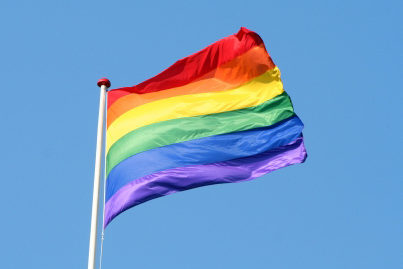
In a judgment in the joint cases of Vallianatos and Mylonas v. Greece and C.S. and others v. Greece delivered today, the Grand Chamber of the European Court of Human Rights ruled that Greece had violated the European Convention on Human Rights by excluding same-sex couples from a “civil union”, restricted in Greece to heterosexual couples.
“All Member States of the Council of Europe must condemn any form of discrimination against homosexuals. Homosexual couples, as heterosexual couples, involved in a stable relationship, should benefit from a legal recognition”, said Karim Lahidji, FIDH President. He added: “Twenty-two of the Member States of the Council of Europe have created a legal form of recognition for same-sex couples. Greece must change its law to comply with the European Convention on Human Rights”.
Evelyne Paradis, Executive Director of ILGA-Europe, said: “The European Court of Human Rights reaffirmed already established principle that sexual orientation discrimination is in breach of the European Convention. Now the Court took yet another step to say that if a country provides legal recognition to unmarried heterosexual couples in a form of civil unions, same-sex couples also must be able to benefit from such legal recognition. European consensus on the legal recognition of same-sex partnership is constantly growing and we welcome the fact the Court is taking it into account and reflect in its jurisprudence.”
Livio Zilli, Senior Legal Adviser at the International Commission of Jurists, said: “The Court reiterated that the Convention was a living instrument to be interpreted in the present-day conditions and that the state was obliged under the Convention to take account of societal developments, as well as the fact that there is no single way or choice when it came to people’s exercise and enjoyment of their right to family or private life.”
In its decision, the Court ruled that Greece had failed to provide a convincing justification for excluding same-sex couples.
The Government’s argument, according to which the law’s main purpose was to protect children of unmarried parents, did not constitute a valid reason, because the law’s real objective was the legal recognition of a new form of family life.
Therefore, exclusion of same-sex couples breaches the Convention.
In November 2008, Greece adopted a law creating the “civil unions”, an alternative to marriage.
However, the first article restricts such unions to “two physical individuals of different sex who have reached the age of majority”. An animated debate relating to the inclusion of same-sex couples took place before the adoption of this law.
During the debate before the Hellenic Parliament, the Minister of Justice at the time, declared: “We mustn’t include same sex couples. We are indeed convinced that the needs and demands of the Hellenic society do not cross this line; as a legislator, the political party in power is accountable to the Greek people; we have our own beliefs and negotiations are over; I believe it is the way to go”.
In their written comments, FIDH, ILGA-Europe, ICJ and AIRE-Centre recalled that the European Court has repeatedly condemned direct discrimination based on sexual orientation as a violation of protected rights.
The Court’s case-law reiterates that when it comes to a difference in treatment based on sex or sexual orientation, the principle of proportionality does not merely require that the measure chosen is in principle suited for realising the aim sought.
It must also be shown that the discriminatory treatment is necessary in order to achieve that aim, otherwise the measure will be in violation of the Convention. Creating a “civil union” only for unmarried different-sex couples amounts to direct discrimination and therefore violates the Convention.
Today’s decision follows recent jurisprudence of the Court against discrimination of same-sex couples. On February 2013, in the X. and others v. Austria case, the European Court condemned Austria for banning a homosexual person to adopt the biological child of his/her partner. It decided that the ban of unmarried same-sex couples, which are in the same situation than unmarried different-sex couples, was not justified and violated article 14 of the Convention in conjunction with article 8.
Contact:
Livio Zilli, Senior Legal Adviser, ICJ, e-mail: livio.zilli(a)icj.org
Additional information:
- Judgement of the European Court of Human Rights in the case of Vallianatos and Mylonas v. Greece and C.S. and others v. Greece
- According to the Rainbow Europe’s Index (May 2013), Greece came 25th among 49 European countries in terms of laws and policies affecting the human rights of LGBTI people.
Greece-Vallianatos_CEDH-news-press release-2013-FR (full French text in pdf)
Nov 6, 2013 | News
The ICJ is calling on the Bangladeshi authorities to immediately and unconditionally release Nasiruddin Elan, Director of the human rights group Odhikar.
Odhikar is an affiliate organization of the ICJ.
On 6 November 2013, a Dhaka cyber crimes tribunal rejected Nasiruddin Elan’s bail application and ordered his detention in Dhaka Central Jail.
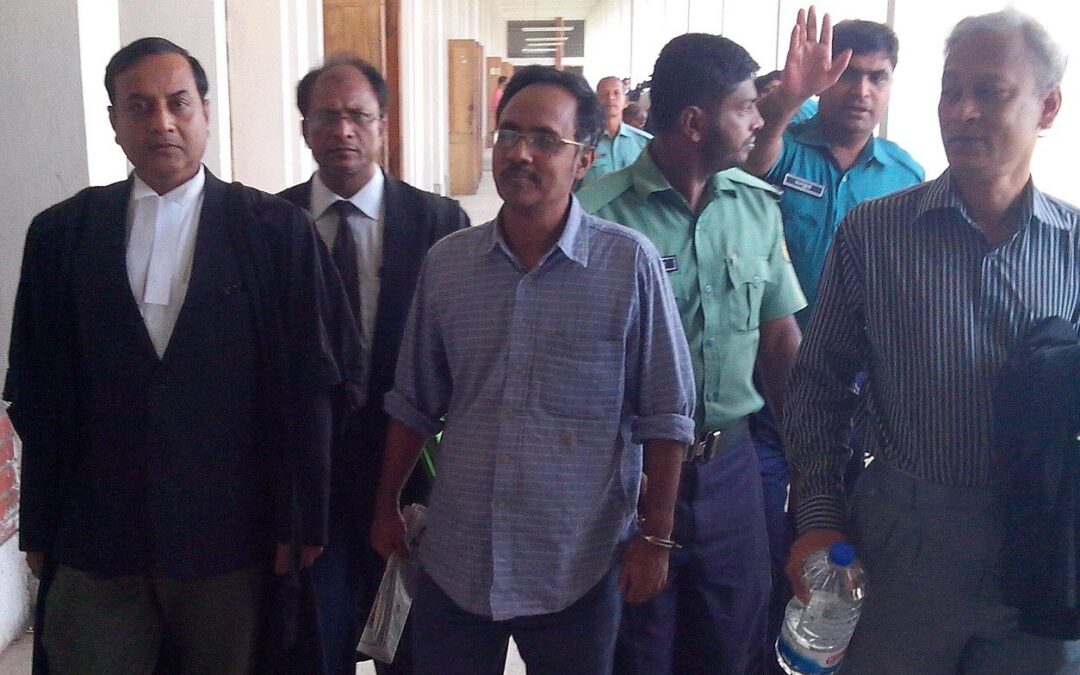
Nasiruddin Elan (in the middle on the picture) has been accused of distorting information, presenting false evidence and manipulating photographs of a Government crackdown on a rally by Hefazat-e-Islam, an Islamist political organization, in May this year.
The action reportedly resulted in multiple deaths and injuries. Odhikar had reported that 61 protestors were killed by the Rapid Action Battalion (RAB) and the police. The Government contests the number of casualties.
“What we are seeing is a continuing unlawful attack on Odhikar and voices critical of the Government,” said Ben Schonveld, ICJ’s South Asia Director. “Nasiruddin Elan is being arbitrarily detained for the lawful exercise of the right to freedom of expression and his legitimate work as a human rights defender.”
“The Government should immediately drop its opposition to Nasiruddin Elan’s bail application,” he added. “We are concerned that he will be one of the many detainees who faces torture and ill-treatment during detention, as documented by Odhikar and other human rights organizations.”
Bangladesh-Elan arrest statement-news-web story-2013 (full text in pdf)

Nov 5, 2013 | Advocacy, Non-legal submissions
The ICJ has called on States that are candidates for membership to the UN Human Rights Council to do more to respect human rights at home and at the international level.
On 12 November, the United Nations General Assembly will elect 14 new members to the Human Rights Council.
The ICJ added its name to a joint letter, delivered by International Service for Human Rights on behalf of 40 NGOs from all regions of the world, emphasising the need for candidate states to uphold the highest standards of respect for human rights, the fullest cooperation with the Human Rights Council, and to refrain from impeding the access of individuals and civil society to international human rights mechanisms.
HRC-GAElections-JointNGOLetter-NonLegalSubmission-2013 (download joint open letter in PDF)
Nov 5, 2013 | News
The ICJ condemns Bangladesh’s imposition of the death penalty in contravention of the global trend towards abolition of capital punishment.
It signifies a weakening of the rule of law and respect for human rights standards in the country.
On 5 November 2013, a special court sentenced 152 persons to death, most of them former officers of the Bangladesh Rifles (BDR), for participating in the 2009 mutiny in which 74 people were killed.
Two days earlier, the International Crimes Tribunal (ICT) had convicted Chowdhury Mueen Uddin and Ashrafuzzaman Khan in absentia for abduction and murder during Bangladesh’s liberation war in 1971 and sentenced them to death.
The ICT, set up by the Government of Bangladesh in 2010 to prosecute persons accused of committing genocide, crimes against humanity, war crimes and other serious crimes during the 1971 war, has so far convicted nine accused. Seven have been given death sentences.
“The numbers of death sentences issued by special courts in Bangladesh is alarming,” said Ben Schonveld, ICJ’s South Asia Director. “There seems little interest in seeking justice; this looks more like revenge.”
“Those responsible for committing atrocities during the Bangladeshi war of liberation and the 2009 mutiny must be prosecuted and brought to justice,” he added. “But the death penalty is a perversion of justice, even more so when imposed after trials that violate due process.”
The ICJ considers the death penalty to constitute a violation of the right to life and the right not to be subjected to cruel, inhuman or degrading punishment. The United Nations General Assembly has repeatedly called on all States to establish a moratorium on the death penalty with a view to abolition.
Under international law and standards, including the International Covenant on Civil and Political Rights, Bangladesh is required to scrupulously and strictly to observe all relevant fair trial guarantees.
This includes the right to effective legal assistance at all stages of the proceedings including the appeal.
The International Crimes Tribunal as well the Special Court set up by Bangladesh to try those accused of committing atrocities in the 2009 mutiny do not meet international standards and Bangladesh’s legal obligations concerning the right to a fair trial.
The 846 suspects tried by the special court in Dhaka for the 2009 mutiny had limited access to lawyers; did not have sufficient knowledge of the charges and evidence against them; and at least 47 suspects died while in custody, allegedly after being subjected to torture.
There are also serious procedural flaws at all stages in the ICT.
Pre-trial release has been routinely and arbitrarily denied; witnesses have been abducted and intimidated; and there have been credible allegations of collusion between the Government, prosecutors and judges.
The ICJ calls on Bangladesh to join the great majority of States around the world in rejecting the death penalty.
To that end, Bangladesh should impose a moratorium on the practice and take steps towards its abolition, as prescribed by repeated United Nations General Assembly Resolutions.
In addition, Bangladeshi authorities must order a retrial of all persons accused of participating in the 2009 mutiny and ensure that their fresh trials meet international law standards on fair trial.
Bangladesh-Death penalty statement-news-web story-2013 (full text in pdf)