Nov 6, 2013 | News
The ICJ is calling on the Bangladeshi authorities to immediately and unconditionally release Nasiruddin Elan, Director of the human rights group Odhikar.
Odhikar is an affiliate organization of the ICJ.
On 6 November 2013, a Dhaka cyber crimes tribunal rejected Nasiruddin Elan’s bail application and ordered his detention in Dhaka Central Jail.
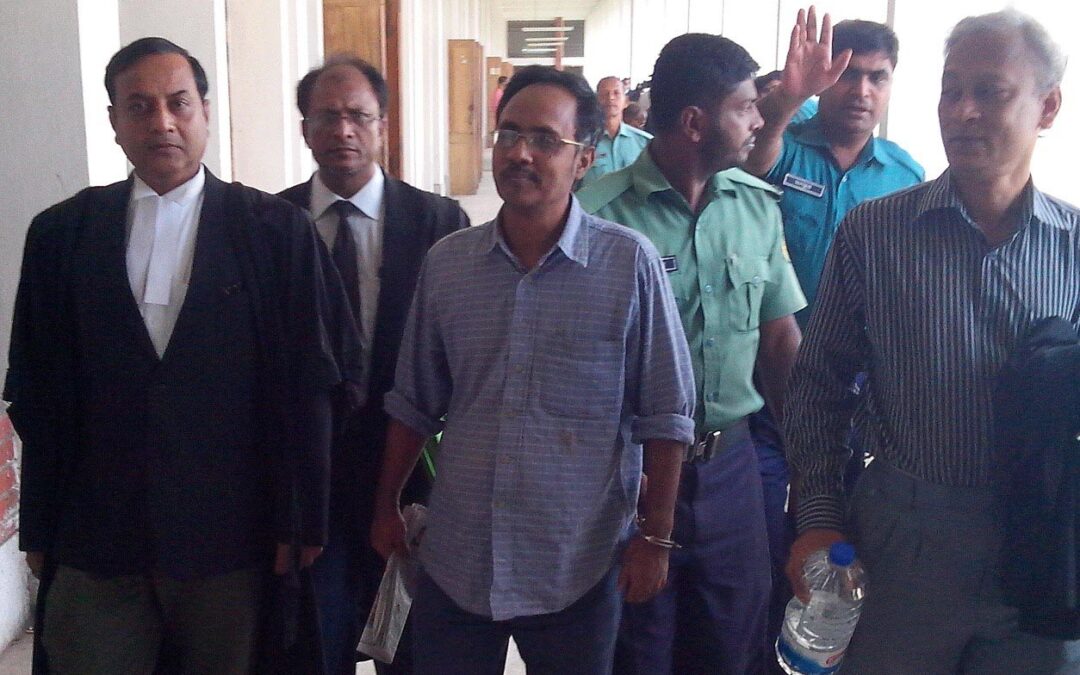
Nasiruddin Elan (in the middle on the picture) has been accused of distorting information, presenting false evidence and manipulating photographs of a Government crackdown on a rally by Hefazat-e-Islam, an Islamist political organization, in May this year.
The action reportedly resulted in multiple deaths and injuries. Odhikar had reported that 61 protestors were killed by the Rapid Action Battalion (RAB) and the police. The Government contests the number of casualties.
“What we are seeing is a continuing unlawful attack on Odhikar and voices critical of the Government,” said Ben Schonveld, ICJ’s South Asia Director. “Nasiruddin Elan is being arbitrarily detained for the lawful exercise of the right to freedom of expression and his legitimate work as a human rights defender.”
“The Government should immediately drop its opposition to Nasiruddin Elan’s bail application,” he added. “We are concerned that he will be one of the many detainees who faces torture and ill-treatment during detention, as documented by Odhikar and other human rights organizations.”
Bangladesh-Elan arrest statement-news-web story-2013 (full text in pdf)

Nov 5, 2013 | Advocacy, Non-legal submissions
The ICJ has called on States that are candidates for membership to the UN Human Rights Council to do more to respect human rights at home and at the international level.
On 12 November, the United Nations General Assembly will elect 14 new members to the Human Rights Council.
The ICJ added its name to a joint letter, delivered by International Service for Human Rights on behalf of 40 NGOs from all regions of the world, emphasising the need for candidate states to uphold the highest standards of respect for human rights, the fullest cooperation with the Human Rights Council, and to refrain from impeding the access of individuals and civil society to international human rights mechanisms.
HRC-GAElections-JointNGOLetter-NonLegalSubmission-2013 (download joint open letter in PDF)
Nov 5, 2013 | News
The ICJ condemns Bangladesh’s imposition of the death penalty in contravention of the global trend towards abolition of capital punishment.
It signifies a weakening of the rule of law and respect for human rights standards in the country.
On 5 November 2013, a special court sentenced 152 persons to death, most of them former officers of the Bangladesh Rifles (BDR), for participating in the 2009 mutiny in which 74 people were killed.
Two days earlier, the International Crimes Tribunal (ICT) had convicted Chowdhury Mueen Uddin and Ashrafuzzaman Khan in absentia for abduction and murder during Bangladesh’s liberation war in 1971 and sentenced them to death.
The ICT, set up by the Government of Bangladesh in 2010 to prosecute persons accused of committing genocide, crimes against humanity, war crimes and other serious crimes during the 1971 war, has so far convicted nine accused. Seven have been given death sentences.
“The numbers of death sentences issued by special courts in Bangladesh is alarming,” said Ben Schonveld, ICJ’s South Asia Director. “There seems little interest in seeking justice; this looks more like revenge.”
“Those responsible for committing atrocities during the Bangladeshi war of liberation and the 2009 mutiny must be prosecuted and brought to justice,” he added. “But the death penalty is a perversion of justice, even more so when imposed after trials that violate due process.”
The ICJ considers the death penalty to constitute a violation of the right to life and the right not to be subjected to cruel, inhuman or degrading punishment. The United Nations General Assembly has repeatedly called on all States to establish a moratorium on the death penalty with a view to abolition.
Under international law and standards, including the International Covenant on Civil and Political Rights, Bangladesh is required to scrupulously and strictly to observe all relevant fair trial guarantees.
This includes the right to effective legal assistance at all stages of the proceedings including the appeal.
The International Crimes Tribunal as well the Special Court set up by Bangladesh to try those accused of committing atrocities in the 2009 mutiny do not meet international standards and Bangladesh’s legal obligations concerning the right to a fair trial.
The 846 suspects tried by the special court in Dhaka for the 2009 mutiny had limited access to lawyers; did not have sufficient knowledge of the charges and evidence against them; and at least 47 suspects died while in custody, allegedly after being subjected to torture.
There are also serious procedural flaws at all stages in the ICT.
Pre-trial release has been routinely and arbitrarily denied; witnesses have been abducted and intimidated; and there have been credible allegations of collusion between the Government, prosecutors and judges.
The ICJ calls on Bangladesh to join the great majority of States around the world in rejecting the death penalty.
To that end, Bangladesh should impose a moratorium on the practice and take steps towards its abolition, as prescribed by repeated United Nations General Assembly Resolutions.
In addition, Bangladeshi authorities must order a retrial of all persons accused of participating in the 2009 mutiny and ensure that their fresh trials meet international law standards on fair trial.
Bangladesh-Death penalty statement-news-web story-2013 (full text in pdf)
Nov 4, 2013 | E-bulletin on counter-terrorism & human rights, News
Read the 77th issue of ICJ’s monthly newsletter on proposed and actual changes in counter-terrorism laws, policies and practices and their impact on human rights at the national, regional and international levels. The E-Bulletin on Counter-Terrorism and Human...

Oct 29, 2013 | News
The ICJ welcomes the report of the UN Special Rapporteur on the independence of judges and lawyers presented to the UN General Assembly today.
The report calls for the adoption by the Human Rights Council of the draft principles governing the administration of justice through military tribunals, known as the ‘Decaux Principles’.
“This is a major step forward towards the establishment of universally applicable minimum standards to regulate the use and operation of military courts and tribunals”, said Alex Conte, Director of the ICJ’s International Law and Protection Programmes.
“The investigation and prosecution of alleged offences involving serious human rights violations is in many countries undertaken by military courts for the purpose of avoiding the accountability of perpetrators of such acts. It is therefore significant that the UN Special Rapporteur has reaffirmed that the jurisdiction of ordinary courts should prevail in such cases,” he added.
“It is also important that the Special Rapporteur has reiterated the recommendation of many human rights experts that the trial of civilians in military courts should in principle not occur and should be limited to strictly exceptional cases,” Conte further said.
The ICJ closely followed and contributed to the development of the Decaux Principles and has repeatedly called for their adoption and implementation by all States.
These principles were elaborated in 2006 in consultation with human rights experts, jurists and military personnel from throughout the world, and include specific provisions relating to the establishment and functioning of military tribunals.
They are based on the principle that military justice should be an integral part of the normal judicial system and should operate in a way that guarantees full compliance with human rights, including the need to ensure accountability for perpetrators of human rights violations.
Contact:
Alex Conte, ICJ International Law and Protection Programmes Director (Geneva), t: +41 79 957 2733; email: alex.conte(a)icj.org