Oct 16, 2014 | Advocacy, Analysis briefs, News, Open letters
The ICJ condemns the imminent “trial” of Constitutional Court judges by Bolivia’s Senate, in proceedings that could see the judges sent to prison over politicians’ disagreement with a legal ruling.
The proceedings “violate the independence of the judiciary and the right to fair trial,” the Geneva-based organization wrote today in an open letter to all Senators and Deputies of the legislative assembly.
The charges in the trial, scheduled to begin on 21 October, are based entirely on a precautionary ruling by the judges that parts of a new law regulating notaries should not be implemented until the Court has an opportunity to hear a constitutional challenge to the law.
“The spectacle of dozens of politicians pretending to act as an independent and impartial criminal court, threatening to throw constitutional court judges in jail over a difference of opinion as to interpretation of the law, is incompatible with respect for human rights, the separation of powers, and the rule of law,” said Matt Pollard, Head of the Centre for Independence of Judges and Lawyers at the ICJ.
Constitutional Court Judges Soraida Rosario Chanez Chire and Ligia Mónica Velásquez Castaños are to be tried on 21 October, while proceedings against Judge Gualberto Cusi Mamani have reportedly been temporarily suspended for reasons of health. The judges were suspended from duty on 28 July.
An analysis brief published by the ICJ and sent to the legislative members concludes that the proceedings violate Bolivia’s international legal obligations under the American Convention on Human Rights and the International Covenant on Civil and Political Rights.
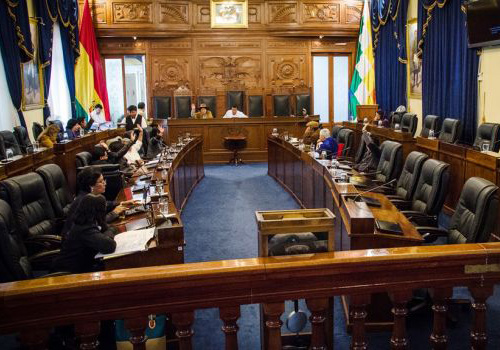
The brief also cites judgments of the Inter-American Court of Human Rights that found violations of the American Convention as a result of defective parliamentary proceedings for removal of judges in other countries. The proceedings in Bolivia are poised to be even more egregious than the proceedings at issue in the earlier judgments, given the possibility for the Bolivian Senate (photo) to impose a criminal conviction and imprisonment.
“The ICJ urges the Senators and Deputies immediately to cancel the proceedings, to end the judges’ suspension from duty, to refrain from any other form of interference with judicial independence, and to reform judicial discipline and removal procedures to bring them into line with international standards,” said Pollard.
(update as of 21 October: the proceedings were postponed to 4 November after one of the judges collapsed on arrival at the Legislative Assembly and was taken to hospital).
Contacts:
English: Matt Pollard, Head of the Centre for Independence of Judges and Lawyers at the ICJ, t: +41 79 246 54 75; e: matt.pollard(a)icj.org
Spanish: Carlos Ayala, ICJ Commissioner, t: +58 212 952 8448; e: carlos.ayala(a)icj.org
BOLIVIA-Unfair trial of judges-News-Press release-2014-SPA (full text in PDF)
BOLIVIA-unfair trial of judges-Advocacy-Open letter-2014-ENG (full text in PDF)
BOLIVIA-unfair trial of judges-Advocacy-Open letter-2014-SPA (full text in PDF)
BOLIVIA-unfair trial of judges-Advocay-Analysis brief-2014-ENG (full text in PDF)
BOLIVIA-unfair trial of judges-Advocacy-Analysis brief-2014-SPA (full text in PDF)

Jun 3, 2014 | Advocacy, Analysis briefs
The ICJ’s commentary analyses in detail the 7 November 2013 judgment of the Court of Justice of the EU (CJEU) in joined cases arising from three asylum claims asserting a well-founded fear of persecution based on same-sex sexual orientation.
Positively, in X, Y and Z v. Minister voor Immigratie en Asiel, the Court found that asylum applicants who have a same-sex sexual orientation and come from countries where consensual homosexual conduct is criminalized, form a particular social group for the purposes of EU refugee law.
Further, the Court’s recognition that sexual orientation is a characteristic so fundamental to one’s identity that one cannot be expected to renounce or conceal it, or to exercise greater restraint in its expression than heterosexuals, is welcome.
Likewise, the Court’s finding that the enforcement of a term of imprisonment that sanctions consensual homosexual acts must be regarded as a disproportionate or discriminatory punishment, and is thus persecutory, is a step forward, particularly given that in some EU countries this was hitherto not the case.
However, in some important respects this judgment represents a missed opportunity. The Court failed to clarify the inconsistency between secondary EU refugee law and the UNHCR’s authoritative interpretation of “a particular social group” in the Refugee Convention’s definition of a refugee.
Further, in choosing to maintain the narrow scope of the questions referred to it, the Court ended up with an unwarrantedly restrictive reading of EU refugee law, which ignores the numerous persecutory effects of criminalizing consensual same-sex sexual orientation or gender identity.
The Court missed a chance to state that these laws, even when they are not enforced in the sense that there exists a recent record of enforcement through the actual imposition of terms of imprisonment, have a persecutory effect, as they criminalize an essential characteristic of one’s identity.
Background
The ICJ decided to publish this commentary for a number of reasons.
First, the CJEU plays an important role in shaping international refugee law jurisprudence.
Further, asylum applications based on a well-founded fear of persecution for reason of real or imputed sexual orientation and/or gender identity or expression are unfortunately likely to increase, both within the EU and beyond.
Moreover, the CJEU’s judgment in this case is likely to have a bearing on the determination of asylum claims premised on membership of other particular social groups.
Lastly, the implementation by the EU and its Member States of the recently “recast” Common European Asylum System will likely give rise to several new referrals to the Court, whose interpretation of the recast instruments will also depend on its asylum case law precedents, including the CJEU’s judgment in this case.
CommentaryXYZ-Advocacy-2014
Apr 16, 2012 | Advocacy, Analysis briefs
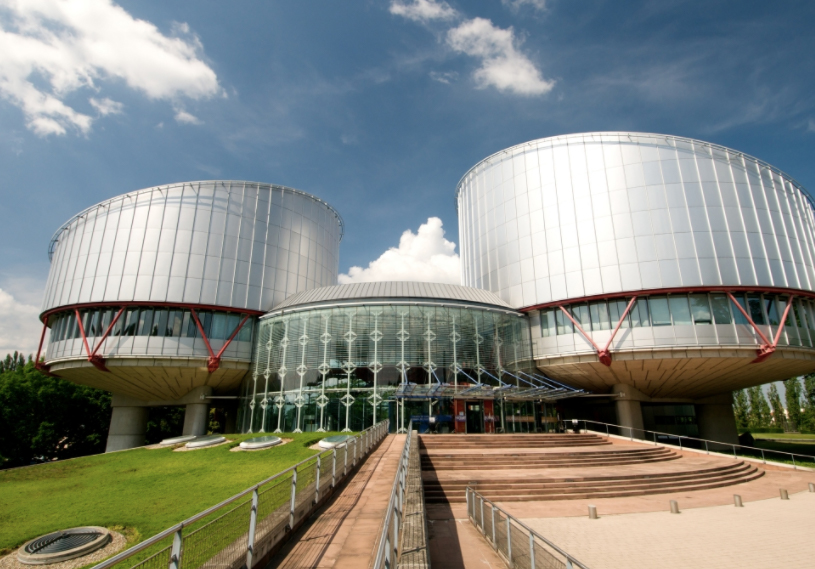
The ICJ and other NGOs delivered a joint statement at the UK Brighton Conference on the Reform of the European Court of Human Rights.
Amnesty International, the AIRE Centre, the British Institute of Human Rights (BIHR), the European Human Rights Advocacy Centre (EHRAC), the Helsinki Foundation for Human Rights (HFHR), Human Rights Watch, INTERIGHTS, the International Commission of Jurists (ICJ), JUSTICE, Open Society Justice Initiative and REDRESS jointly delivered a statement on their views on the declaration on reform of the European Court of Human Rights under negotiation at Brighton (UK) under the UK Presidency of the Council of Europe.
Europe-Brightondeclaration-jointstatement-2012 (download the joint statement)

Mar 29, 2012 | Advocacy, Analysis briefs
 During the 19th session of the Human Rights Council, a plenary Panel discussion was convened on discrimination and violence based on sexual orientation and gender identity – the first of its kind.
In a joint oral statement with Human Rights Watch and Amnesty International, the ICJ welcomed the study by the Office of the High Commissioner for Human Rights and addressed concerns about the serious mischaracterization of international human rights law by some delegations at the Human Rights Council.
oral statement-analysis brief-2012 (full text in English, PDF)

Nov 24, 2011 | Advocacy, Analysis briefs
Under the second cycle of the Universal Periodic Review (UPR) mechanism, the UN Human Rights Council Working Group on the UPR will be undertaking a review of South Africa during its 13th session in June 2012.
In a submission to the Working Group, the International Commission of Jurists has focused on the issues of: access to justice, especially in the context of business and human rights; sexual violence, including on the basis of sexual orientation and gender identity; the protection of migrant rights; police accountability and oversight; and international human rights instruments and South Africa’s cooperation with the UN treaty bodies and the Council’s Special Procedures.
South Africa-ICJ submission UPR-analysis brief-2011 (full text in English, PDF)

Oct 17, 2011 | Advocacy, Analysis briefs, News
The Maastricht Centre for Human Rights and the ICJ are pleased to announce the adoption of the Maastricht Principles on Extraterritorial Obligations of States in the area of Economic, Social and Cultural Rights.
These international legal principles clarify the human rights obligations of States beyond their own borders.
principles obligations adopted-press release-2011 (full text in English, PDF)
Maastricht principles-analysis brief-2011 (full text in English, PDF)