Mar 22, 2018 | Advocacy, Non-legal submissions
The ICJ today highlighted at the UN the need for further action to address impunity in Sri Lanka and in Colombia.
The statement, delivered in a general debate at the UN Human Rights Council, responded to UN reports on Sri Lanka and Colombia, and read as follows:
Sri Lanka has not made sufficient progress on its commitments and obligations as reflected in Council resolution 30/1. Among the mechanisms contemplated, only the Office on Missing Persons (OMP) is operational. The process for establishing the other mechanisms, and the extent to which their composition will be based on the broad national public consultations carried out in 2016, remains unclear. The ICJ reiterates that, in line with operative paragraph 6 of resolution 30/1, the accountability mechanism cannot be seen as credible without involvement of international judges, prosecutors and investigators.
Furthermore, despite promises to repeal the Prevention of Terrorism Act (PTA), arrests still take place. As the High Commissioner recommended, the PTA should be promptly repealed without waiting for replacement legislation. Any proposed counterterrorism law must comply with international human rights standards.
In Colombia, the ICJ shares OHCHR’s deep concern about the exclusion of non-military State agents and private individuals from the scope of mandatory application of the Integrated System of Justice, Truth, Reparations and Guarantees of Non-repetition (per paragraph 90 of the Report). Furthermore, four months of unjustified delay by the Government in accrediting the new representative of the OHCHR Office, which ended only yesterday, undermined the ability of the Office to provide adequate technical assistance to guarantee victims’ rights in the Integrated System, as provided for by the Peace Agreement.”
[Paragraph 6 of Human Rights Council resolution 30/1 provides that the Council, “Welcomes the recognition by the Government of Sri Lanka that accountability is essential to uphold the rule of law and to build confidence in the people of all communities of Sri Lanka in the justice system, notes with appreciation the proposal of the Government of Sri Lanka to establish a judicial mechanism with a special counsel to investigate allegations of violations and abuses of human rights and violations of international humanitarian law, as applicable; affirms that a credible justice process should include independent judicial and prosecutorial institutions led by individuals known for their integrity and impartiality; and also affirms in this regard the importance of participation in a Sri Lankan judicial mechanism, including the special counsel’s office, of Commonwealth and other foreign judges, defence lawyers and authorized prosecutors and investigators;”]
Mar 20, 2018 | Advocacy, Non-legal submissions
The ICJ today joined other NGOs in condemning and calling for proper investigation of the killing of human rights defender Marielle Franco in Brazil, at the Human Rights Council.
The statement read as follows:
“Protection of human rights defenders is key to the implementation of the Vienna Declaration on Human Rights.
City councilwoman Marielle Franco and Anderson Gomes were brutally killed on 14 March in Rio de Janeiro, Brazil. Her mandate focused on structural racism and police violence suffered by the poor, black and young in favelas, and on the empowering black women and the LGBTI community.
She was appointed as parliamentary rapporteur to oversee the abuses of the highly militarized federal intervention in Rio, decreed by the President, against the will of the community, and under concerns by the High Commissioner.
Many who speak truth to power in Brazil are facing unprecedented violence and stigmatization, as the country ranks at the top in defenders’ deaths. The defenders’ protection program remains underfunded and understaffed.
Marielle’s strength, engagement and sorority serve as a source of inspiration for the work on the promotion and protection of the rights of the most marginalized groups.
We urge Brazil to ensure a prompt, impartial and independent investigation, bringing those responsible to justice, by seriously exploring the hypothesis on an extrajudicial execution, and to provide effective protection to the survivors of this attack.”
The full statement together with a list of the organisations joining it, may be downloaded here: UN-HRC37-JointStatement-GD8-Brazil-2018
Mar 20, 2018 | Advocacy, Non-legal submissions
The ICJ today spoke at the Human Rights Council about the creation of a UN database of business enterprises involved in Israeli settlements in the Occupied Palestinian Terrority (OPT).
The statement, delivered in general debate under item 7 of the Council agenda, read as follows:
“Regarding the Report on a Database of business enterprises involved in listed activities in the settlements on the Occupied Palestinian Territory (A/HRC/37/39), the ICJ recognizes that considerable progress has been made, but considers that the normative and methodological frameworks of the database would benefit from incorporating an analysis of corporate complicity under international law, in addition to the existing references to the UN Guiding Principles on Business and Human Rights.
The ICJ stresses that a transparent process and strong due process safeguards in relation to companies alleged to be involved are essential and notes the efforts of the OHCHR in this regard.
All States, including the home States of the companies involved, have a responsibility to prevent companies from operating in breach of international law. Businesses themselves should see the database as an opportunity to more proactively incorporate respect for human rights within their policies and operations.
The database should contribute to global efforts to hold all business enterprises accountable for their role in violations of human rights and humanitarian law. Indeed, the ICJ urges all States, including those that have supported the creation of this database, to support and give due attention to addressing the human rights impacts of businesses in their own territories as well as global operations of businesses for which they are the home State.”
Video of the statement is available here:

Mar 20, 2018 | Advocacy
The ICJ today submitted a briefing note to the Senate of Swaziland calling for its urgent adoption of the Sexual Offences and Domestic Violence Bill 2015.
The ICJ’s briefing note concludes that enactment of the Bill is a matter required of the Kingdom of of Swaziland pursuant to its regional and universal human rights law obligations to criminalize and sanction the perpetrators of sexual and gender-based violence. Compliance with those obligations is reinforced by the ‘Vision 2022’ of His Majesty King Mswati III, the aims and targets of the Deputy Prime Minister’s Office and Swaziland’s consensus in the adoption of the 2030 Agenda for Sustainable Development.
The ICJ’s briefing note also concludes that, ten years after initial drafting of the Bill, its enactment during the current session of the Parliament of Swaziland is an essential step in complying with recommendations of the UN Human Rights Committee and CEDAW Committee and as a means of discharging the commitments made by His Majesty’s Government during the 2016 Universal Periodic Review.
Swaziland-SOADVBill-Advocacy-ParliamentaryBriefingNote-2018-ENG (Parliamentary Briefing Note, in PDF)
Mar 19, 2018 | Advocacy, Non-legal submissions
The ICJ spoke at the UN today on concerns about a resurgence of communal violence, and a failure to implement reconciliation and justice mechanisms, in Sri Lanka.
The statement, made during the adoption of the outcome of the Universal Periodic Review for Sri Lanka by the Human Rights Council, read as follows:
“The International Commission of Jurists (ICJ) welcomes the report of the Working Group on the Universal Periodic Review (UPR) on Sri Lanka.
Sri Lanka has stated that it maintains zero tolerance for hate speech and religious violence, and that the National Human Rights Action Plan 2017–2021 contains a firm commitment to enforce section 3(1) of the ICCPR Act. The ICJ further notes that a circular was issued requiring all police officers to take immediate action in this regard. Despite these commitments, recent events demonstrate renewed conflict owing to communal violence directed at the Muslim minority. A state of emergency was proclaimed on 6 March following inaction from law enforcement, and its inability to contain the violence, and emergency regulations were in operation until yesterday.
The ICJ urges the government to demonstrate through action, its willingness bring to account those who have incited communal violence, in line with the ICCPR Act and the commitments conveyed by His Excellency the Ambassador here today. Pervading impunity has emboldened perpetrators to incite violent hatred publicly. Justice must follow recent arrests, ensuring impartial and effective investigations and trials, in line with human rights.
The ICJ also notes the limited progress made on implementing HRC resolution 30/1. Of the reconciliation mechanisms promised, only the Office on Missing Persons is operational. There is little transparency with regards to the other proposed mechanisms (including the mechanism on accountability with involvement of international judges, prosecutors and investigators), or in relation to repeal and replacement of the Prevention of Terrorism Act. Any new counterterrorism law must comply with international human rights standards, and we welcome the Ambassador’s affirmation of the Government’s commitment to this today.
The ICJ urges Sri Lanka to accept and implement all relevant UPR recommendations without delay, before the opportunity for reform may be lost.”
Video of the ICJ statement is available here:
Video of the opening presentation by H.E. the Ambassador of Sri Lanka is available here:
Mar 19, 2018 | Advocacy, Non-legal submissions
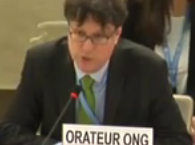
The ICJ today delivered an oral statement at the UN calling on Pakistan to amend or repeal blasphemy laws, end military trials of civilians, and take effective measures against impunity.
The statement was delivered during the adoption of the Universal Period Review Outcome for Pakistan, at the UN Human Rights Council. It read as follows:
“The International Commission of Jurists (ICJ) regrets that Pakistan has not supported recommendations related to amending its blasphemy laws, ensuring its counter-terrorism measures are compatible with human rights, and combatting impunity for serious human rights violations.
Pakistan’s blasphemy laws are frequently misused; blatantly discriminate against minority religions and sects; infringe upon the rights to freedom of expression and religion; and give rise to serious fair trial concerns. The Government has failed to amend them in accordance with its international law obligations.
In January 2015, Pakistan empowered military courts to try people accused of terrorism-related offences. The ICJ has documented serious fair trials violations in the operation of military courts including: denial of the right to counsel of choice; failure to disclose the charges against the accused; denial of a public hearing; and a very high number of convictions based on ‘confessions’ without adequate safeguards against torture and other ill-treatment.
The Government has also failed to take steps to combat impunity for serious human rights violations such as extrajudicial killings, enforced disappearances, and torture and other ill-treatment, which are facilitated by laws such as the Actions (in aid of civil power) Regulation and other national security legislation.
Despite repeated commitments to do so, Pakistan has also not enacted legislation to recognize torture or enforced disappearance as a distinct, autonomous offence in its penal code.
The ICJ therefore urges the Government to reconsider, accept and implement UPR recommendations to:
- Ensure that military courts have no jurisdiction over civilians, including for terrorism-related offences;
- Repeal or amend all blasphemy laws, in line with international standards; and
- Ensure all perpetrators of serious human rights violations – including enforced disappearance and extrajudicial killings –are brought to justice.”
Video of the ICJ statement is available here: