ICJ concerned that the MultiChoice Group claims it is “not in the position to take actions” against Emmanuel TV for discriminatory ‘Conversion Therapy’ Clips

ICJ concerned that the MultiChoice Group claims it is “not in the position to take actions” against Emmanuel TV for discriminatory ‘Conversion Therapy’ Clips

In May 2021 the ICJ wrote to The MultiChoice Group in South Africa urging it to suspend Emmanuel TV on any of the DSTV platforms for broadcasting  televangelist Pastor TB Joshua’s multiple video clips ostensibly depicting  violent ‘conversion therapy’ and hate speech against LGBT persons amounting to discrimination and human rights abuses. MultiChoice responded  that it has “no editorial control or oversight” over Emmanuel TV as it is a “third-party channel” and therefore MultiChoice cannot investigate the incident further or take any remedial action.

MultiChoice claims on their website to “entertain, inform and empower African communities”. In addition to this, their entertainment platforms are a hub for approximately 14 million people across 50 countries. MultiChoice has a huge reach into African countries and in the homes of millions of people living in Africa. As a result, they have a responsibility to act in a way which does not promote harmful practises.

In response to ICJ’s letter, MultiChoice stated that it does not review the content broadcast on third-party channels such as Emmanuel TV prior to its broadcast. In place of a thorough investigation, the entertainment group said that it contacted Emmanuel TV and the latter stated that the ‘conversion therapy’ clips were not broadcast in April 2021. It is significant to note that Emmanuel TV did not deny that the clips were aired at all. Rather, MultiChoice alleged that it was simply “unable” to independently verify that the clip was broadcasted in April 2021 or at all.

Contrary to the impression given in its letter to the ICJ, MultiChoice is not limited to investigating offensive broadcasts that are aired within  a specific time period. Additionally, while the ICJ notes  MultiChoice’s assertion that Emmanuel TV is a third-party channel and consequently MultiChoice has no editorial control or oversight over the content of the channel, the ICJ believes that MultiChoice has a duty to not broadcast material that is discriminatory and in contravention of the South African Constitution.

MultiChoice has a responsibility to conduct a serious investigation into this matter  and take the necessary remedial action. Consequently, we do not find that Emmanuel TV’s confirmation to MultiChoice,  that the clip was not broadcast during April 2021 is sufficient; and MultiChoice’s inability to verify whether this program was broadcast at all, is unsatisfactory.

The UN Independent Expert on protection against violence and discrimination based on sexual orientation and gender identity, under the umbrella of the United Nations Human Rights Commission, has concluded in May 2020, that conversion therapy amounts to torture and ill-treatment and has called for a global ban on such practices.

In light of this, the ICJ is of the view that MultiChoice has a greater responsibility to the African audience to refrain from participating in the broadcast of such harmful practices, and must publicly take a stance against facilitating the airing of such broadcasts. The ICJ believes that MultiChoice’s responsibility as Africa’s “leading entertainment company” is not to pay “lip service” to the values of the South African Constitution, but rather to hold itself to higher thresholds of accountability. 

ICJ has consequently urged MultiChoice to:

  1. Independently investigate this and other discriminatory and potentially unlawful broadcasts by Emmanuel TV and take appropriate remedial measures.
  2. Undertake to exclude Emmanuel TV as part of MultiChoice’s package to the public, or alternatively, to heavily condition its contract with Emmanuel TV to disallow the broadcast of offensive materials; should the investigation lead to the conclusion that the clip was broadcasted by them.
  3. Ensure that such offensive materials are not broadcast on any MultiChoice channels, irrespective of their status as third-party channels.
  4. Offer an apology from Multichoice Group to the LGBT persons, unless MultiChoice is able to demonstrate independently that the clip was not broadcast at all on their platform, neither by Emmanuel TV nor by any other third-party channel.
  5. Undertake an updating of the MultiChoice Group’s internal policies to bring them in line with human rights standards, the South African Constitution, and local laws on non-discrimination. This includes contractual arrangements with third party channels like Emmanuel TV which may broadcast discriminatory content.


Contact

Kaajal Ramjathan-Keogh, ICJ Africa Director, Kaajal.Keogh(a)icj.org

Tanveer Jeewa, Legal and Communications Officer, Tanveer.Jeewa(a)icj.org

OPT/Israel: Crimes under international law must immediately be investigated (UN Special Session)

OPT/Israel: Crimes under international law must immediately be investigated (UN Special Session)

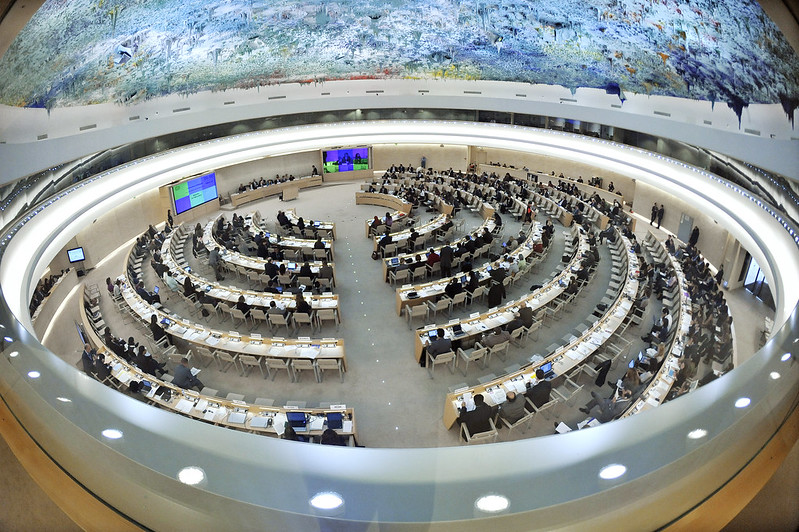
The ICJ today addressed an emergency Special Session of the UN Human Rights Council on the Occupied Palestinean Territories and Israel, calling for accountability for the serious violations of international humanitarian law and international human rights law committed by all parties.

The Special Session is expected to adopt a resolution to address this situation.

The ICJ statement read as follows:

“Madame President,

May 2021 has witnessed the commission of serious crimes under international law by Israel in occupied East Jerusalem and the West Bank, and by Israel and Palestinian armed groups in the context of the recent round of hostilities in the Gaza Strip. As in the past, the conflict exacted a heavy toll on civilians taking no part in hostilities, including more than 65 slain Palestinian children. Unlike the past, those responsible must be held criminally accountable for these crimes.

The International Commission of Jurists calls on the Council to establish a Commission of Inquiry to investigate serious violations of international humanitarian law and international human rights law committed by all parties with a view to:

  • Establishing the facts, documenting, and reporting on alleged violations and abuses of international humanitarian law and international human rights law;
  • Collecting and preserving evidence of crimes under international law committed in the West Bank, including East Jerusalem, Israel and in the context of the Gaza hostilities; and
  • Identifying all those responsible for such crimes.

This Council should call on all States to cooperate with the ongoing investigation of the International Criminal Court. All States, and any mechanisms of this Council, should cooperate and share relevant information with the Commission of Inquiry.

Thank you.”

Contact:

Massimo Frigo, ICJ UN Representative, e: massimo.frigo(a)icj.org, t: +41797499949
UN: human rights are essential to an effective counter-terrorism strategy (ICJ Statement)

UN: human rights are essential to an effective counter-terrorism strategy (ICJ Statement)

At a UN dialogue on counter-terrorism, the ICJ warned States and UN institutions against the use of overbroad and ill-defined concepts in the 7th revision of the UN Global Counter-Terrorism Strategy, because they could breach the principle of legality and undermine protections under international human rights law.

The ICJ intervened today in the virtual two-day dialogue with human rights and civil society partners on the theme of “Building a Better Paradigm to Prevent and Counter Terrorism,” organised by the United Nations Office of Counter-Terrorism (UNOCT) and the Permanent Mission of Spain to the United Nations.

The Dialogue brings together Member States, UN entities, human rights representatives, women groups, youth and civil society actors, as well as experts and other stakeholders for a practical exchange of views on how to address terrorism and violent extremism while safeguarding and promoting human rights, in particular the rights of women, children and victims of terrorism.

The ICJ Statement reads as follows:

“Madam Special Rapporteur, Your Excellencies, Colleagues,

Thank you very much for the organizing this consultation.

The International Commission of Jurists has been working for decades to ensure that counter-terrorism measures are compliant with, and do not lead to violations and abuses of human rights and the rule of law.

The ICJ has produced authoritative guidance, such as the ICJ Berlin Declaration on Upholding Human Rights and the Rule of Law in Combating Terrorism of 2004 and a four-year study concluded in 2009 by the ICJ Eminent Jurists Panel on Terrorism, Counter-Terrorism and Human Rights, the result of 16 hearings across the globe.

That Panel concluded that the approach many States had taken in short-circuiting foundational rule of law and human rights principles caused “enduring long term harm.”

The ICJ has been insistent that countering terrorism and protecting human rights are important objectives that not only are not in conflict, but are part of a single shield of protection that States must provide for.

This finding is as valid today as it was then, as the Global Counter-Terrorism Strategy itself recognizes that “when counter-terrorism efforts neglect the rule of law … and violate international law … they not only betray the values that they seek to uphold, but they may also further fuel violent extremism that can be conducive to terrorism.”

In this regard, we are concerned at the possible use in the UN Global Counter-Terrorism Strategy of undefined concepts and terms, like “violent extremism”, “violent nationalism”, political concepts of “far right” and “far left” or “extremism”.

The abusive invocation of these terms carries risks for the protection of freedom of expression, freedom of religion and belief, freedom of association and the right to political participation, all protected under international human rights law.

Critically, from a rule of law perspective, legal certainty is a key principle of human rights law that informs the requirement that any legitimate restrictions of human rights including when countering terrorism must be prescribed by law.

Any undefined or widely defined concept of terrorism or extremism should not be promoted or applied in international instruments, standards or strategies, that, where incorporated into national laws and practice, would lead to violations of this international human rights law violations.

In this regard, we share the assessment by the Special Rapporteur on the promotion and protection of human rights while countering terrorism in her 2020 report to the UN Human Rights Council (A/HRC/43/46) and by the OHCHR in its Report on best practices on countering violent extremism (A/HRC/33/29, para. 19).

Concepts like “violent extremism”, nationalism, political opinions and other forms of religious, ethnic, or other belief or opinion, however extreme, cannot be part of the GCTS, as they are otherwise protected by international human rights law guarantees to protect the rights to freedoms of expression, religion or belief, and/or of association.

Furthermore, their insertion would water down the anti-terrorism focus of the strategy and lead the way to the application of very pervasive measures clearly restrictive of human rights for conduct that is not linked to terrorism.

The Global Strategy should focus exclusively on countering terrorism. Any more expansive approach will risk leading to measures in breach of human rights law and, therefore, of the founding values of the UN under article 2 of the Charter.

I thank you.”


(The ICJ Statement is at minute 2:48:21)

ICJStatement-OCTSpainVirtualDialogue-SessionI-final (download the statement)


Contact:

Massimo Frigo, ICJ UN Representative, e: massimo.frigo(a)icj.org, t: +41797499949

Nepal: experts affirm the need for reform of Transitional Justice legislation to ensure the right to an effective remedy to all victims and survivors, particularly women

Nepal: experts affirm the need for reform of Transitional Justice legislation to ensure the right to an effective remedy to all victims and survivors, particularly women

The ICJ launched a new briefing paper Nepal: Transitional Justice Mechanisms with Gender Perspective in a webinar held on 12 May 2021.

The discussion included the need to give practical effect to Nepal’s obligation under international law to ensure the right to an effective remedy to the victims, including women victims of sexual and gender-based violence during the country’s internal armed conflict (1996 – 2006). Participants focused in particular on the need to ensure that gender issues are incorporated in the transitional justice mechanism.

The Honourable Kalyan Shrestha, former Chief Justice of the Supreme Court of Nepal and ICJ Commissioner, stressed the importance of the role of the Supreme Court of Nepal in establishing landmark jurisprudence on transitional justice.

Justice Shrestha explained how despite the fact that the country had established a progressive Constitution and amended legislation to provide for equality, non-discrimination and access to justice, women victims and survivors of a decade long armed conflict continued to face real barriers to justice. These including short periods of statute of limitations preventing the filing rape and sexual violations cases and lack of support mechanisms for women, which compounded existing economic pressure and social obstacles.

Bandana Rana, Member of the UN Committee on the Elimination of Discrimination against Women (CEDAW), addressed the situation of sexual and gender – based violence against women in Nepal during the armed conflict. She said that Nepal was bound by clear international legal obligations, including under the CEDAW and other treaties. Yet the Nepali government has not taken effective measures to ensure access to justice and the right to an effective remedy to the victims of SGBV during the conflict.

Laxmi Pokharel, ICJ Legal Adviser, summarized the ICJ’s briefing paper on “Nepal: Transitional Justice Mechanisms with Gender Perspective”. The Paper’s major recommendations, to the Government of Nepal, are:

  • Amend the Truth and Reconciliation Act (TRC) in line with the Supreme Court’s order and Nepal’s international obligations;
  • Ensure participatory, consultative processes while amending the TRC Act;
  • Ensure the participation of women at all levels of recruitment, including in the formation of the recommendation committee, in the appointment of Commissioners of both the TRC and the Commission on Investigation of Disappeared Persons (COID) and at all levels of staffing with a view to ultimately achieving gender parity;
  • Provide gender-sensitive trainings to the Commissioners and staff of the Commissions in order to enhance their capacity to address gender issues in their operation;
  • Take all necessary steps to amend the Criminal Code to remove the statutory limitation for filing incidents of rape and other sexual violence, including in relation to acts committed during the armed conflict, in order to ensure justice for all victims;
  • Ensure that amnesties and mediation are not used to replace criminal responsibility for gross violations of human rights, including rape and other sexual violence.
  • Incorporate a gender-responsive approach in all aspects of the Commissions’ work, including in the interpretation and application of the mandate of the Commissions, prosecution of perpetrators and reparation to the victims and survivors;
  • Incorporate an approach in the Commissions’ work that does not restrict women’s experiences during the armed conflict only to bodily harm suffered, but also takes account of structural gender biases and its consequences during the period of a conflict;
  • Design and implement gender-friendly procedures for investigation, including statement taking, victim and witness protection and other activities of the Commissions;
  • Design and implement specific reparation policies to address the unique needs of women victims;
  • Ensure that the gendered aspects of the armed conflict, including its causes and consequences are incorporated in the final report of the Commissions;
  • Take effective measures to ensure the widest possible dissemination of the final report of the Commissions in order to ensure that the wider population is made aware of the truth, most especially in relation to women.

The webinar was jointly organized by ICJ in collaboration with the United Nation’s Office of the High Commissioner for Human Rights (OHCHR) and UN Women. This event was organized under the ‘Enhancing Access to Justice for Women in Asia and the Pacific’ project funded by the Swedish International Development Cooperation Agency (SIDA). Due to the COVID – 19 pandemic the webinar was conducted virtually and live broadcasted on Facebook. It was conducted in English language and simultaneous translation in Nepali language was also available.

Contact

Laxmi Pokharel, ICJ Legal Adviser – Nepal, email: laxmi.pokharel(a)icj.org

Download

Briefing paper on “Nepal: Transitional Justice Mechanisms with Gender Perspective” (full report in PDF)

Turkey: ICJ intervenes in a case concerning anti-terror laws and effective remedies

Turkey: ICJ intervenes in a case concerning anti-terror laws and effective remedies

The International Commission of Jurists (ICJ), the Turkey Litigation Support Project (TLSP) and Human Rights Watch (HRW) have intervened before the European Court of Human Rights in a case concerning the arrest and pre-trial detention of Turkish opposition politician Selahattin Demirtaş, on a series of charges relating to the exercise of his freedom of political expression. The applicant alleges that his pre-trial detention was arbitrary and unlawful.

In the intervention, the organisations underline that restrictions on freedom of expression, widespread detention and criminal prosecution under expansive anti-terrorism laws, and the impact on democratic debate and rights protection are now well documented in Turkey. This is particularly striking, and the repercussions serious, when opposition politicians are targeted for their expressions of opinion and engagement in democratic debate.

The interveners address:

  • the nature and application of anti-terror criminal laws in Turkey and the implications for protection of the right to liberty (Article 5(1) of the European Convention on Human Rights (ECHR)) and freedom of expression (Article 10 ECHR) and for the limitation on use of restrictions on rights (Article 18 ECHR); and
  • the effectiveness of the individual application procedure to the Turkish Constitutional Court as a remedy in detention cases, in particular in cases concerning the exercise of freedom of expression, in light of delays, the erosion of the independence and impartiality of the judiciary, and non-compliance of lower courts with the Constitutional Court’s decisions that protect Convention rights.

Full text of the intervention can be downloaded here.

Translate »