Feb 4, 2021 | Agendas, Events, News
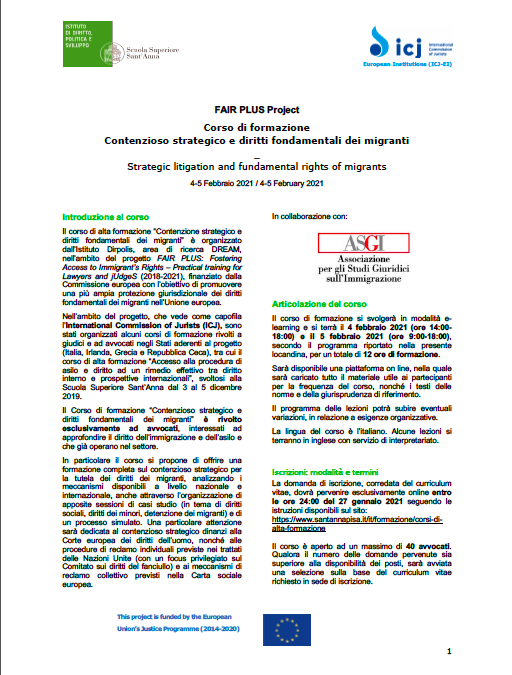
Today, the ICJ in collaboration with Scuola Universitaria Sant’Anna is holding an online training seminar on strategic litigation and fundamental rights of migrants.
The two-day training (4-5 February 2021) brings together 40 lawyers working in the field of migration and refugee law in Italy.
Experts from ASGI (Association for Juridical Studies on Immigration), ICJ and Scuola Universitaria Sant’Anna will provide an overview and analysis of redress mechanisms available at national and international level to migrants and their representatives. The training pays particular attention to strategic litigation before the European Court of Human Rights, the individual complaint procedures under the UN treaties with a focus on the Committee on the Rights of the Child, and to the collective complaint mechanism under the European Social Charter. The training will also cover social rights, children’s rights, immigration detention, and a moot court exercise.
See the full agenda here.
This training is a part of FAIR PLUS project. It was carried out with the financial support of the European Union’s Justice programme (2016-2020). Its contents represents the views of ICJ only and is its sole responsibility. The European Commission does not accept any responsibility for use that may be made of the information it contains.
Jan 15, 2021 | Agendas, Events, News
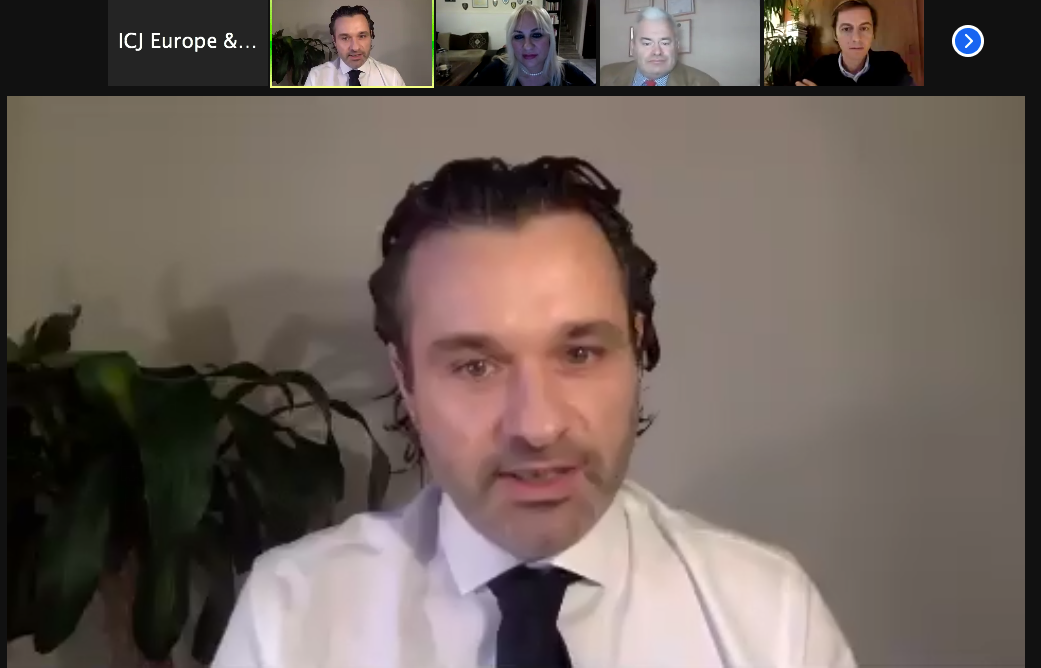
Today, the ICJ in collaboration with Greek Council of Refugees (GCR) is holding the second part of the training for Greek judges and lawyers on asylum procedures and detention of third country nationals.
The first part of the training, which has been held on 18 December 2020, addressed administrative detention of third-country nationals. The second training will consider issues related to fair and effective asylum procedures. Over 60 national judges and 10 Greek lawyers will participate in the training.
Speakers (from the Administrative Court of Appeal, First Instance Administrative court and the Court of Justice of the EU) will discuss Directive 2011/95/EE (inclusion clause in refugee protection status); the asylum procedure and procedural guarantees; case-law of the CJEU on asylum and common issues in asylum applications, including credibility and safe third country.
See the agenda for both parts of the training in English and in Greek.
This training is a part of FAIR PLUS project. It was carried out with the financial support of the European Union. Its contents are the sole responsibility of ICJ and do not necessarily reflect the views of the European Union.
Dec 18, 2020 | Agendas, Events, News
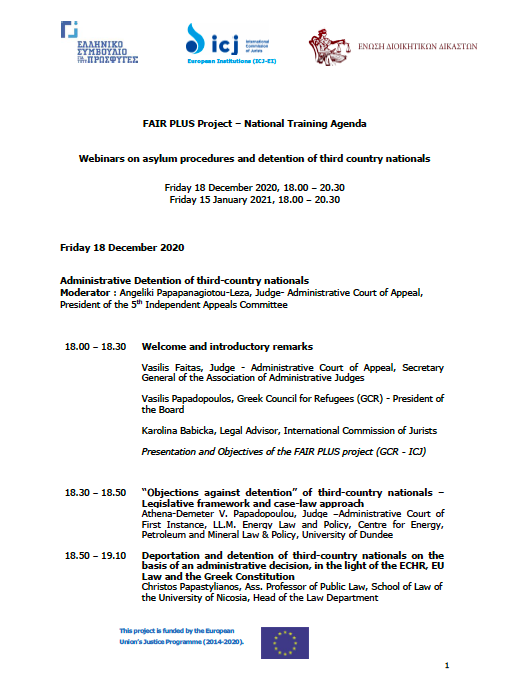
The ICJ and the Greek Council for Refugees (GCR) today hold the first part of the online training for Greek judges and lawyers on asylum procedures and detention of third country nationals as a part of the FAIR PLUS project.
The training brings together experts from the Greek Administrative Court of Appeal, Administrative Court of First Instance, European Court of Human Rights, GCR, ICJ and academics for a discussion on administrative detention on third-country nationals with a focus on the current situation in Greece.
Among the topics to be discussed today are domestic remedies to detention of third-country nationals; as well as deportation and detention of third country nationals in light of the European Convention on Human Rights (ECHR), EU law and Greek constitutional and European Court of Human Rights (ECtHR) case-law regarding immigration detention.
The second part of the training, on fair and effective asylum procedures, is planned for 15 January 2021, and will focus on Directive 2011/95/EE (inclusion clause in refugee protection status); asylum procedure and procedural guarantees; case-law of the CJEU on asylum and common issues of asylum applications – credibility and safe third country.
This is the third training delivered as part of this project, the first two having been held in person this January in Dublin and last December in Pisa.
See the agenda for both parts of the training in English and in Greek.
This training is a part of FAIR PLUS project. It was carried out with the financial support of the European Union. Its contents are the sole responsibility of ICJ and do not necessarily reflect the views of the European Union.
Dec 15, 2020 | Agendas, Events
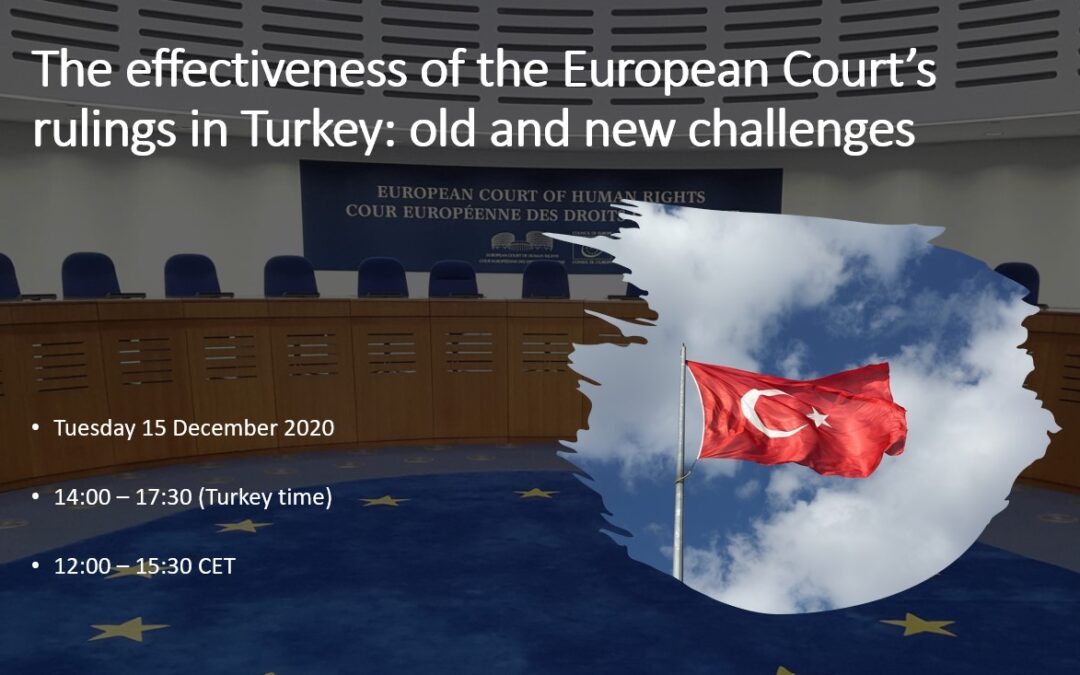
Join ICJ and IHOP in this online conference in which Turkish and international experts will discuss the current challenges in Turkey to promptly and fully implement the judgments of the Court and how to improve the execution of judgments in the Turkish national system.
Turkey is the Council of Europe member state with the third highest number of European Court of Human Rights judgments awaiting execution, after the Russian Federation and Ukraine. As a Party to the European Convention on Human Rights and founding member of the Council of Europe, Turkey has committed to implement all rulings of the Strasbourg Court, yet the results of this commitment are far from clear.
Implementation of the European Court judgments is a key indicator in Europe of a country’s commitment to human rights and the rule of law, and failure to implement judgments fundamentally undermines access to justice for victims of human rights violations by watering down the impact of their litigation before the Court.
Failure to implement judgments through general implementation measures reforming laws, policies and practices, also leads to persistent, repeated violations of the States’ obligations under the European Convention on Human Rights. This problem has existed for many years in Turkey, leaving long-standing systemic human rights problems unsolved. Recently civil society has denounced the Turkish authorities’ attempts to circumvent the general application of certain new key rulings of the European Court.
In this conference, Turkish and international experts will discuss the current challenges in Turkey to promptly and fully implement the judgments of the Court and how to improve the execution of judgments in the Turkish national system:
– Justice Egbert Myjer, Former Judge at the European Court of Human Rights and Commissioner of the ICJ,
– Prof. Philip Leach, Professor of Human Rights Law at Middlesex University
– George Stafford, Director at European Implementation Network
– Emma Sinclair-Webb, Turkey Director, Human Rights Watch
– Kerem Altıparmak, ICJ Legal Consultant
– Ayşe Bingöl Demir, Turkey Human Rights Litigation Support Project Co-Director, Lawyer
– Prof. Başak Çalı, Professor of International Law, Co-Director of the Centre for Fundamental Rights at the Hertie School
The event will be introduced and moderated by Feray Salman, General Coordinator of the Human Rights Joint Platform (IHOP), Roisin Pillay, Director of the ICJ Europe and Central Asia Programme, and Massimo Frigo, Senior Legal Adviser of the ICJ Europe and Central Asia Programme.<
TO REGISTER WRITE TO: ihop@ihop.org.tr
IHOPICJ-ZoomConference-ExecutionECtHRTurkey-Agenda-2020-ENG (download the agenda in English)
IHOPICJ-ZoomConference-ExecutionECtHRTurkey-Agenda-2020-TUR (download the agenda in Turkish)
The event is part of the REACT project: implemented jointly by ICJ and IHOP, this project seeks to support the role of civil society actors in turkey in ensuring effective access to justice for the protection of human rights. This project is funded by the European Union. The views expressed in the event do not necessarily reflect the opinion of the EU.
Nov 23, 2020 | Agendas, Events, News
The International Commission of Jurists and the Human Rights Joint Platform (IHOP) invite you to a Zoom workshop where Turkish and international experts will discuss the plight of violence against women in Turkey in light of the Council of Europe’s Istanbul Convention.
To participate, please register by writing an email to ihop@ihop.org.tr (the Human Rights Joint Platform).
Join our great panel of speakers:
– Dame Silvia Cartwright, ICJ Commissioner, former Governor-General and High Court judge of New Zealand, former CEDAW member
– Prof. Dr. Feride Acar, former Member of CEDAW, former Chair of GREVIO
– Zuzanna Warso, Lawyer, Helsinki Foundation for Human Rights of Poland
– Hülya Gülbahar, Women rights activist, Lawyer
– Nebahat Akkoç, Chair of KAMER Foundation
– Yasemin ÖZ, Lawyer, Kaos GL
– Feray Salman, General Coordinator of the Human Rights Joint Platform (IHOP)
– Massimo Frigo, ICJ Senior Legal Adviser
IHOPICJ-ZoomConference-WomenAccess2Justice-Agenda-2020-ENG (download the agenda in English)
IHOPICJ-ZoomConference-WomenAccess2Justice-Agenda-2020-TUR (download the agenda in Turkish)
The event is part of the REACT project: implemented jointly by ICJ and IHOP, this project seeks to support the role of civil society actors in turkey in ensuring effective access to justice for the protection of human rights. This project is funded by the European Union. The views expressed in the event do not necessarily reflect the opinion of the EU.
Nov 12, 2020 | Agendas, Events, News
The International Commission of Jurists and the Human Rights Joint Platform (IHOP) invite you to a Zoom workshop where Turkish and international experts will discuss the legacy of the 2016-2018 state of emergency in Turkey for access to justice today.
To participate, please register by writing an email to ihop@ihop.org.tr (the Human Rights Joint Platform)
Join our great panel of speakers:
– Professor Sarah Cleveland, ICJ Commissioner
– Dr. Dilet Kurban, Hertie School
– Lawyer Ziynet Özçelik, Ankara Bar Association
– Dinçer Demirkent, Human Rights School
– Roisin Pillay, Director of ICJ Europe and Central Asia Programme
– Kerem Altiparmak, ICJ Turkey Legal Adviser
The workshop will address how state of emergency measures, such as dismissals and closures of legal entities, still impact on the human right of people in Turkey today.
The experts will discuss whether the remedies set up by Turkish authorities are up to standard with Turkey’s international human rights law obligations.
IHOPICJ-ZoomWorkshop-StateofEmergency-Agenda-2020-ENG (download the agenda in English)
IHOPICJ-ZoomWorkshop-StateofEmergency-Agenda-2020-TUR (download the agenda in Turkish)
The event is part of the REACT project: implemented jointly by ICJ and IHOP, this project seeks to support the role of civil society actors in turkey in ensuring effective access to justice for the protection of human rights. This project is funded by the European Union. The views expressed in the event do not necessarily reflect the opinion of the EU.