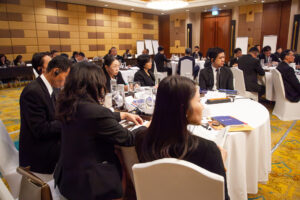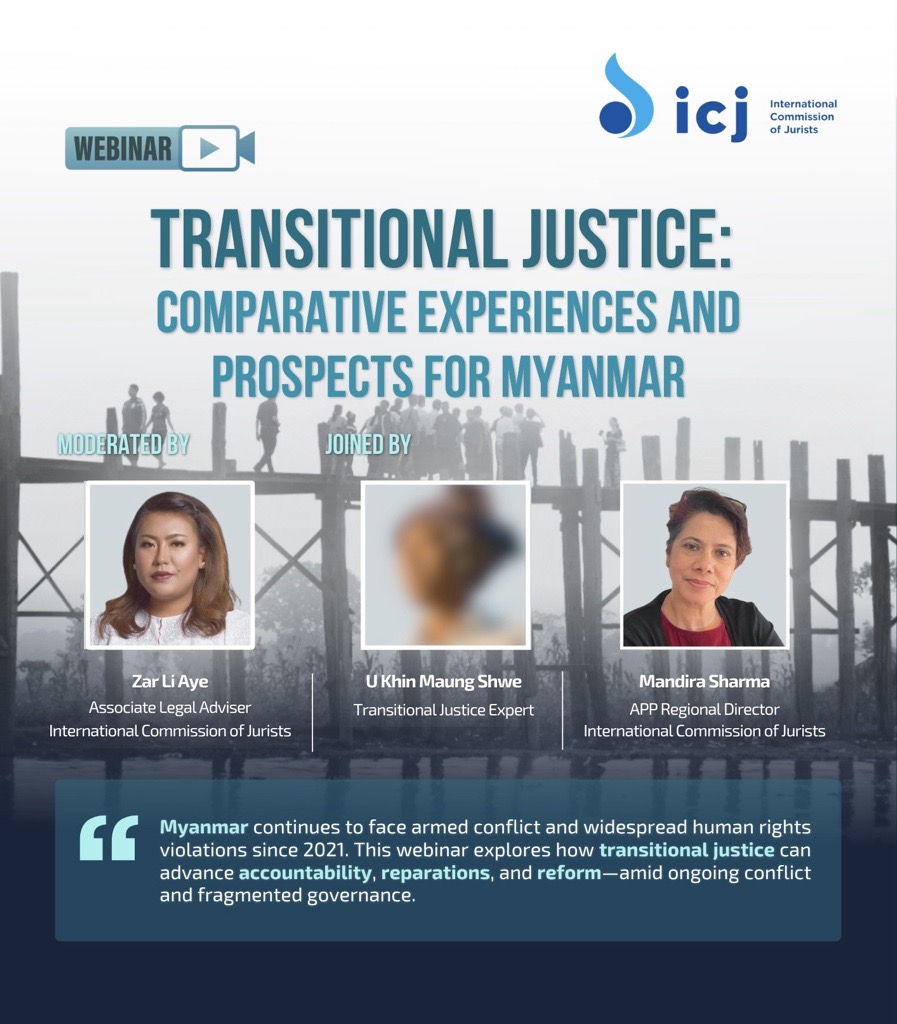
On 6 May 2026, drawing on comparative experiences from other countries, the International Commission of Jurists (ICJ) convened a webinar to examine the prospects for transitional justice (TJ) in Myanmar. The webinar brought together national and international experts, legal practitioners, civil society representatives, and human rights defenders to discuss and explore possible accountability pathways and justice mechanisms with respect to Myanmar’s widespread human rights violations and abuses in the context of the ongoing armed conflict ravaging the country.
The human rights situation in the country has significantly worsened since the 2021 military coup, and grave human rights violations and abuses continue to be perpetrated with impunity. As the military regime continues to perpetrate serious abuses and justice prospects within the country remain unattainable, legal proceedings related to egregious crimes under international law committed against the Rohingya have been initiated before the International Criminal Court and in other countries, including Argentina, under the principle of universal jurisdiction. While the country remains under military rule, civil society organizations (CSOs) and democratic political actors in Myanmar have increasingly resorted to lessons from comparative experiences in other countries to protect and preserve evidence for future accountability processes, including potential transitional justice mechanisms. Against this backdrop, discussions on transitional justice have become increasingly relevant, even in the absence of a political transition at present in the country.
Dr. Mandira Sharma, Director for the Asia and Pacific Programme at the ICJ, shared comparative transitional justice experiences from countries including Argentina, South Africa, Nepal, and Sierra Leone. Saya Khin Maung Shwe brought national perspectives highlighting the prospects and challenges of TJ in Myanmar.
These discussions highlighted key lessons related to accountability, the evolving understanding of amnesties, victims’ rights, and institutional reform. Speakers emphasized that international law clearly prohibits blanket amnesties for crimes under international law and serious human rights violations, reaffirming that victims retain the right to justice and reparations. While certain conditional and limited forms of amnesty may arise in transitional contexts, there can be no exemption from accountability for grave crimes.
The webinar also examined the particular challenges of pursuing transitional justice amid an active conflict characterized by institutional collapse in the country, fragmented governance, and competing political narratives, such as the case in Myanmar. Participants explored potential future scenarios for transitional justice in Myanmar and highlighted the importance of credible documentation and engagement with international accountability mechanisms, such as the Independent Investigative Mechanism for Myanmar (IIMM). Practical priorities for CSOs operating both inside and outside the country were identified, including the preservation of digital evidence, the use of universal jurisdiction, and the need to sustain international advocacy to end the conflict and military rule.
The webinar was attended by approximately 70 participants from diverse professional and geographic backgrounds.
Contacts
Dr. Mandira Sharma, Regional Director, ICJ Asia and the Pacific Programme, e: mandira.sharma@icj.org
Zar Li Aye, ICJ Legal Adviser, e: zarli.aye@icj.org