Apr 22, 2015 | Multimedia items, News, Video clips
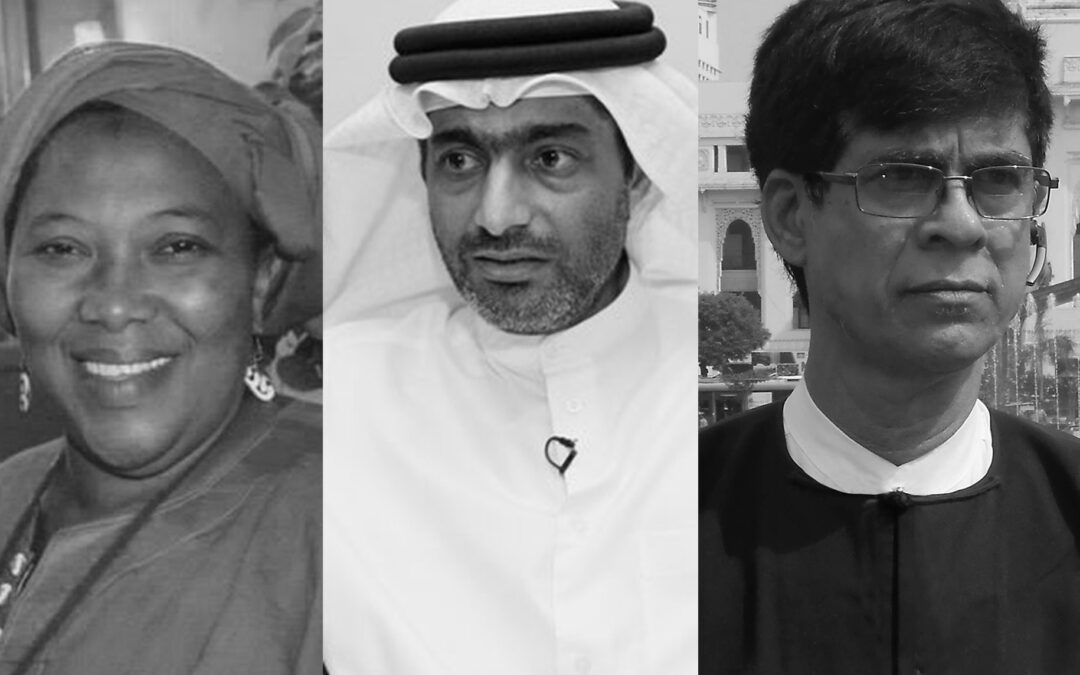
The three final human rights defenders who will compete for the award are Ahmed Mansoor (United Arab Emirates), Robert Sann Aung (Myanmar) and Asmaou Diallo (Guinea). The ICJ is member of the MEA Jury.
The Martin Ennals Award for Human Rights Defenders (MEA) is the main award of the human rights movement and as such can be labelled as the Nobel Price for human rights.
It is a unique collaboration among ten of the world’s leading human rights organizations to give protection to human rights defenders worldwide.
This award is selected by the International Human Rights Community (members of the jury are ICJ, Amnesty International, Human Rights Watch, Human Rights First, International Federation for Human Rights, World Organisation Against Torture, Front Line Defenders, EWDE Germany, International Service for Human Rights and HURIDOCS).
It is given to Human Rights Defenders who have shown deep commitment and face great personal risk. The aim of the award is to highlight their work and protect them through increased visibility.
The 2015 Award will be presented on Oct. 6th at a ceremony hosted by the City of Geneva.
Since 2006, Ahmed Mansoor (United Arab Emirates) has focussed on initiatives concerning freedom of expression, civil and political rights.
He successfully campaigned in 2006-2007 to support two people jailed for critical social comments. They were released and the charges dropped.
Shortly after, the Prime Minister of UAE issued an order not to jail journalists in relation to their work.
He is one of the few voices within the United Arab Emirates who provides a credible independent assessment of human rights developments.
He regularly raises concerns on arbitrary detention, torture, international standards for fair trials, non-independence of the judiciary, and domestic laws that violate international law.
He was jailed in 2011 and since then has been denied a passport and banned from travelling.
“I’m very pleased to be nominated for the Martin Ennals award,” he said. “This recognition indicates that we are not left alone in this part of the world and I hope it will shed further light on the human rights issues in the UAE. It is not just full of skyscrapers, big malls and an area attractive to businesses, but there are other struggles of different sorts beneath all of that.”
Since his first year of University in 1974, Robert Sann Aung (Myanmar) has courageously fought against human rights abuses.
He has been repeatedly imprisoned in harsh conditions, physically attacked as well as regularly threatened.
His education was interrupted numerous times and he was disbarred from 1993 – 2012.
In 2012, he managed to regain his license to practice law. Since then he has represented jailed child soldiers, those protesting at a contested copper mine, peaceful political protesters, those whose land has been confiscated by the military, as well as student activists.
Throughout his career he has provided legal services, or just advice, often pro bono, to those whose rights have been affected.
“I feel humble and extremely honored to be nominated for this prestigious award. This nomination conveys the message to activists, human rights defenders and promoters who fight for equality, justice and democracy in Myanmar that their efforts are not forgotten by the world,” he said.
Asmaou Diallo (Guinea)’s human rights work started following the events of 28 September 2009 when the Guinean military attacked peaceful demonstrators.
Over 150 were killed, including her son, and over 100 women raped. Hundreds more were injured.
She and l’Association des Parents et Amis des Victimes du 28 septembre 2009 (APIVA), which she founded, work to obtain justice for these crimes and to provide medical and vocational support to victims of sexual assault, many of whom cannot return to their homes.
She has worked to encourage witnesses to come forward and supported them as they provided information and testimony to court proceedings.
As a result, eleven people have been charged, including senior army officers.
“Being among the nominees for the Martin Ennals Foundation encourages me to continue my fight for the protection and promotion of human rights in Guinea. I trust that this award will have a positive effect on the legal cases concerning the events of the September 28, 2009, and will be a lever for all defenders of human rights in Guinea,” she said.
Contact:
Olivier van Bogaert, Director Media & Communications, ICJ representative in the MEA Jury, t: +41 22 979 38 08 ; e: olivier.vanbogaert(a)icj.org
Michael Khambatta, Director, Martin Ennals Foundation, t: +41 79 474 8208 ; e: khambatta(a)martinennalsaward.org
Universal-MEA Final Nominees 2015-News-Press Release-2015-ENG (Official press release in English)
Universal-MEA Final Nominees 2015-News-Press Release-2015-FRE (Official press release in French)
Universal-MEA Final Nominees 2015-News-Press Release-2015-ARA (Official press release in Arabic)
Universal-MEA Final Nominees 2015-News-Press Release-2015-BUR (Official press release in Burmese)
UAE-MEA 2015 Bio Ahmed Mansoor-2015-ENG (full bio in PDF)
Myanmar-MEA 2015 Bio Robert Sann Aung-2015-ENG (full bio in PDF)
Guinea-MEA 2015 Bio Asmaou Diallo-2015-ENG (full bio in PDF)
Feb 3, 2015 | Multimedia items, News, Video clips
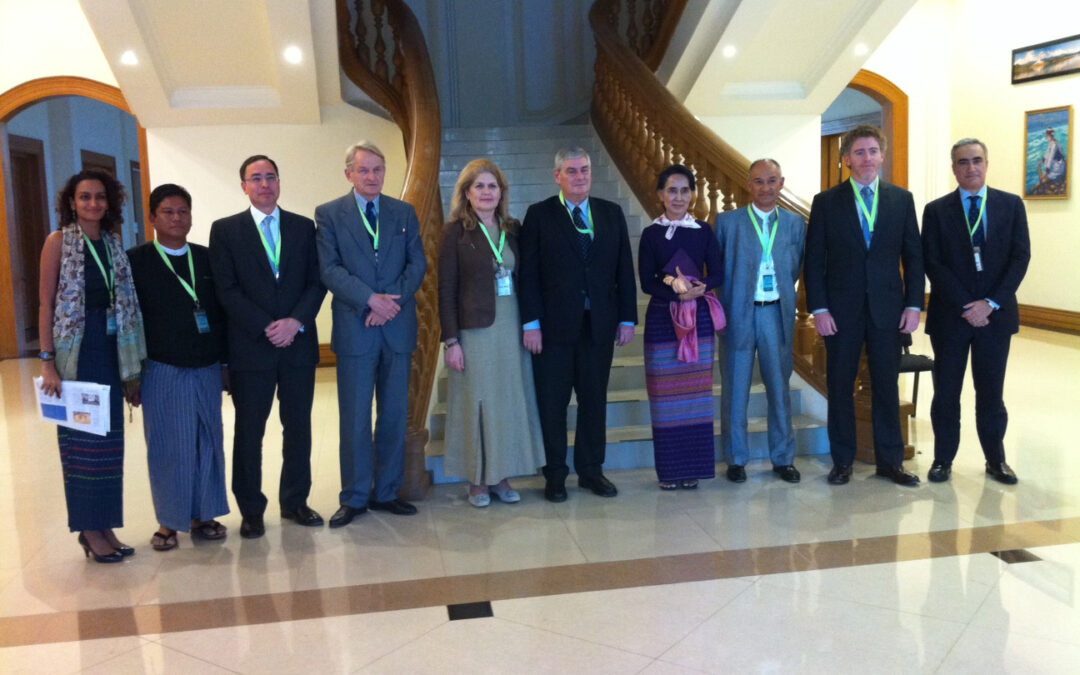
On video, ICJ Commissioner Azhar Cachalia and ICJ Asia & Pacific Regional Director Sam Zarifi, talk about a workshop with the Supreme Court of the Union of Myanmar. In parallel with this event, the ICJ met with Daw Aung San Suu Kyi.
The ICJ’s workshop with the Supreme Court of the Union of Myanmar was on the subject of judicial ethics and the rule of law, while at the meeting with Daw Aung San Suu Kyi, discussions covered the ICJ’s focus in Myanmar to support the judiciary in taking important steps towards asserting its independence from other branches of government; and to overcome significant individual and institutional obstacles, such as undue influence by the Executive in politically sensitive and criminal cases, corruption and a lack of resources.
Daw Suu and her colleagues shared information about the Rule of law Centres being initiated as a step towards building the capacity of local legal practitioners and contributing to rule of law reforms in Myanmar.
The ICJ delegation was led by Secretary-General Wilder Tayler, and included Asia & Pacific Regional Director Sam Zarifi, ICJ Commissioners Justices Azhar Cachalia, Ketil Lund and Radmila Dicic, International Legal Advisers Vani Sathisan and Daniel Aguirre and National Legal Adviser Kyawmin San.
Daw Aung San Suu Kyi is the Chairperson of the Lower House Committee for Rule of Law, Peace and Tranquility in the Myanmar Parliament and Chairperson of the National League for Democracy, and members of her Committee. She was awarded the Nobel Peace Prize in 1991.
Justice Azhar Cachalia, ICJ Commissioner and Chair of ICJ’s Executive Committee, talks about his participation in, and contribution to, an ICJ workshop with the Supreme Court of Myanmar.
Sam Zarifi, Director of ICJ’s Asia & Pacific Programme talks about ICJ’s workshop with the Supreme Court of Myanmar
Dec 5, 2014 | Multimedia items, News, Video clips
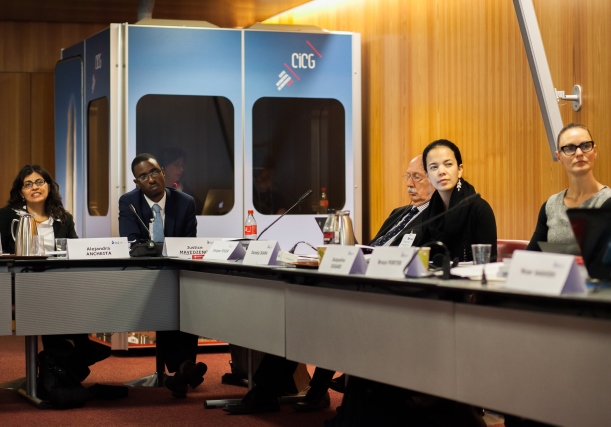
Jacqueline Dugard, Hina Jilani, Rodrigo Uprimny Yepes, Gilles Badet, Alejandra Ancheita and Harsh Mander talk about their experience and the situation of economic, social and cultural rights in their respective countries.
These prominent participants in ICJ’s Geneva Forum 2014 give their views on judicial protection of economic, social and cultural rights (ESCR) as well as on what needs to be changed to address obstacles to guarantee an effective remedy for victims of violations of their socio-economic rights.
They also tell about the main opportunities and key challenges for the realization of ESCR in their respective countries.
The 2014 Geneva Forum of Judges and Lawyers is a joint initiative of the ICJ Center for the Independence of Judges and Lawyers (CIJL) and the ICJ Programme on Economic, Social and Cultural Rights.
It has been made possible with the support of the République et Canton de Genève, the Permanent Mission of Germany to the United Nations in Geneva, and the Taipei Bar Association.
Nov 7, 2014 | Multimedia items, News, Video clips
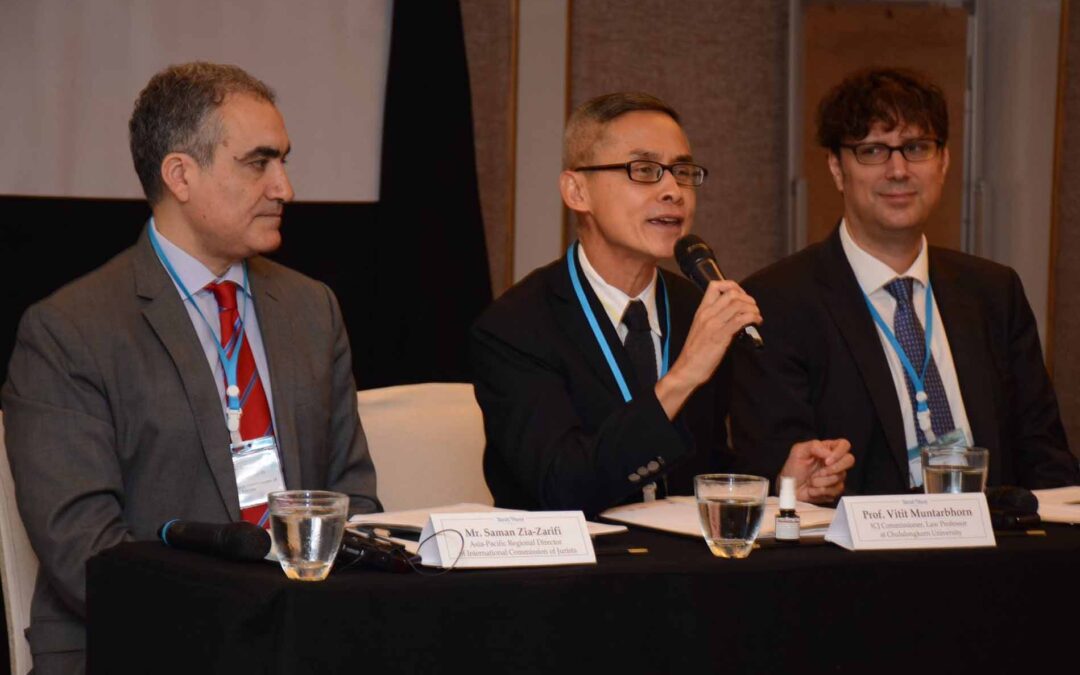
For the fist time, about 40 judges and representatives from judicial training institutions across Southeast Asia gathered to discuss recent developments in international human rights law on the right to life, with a focus on extrajudicial executions, deaths in custody and enforced disappearances.
Oct 7, 2014 | Multimedia items, News, Video clips
Alejandra Ancheita, founder and Executive Director of ProDESC, is one of the pioneers in seeking accountability for transnational companies in Mexican courts when local communities’ rights are not taken into account.
Alejandra Ancheita has worked with migrants, workers, and indigenous communities for over 15 years to protect their land and labour rights vis a vis transnational mining and energy companies.
These disputes have included violent attacks on those she is trying to protect.
In Mexico, there is a clear pattern of attacks, threats, criminalization, and murders of human rights defenders.
Alejandra Ancheita and ProDESC have been subjected to surveillance, a defamation campaign in the national media, and a break in at their offices.
“This recognition calls attention to the increasing violence being suffered by human rights defenders in Mexico, particularly women defenders,” she said. “I hope that it will provide better conditions and increased security not just for me, but for all human rights defenders in my country.”
“The ICJ is extremely pleased by the decision to pay tribute to the work of Alejandra Ancheita, not only because of her outstanding commitment and courage as an individual, but also because of the recognition that this award will provide to the area of human rights work that she has been dedicating herself to for many years,” said Olivier van Bogaert, ICJ Director of Media and Communications, and ICJ Representative on the MEA Jury.
The ICJ which also developed a longstanding work on economic, social and cultural rights, and on business and human rights, will devote the 2014 edition of its Geneva Forum for judges and lawyers to the role of courts in protecting economic, social and cultural rights.
The two other finalists, Cao Shunli (China) and Adilur Rahman Khan (Bangladesh), received Martin Ennals Prizes.
Cao Shunli, who died in in detention in March 14th after being denied medical attention for known health conditions had vigorously advocated for access to information, freedom of speech, and freedom of assembly.
She disappeared in September 2013 shortly before boarding a flight order to participate in the Human Rights Council.
Chinese authorities only acknowledged her detention months later.
A special foundation is planned in her honor.
Since the 1990’s, Adilur Rahman Khan worked on a wide range of human rights issues, such as illegal detention, enforced disappearances, and extra-judicial killings.
Personally he is facing criminal prosecution for documenting the extrajudicial deaths of 61 people during demonstrations against the government.
His organization, Odhikar, is one of the few independent voices left in Bangladesh.
It is facing closure as donor funds destined for Odhikar are being blocked by the Prime Minister’s Office.
The “Nobel Prize of Human Rights”, the Martin Ennals Award for Human Rights Defenders (MEA) is a unique collaboration among ten of the world’s leading human rights organizations to give protection to human rights defenders worldwide.
Strongly supported by the City of Geneva, the award is given to Human Rights Defenders who have shown deep commitment and face great personal risk. Its aim is to provide protection through international recognition.
The Jury is composed of the following NGOs: ICJ, Amnesty International, Human Rights Watch, Human Rights First, Int’l Federation for Human Rights, World Organisation Against Torture, Front Line Defenders, EWDE Germany, International Service for Human Rights, and HURIDOCS.
Contact:
Michael Khambatta, Director Martin Ennals Foundation, t: +41 79 474 8208, e: khambatta(a)martinennalsaward.org
Olivier van Bogaert, ICJ Director of Media and Communications, and ICJ Representative on the MEA Jury, t: +41 22 979 38 08, e: olivier.vanbogaert(a)icj.org
Multimedia gallery:
Livestreaming of the Martin Annals Award 2014 Ceremony
Alejandra Acheita film:
Cao Shunli film:
Adilur Rahman Kahn film:
Aug 2, 2014 | Multimedia items, News, Video clips
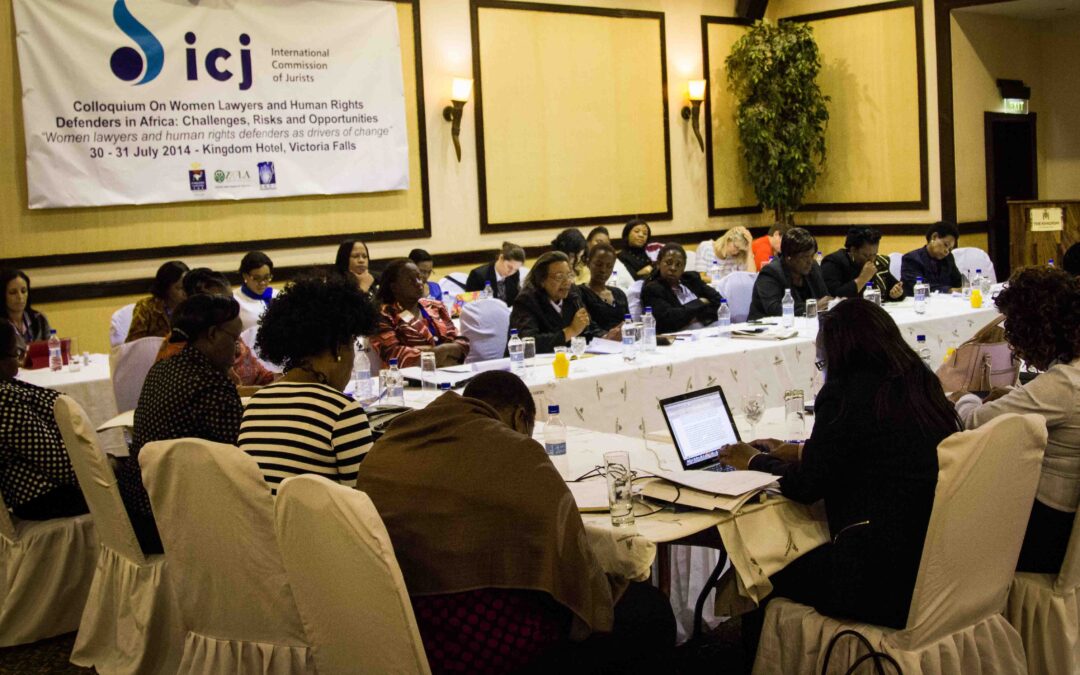
Women judges, lawyers and human rights defenders from across Africa participated in ICJ Colloquia on “Women Lawyers and Human Rights Defenders: Challenges and Opportunities” on 30 and 31 July in Victoria Falls, Zimbabwe.
The colloquia were hosted in collaboration and partnership with the Gender Committee of the SADC Lawyers Association, the Zimbabwe Women Lawyers Association and Zimbabwe Lawyers for Human Rights.
It enabled over 40 women lawyers, human rights defenders and judges to come together to identify the challenges faced by women lawyers and human rights defenders and elaborate action steps.
Discussions also addressed the role of the judiciary in advancing gender equality, women’s access to justice and protection of women human rights defenders.
The Colloquia are part of an ICJ multi-year initiative on women judges, lawyers and human rights defenders as agents of change.
Interviews:
Justice Martha Koome (Kenya)
Justice Lillian Tibatemwa-Ekirikubinza (Uganda)
Doo Aphane (Swaziland)
Jane Serwanga (Kenya)